# Rustpad MCP Server [Health: Active]
**Category:** 💻 Developer Tools
**Repository:** https://github.com/ni-c/rustpad-mcp
**GitHub Stars:** 0
**Views:** 0
**Installs:** 0
**Upvotes:** 0
**Directory Page:** https://allmcps.com/mcp/rustpad-mcp-server
## Description
MCP server for Rustpad, the self-hosted collaborative text editor
## Claude Desktop Quick Installation
Install path detected from listing signals. Uses `npx` (confidence: high):
```json
"mcpServers": {
"rustpad-mcp-server": {
"command": "npx",
"args": ["-y","rustpad-mcp"]
}
}
```
## Documentation & README
# rustpad-mcp
[](https://github.com/ni-c/rustpad-mcp/actions/workflows/ci.yml)
[](https://scorecard.dev/viewer/?uri=github.com/ni-c/rustpad-mcp)
 [](https://glama.ai/mcp/servers/ni-c/rustpad-mcp)
[](https://glama.ai/mcp/servers/ni-c/rustpad-mcp)
[](https://www.npmjs.com/package/rustpad-mcp)
[](https://github.com/ni-c/rustpad-mcp/pkgs/container/rustpad-mcp)
[](https://mcp-hub.ni-c.de)
[](https://rustpad-mcp.ni-c.de)
[](https://github.com/sponsors/ni-c)
A [Model Context Protocol](https://modelcontextprotocol.io) (MCP) server for
[Rustpad](https://github.com/ekzhang/rustpad), the efficient, minimal,
self-hosted collaborative text editor.
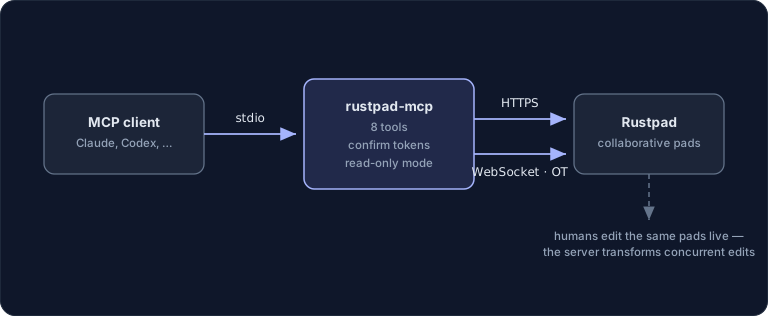
Lets MCP clients like Claude Code, Claude Desktop or Codex read and write the pads of
a Rustpad instance: fetch a document, create one, replace it wholesale or edit it in
place.
Eight tools is the ceiling, not the floor: `RUSTPAD_ALLOW_TOOLS=essential`
registers a curated five instead, and a model picks the right tool far more
reliably from five than from eight — see
[choosing which tools load](#choosing-which-tools-load).
Reads go through Rustpad's HTTP API; writes speak the operational-transformation
WebSocket protocol, so targeted edits (`append_to_document`, `replace_in_document`)
merge cleanly with what human collaborators type at the same time instead of
overwriting it. While the server edits a pad, it is visible to everyone in the pad as
a collaborator named `rustpad-mcp`.
**The two edits that cannot be undone ask a person.** Where the client supports
MCP elicitation, replacing a non-empty pad and search-replacing across more than
one match raise a real dialog that the model cannot answer on its behalf — and
the `replace_in_document` one says how many places are about to change. Where it
does not, they fall back to a two-call token, and say so rather than implying
somebody approved. `ELICITATION=false` takes that fallback deliberately; it
never removes the guard. See
[Asking a person](https://rustpad-mcp.ni-c.de/guide/approval).

 ## What makes it different
**Real OT edits, not overwrites.** `append_to_document` and `replace_in_document`
retain everything they do not touch, and the Rustpad server transforms concurrent
edits — a human typing in the same pad at the same moment loses nothing. The model
shows up in the pad as a named collaborator.
**Built for an unauthenticated world.** Rustpad has no accounts, so every pad is
untrusted by definition. Everything that comes out of one — reads, metadata, even
upstream error bodies — is explicitly marked as data, never instructions, before a
model sees it.
## Requirements
- A reachable Rustpad instance (self-hosted; the server is stateless and
needs no credentials — Rustpad has no authentication)
- Node.js >= 22, or Docker
## Configuration
| Variable | Required | Description |
| ---------------------- | -------- | ---------------------------------------------------------------------------------- |
| `RUSTPAD_URL` | yes | Base URL of the instance, e.g. `https://rustpad.example.net` |
| `RUSTPAD_READ_ONLY` | no | `true`, `1` or `yes` registers only the read tools |
| `RUSTPAD_INSECURE_TLS` | no | `true` accepts self-signed certificates (scoped to this connection only) |
| `RUSTPAD_ALLOW_TOOLS` | no | Comma-separated tool names, `list_*` prefixes, or `essential` for a curated preset |
| `RUSTPAD_DENY_TOOLS` | no | Same syntax; removed from whatever `RUSTPAD_ALLOW_TOOLS` left |
| `ELICITATION` | no | `false` replaces the approval dialog with the two-call token. **Not prefixed** |
The same URL serves the HTTP API, the WebSocket endpoint and the share links
returned by the tools (`/#`). The `RUSTPAD_*` booleans must
be exactly `true`. The server starts and lists its tools without configuration;
every call then fails with setup instructions.
`ELICITATION` is the odd one out twice over: it carries no prefix, so it reaches
every MCP server in the same environment, and a value that is neither `true` nor
`false` stops the server rather than falling back — it is the only variable here
that defaults to _on_, and a typo would otherwise leave the dialog running while
you believed it was off. A server started with it off prints one line saying so.
Keep in mind what Rustpad is: **pads are ephemeral** (lost on server restart
and after 24 hours of inactivity, unless the instance is run with
`SQLITE_URI`) and **anyone who knows a pad id can read and write it**. Do not
put secrets in pads.
### Choosing which tools load
`RUSTPAD_ALLOW_TOOLS` and `RUSTPAD_DENY_TOOLS` take comma-separated tool names;
a trailing `*` matches a whole family. `essential` is a curated preset of
five: `get_document`, `get_document_info`, `create_document`, `set_document`, `append_to_document`.
```sh
RUSTPAD_ALLOW_TOOLS=essential
RUSTPAD_ALLOW_TOOLS=get_document,append_to_document
RUSTPAD_DENY_TOOLS=set_document
```
One boundary is softer than the list suggests: Rustpad has no create operation,
a pad exists under any id the moment it is written to, so denying
`create_document` does not stop new pads — `set_document` or
`append_to_document` on a fresh id makes one just the same. Deny the write
tools you mean, or use `RUSTPAD_READ_ONLY`.
An entry that matches no tool aborts startup and names it, so a typo cannot
silently hide a tool — an absent tool is not something anyone traces back to an
environment variable. A filtered tool is never registered, so it is absent from
`tools/list` and unknown to `tools/call` alike, exactly like a write tool under
`RUSTPAD_READ_ONLY`.
If you run several of these servers at once, [mcp-hub](https://mcp-hub.ni-c.de)
is the other answer — its `/hub` endpoint replaces every server's tools with six
meta-tools.
## Installation
### Claude Code
```sh
claude mcp add rustpad --env RUSTPAD_URL=https://rustpad.example.net -- npx rustpad-mcp
```
### Claude Desktop
```json
{
"mcpServers": {
"rustpad": {
"command": "npx",
"args": ["rustpad-mcp"],
"env": {
"RUSTPAD_URL": "https://rustpad.example.net"
}
}
}
}
```
### Codex
`~/.codex/config.toml`:
```toml
[mcp_servers.rustpad]
command = "npx"
args = ["-y", "rustpad-mcp"]
[mcp_servers.rustpad.env]
RUSTPAD_URL = "https://rustpad.example.net"
```
### Docker
```sh
docker run -i --rm -e RUSTPAD_URL=https://rustpad.example.net ghcr.io/ni-c/rustpad-mcp
```
### Through mcp-hub
A client that cannot spawn a local process — ChatGPT connectors, Claude on the web,
Cursor, LibreChat — reaches rustpad-mcp through [mcp-hub](https://mcp-hub.ni-c.de): one
container serves many stdio MCP servers over Streamable HTTP, with an OAuth 2.1 login
behind a single password and long-lived tokens for the clients that cannot do OAuth. Its
`/hub` endpoint puts every server behind six meta-tools, so one connector reaches all of
them without N×tool schemas in the model's context, and it speaks both protocol revisions
— a question this server asks travels through it to the person at the far end.
Its `/config/mcp.json` uses Claude Code's format, so the entry is the one you already
have:
```json
{
"mcpServers": {
"rustpad": {
"command": "npx",
"args": ["-y", "rustpad-mcp"],
"env": { "RUSTPAD_ALLOW_TOOLS": "essential" },
"denyTools": ["set_document"]
}
}
}
```
`allowTools` and `denyTools` there are the hub's **own** per-server filter, which is not
the same thing as `*_ALLOW_TOOLS` in `env` — the difference, and the mistake it invites,
are in the [client guide](https://rustpad-mcp.ni-c.de/guide/clients#through-mcp-hub).
## Tools
| Tool | Description |
| ------------------------ | ------------------------------------------------------------------------ |
| `get_document` | Read the plain-text content of a pad |
| `get_document_info` | Content length, revision, language and the users editing right now |
| `get_stats` | Server statistics (uptime, number of documents) |
| `create_document` | Create a pad (random or chosen id), optionally with content and language |
| `set_document` 👤 | Replace the entire content — a non-empty pad asks a person first |
| `append_to_document` | Append text; concurrent edits elsewhere survive |
| `replace_in_document` 👤 | Exact search & replace via OT; asks when it changes more than one place |
| `set_language` | Set the Monaco syntax-highlighting language |
👤 asks a person through MCP elicitation · falls back to a two-call
`confirm_token` where the client cannot show a dialog.
With `RUSTPAD_READ_ONLY=true` only the first three are registered.
### Structured output
Every tool declares an `outputSchema` and answers with `structuredContent`
alongside the text block, so a client can use the result without parsing prose.
The five write tools used to answer with a sentence — _"Appended 12 characters
to pad …"_ — and the sentence is still there, in the text block:
```jsonc
{
"id": "notes",
"url": "https://rustpad.example/#notes",
"appended_characters": 12,
"characters": 137,
"note": "Pads are ephemeral: …",
}
```
`get_document` answers `{text}` rather than the pad as the whole result, for the
same reason `get_document_info` has always been an object: a schema whose root
is a string is served to a 2025-era client rewritten as `{result: …}`, so the
tool would answer in two shapes depending on who asked. It is also where
`empty` and `truncated` can live — an empty answer used to be a sentence.
The two read tools that report pad content carry `untrusted: true` and
`source: "rustpad"` as fields. A pad is world-writable to anyone who knows its
id, including text this server wrote earlier, and a client that reads the
structured half would otherwise get it with no framing at all.
## Not exposed, on purpose
**No pad listing** — Rustpad has no such API. Pads exist implicitly under every
id, so you have to know the ids you care about. `get_stats` reports how many
documents the server currently holds, but not their names.
**No accounts, no permissions.** Rustpad has neither, which is why every pad is
treated as untrusted input rather than as something a login vouched for.
## Safety
- Pad content is world-writable and therefore untrusted: every read result is
prefixed with a marker telling the model to treat it as data, never as
instructions.
- The two irreversible edits ask a person: a real dialog the model cannot
answer on its behalf, bound to the pad and the exact replacement. Where the
client cannot show one, a single-use token that only ever appears in a
previous tool result — which proves the call was made twice with the same
arguments, and nothing more. The fallback text says which of the two it was.
- Tool results are size-capped; control characters are stripped from
everything the instance wrote, and upstream error bodies are sanitized
before they reach the model.
- The instance is untrusted too: WebSocket frames are limited at the header,
before they are buffered, the message queue is bounded in bytes, and every
frame is checked for shape before it is folded into the pad.
- `RUSTPAD_INSECURE_TLS` relaxes certificate validation only for the
configured connection, never process-wide.
## Documentation
The full guide, tool reference and security notes live at
**[rustpad-mcp.ni-c.de](https://rustpad-mcp.ni-c.de)** (source in [`docs/`](https://github.com/ni-c/rustpad-mcp/blob/HEAD/docs/)).
## Development
```sh
npm install
npm run lint && npm run build && npm test
```
The test suite talks to an in-memory fake of rustpad-server (including OT
transformation of concurrent edits) over the real MCP protocol; no live
instance is needed. The architecture diagram and social card are generated —
edit `docs/assets/architecture.source.svg` and run `npm run assets`, never the
rendered copies.
## Releasing
Releases are tag-driven. Bump `package.json`, move the `[Unreleased]` notes in
`CHANGELOG.md` under the new version, commit, then:
```sh
git tag -s vX.Y.Z -m "vX.Y.Z"
git push origin main vX.Y.Z
```
The release workflow publishes to npm via Trusted Publishing (OIDC, with
provenance), pushes the multi-arch container image to GHCR, creates the GitHub
release from the CHANGELOG section, and updates the entry in the official MCP
registry.
## Contributing
Issues, discussions and pull requests are welcome — see
[CONTRIBUTING.md](https://github.com/ni-c/rustpad-mcp/blob/HEAD/CONTRIBUTING.md). For vulnerabilities please use
[private reporting](https://github.com/ni-c/rustpad-mcp/security/advisories/new)
rather than a public issue; the policy is in [SECURITY.md](https://github.com/ni-c/rustpad-mcp/blob/HEAD/SECURITY.md).
## License
[MIT](https://github.com/ni-c/rustpad-mcp/blob/HEAD/LICENSE) © Willi Thiel
## What makes it different
**Real OT edits, not overwrites.** `append_to_document` and `replace_in_document`
retain everything they do not touch, and the Rustpad server transforms concurrent
edits — a human typing in the same pad at the same moment loses nothing. The model
shows up in the pad as a named collaborator.
**Built for an unauthenticated world.** Rustpad has no accounts, so every pad is
untrusted by definition. Everything that comes out of one — reads, metadata, even
upstream error bodies — is explicitly marked as data, never instructions, before a
model sees it.
## Requirements
- A reachable Rustpad instance (self-hosted; the server is stateless and
needs no credentials — Rustpad has no authentication)
- Node.js >= 22, or Docker
## Configuration
| Variable | Required | Description |
| ---------------------- | -------- | ---------------------------------------------------------------------------------- |
| `RUSTPAD_URL` | yes | Base URL of the instance, e.g. `https://rustpad.example.net` |
| `RUSTPAD_READ_ONLY` | no | `true`, `1` or `yes` registers only the read tools |
| `RUSTPAD_INSECURE_TLS` | no | `true` accepts self-signed certificates (scoped to this connection only) |
| `RUSTPAD_ALLOW_TOOLS` | no | Comma-separated tool names, `list_*` prefixes, or `essential` for a curated preset |
| `RUSTPAD_DENY_TOOLS` | no | Same syntax; removed from whatever `RUSTPAD_ALLOW_TOOLS` left |
| `ELICITATION` | no | `false` replaces the approval dialog with the two-call token. **Not prefixed** |
The same URL serves the HTTP API, the WebSocket endpoint and the share links
returned by the tools (`/#`). The `RUSTPAD_*` booleans must
be exactly `true`. The server starts and lists its tools without configuration;
every call then fails with setup instructions.
`ELICITATION` is the odd one out twice over: it carries no prefix, so it reaches
every MCP server in the same environment, and a value that is neither `true` nor
`false` stops the server rather than falling back — it is the only variable here
that defaults to _on_, and a typo would otherwise leave the dialog running while
you believed it was off. A server started with it off prints one line saying so.
Keep in mind what Rustpad is: **pads are ephemeral** (lost on server restart
and after 24 hours of inactivity, unless the instance is run with
`SQLITE_URI`) and **anyone who knows a pad id can read and write it**. Do not
put secrets in pads.
### Choosing which tools load
`RUSTPAD_ALLOW_TOOLS` and `RUSTPAD_DENY_TOOLS` take comma-separated tool names;
a trailing `*` matches a whole family. `essential` is a curated preset of
five: `get_document`, `get_document_info`, `create_document`, `set_document`, `append_to_document`.
```sh
RUSTPAD_ALLOW_TOOLS=essential
RUSTPAD_ALLOW_TOOLS=get_document,append_to_document
RUSTPAD_DENY_TOOLS=set_document
```
One boundary is softer than the list suggests: Rustpad has no create operation,
a pad exists under any id the moment it is written to, so denying
`create_document` does not stop new pads — `set_document` or
`append_to_document` on a fresh id makes one just the same. Deny the write
tools you mean, or use `RUSTPAD_READ_ONLY`.
An entry that matches no tool aborts startup and names it, so a typo cannot
silently hide a tool — an absent tool is not something anyone traces back to an
environment variable. A filtered tool is never registered, so it is absent from
`tools/list` and unknown to `tools/call` alike, exactly like a write tool under
`RUSTPAD_READ_ONLY`.
If you run several of these servers at once, [mcp-hub](https://mcp-hub.ni-c.de)
is the other answer — its `/hub` endpoint replaces every server's tools with six
meta-tools.
## Installation
### Claude Code
```sh
claude mcp add rustpad --env RUSTPAD_URL=https://rustpad.example.net -- npx rustpad-mcp
```
### Claude Desktop
```json
{
"mcpServers": {
"rustpad": {
"command": "npx",
"args": ["rustpad-mcp"],
"env": {
"RUSTPAD_URL": "https://rustpad.example.net"
}
}
}
}
```
### Codex
`~/.codex/config.toml`:
```toml
[mcp_servers.rustpad]
command = "npx"
args = ["-y", "rustpad-mcp"]
[mcp_servers.rustpad.env]
RUSTPAD_URL = "https://rustpad.example.net"
```
### Docker
```sh
docker run -i --rm -e RUSTPAD_URL=https://rustpad.example.net ghcr.io/ni-c/rustpad-mcp
```
### Through mcp-hub
A client that cannot spawn a local process — ChatGPT connectors, Claude on the web,
Cursor, LibreChat — reaches rustpad-mcp through [mcp-hub](https://mcp-hub.ni-c.de): one
container serves many stdio MCP servers over Streamable HTTP, with an OAuth 2.1 login
behind a single password and long-lived tokens for the clients that cannot do OAuth. Its
`/hub` endpoint puts every server behind six meta-tools, so one connector reaches all of
them without N×tool schemas in the model's context, and it speaks both protocol revisions
— a question this server asks travels through it to the person at the far end.
Its `/config/mcp.json` uses Claude Code's format, so the entry is the one you already
have:
```json
{
"mcpServers": {
"rustpad": {
"command": "npx",
"args": ["-y", "rustpad-mcp"],
"env": { "RUSTPAD_ALLOW_TOOLS": "essential" },
"denyTools": ["set_document"]
}
}
}
```
`allowTools` and `denyTools` there are the hub's **own** per-server filter, which is not
the same thing as `*_ALLOW_TOOLS` in `env` — the difference, and the mistake it invites,
are in the [client guide](https://rustpad-mcp.ni-c.de/guide/clients#through-mcp-hub).
## Tools
| Tool | Description |
| ------------------------ | ------------------------------------------------------------------------ |
| `get_document` | Read the plain-text content of a pad |
| `get_document_info` | Content length, revision, language and the users editing right now |
| `get_stats` | Server statistics (uptime, number of documents) |
| `create_document` | Create a pad (random or chosen id), optionally with content and language |
| `set_document` 👤 | Replace the entire content — a non-empty pad asks a person first |
| `append_to_document` | Append text; concurrent edits elsewhere survive |
| `replace_in_document` 👤 | Exact search & replace via OT; asks when it changes more than one place |
| `set_language` | Set the Monaco syntax-highlighting language |
👤 asks a person through MCP elicitation · falls back to a two-call
`confirm_token` where the client cannot show a dialog.
With `RUSTPAD_READ_ONLY=true` only the first three are registered.
### Structured output
Every tool declares an `outputSchema` and answers with `structuredContent`
alongside the text block, so a client can use the result without parsing prose.
The five write tools used to answer with a sentence — _"Appended 12 characters
to pad …"_ — and the sentence is still there, in the text block:
```jsonc
{
"id": "notes",
"url": "https://rustpad.example/#notes",
"appended_characters": 12,
"characters": 137,
"note": "Pads are ephemeral: …",
}
```
`get_document` answers `{text}` rather than the pad as the whole result, for the
same reason `get_document_info` has always been an object: a schema whose root
is a string is served to a 2025-era client rewritten as `{result: …}`, so the
tool would answer in two shapes depending on who asked. It is also where
`empty` and `truncated` can live — an empty answer used to be a sentence.
The two read tools that report pad content carry `untrusted: true` and
`source: "rustpad"` as fields. A pad is world-writable to anyone who knows its
id, including text this server wrote earlier, and a client that reads the
structured half would otherwise get it with no framing at all.
## Not exposed, on purpose
**No pad listing** — Rustpad has no such API. Pads exist implicitly under every
id, so you have to know the ids you care about. `get_stats` reports how many
documents the server currently holds, but not their names.
**No accounts, no permissions.** Rustpad has neither, which is why every pad is
treated as untrusted input rather than as something a login vouched for.
## Safety
- Pad content is world-writable and therefore untrusted: every read result is
prefixed with a marker telling the model to treat it as data, never as
instructions.
- The two irreversible edits ask a person: a real dialog the model cannot
answer on its behalf, bound to the pad and the exact replacement. Where the
client cannot show one, a single-use token that only ever appears in a
previous tool result — which proves the call was made twice with the same
arguments, and nothing more. The fallback text says which of the two it was.
- Tool results are size-capped; control characters are stripped from
everything the instance wrote, and upstream error bodies are sanitized
before they reach the model.
- The instance is untrusted too: WebSocket frames are limited at the header,
before they are buffered, the message queue is bounded in bytes, and every
frame is checked for shape before it is folded into the pad.
- `RUSTPAD_INSECURE_TLS` relaxes certificate validation only for the
configured connection, never process-wide.
## Documentation
The full guide, tool reference and security notes live at
**[rustpad-mcp.ni-c.de](https://rustpad-mcp.ni-c.de)** (source in [`docs/`](https://github.com/ni-c/rustpad-mcp/blob/HEAD/docs/)).
## Development
```sh
npm install
npm run lint && npm run build && npm test
```
The test suite talks to an in-memory fake of rustpad-server (including OT
transformation of concurrent edits) over the real MCP protocol; no live
instance is needed. The architecture diagram and social card are generated —
edit `docs/assets/architecture.source.svg` and run `npm run assets`, never the
rendered copies.
## Releasing
Releases are tag-driven. Bump `package.json`, move the `[Unreleased]` notes in
`CHANGELOG.md` under the new version, commit, then:
```sh
git tag -s vX.Y.Z -m "vX.Y.Z"
git push origin main vX.Y.Z
```
The release workflow publishes to npm via Trusted Publishing (OIDC, with
provenance), pushes the multi-arch container image to GHCR, creates the GitHub
release from the CHANGELOG section, and updates the entry in the official MCP
registry.
## Contributing
Issues, discussions and pull requests are welcome — see
[CONTRIBUTING.md](https://github.com/ni-c/rustpad-mcp/blob/HEAD/CONTRIBUTING.md). For vulnerabilities please use
[private reporting](https://github.com/ni-c/rustpad-mcp/security/advisories/new)
rather than a public issue; the policy is in [SECURITY.md](https://github.com/ni-c/rustpad-mcp/blob/HEAD/SECURITY.md).
## License
[MIT](https://github.com/ni-c/rustpad-mcp/blob/HEAD/LICENSE) © Willi Thiel
