# Predictive Maintenance MCP Server [Health: Active]
**Category:** 💻 Developer Tools
**Repository:** https://github.com/LGDiMaggio/predictive-maintenance-mcp
**GitHub Stars:** 93
**Views:** 0
**Installs:** 0
**Upvotes:** 0
**Directory Page:** https://allmcps.com/mcp/predictive-maintenance-mcp-server
## Description
Industrial predictive maintenance: vibration analysis, bearing faults, ISO 20816-3
## Claude Desktop Quick Installation
Install path detected from listing signals. Uses `uvx` (confidence: high):
```json
"mcpServers": {
"predictive-maintenance-mcp-server": {
"command": "uvx",
"args": ["predictive-maintenance-mcp"]
}
}
```
## Documentation & README
# Predictive Maintenance MCP Server
[](https://www.python.org/downloads/)
[](https://doi.org/10.5281/zenodo.17611542)
[](https://github.com/LGDiMaggio/predictive-maintenance-mcp/actions/workflows/tests.yml)
[](https://codecov.io/gh/LGDiMaggio/predictive-maintenance-mcp)
[](https://opensource.org/licenses/MIT)
[](https://glama.ai/mcp/servers/LGDiMaggio/predictive-maintenance-mcp)
**Give your AI assistant evidence-based vibration diagnostics — machinery fault detection, ISO-cited severity, and diagnostic reports built to support and accelerate expert decision-making.**
An open-source [MCP](https://modelcontextprotocol.io/) server that turns LLMs into condition monitoring assistants for reliability engineers. Its core design rule: **the server refuses to guess**. No diagnosis is ever inferred from filenames or statistical parameters alone — a fault indication requires matching spectral evidence. Every severity claim cites ISO 20816-3, and the evaluative wording in reports is authored by the server, not improvised by the model. The AI orchestrates the analysis and presents the evidence — detected fault frequencies, matched fault patterns, severity zones — while the final judgment stays with the engineer. Also available as a **Claude Code plugin** with 8 diagnostic skills.
---
## See It in Action
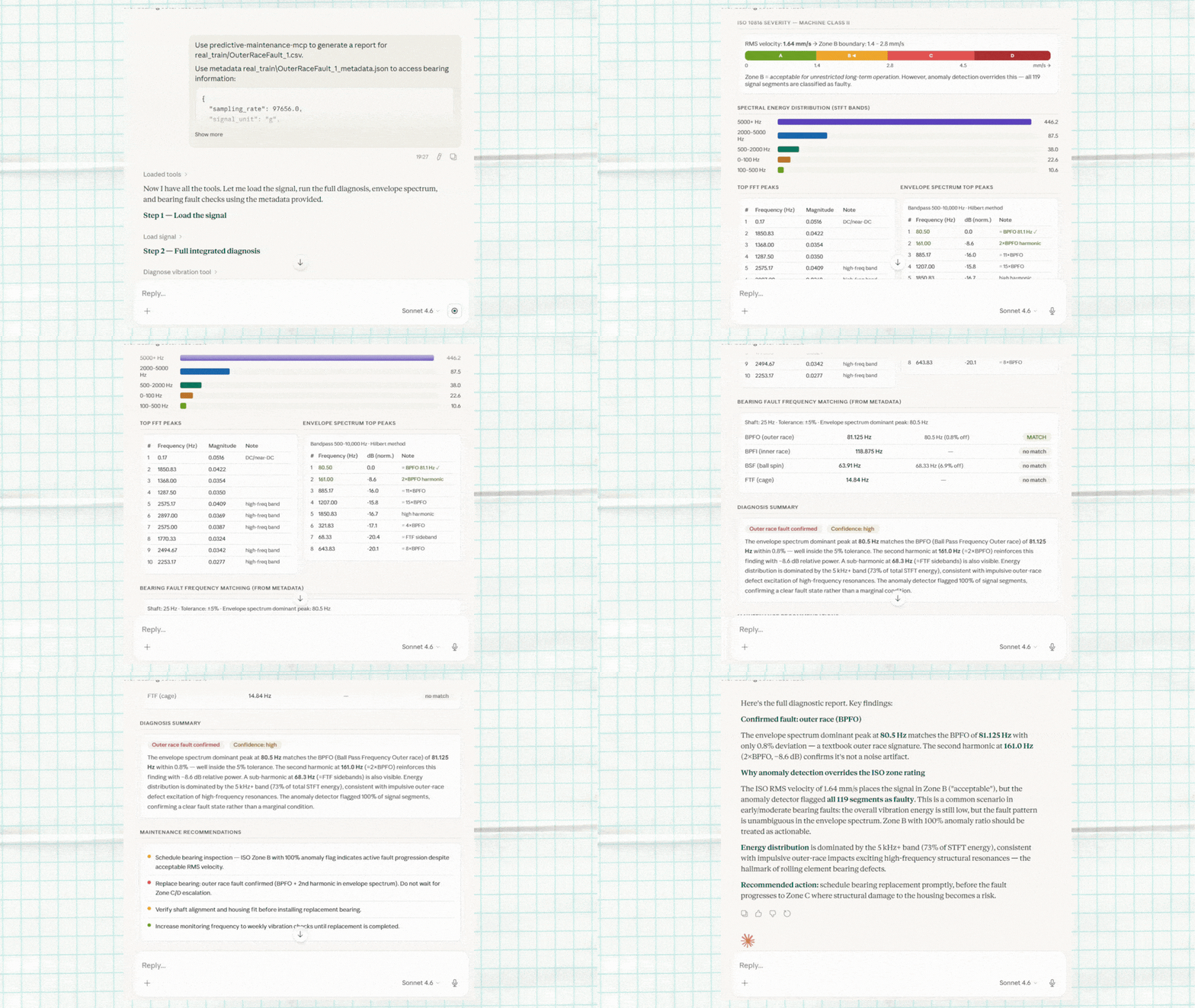
Full diagnostic workflow: load signal → spectral analysis → fault detection → severity assessment → report generation
---
## Choose Your Path
| You are | Start here |
|---------|------------|
| **Reliability / maintenance engineer** — diagnostics in plain language, no coding | [Engineer's Quickstart](https://github.com/LGDiMaggio/predictive-maintenance-mcp/blob/HEAD/docs/QUICKSTART_ENGINEER.md) |
| **AI / MCP developer** — run, integrate, and extend the server | [Developer's Quickstart](https://github.com/LGDiMaggio/predictive-maintenance-mcp/blob/HEAD/docs/QUICKSTART_DEVELOPER.md) · [Quick Start](#quick-start) below |
| **Researcher / evaluator** — how the numbers are measured | [Benchmark Methodology](https://github.com/LGDiMaggio/predictive-maintenance-mcp/blob/HEAD/docs/benchmark-methodology.md) · [Benchmark](#benchmark) below |
---
## Quick Start
**Get running in ~3 minutes.** On Windows, one script wires everything into Claude Desktop — it installs the venv, pre-compiles dependencies, and writes `claude_desktop_config.json` for you (OneDrive / cloud-sync paths included):
```powershell
git clone https://github.com/LGDiMaggio/predictive-maintenance-mcp.git
cd predictive-maintenance-mcp
.\setup_claude.ps1
```
Restart Claude Desktop, then try:
> *"Load real_train/OuterRaceFault_1.csv and check if the bearing is healthy."*
Manual config (macOS / Linux / other MCP clients)
Install the package:
```bash
pip install predictive-maintenance-mcp
```
Find the full path to `uvx` (`which uvx` on macOS/Linux, `where uvx` on Windows), then add to your client config — `~/Library/Application Support/Claude/claude_desktop_config.json` (macOS) or `%APPDATA%\Claude\claude_desktop_config.json` (Windows):
```json
{
"mcpServers": {
"predictive-maintenance": {
"command": "/full/path/to/uvx",
"args": ["predictive-maintenance-mcp"],
"env": { "UV_LINK_MODE": "copy" }
}
}
}
```
> **Why the full path?** Claude Desktop launches servers with a minimal `PATH` that often omits user-local tool directories (e.g. `~/.local/bin`). Using the full path to `uvx` avoids a silent "command not found" failure. On Windows the typical path is `C:\Users\\.local\bin\uvx.exe`.
> **More options**: [install from source](https://github.com/LGDiMaggio/predictive-maintenance-mcp/blob/HEAD/INSTALL.md) · [VS Code setup](https://github.com/LGDiMaggio/predictive-maintenance-mcp/blob/HEAD/INSTALL.md) · [Docker / HTTPS deployment](https://github.com/LGDiMaggio/predictive-maintenance-mcp/blob/HEAD/docs/DEPLOYMENT.md) · [use with local LLMs (Ollama)](https://github.com/LGDiMaggio/predictive-maintenance-mcp/blob/HEAD/docs/OLLAMA_GUIDE.md)
---
## Benchmark
A blind, reproducible diagnostic-accuracy benchmark on the public
[CWRU Bearing Data Center](https://engineering.case.edu/bearingdatacenter)
dataset (12 kHz drive-end subset: 60 fault records + 4 normal baselines).
Fault labels never reach the system under test — signals enter under opaque
ids, a separate scorer is the only label reader, and blindness, checksum
integrity, and determinism are enforced by CI-run guard tests, not prose.
Results are stratified by the per-record diagnosability grades of the
Smith & Randall (2015) reference study, so records that study found
undiagnosable by any classical method are reported separately instead of
inflating or deflating the headline.
On records the reference study grades clearly diagnosable (Y1+Y2, 44 records):
characteristic fault frequency detected on 44/44,
correct fault ranked first on 34/44 (77.3%),
and 9/9 on the textbook-signature (Y1) stratum.
On the 4 healthy baselines, 2 records raised a false indication under the same criterion.
The numbers above are read from the committed, re-runnable artifact
([results.json](https://github.com/LGDiMaggio/predictive-maintenance-mcp/blob/HEAD/benchmarks/cwru/results/results.json)) and drift-guarded by CI:
every value is bound to its key in the artifact, and a mismatch fails the build.
Methodology, blind protocol, and honest-benchmarking notes:
[docs/benchmark-methodology.md](https://github.com/LGDiMaggio/predictive-maintenance-mcp/blob/HEAD/docs/benchmark-methodology.md). Reproduce with:
```bash
python -m benchmarks.cwru all
```
---
## What Can It Do?
**Point the AI at a vibration signal → get the evidence behind the fault — detected frequencies, matched fault patterns, ISO-cited severity — to support your call.**
| You say | The AI does |
|---------|-------------|
| *"Is this bearing healthy?"* | Loads the signal, runs spectral analysis, surfaces matching fault-frequency evidence, cites the ISO 20816-3 severity zone |
| *"Generate a full diagnostic report"* | Produces an interactive HTML report with charts, fault markers, and server-authored severity wording |
| *"Extract specs from test_pump_manual.pdf and diagnose the signal"* | Reads the equipment manual, looks up the bearing model, calculates expected fault frequencies, flags which ones the signal actually shows |
| *"Train an anomaly detector on my healthy baselines, then flag anomalies"* | Trains a model on your normal data, scores new signals, flags outliers for your review |
| *"What changed on pump P-101 since the baseline?"* | Reads the asset's recorded history, compares the latest acquisitions with the declared reference, and reports each indicator's change with the criterion it applied |
The AI doesn't guess: it calls **41 specialized MCP endpoints** (38 tools + 3 prompts) running locally on your machine. Every signal is referenced by a single `signal_id` handle from load to report. Your data never leaves your infrastructure.
Full endpoint reference, grouped by category: **[Tool Catalog](https://github.com/LGDiMaggio/predictive-maintenance-mcp/blob/HEAD/docs/TOOL_CATALOG.md)**.
---
## Claude Code Plugin
The project includes a **plugin for Claude Code** with domain-specific skills that activate automatically during conversation.
```shell
/plugin marketplace add LGDiMaggio/predictive-maintenance-mcp
/plugin install predictive-maintenance@predictive-maintenance-marketplace
```
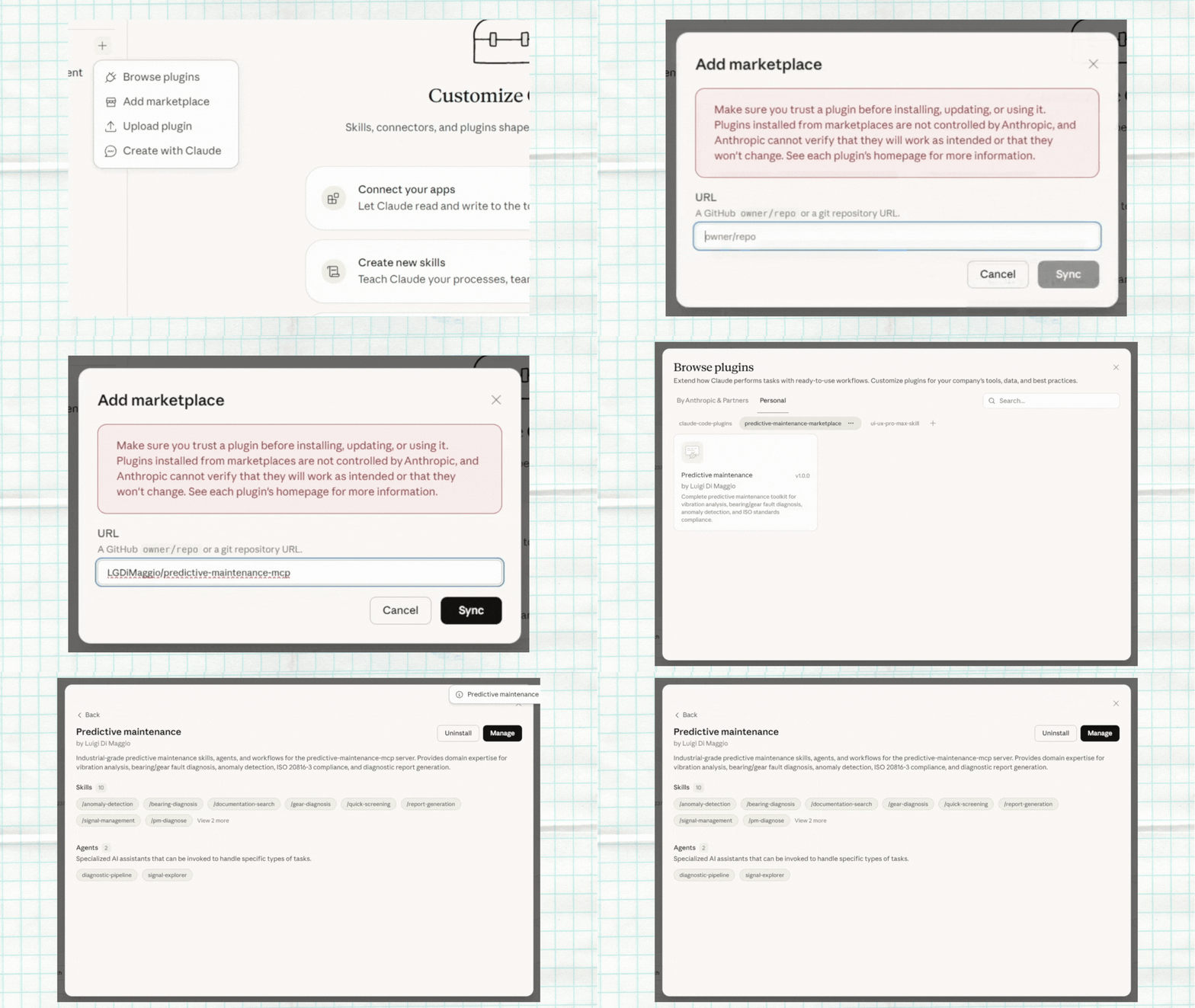
The plugin adds **8 skills** that activate automatically based on context (bearing-diagnosis, gear-diagnosis, quick-screening, report-generation, anomaly-detection, signal-management, documentation-search, prognostics), **2 agents** that run multi-step diagnostic workflows end-to-end and hand you the evidence (diagnostic-pipeline, signal-explorer), and **3 commands** for quick entry points (`/pm-diagnose`, `/pm-screen`, `/pm-report`).
Full skill, agent, and command reference: [Plugin README](https://github.com/LGDiMaggio/predictive-maintenance-mcp/blob/HEAD/plugin/README.md).
---
## Reports
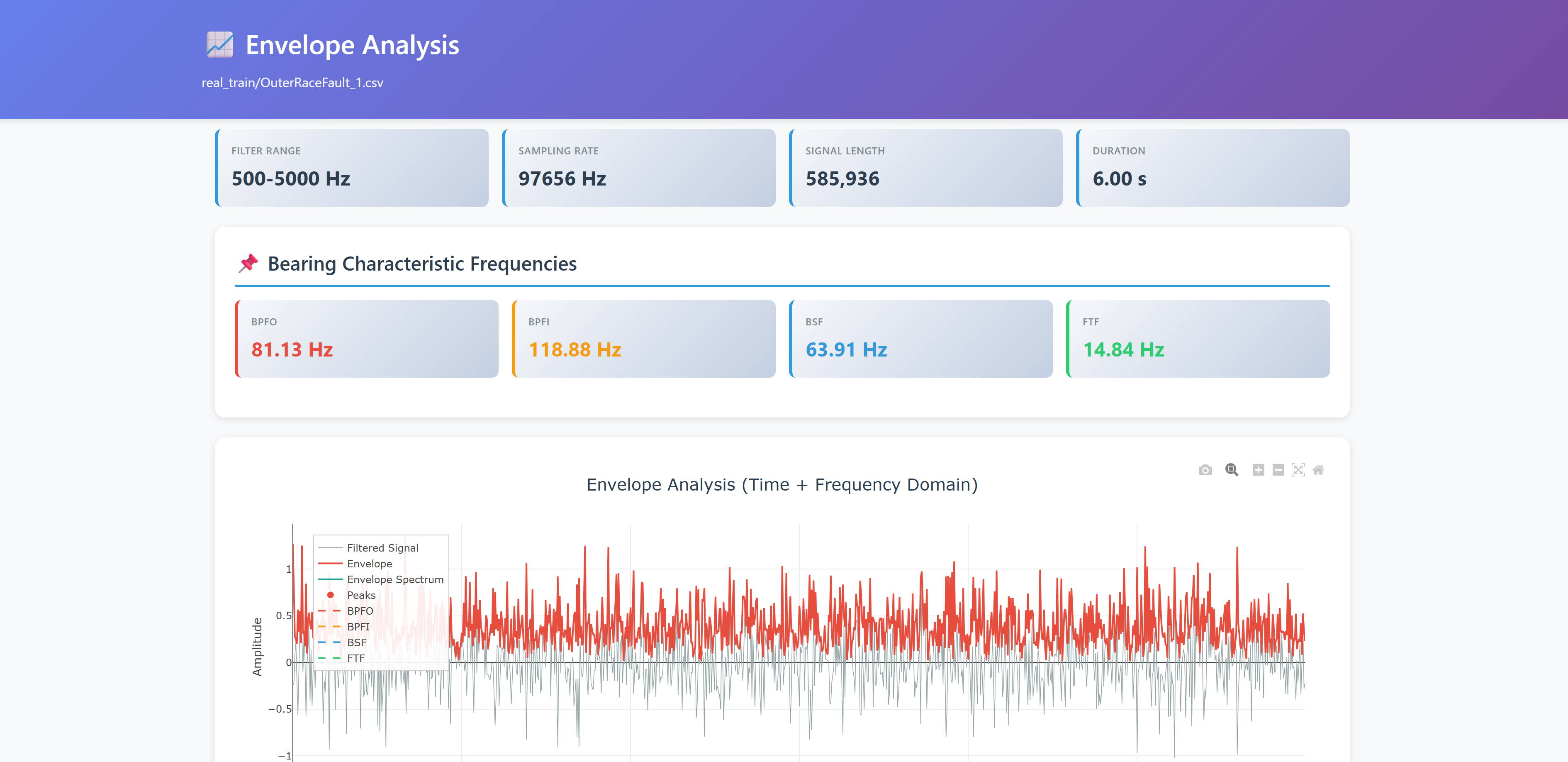
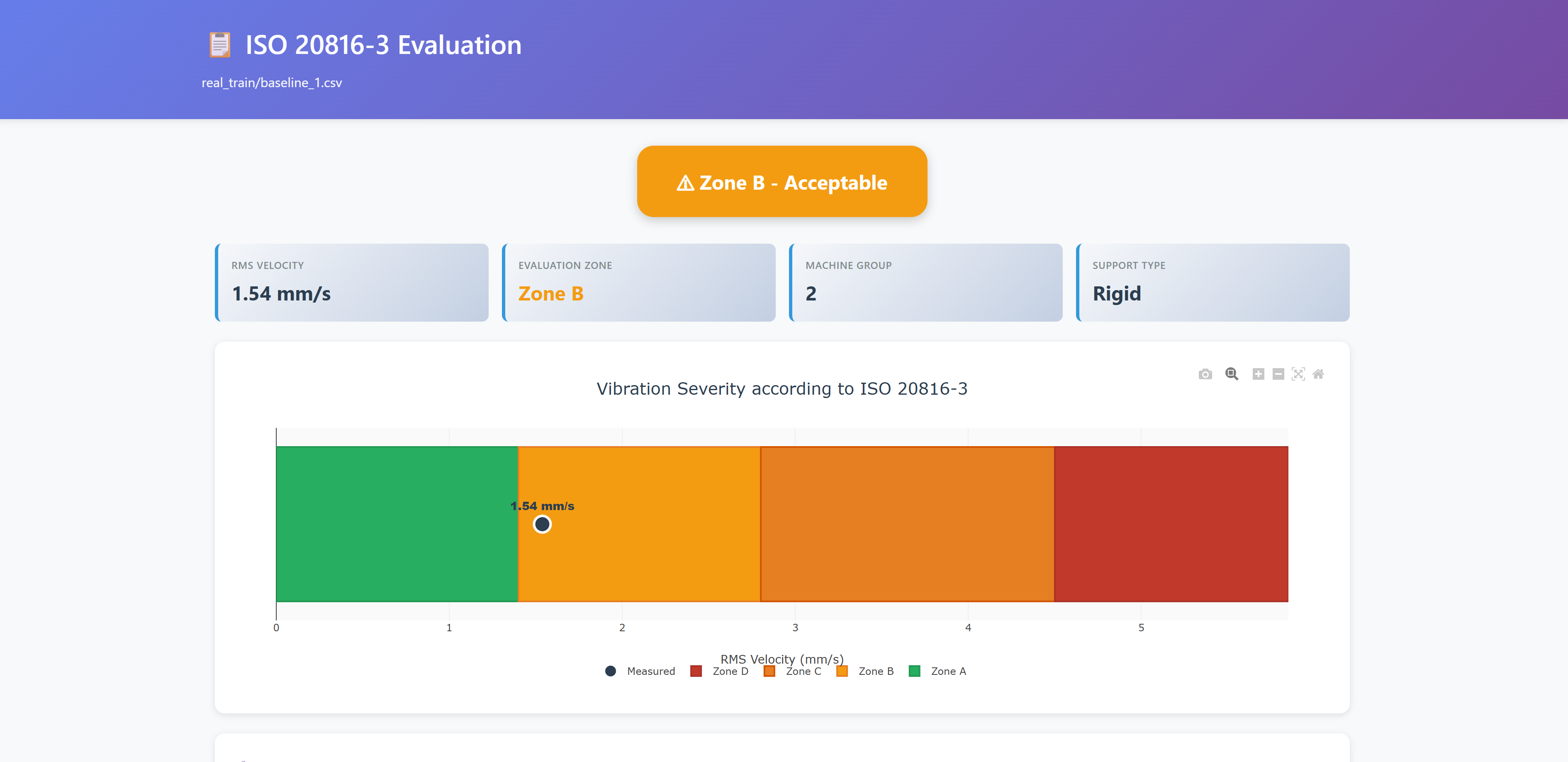
All analysis tools generate **interactive HTML reports** you can open in any browser — pan, zoom, hover for details. Also supports structured Word (.docx) exports.
Report examples
| Report Type | What it shows |
|-------------|---------------|
| Frequency spectrum | Peak detection, harmonic markers |
| Envelope analysis | Bearing fault frequency matching |
| Severity assessment | Vibration health zones (ISO 20816-3) |
| Word document | Full diagnostic narrative with embedded charts |
| PCA visualization | Multi-signal anomaly clustering |
| Feature comparison | Side-by-side signal feature analysis |
---
## Sample Data Included
The project ships with **20 real bearing vibration signals** from production machinery tests — ready to use out of the box: a training set (2 healthy baselines + 12 fault signals, inner and outer race) and a test set (1 healthy baseline + 5 fault signals).
Try: *"Load real_train/OuterRaceFault_1.csv and diagnose the bearing fault."*
Full dataset documentation: [data/README.md](https://github.com/LGDiMaggio/predictive-maintenance-mcp/blob/HEAD/data/README.md)
---
## Asset Health Ledger
A single diagnosis answers "what does this signal show". The asset health ledger answers "what changed on this machine since the reference", from measurements taken weeks apart, on terms the engineer declared.
- **Declared identity.** The companion metadata file names the asset, the measurement point and the acquisition instant, plus the conditions a comparison depends on (speed, load, sensor, direction). Nothing is inferred from file names or content.
- **A history that survives restarts.** Every loaded measurement with an identity is recorded in a local append-only ledger, one JSON Lines file per asset, with its derived indicators. Waveforms are never copied, events are never rewritten.
- **Qualified comparability.** A measurement that contradicts its point or its reference (another unit family, another direction, a speed too far off) is excluded with the reason; one that only lacks context (no speed, no direction, a naive timestamp) stays in the trend with the qualification attached.
- **A reference that is declared, never assumed.** The engineer declares which measurements are the healthy baseline, and the declaration is attributed. Without one, the first comparable acquisitions serve as a relative reference and are never called healthy.
- **Change with its criterion.** Each indicator is judged against the reference band; the classification (no change, isolated episode, unconfirmed single acquisition, persistent change) states the rule it applied, and bearing evidence is counted over the last acquisitions.
Four tools carry the workflow: `declare_measurement_point`, `declare_healthy_baseline`, `get_asset_history` and `assess_asset_change`. The ledger puts the evidence over time in front of the engineer; the judgement about the machine stays with the engineer. Contract and operations: [Adapter Guide](https://github.com/LGDiMaggio/predictive-maintenance-mcp/blob/HEAD/docs/ADAPTER_GUIDE.md#declaring-a-measurement) · worked flow: [Examples](https://github.com/LGDiMaggio/predictive-maintenance-mcp/blob/HEAD/EXAMPLES.md#example-8-asset-history) · reference adapter: [STWIN.box](https://github.com/LGDiMaggio/predictive-maintenance-mcp/blob/HEAD/examples/adapters/stwinbox/README.md).
---
## Architecture
```
YOU (natural language)
│
v
LLM (Claude, GPT, Ollama...)
understands intent, selects tools
│
v ── Model Context Protocol ──
┌──────────────────────────────┐
│ Predictive Maintenance │
│ MCP Server │
│ │
│ Signal Analysis Reports │
│ Fault Detection ML │
│ Severity Rating RAG Docs │
└──────────────────────────────┘
│
v
YOUR DATA (stays local)
signals · manuals · models
```
The codebase follows a **modular architecture** organized around the ISO 13374 Six-Block Diagnostic standard — signal acquisition, processing, diagnostics, prognostics, and decision support as separate sub-packages. Standards implemented: ISO 13374, ISO 20816-3, MIMOSA OSA-CBM. Module-level detail: [Architecture guide](https://github.com/LGDiMaggio/predictive-maintenance-mcp/blob/HEAD/docs/architecture.md).
**Key design choices:**
- **Privacy-first** — raw vibration data never leaves your machine; only computed results flow to the LLM
- **LLM-agnostic** — works with Claude, ChatGPT, Microsoft Copilot Studio, or any MCP-compatible client. Use [Ollama](https://github.com/LGDiMaggio/predictive-maintenance-mcp/blob/HEAD/docs/OLLAMA_GUIDE.md) for fully air-gapped deployments
- **Modular** — use only the tools you need, extend with your own
---
## Documentation
| Guide | For |
|-------|-----|
| [Quickstart for Engineers](https://github.com/LGDiMaggio/predictive-maintenance-mcp/blob/HEAD/docs/QUICKSTART_ENGINEER.md) | Get results fast, no coding required |
| [Quickstart for Developers](https://github.com/LGDiMaggio/predictive-maintenance-mcp/blob/HEAD/docs/QUICKSTART_DEVELOPER.md) | Understand MCP, extend the server |
| [Tool Catalog](https://github.com/LGDiMaggio/predictive-maintenance-mcp/blob/HEAD/docs/TOOL_CATALOG.md) | Every MCP endpoint, grouped by category |
| [Adapter Guide](https://github.com/LGDiMaggio/predictive-maintenance-mcp/blob/HEAD/docs/ADAPTER_GUIDE.md) | Bring vendor/DAQ raw data in via explicit declarations |
| [Plugin README](https://github.com/LGDiMaggio/predictive-maintenance-mcp/blob/HEAD/plugin/README.md) | Claude Code plugin installation and usage |
| [HTTPS Deployment](https://github.com/LGDiMaggio/predictive-maintenance-mcp/blob/HEAD/docs/DEPLOYMENT.md) | Docker + HTTPS for enterprise environments |
| [Ollama Guide](https://github.com/LGDiMaggio/predictive-maintenance-mcp/blob/HEAD/docs/OLLAMA_GUIDE.md) | Use with local LLMs (fully air-gapped) |
| [Architecture](https://github.com/LGDiMaggio/predictive-maintenance-mcp/blob/HEAD/docs/architecture.md) | ISO 13374 block mapping and module design |
| [Benchmark Methodology](https://github.com/LGDiMaggio/predictive-maintenance-mcp/blob/HEAD/docs/benchmark-methodology.md) | How the CWRU diagnostic benchmark is measured |
| [Examples](https://github.com/LGDiMaggio/predictive-maintenance-mcp/blob/HEAD/EXAMPLES.md) | Complete diagnostic workflows |
| [Installation](https://github.com/LGDiMaggio/predictive-maintenance-mcp/blob/HEAD/INSTALL.md) | Detailed setup and troubleshooting |
| [Contributing](https://github.com/LGDiMaggio/predictive-maintenance-mcp/blob/HEAD/CONTRIBUTING.md) | How to contribute (all skill levels welcome) |
| [Changelog](https://github.com/LGDiMaggio/predictive-maintenance-mcp/blob/HEAD/CHANGELOG.md) | Version history |
---
## Testing
**85%+ test coverage**, enforced as a CI minimum, across Windows, macOS, and Linux (Python 3.11 & 3.12) — the current measured figure is on the codecov badge above.
```bash
pytest # run all tests
pytest --cov=src --cov-report=html # with coverage report
```
20+ test files covering signal analysis, fault detection, severity assessment, ML models, report generation, RAG search, and real bearing fault data validation.
---
## Roadmap
- [x] 41 MCP endpoints (38 tools, 3 prompts) with modular architecture and a single `signal_id` handle
- [x] Claude Code plugin (8 skills, 2 agents, 3 commands)
- [x] 85%+ test coverage enforced in CI, CI/CD on 3 platforms
- [x] Docker + SSE/HTTP transport for enterprise deployment
- [x] Semantic document search (FAISS + TF-IDF)
- [x] Blind, reproducible diagnostic benchmark on the CWRU dataset (extensible to Paderborn)
- [ ] Customizable severity thresholds
- [x] Remaining useful life (RUL) estimation from repeated measurements (linear, exponential, Kalman)
- [x] Trend analysis and degradation onset detection
- [x] Asset health ledger: per-asset measurement history with a declared reference and qualified comparability
- [ ] Multi-signal trending and historical comparison
- [ ] Real-time streaming (MQTT/Kafka)
- [ ] Fleet dashboard for multi-asset monitoring
- [ ] CMMS integration (SAP, Maximo, Infor)
> Ideas? [Open a discussion](https://github.com/LGDiMaggio/predictive-maintenance-mcp/discussions) or [create an issue](https://github.com/LGDiMaggio/predictive-maintenance-mcp/issues/new/choose).
---
## Are you using this?
I'd genuinely love to know. Whether you ran it on real machinery or just tried the sample data, drop a line in [Discussions](https://github.com/LGDiMaggio/predictive-maintenance-mcp/discussions) — one sentence about your machine or use case is enough. Real-world feedback directly shapes what gets built next.
---
## Related
**[claude-stwinbox-diagnostics](https://github.com/LGDiMaggio/claude-stwinbox-diagnostics)** — Extends this project by connecting a physical edge sensor (STEVAL-STWINBX1) to Claude via MCP, with Claude Skills for guided condition monitoring. Same analysis engine, real hardware, operator-friendly reports.
---
## Contributing
Contributions welcome from **everyone** — not just programmers. Domain experts, technical writers, and testers are equally valued. See [CONTRIBUTING.md](https://github.com/LGDiMaggio/predictive-maintenance-mcp/blob/HEAD/CONTRIBUTING.md) for paths tailored to your background.
**Quick start**: browse [Issues](https://github.com/LGDiMaggio/predictive-maintenance-mcp/issues) for `good first issue` or `help wanted` labels.
---
## Citation
```bibtex
@software{dimaggio_predictive_maintenance_mcp_2025,
title = {Predictive Maintenance MCP Server},
author = {Di Maggio, Luigi Gianpio},
year = {2025},
version = {0.13.0},
url = {https://github.com/LGDiMaggio/predictive-maintenance-mcp},
doi = {10.5281/zenodo.17611542}
}
```
## License
MIT — see [LICENSE](https://github.com/LGDiMaggio/predictive-maintenance-mcp/blob/HEAD/LICENSE). Sample data is CC BY-NC-SA 4.0 (non-commercial); for commercial use, replace with your own machinery data.
## Acknowledgments
[MCP Python SDK](https://github.com/modelcontextprotocol/python-sdk) (descended from [FastMCP](https://github.com/jlowin/fastmcp)) · [Model Context Protocol](https://modelcontextprotocol.io/) by Anthropic · Sample data from [MathWorks](https://github.com/mathworks/RollingElementBearingFaultDiagnosis-Data) · Core development assisted by [Claude](https://claude.ai)
---
*An open-source predictive maintenance AI agent and condition monitoring copilot — built to support reliability engineers and the developer community.*