# Plumb
**Category:** 💻 Developer Tools
**Repository:** https://github.com/plumbkit/plumb
**Views:** 0
**Installs:** 0
**Upvotes:** 0
**Directory Page:** https://allmcps.com/mcp/plumb
## Description
LSP-backed IDE intelligence plus concurrency-safe, transactional edits for AI coding agents.
## Claude Desktop Quick Installation
Heuristic fallback — verify the package name and runner against the repository README before running it. Uses `npx` (confidence: low):
```json
"mcpServers": {
"plumb": {
"command": "npx",
"args": ["-y","plumb"]
}
}
```
## Documentation & README
[](https://github.com/plumbkit/plumb/actions/workflows/ci.yml)
[](https://pkg.go.dev/github.com/plumbkit/plumb)
[](https://goreportcard.com/report/github.com/plumbkit/plumb)
[](https://opensource.org/licenses/MIT)
**IDE intelligence for agents — guardrails for unattended work, coordination for fleets.**
Plumb is an [MCP](https://modelcontextprotocol.io) server that gives a coding agent the intelligence layer of an IDE — [LSP](https://microsoft.github.io/language-server-protocol/)-backed semantics, a [tree-sitter](https://tree-sitter.github.io/tree-sitter/) code index, and project memory — inside guardrails: atomic, lock-serialised writes with transactional rollback, scoped filesystem and git access, and a daemon that survives its own crashes. And because every agent you run shares that one daemon, plumb is also the coordination layer between them: peers see the writes others made, message each other, and hand off work instead of duplicating it. A single binary; nothing else to install.
---
## Why Plumb
LLM agents usually work by reading whole files into the context window — token-heavy, lossy at scale, blind to symbol semantics, and unsafe to let loose on a real repo. Plumb is built on four pillars, in priority order.
### 1. Reliability & write-safety
Leaving an agent to edit a codebase for an hour is only viable if writes can't corrupt files and a crash can't wedge your session.
- **Atomic I/O** — every write is staged in a temp file and renamed into place. No partial writes, ever. Symlink-aware, CRLF-tolerant.
- **Per-path locking** — the daemon serialises concurrent writes to the same file across every session and chat window. No races.
- **Multi-file transactions** — apply edits across dozens of files with guaranteed atomic rollback if any step fails.
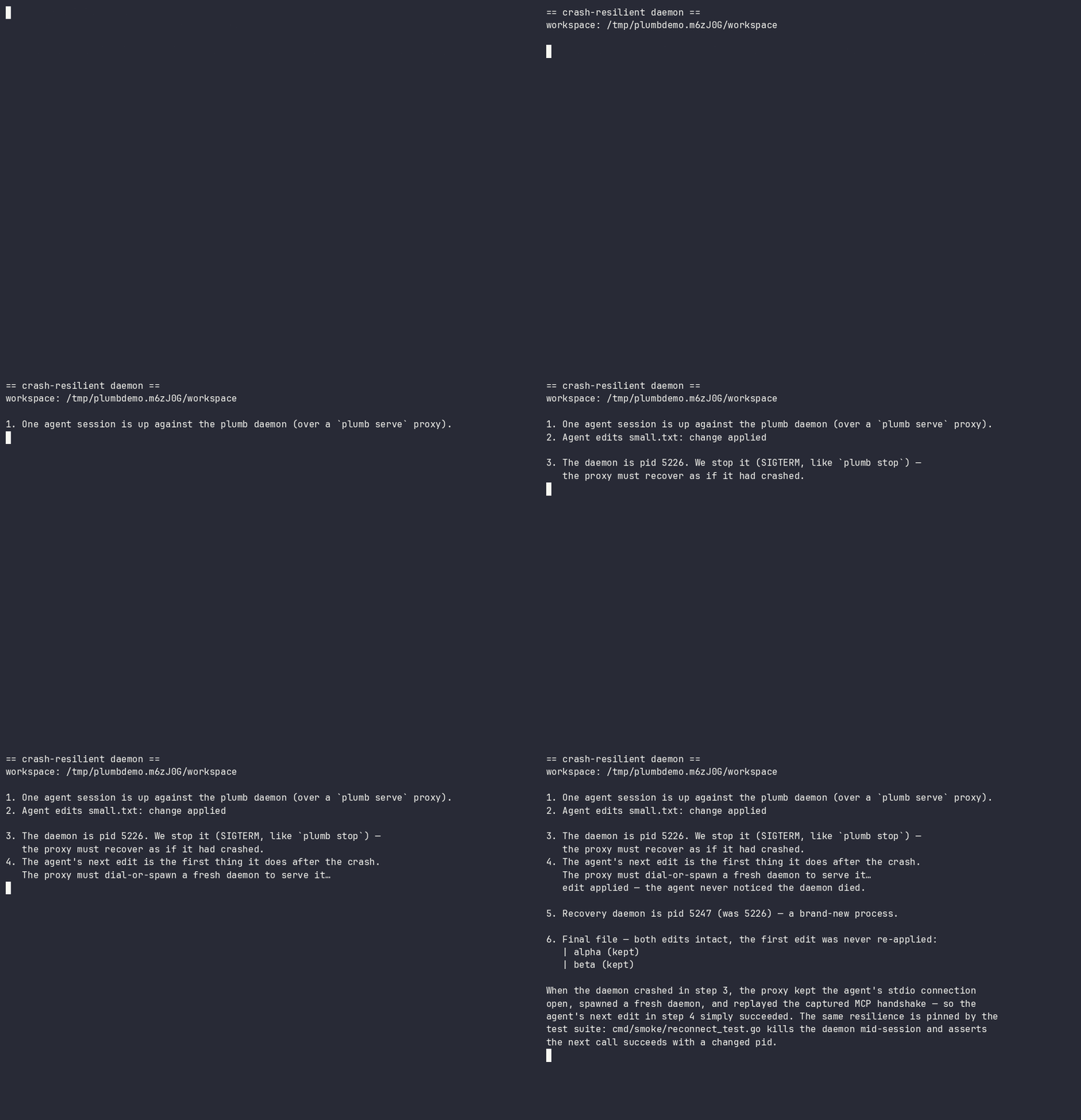
- **Crash-resilient daemon** — `plumb serve` is a reconnecting proxy. If the daemon crashes or hangs, it respawns one and replays the handshake; the agent never notices. In-flight writes are never silently re-run.
- **Optimistic concurrency** — mtime/sha guards catch stale edits before they clobber newer changes.
See it run: [`docs/demos/`](https://github.com/plumbkit/plumb/blob/HEAD/docs/demos/) — `two-agents-one-file.sh` (a stale write is refused, nothing is lost) and `daemon-respawn.sh` (below — the daemon is killed mid-session; the agent's next edit still succeeds):
### 2. Multi-agent coordination
One daemon serves every agent you run — which makes it the natural place for agents to *see and talk to* each other, not merely avoid each other's writes. Locks stop two agents corrupting a file; coordination stops them duplicating a task, rebasing onto a function signature a peer is mid-rewrite of, or shipping a change a peer's in-flight work is about to invalidate.
- **Peer awareness** (on by default) — `workspace_sessions` names every active session and the writes it made, as the daemon recorded them. Recorded activity, not another agent's say-so: an agent about to start a task can see that a peer is already in those files. (Read-only operations never appear, and a write that failed or was refused is kept but marked `[failed — no change applied]` — so "a peer is working here" and "this landed" are distinguishable at a glance.)
- **An agent-to-agent mailbox** (on by default, same workspace) — `leave_note` / `check_messages` give sessions a threaded channel: hand a change to the peer already rewriting those files, or ask a peer to *measure* a behaviour instead of assuming it. Messages ride on ordinary tool results, so a working agent receives them without polling.
- **Advisory intents** (opt-in: `[collab] intents`) — `share_intent` declares what an agent is working on; a peer whose write touches a claimed path gets a hint at the moment of the would-be collision. Intents are deliberately labelled as unverified claims, kept distinct from the daemon-recorded activity feed, and never block anything.
- **Durable findings** (opt-in: `[collab] knowledge_handoff`) — `share_findings` turns what an agent just learned into a searchable, secret-scrubbed project memory immediately, so the knowledge outlives the session that produced it.
Coordination is advisory by design — the write-safety above never depends on agents cooperating. Reference: [Cross-agent sharing](https://github.com/plumbkit/plumb/blob/HEAD/docs/tools.md#cross-agent-sharing-collab) in the tool docs and the [`[collab]` config section](docs/configuration.md#collab--cross-agent-sharing).
### 3. Semantic intelligence
The same primitives your editor has, exposed as structured tools:
- **LSP-backed refactors** — `rename_symbol`, `replace_symbol_body`, `safe_delete_symbol` understand scope, types, and references.
- **Real diagnostics inline** — actual `gopls`/`pyright` output is appended to every write, so the agent learns it broke the build immediately.
- **Symbol search** — scoped to your code, no stdlib or dependency noise.
### 4. Context efficiency & safety controls
- **Read only what you need** — symbols or line ranges, not 2,000-line files.
- **Scoped access you control** — a per-connection path allowlist (read-only vs read-write roots) plus tiered git gating (destructive and network operations are off by default and need explicit confirmation). See [SECURITY.md](https://github.com/plumbkit/plumb/blob/HEAD/SECURITY.md).
- **One-round-trip bootstrap** — `session_start` returns workspace, branch, recent commits, diagnostics, and project memory.
See the measured, reproducible numbers behind this: [**docs/use-cases.md**](https://github.com/plumbkit/plumb/blob/HEAD/docs/use-cases.md) — reading one function is 2.9×–33.4× less context than the whole file (the ratio is how much of the file you didn't need), and `find_references` returns the real call sites where a text search is 60% noise. The page publishes the losses too: `read_multiple_files` costs 1.31× **more** payload than reading the files natively (down from 1.32×, but still a loss — see Scenario 10 for why it isn't smaller). Every figure is regenerated by [`scripts/measure-use-cases.py`](https://github.com/plumbkit/plumb/blob/HEAD/scripts/measure-use-cases.py).
---
## Get started
Plumb is a single binary — from zero to your first answer:
**1. Install**
```sh
# Homebrew (macOS + Linux) — recommended
brew install plumbkit/plumb/plumb
# or with Go
go install github.com/plumbkit/plumb/cmd/plumb@latest
# or grab a prebuilt binary: https://github.com/plumbkit/plumb/releases
```
> **macOS note:** prebuilt binaries are not yet notarised — on first run you may
> need `xattr -d com.apple.quarantine ./plumb`, or right-click → Open. Homebrew
> installs avoid this.
**2. Connect your agent**
```sh
plumb setup claude-code # also: claude-desktop, codex, gemini, cursor, …
```
`plumb setup` writes the MCP config for you — no hand-editing JSON.
**3. Open your project and try it**
Make sure the language server you need is on your `$PATH` (`gopls` for Go,
`pyright` for Python, …), then point your agent at a real question. In Claude
Code:
```sh
cd your/project
claude "Use plumb to orient in this repo (session_start), then show me
everywhere is called and what would break if I changed its signature."
```
Plumb resolves the workspace and runs `session_start` for orientation, then
answers with real LSP and topology data — actual call sites and blast radius —
instead of guessing from file dumps. It's read-only; nothing is modified. (Any
connected agent works — just paste the prompt.)
> No `go.mod`/`pyproject.toml` and not a git repo? Run `plumb init` once to pin
> the workspace root (it also seeds `.plumb/context.md` and project config).
Full walkthrough → [**docs/getting-started.md**](https://github.com/plumbkit/plumb/blob/HEAD/docs/getting-started.md).
---
## Language support (honest version)
Plumb negotiates LSP capabilities per language and also ships a built-in tree-sitter index for search and navigation with no language server. Support comes in tiers — we'd rather be precise than claim a big number.
| Tier | Languages | What you get |
|---|---|---|
| **First-class** (CI-tested, real-binary integration) | **Go** (gopls), **Python** (pyright) | Full LSP: definitions, references, rename, diagnostics, hierarchies + all write tools |
| **Validated** | **Java** (jdtls), **Rust** (rust-analyzer), **Swift** (sourcekit-lsp), **TypeScript/JS** (typescript-language-server), **Zig** (zls), **Kotlin** (kotlin-lsp), **HTML** (vscode-html-language-server) | Full LSP; just put the server on `$PATH` and it activates automatically (exclude any language with `[lsp.] enabled = false`). HTML carries one caveat: that server has no filesystem access, so it answers only from documents already opened |
| **Search & navigation** (tree-sitter, no LSP needed) | 31+ incl. JS/TS/TSX, Ruby, C, C#, Elixir, Scala, PHP, JSON, CSS, SCSS, XML, Lua, C++, Objective-C, Dart, Bash, SQL, HCL, Dockerfile, TOML, YAML, Markdown | Ranked symbol search, outlines, graph exploration via the Topology index |
Real-binary validation has been exercised on **macOS and Linux** — as of 2026-08-21, all nine adapters pass their integration tests against real server binaries on both. Details, including three toolchain traps that look like adapter bugs, are in [docs/adding-an-lsp.md](https://github.com/plumbkit/plumb/blob/HEAD/docs/adding-an-lsp.md#validation-levels). Windows is [tracked but not yet supported](https://github.com/plumbkit/plumb/issues/8) — the daemon's Unix-socket architecture needs a port.
---
## How it works
`plumb serve` is a thin, reconnecting stdio proxy. The real work happens in one shared background daemon, so language servers stay warm across chats.
```mermaid
flowchart TD
A1["Claude"] --> S1["plumb serve *"]
A2["Codex"] --> S2["plumb serve *"]
A3["Gemini"] --> S3["plumb serve *"]
S1 --> K["plumb.sock"]
S2 --> K
S3 --> K
K --> D["plumb daemon **"]
D --> SDB[("stats.db *** global — all projects")]
D --> G["gopls → /projects/foo"]
D --> P["pyright → /projects/bar"]
G --> F1[("/projects/foo/.plumb/ *** topology.db · memory.db")]
P --> F2[("/projects/bar/.plumb/ *** topology.db · memory.db")]
```
`*` `plumb serve` is a reconnecting proxy — if the daemon crashes or hangs it respawns one and replays the handshake, so your session survives without the agent noticing.
`**` one shared process, reused across every conversation.
`***` SQLite. One **global** `stats.db` (tool stats + episodic summaries); two **per-project** indexes under each workspace's `.plumb/` — `topology.db` (the code graph) and `memory.db` (memory search). Schema details → [**docs/architecture.md**](https://github.com/plumbkit/plumb/blob/HEAD/docs/architecture.md#databases-at-a-glance).
Servers stay warm across chats, per-path locks are shared across every connection, and symbol indexes update live after each write. Full architecture → [**docs/architecture.md**](https://github.com/plumbkit/plumb/blob/HEAD/docs/architecture.md).
---
## Monitoring (TUI)
Run `plumb` with no arguments for a live dashboard — see what your agent is doing in real time: every tool call as it happens, daemon health, per-tool stats, and streaming logs you can follow and filter. The fastest way to catch a runaway loop or confirm an edit landed.
---
## Core capabilities
Plumb exposes **58 tools**. The ones you'll use constantly:
`session_start` · `workspace_symbols` · `get_definition` · `find_references` · `rename_symbol` · `edit_file` · `transaction_apply` · `diagnostics`
The rest cover filesystem reads/writes, LSP hierarchies, tiered git, an optional local **Topology** index (ranked search + blast-radius/route analysis, no language server needed), durable per-project memory, and cross-agent coordination (peer sessions, an agent mailbox, opt-in intents and knowledge handoff). Full API reference: [**docs/tools.md**](https://github.com/plumbkit/plumb/blob/HEAD/docs/tools.md).
---
## Configuration
Global or per-project `config.toml`, or environment variables. Run `plumb config show` to see the resolved config with provenance.
```toml
[edits]
strict = true # require read_file before edit_file
rate_limit_per_minute = 30 # bound runaway agent loops
[git]
allow_destructive = false # reset/checkout/rebase off by default
allow_push = false # push/fetch/pull off by default
```
Full settings reference: [**docs/configuration.md**](https://github.com/plumbkit/plumb/blob/HEAD/docs/configuration.md).
---
## The hard part
Agents can already *read* code well enough; writing it unsupervised — concurrently, transactionally, recoverably — is what's still unsolved. Plumb is the bet that this is the half worth getting right first. It's early, and the language coverage says so: a small validated core, the rest clearly marked experimental.
---
## Roadmap
Plumb is pre-1.0. The core — write-safety, the resilient daemon, the topology index, and project memory — is in daily use. The road to 1.0 is mostly about *proving* it beyond the validated core and smoothing distribution. Issues and ideas welcome.
**Shipped**
- [x] Concurrency-safe, atomic, transactional writes with rollback
- [x] Crash-resilient reconnecting daemon
- [x] Tree-sitter topology index + per-project memory
- [x] Cross-agent coordination: peer awareness + agent mailbox (default on), intents + knowledge handoff (opt-in)
- [x] Go and Python LSP adapters validated (real-binary)
**Getting to 1.0.** Rather than jump from 0.9 straight to 1.0, Plumb ships a series of focused minor releases — **0.10 through 0.19** — each with one coherent theme. **0.19.x is the last 0.x release;** 1.0 follows it as a deliberate stability commitment. Native Windows support is intentionally a post-1.0 (1.1) item, not a 1.0 gate. The themed plan:
- **0.10** — distribution + honest claims (Homebrew, semantic re-rank → GA)
- **0.11** — validate the experimental LSP adapters on real binaries (zls ✓ validated; Kotlin ✓ validated on JetBrains' kotlin-lsp)
- **0.12** — Swift on Xcode via Build Server Protocol guidance
- **0.13** — daemon robustness (git-write crash safety, liveness probe)
- **0.14** — agent ergonomics + tool surface
- **0.15** — honesty + full config surface
- **0.16** — stabilisation + cross-platform proving
- **0.17** — distribution + discoverability (registries)
- **0.18** — proof + docs
- **0.19** — soak + feedback, the last 0.x (rolling patches, not a formal RC)
- **1.0** — general availability: the stability + validated-core promise
Full detail, rationale, and the post-1.0 items (Windows, tree-sitter cleanup) are in [docs/roadmap.md](https://github.com/plumbkit/plumb/blob/HEAD/docs/roadmap.md).
## Contributing
See [CONTRIBUTING.md](https://github.com/plumbkit/plumb/blob/HEAD/CONTRIBUTING.md) and [AGENTS.md](https://github.com/plumbkit/plumb/blob/HEAD/AGENTS.md) for architecture and code style. We follow Australian English in all prose. By contributing you agree to the [Code of Conduct](https://github.com/plumbkit/plumb/blob/HEAD/CODE_OF_CONDUCT.md).
## License
MIT — see [LICENSE](https://github.com/plumbkit/plumb/blob/HEAD/LICENSE).
