# Playrunner
**Category:** 📂 Browser Automation
**Repository:** https://github.com/playrunner/playrunner
**Views:** 0
**Installs:** 0
**Upvotes:** 0
**Directory Page:** https://allmcps.com/mcp/playrunner
## Description
Discover Playwright workflows, start runs, and inspect results in Playrunner Cloud.
## Claude Desktop Quick Installation
Heuristic fallback — verify the package name and runner against the repository README before running it. Uses `npx` (confidence: low):
```json
"mcpServers": {
"playrunner": {
"command": "npx",
"args": ["-y","playrunner"]
}
}
```
## Documentation & README

Playrunner
Run Playwright at scale—without building the platform around it.
Keep the tests and CI you already use. Bring runners, environments,
credentials, reports, integrations, and automatic sharding into one visual
workflow.
Please ⭐ star Playrunner if you find it useful
Try Playrunner Cloud →
·
Run it locally
·
Read the docs




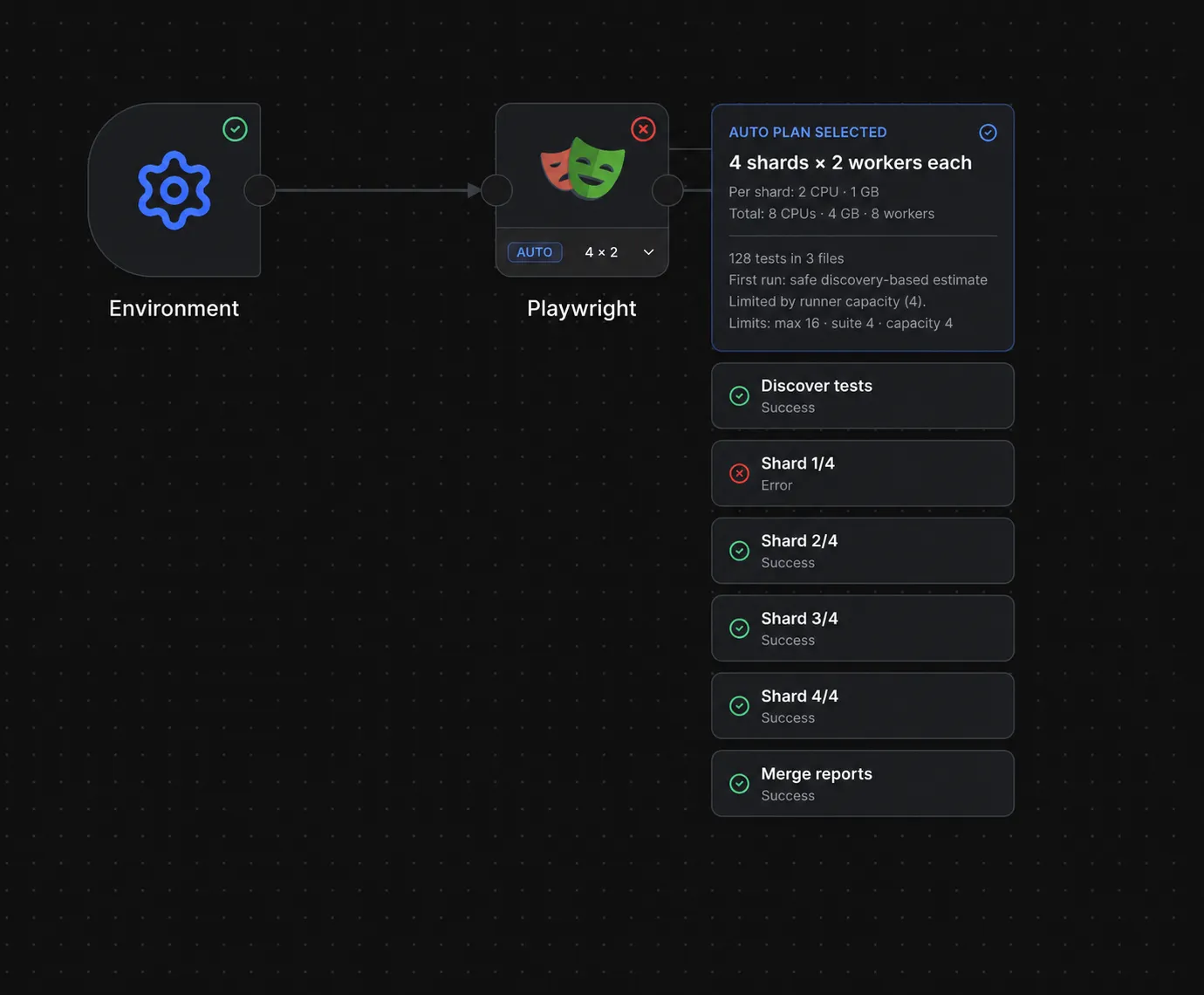
One Playwright node. Four concurrent shards. One merged report—even when a shard fails.
## Your tests stay. The platform glue goes.
Playwright runs your tests brilliantly. The hard part is everything around the
command: compute, environments, credentials, schedules, conditions, artefacts,
reporting, and the CI scripts that connect them.
Playrunner turns those moving parts into a workflow your whole team can see,
run, and evolve.
| | |
| ------------------------------------ | ------------------------------------------------------------------------------------------------------------------------------------- |
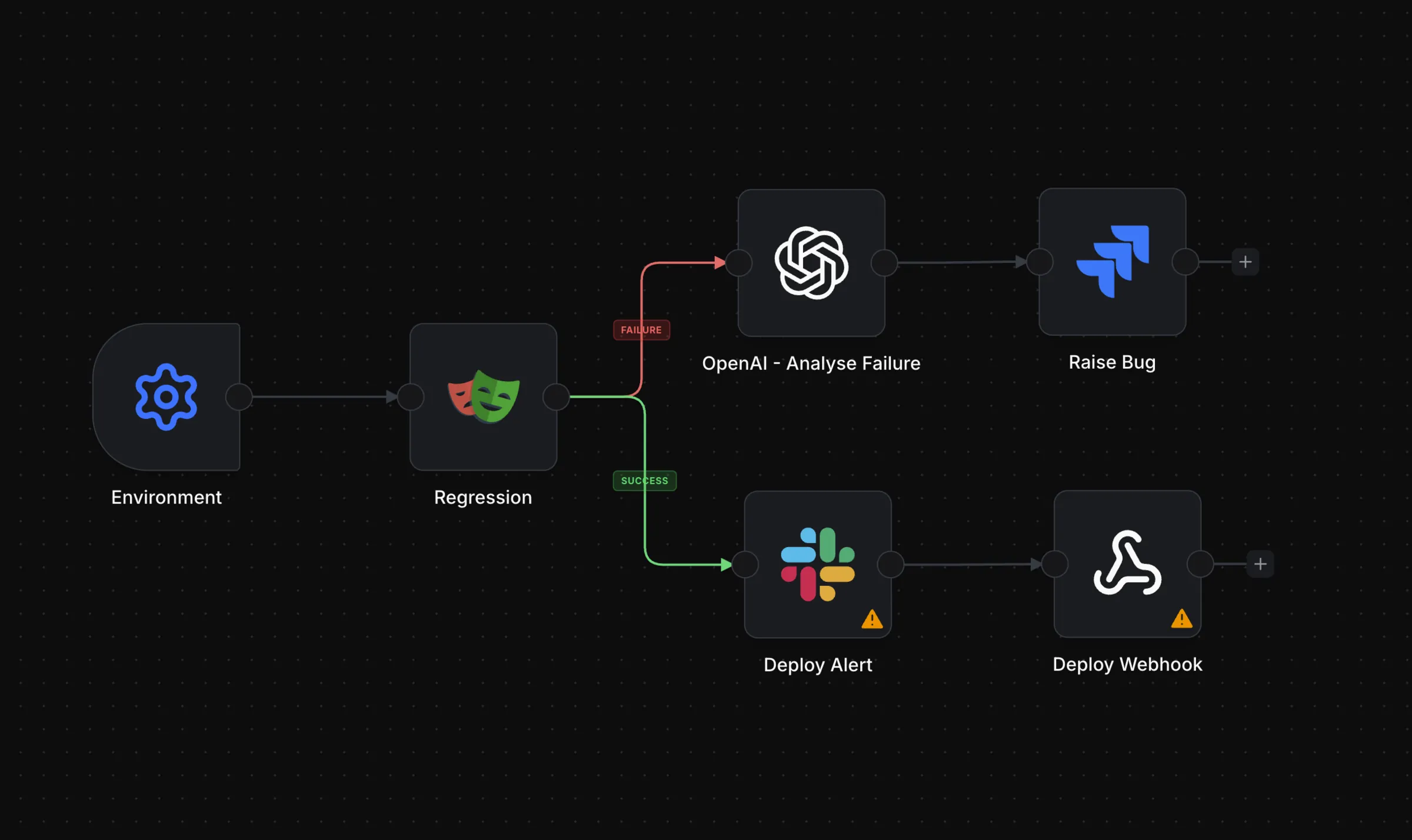
| **🎨 Build visually** | Connect tests, triggers, conditions, branches, and downstream systems on a live workflow canvas. |
| **🤖 Code with confidence** | Ask AI to generate a Playrunner workflow alongside your app, then create or update it from the CLI in your development pipeline. |
| **⚡ Shard automatically** | Discover the real suite, fit useful parallelism to runner capacity, and merge every shard into one report. |
| **🏃 Run where you want** | Use local Docker, managed cloud runners, or your own infrastructure without changing the suite. |
| **🔎 See the complete run** | Follow node state and logs live, with Playwright reports, screenshots, videos, and traces attached to the run. |
| **🔐 Keep secrets out of workflows** | Reuse managed environments and credentials instead of copying sensitive values into scripts. |
| **🪪 Reuse browser sign-ins** | Capture authenticated browser sessions interactively and attach them to Playwright nodes without storing identity-provider passwords. |
| **🧩 Extend with integrations** | Wire source control, schedules, messaging, AI analysis, issue tracking, webhooks, and more into the same DAG. |
## From suite to signal
```text
Trigger → Environment → Playwright → Condition → Slack / Jira / AI / Webhook
│
└── reports · traces · screenshots · video
```
1. **Bring your existing tests.** Your repository, Playwright configuration,
and CI can stay as they are.
2. **Choose where they run.** Start with local Docker, then move execution to
managed or self-hosted runners when you are ready.
3. **Draw the workflow.** Add schedules, branches, notifications, failure
analysis, tickets, and downstream actions without another CI matrix.
4. **Inspect one complete result.** Follow execution live and keep every log,
report, and artefact attached to the run that produced it.
## Reuse authenticated browser sessions
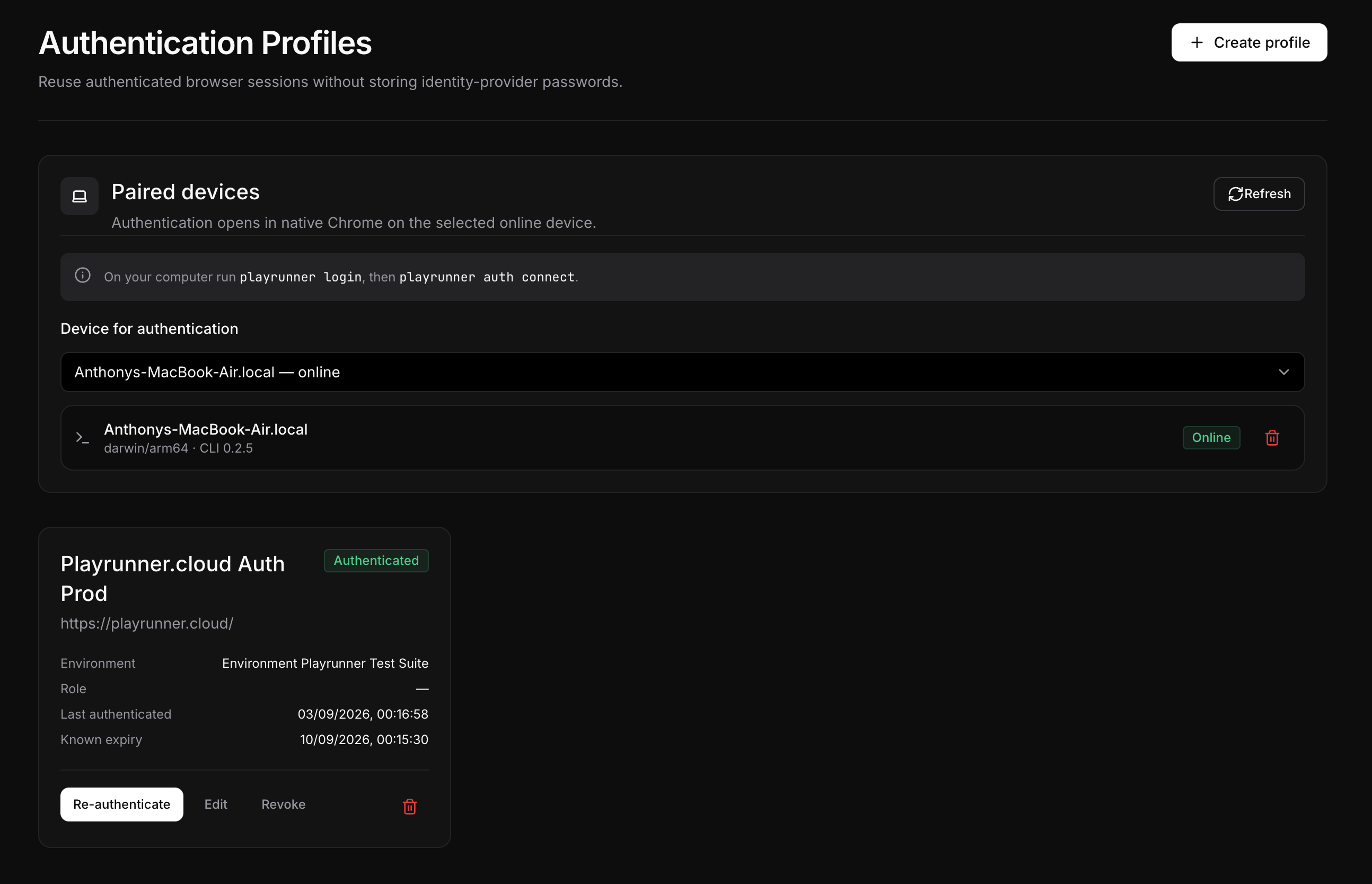
Authentication Profiles let tests start from a real signed-in browser session
without storing identity-provider passwords in Playrunner. Create a profile for
an Environment and authenticate manually in a visible browser. Local
Playrunner opens the browser through its API; Playrunner Cloud uses a paired
computer running the outbound-only CLI authentication companion.
```bash
npm install --global playrunner@latest
playrunner login
playrunner auth connect
```
Keep the companion terminal open, select the online device under
**Authentication Profiles**, and start authentication. After signing in to the
Chrome window, return to the terminal and press **Enter** to encrypt and upload
the captured session state.
Select the profile on any Playwright node that needs it. Playrunner restores
the session for that execution while keeping profiles isolated by Environment.
The CLI is needed only while capturing or refreshing the profile. Cloud
**Test session** checks and Hosted Runner workflows restore the encrypted
stored state remotely and do not require the companion to remain connected.
Each profile records its application, role, authentication status, last sign-in,
and known expiry, and can be reauthenticated, revoked, or removed when access
changes. Follow the
[Authentication Profiles tutorial](https://playrunner.dev/docs/tutorials/authentication-profiles/)
and [CLI companion guide](https://playrunner.dev/docs/cli/authentication-companion/)
for pairing, capture, hosted testing, and security.
## Playrunner from the command line
The Playrunner CLI brings the same workflows to your terminal and CI/CD
pipeline—without a global install. Use a revocable machine token to start a
saved workflow, stream its progress, and turn its final status into a quality
gate:
```bash
export PLAYRUNNER_URL='https://playrunner.cloud'
export PLAYRUNNER_API_KEY=''
npx playrunner WORKFLOW_ID
```
By default, the command waits for completion and exits non-zero when the
workflow fails, is cancelled, or times out. Pass inputs and acceptance criteria
to a run, attach pull-request context, emit newline-delimited JSON, or use
`--no-wait` when another system will monitor the result.
The CLI also supports **workflow as code**. Keep a project and workflow
definition in source control, then create or update it idempotently from JSON:
```bash
npx playrunner workflow create --file playrunner-workflow.json
```
Use `npx playrunner --help` for every option. See the
[CLI overview](https://github.com/playrunner/playrunner/blob/HEAD/docs/docs/cli/index.md), [run guide](https://github.com/playrunner/playrunner/blob/HEAD/docs/docs/cli/run-workflow.md),
and [workflow creation guide](https://github.com/playrunner/playrunner/blob/HEAD/docs/docs/cli/create-workflow.md) for token scopes,
CI examples, inputs, source-change context, and the complete definition format.
## Quick start
### Prerequisites
- Docker Desktop
- Node.js 20+
- npm
### Start the full local stack
```bash
./install-local.sh
cp .env.local.example .env.local
./start-local.sh
```
On the first run, Playrunner opens the setup app. Follow the printed URL to
confirm PostgreSQL and create the first admin account. With the default ports:
- Playrunner: `http://127.0.0.1:3100`
- Setup: `http://127.0.0.1:3100/setup`
- Documentation: `http://127.0.0.1:3104/playrunner/`
The `.env.local` file is optional unless you want to change ports before the
first run. If it is missing, `./start-local.sh` creates it from the example. For
the complete walkthrough, see the
[Getting Started guide](https://github.com/playrunner/playrunner/blob/HEAD/docs/docs/tutorials/01-getting-started.md).
Reopen setup or change the local defaults
To reopen the setup wizard:
```bash
rm apps/api/.env
./start-local.sh
```
Remove `.env.local` as well if you want Playrunner to regenerate the local port
and PostgreSQL defaults.
Run only the documentation site
```bash
cd docs
npm run start -- --port 3104
```
Then open `http://127.0.0.1:3104/playrunner/`.
## Explore
| Start here | What you will find |
| -------------------------------------------------------------------------- | ---------------------------------------------------------------- |
| [Automatic sharding](https://github.com/playrunner/playrunner/blob/HEAD/docs/docs/use-cases/automatic-playwright-sharding.md) | Suite discovery, capacity-aware planning, and report merging |
| [Integration reference](https://github.com/playrunner/playrunner/blob/HEAD/docs/docs/integration-packages/index.md) | Available nodes, providers, and configuration |
| [Runner architecture](https://github.com/playrunner/playrunner/blob/HEAD/docs/docs/runner-architecture/index.md) | Local, managed, and self-hosted execution |
| [Workflow execution](https://github.com/playrunner/playrunner/blob/HEAD/docs/docs/local-dev/07-workflow-execution.md) | How the API, orchestrator, and ephemeral runners coordinate |
| [Contributing](https://github.com/playrunner/playrunner/blob/HEAD/docs/docs/contributing.md) | Ways to extend runners, integrations, reporting, and the product |
## Package end-to-end tests
Package E2E tests run the real Vite frontend and Playrunner API against the
isolated `playrunner_e2e` PostgreSQL schema. Complete local setup first so
`apps/api/.env` contains a working `DATABASE_URL`, and keep PostgreSQL running.
Install Chromium once on a new development machine:
```bash
npm exec --prefix apps/frontend -- playwright install chromium
```
Run the deterministic mock-provider suite:
```bash
npm run test:e2e:mock
```
Run one integration package by its Playwright tag:
```bash
npm run test:e2e:mock -- --grep @github
npm run test:e2e -- --grep @github
```
Mock mode still uses the real frontend, authentication, API, credential
encryption, and database; only outbound provider boundaries may be faked.
Live-provider scenarios are opt-in and require protected credentials:
```bash
npm run test:e2e:live
npm run test:e2e:live -- --grep @github
```
Set `PLAYRUNNER_E2E_DATABASE_URL` to use another PostgreSQL server. Open the
latest report with `npx playwright show-report`, or read the
[Testing guide](https://github.com/playrunner/playrunner/blob/HEAD/docs/docs/testing/index.md) for architecture and package
authoring details.
## License
Playrunner is source-available under the [Playrunner Sustainable Use License](https://github.com/playrunner/playrunner/blob/main/LICENSE), copyright © 2026 Concept AI PTY LTD.