Phantom
**Delegate more to AI without putting real keys in agent context.**
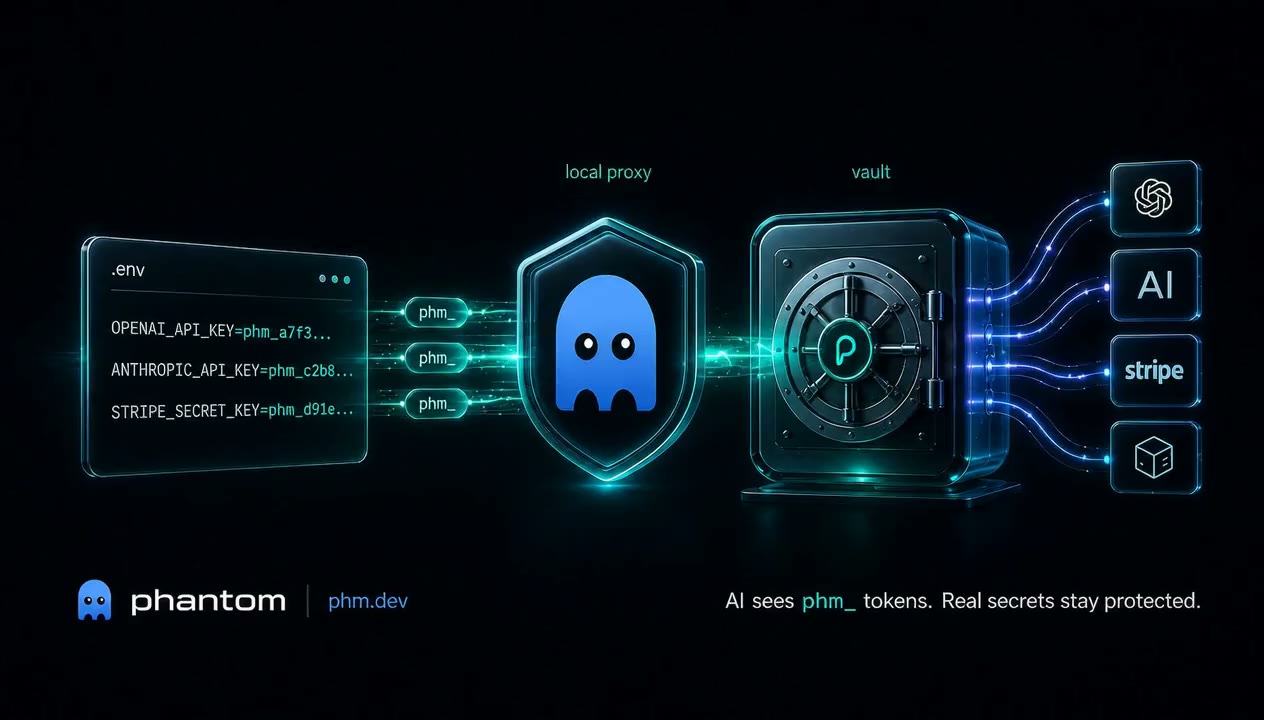
Phantom replaces project secrets with scoped `phm_` placeholders. Applications use those placeholders through an authenticated local proxy, while agents use value-blind MCP tools for inventory, diagnostics, and governed requests.
[](https://github.com/ashlrai/phantom-secrets/stargazers)
[](https://github.com/ashlrai/phantom-secrets/actions/workflows/ci.yml)
[](https://github.com/ashlrai/phantom-secrets/releases/tag/v0.7.8)
[](CHANGELOG.md#079---2026-09-06)
[](rust-toolchain.toml)
[](LICENSE)
[**Quick start**](#quick-start) ·
[**⭐ Star Phantom**](https://github.com/ashlrai/phantom-secrets) ·
[**Delegate safely**](https://github.com/ashlrai/phantom-secrets/blob/HEAD/docs/delegation-quickstart.md) ·
[**Why Phantom?**](#why-phantom) ·
[**MCP setup**](#mcp-integration-claude-code-cursor-windsurf-codex) ·
[**Docs**](https://github.com/ashlrai/phantom-secrets/blob/HEAD/docs/README.md) ·
[**Contribute**](https://github.com/ashlrai/phantom-secrets/blob/HEAD/CONTRIBUTING.md) ·
[**phm.dev**](https://phm.dev)
---
> **▶ [Historical v0.4 demo — current behavior differs](https://github.com/ashlrai/phantom-secrets/releases/download/v0.4.0/phantom-demo.mp4)** ·
> **🛡 [Security model](https://github.com/ashlrai/phantom-secrets/blob/HEAD/SECURITY.md)** ·
> **📋 [Threat model](https://github.com/ashlrai/phantom-secrets/blob/HEAD/THREAT_MODEL.md)** ·
> **💬 [Discussions](https://github.com/ashlrai/phantom-secrets/discussions)**
> [!IMPORTANT]
> **Release-state snapshot (verified 2026-09-05):** the
> immutable `v0.7.8` GitHub release at source commit
> `f065b13462f9eaf27e0443f8911f021575b7c409`. Its 19-asset release set,
> checksums, archive-specific SPDX SBOMs, GitHub provenance and SBOM
> attestations, and all six native release rows are bound to that immutable
> release record by tag-bound workflow
> [33952398697](https://github.com/ashlrai/phantom-secrets/actions/runs/33952398697).
> Exact public registry endpoints were requeried on 2026-09-05. Homebrew
> independently publishes reviewed `v0.7.8`; npm `latest` remains `0.6.0`, and the npm
> `0.7.4` wrappers remain quarantined under `release-candidate` after failed
> npm-channel acceptance. The GitHub receipt alone does not prove the separately
> verified Homebrew formula, an npm or crates.io package, MCP Registry entry, hosted-service
> commissioning, provider activation, signing/notarization, certification, or
> customer acceptance. See
> [release readiness](https://github.com/ashlrai/phantom-secrets/blob/HEAD/docs/release-readiness.md) and
> [platform support](https://github.com/ashlrai/phantom-secrets/blob/HEAD/docs/platform-support.md).
## Start here
Choose the smallest path that answers your next question. The first path uses
no credential, makes no network request, and does not install or configure
Phantom.
| Goal | Start | What it establishes |
|---|---|---|
| See the delegation boundary with no secret or setup | Run `node examples/first-five-minutes/run.mjs`, then read the [first-five-minutes walkthrough](https://github.com/ashlrai/phantom-secrets/blob/HEAD/examples/first-five-minutes/README.md) | A deterministic, read-only example contract; not vault, proxy, provider, or deployment acceptance. |
| Protect a real local project | Follow [Quick Start](#quick-start) with the reviewed `v0.7.8` GitHub release | Local initialization and diagnostics on your machine. |
| Connect an AI coding client | Complete the [first MCP task](#first-mcp-task-verify-the-boundary) | Value-blind capability, status, and repository checks; no provider action. |
| Define a bounded task for an agent | Use the [safe delegation quickstart](https://github.com/ashlrai/phantom-secrets/blob/HEAD/docs/delegation-quickstart.md) | A reviewable task contract with explicit authority and acceptance boundaries. |
| Evaluate a team rollout | Use the [enterprise adoption guide](https://github.com/ashlrai/phantom-secrets/blob/HEAD/docs/enterprise-adoption.md) | A controlled evaluation plan; not a claim of commissioned cloud or enterprise service. |
| Audit the trust model first | Read the [security model](https://github.com/ashlrai/phantom-secrets/blob/HEAD/SECURITY.md) and [threat model](https://github.com/ashlrai/phantom-secrets/blob/HEAD/THREAT_MODEL.md) | Documented controls, assumptions, and residual risks. |
## Why Phantom?
AI coding agents routinely work in repositories that also contain local credentials. Once a real API key enters an agent context, transcript, tool call, or generated file, you have lost control of where that value may persist.
Traditional secrets managers focus on keys *at rest* and *in transit*. Phantom adds a boundary for agent **context**:
- 🔒 **Reduces one credential-exposure path** — managed project dotenv files contain sensitive `phm_` mappings, MCP responses remain value-blind, and exact proxy routes inject their own configured authentication values. Unmanaged files, broader shell authority, and same-user processes remain in the threat model.
- ⚡ **Fast local setup** — after installing the reviewed `v0.7.8` GitHub release, `phantom init` protects a project without requiring an account, DNS changes, or a custom CA.
- 🧰 **Agent-native integrations** — setup helpers and value-blind MCP workflows for Claude Code, Cursor, Windsurf, and Codex, plus project instructions for GitHub Copilot.
- 🦀 **Open source, local-first, MIT** — secrets use the native OS credential store when it is available, with an explicit encrypted-file fallback. Optional cloud sync encrypts vault payloads client-side before the server stores them.
### Project status and trust boundary
Phantom's implemented user-facing surfaces are the CLI, vault, authenticated local proxy, MCP server, and optional cloud/team workflows documented below. Cloud and team behavior additionally depends on the deployed service, account plan, and provider configuration; source code alone is not deployment or customer-acceptance evidence. The conversation facade is intentionally narrow:
- `phantom_do` is **proposal-only**. It canonicalizes a closed Cargo action and reports its digest, effect, and activation blockers; `execute` is hard denied.
- `phantom_setup_workspace` can propose setup, create a bearerless request, and report authenticated status. Applying a request remains a separate trusted-terminal operation.
- Advanced MCP tools remain a compatibility catalog, disabled by default, with separate explicit confirmation and informed terminal-approval gates. They are not governed by the conversation facade's capability card.
- `phantom grant` retains value-blind lifecycle metadata and design-source foundations, but 0.7.8 hard-denies every live provider issuance/renewal path before credential or network access. A provider grant is not an execution-kernel **authority grant**, broker lease, or permission for an agent to execute work.
- The authority, broker, runtime, session, and evidence crates are **inactive, fail-closed foundations**. They do not establish live Locus authority, broker credentials, execute agent actions, or produce externally trusted receipts today.
See the [documentation map](https://github.com/ashlrai/phantom-secrets/blob/HEAD/docs/README.md), [architecture](https://github.com/ashlrai/phantom-secrets/blob/HEAD/docs/architecture.md),
[security policy](https://github.com/ashlrai/phantom-secrets/blob/HEAD/SECURITY.md), and [threat model](https://github.com/ashlrai/phantom-secrets/blob/HEAD/THREAT_MODEL.md) for the
evidence behind those boundaries.
## Quick Start
Install both binaries from the reviewed [`v0.7.8` GitHub release](#installation).
The Homebrew formula separately publishes the reviewed `v0.7.8` binaries:
```bash
$ brew tap ashlrai/phantom
$ brew trust --formula ashlrai/phantom/phantom
$ brew install ashlrai/phantom/phantom
```
For exact `v0.7.8` on macOS, Linux, or Windows, use the matching release asset
in [Installation](#installation). Then protect and verify the project:
```bash
$ phantom init
# Auto-detects .env, .env.local, or .env in subdirectories
# Stores real secrets in the native credential store or encrypted vault,
# then rewrites .env with phantom tokens
# Auto-configures Claude Code MCP server if detected
$ phantom agent doctor
# One human-readable readiness check for AI-agent safety
$ phantom exec -- claude
# Authenticated proxy running on an ephemeral 127.0.0.1 port
# App/test processes use phantom tokens; agents use value-blind metadata
```
For a task contract you can hand to Claude Code, Codex, Cursor, Windsurf, or
Copilot, use the [safe delegation quickstart](https://github.com/ashlrai/phantom-secrets/blob/HEAD/docs/delegation-quickstart.md) and
the [copyable policy and task templates](https://github.com/ashlrai/phantom-secrets/blob/HEAD/examples/agent-delegation/README.md).
Teams evaluating a controlled rollout can start with the
[enterprise adoption guide](https://github.com/ashlrai/phantom-secrets/blob/HEAD/docs/enterprise-adoption.md).
### Windows
The same core command surface is implemented for native Windows, with remaining
native acceptance limits tracked in the platform matrix. Install the exact `v0.7.8`
Windows ZIP for your architecture from [Installation](#installation), verify its
published `.sha256` sidecar, and place both executables on `PATH`. WSL is a
separate Linux environment with its own filesystem and credential-store context.
For an explicitly supervised foreground proxy, run `phantom start` with stdin,
stdout, and stderr each attached to a trusted terminal. Terminal attachment is
an admission check, not proof of who controls a PTY. The CLI detects your shell and prints the matching env-var syntax;
copy those exports into the terminal that launches the client, keep the owning
terminal open, and press Ctrl-C there to stop. Detached `--daemon` mode and
external process control are fail-closed until Phantom has a separately reviewed
private cross-platform control channel. `phantom stop` only authenticates a
legacy v0.7.3 `.phantom.pid` session to report migration guidance; v0.7.3 had no
authenticated shutdown endpoint, so the new binary never kills that process or
deletes its record. Stop it from its owning v0.7.3 terminal with Ctrl-C, or use
the bounded recovery procedure in [Troubleshooting](https://github.com/ashlrai/phantom-secrets/blob/HEAD/docs/troubleshooting.md).
For reference:
**PowerShell:**
```powershell
$env:OPENAI_BASE_URL = "http://127.0.0.1:PORT/openai/_phantom/TOKEN/"
$env:PHANTOM_PROXY_PORT = "PORT"
$env:PHANTOM_PROXY_TOKEN = "TOKEN"
```
**cmd.exe:**
```cmd
set OPENAI_BASE_URL=http://127.0.0.1:PORT/openai/_phantom/TOKEN/
set PHANTOM_PROXY_PORT=PORT
set PHANTOM_PROXY_TOKEN=TOKEN
```
**Git Bash / WSL:** use the `export X=Y` syntax from the main quick-start.
Notes:
- `PHANTOM_PROXY_TOKEN` is the proxy session authenticator. By default, `phantom exec` and `phantom start` include it in local `*_BASE_URL` values as `/_phantom/TOKEN/` so unmodified SDKs work. Header-aware clients can set `PHANTOM_PROXY_HEADER_AUTH_ONLY=1` and send `x-phantom-proxy-token: $PHANTOM_PROXY_TOKEN` instead.
- If `phantom.exe` is blocked by Windows application-control policy, do not automatically remove Mark-of-the-Web. First verify the archive checksum and both binary identities against the release metadata. If local policy permits the verified binaries, a user may then remove the mark explicitly with PowerShell: `Get-ChildItem "$env:USERPROFILE\.phantom-secrets\bin\*.exe" | Unblock-File`.
- The pre-commit hook installed by `phantom init` is a `#!/bin/sh` script. Native git from the command line invokes it via Git for Windows' bundled `sh.exe`, which is what the official Git for Windows installer ships. GUI clients (GitHub Desktop, some IDE integrations) may run with a stripped-down `PATH` that lacks `sh.exe` and silently skip the hook — for these, run commits from a terminal, or use `phantom check --staged` directly. CI is the durable safety net regardless.
- The immutable `v0.7.8` release contains x64 and ARM64 Windows ZIPs, and both native Windows rows passed the tag-bound release acceptance workflow. The archives are not Authenticode-signed; this receipt does not prove every enterprise application-control policy will accept them. See the [platform support matrix](https://github.com/ashlrai/phantom-secrets/blob/HEAD/docs/platform-support.md).
## How It Works
```
.env file (AI read denied) OS Keychain / Vault
+--------------------------+ +---------------------+
| OPENAI_API_KEY=phm_a7f3 | ---> | sk-real-secret-key |
| STRIPE_KEY=phm_c9d1... | | sk_live_real-key... |
+--------------------------+ +---------------------+
| |
v v
App / test process Phantom Proxy (127.0.0.1)
+--------------------------+ +------------------------------+
| Loads phm_ tokens | | Intercepts HTTP requests |
| Agent gets MCP metadata | ---> | Injects route-owned auth key |
| Makes API calls to proxy | | Forwards over TLS to real API|
+--------------------------+ +------------------------------+
```
1. `phantom init` reads `.env`, stores real secrets in the native OS credential store or encrypted-file fallback, and rewrites `.env` with `phm_` tokens
2. `phantom exec -- claude` starts a local reverse proxy, sets SDK-compatible service base URLs such as `OPENAI_BASE_URL=http://127.0.0.1:PORT/openai/_phantom/TOKEN/`, exposes `PHANTOM_PROXY_TOKEN` to the child process, and launches the command
3. API calls hit the proxy, which authenticates the local session, removes its local auth token, injects only the matched route's vault value into that route's exact configured authentication header, and forwards over TLS. Client-controlled headers and bodies never resolve `phm_` tokens.
4. When the session ends, the proxy shuts down and its bearer is invalid. `phantom exec` also replaces project tokens with fresh child-process tokens for that run. Project `phm_` values persist until rotation; they are not provider credentials and are never client-resolved, but a process controlling an authenticated active proxy can still invoke its configured provider routes.
Phantom does not grant AI tools permission to read `.env` or other dotenv files. `phantom setup` removes legacy Phantom-managed dotenv read grants and preserves deny rules; agents use value-blind MCP inventory instead.
### Provider grants
`phantom grant` retains value-blind lifecycle metadata and provider protocol
design foundations. In 0.7.8, all live provider issuance, enrollment exchange,
refresh, renewal, and revocation execution is hard-denied before Phantom reads a
provider credential or opens a provider network connection. Do not use grant or
rotation commands expecting a vendor-side change. Test-only mocks demonstrate
local transaction behavior only; they are not live-provider acceptance.
In these docs, **provider grant** means design-era credential lifecycle metadata;
no live grant flow runs in 0.7.8. **Authority grant** means the inactive, value-free execution
authority type in `phantom-authority`. A provider grant cannot be reinterpreted
as an authority grant, Locus credential, broker lease, or execution permit. See
the [design-era grant lifecycle specification](https://github.com/ashlrai/phantom-secrets/blob/HEAD/docs/grants-spec.md); the
[issuance contract](https://github.com/ashlrai/phantom-secrets/blob/HEAD/ISSUANCE_CONTRACT.md) is the original design contract and
retains design-era status language.
## MCP Integration (Claude Code, Cursor, Windsurf, Codex)
Phantom ships an MCP server so AI coding tools can inspect value-blind metadata
and request gated lifecycle operations. MCP responses do not return real secret
values.
### First MCP task: verify the boundary
Use this read-only path before exploring the full tool catalog:
1. Install both binaries from the reviewed [`v0.7.8` GitHub release](#installation).
2. From the project you want to inspect, run `phantom setup --client codex`,
replacing `codex` with `claude`, `cursor`, or `windsurf` when appropriate.
3. Restart the AI client so it loads the generated MCP configuration.
4. Ask the client: “Call `phantom_capability`, then `phantom_status`. Report the
value-blind authority, hard denials, vault backend, secret count, and service
mappings. Do not request or reveal secret values.”
5. Ask the client: “Call `phantom_check` with `staged: false`. Report findings
without changing files or credentials.”
These calls inspect the configured local surface. They do not prove that cloud,
team, deployment, provider, authority-kernel, or customer workflows are active
or accepted.
- **Conversation facade** — `phantom_capability` reports authority and hard denials for the small facade (not the separately gated advanced compatibility catalog); `phantom_do` canonicalizes one closed Cargo action and reports the exact activation blockers without executing it; `phantom_setup_workspace` proposes an exact value-blind plan, creates a bearerless apply request after revalidation, or reads authenticated request status. Provisioning the machine-local seal key and creating a request both require `confirm` plus an out-of-band approval token; MCP never claims or applies the request.
- **Vault** — `phantom_list_secrets`, `phantom_status`, `phantom_init`, `phantom_add_secret_interactive`, `phantom_add_secret` (deprecated; refuses plaintext), `phantom_remove_secret`, `phantom_rotate`, `phantom_copy_secret`
- **Detection + diagnostics** — `phantom_doctor`, `phantom_why`, `phantom_check`, `phantom_env`, `phantom_validate_secret`, `phantom_validate_all`
- **Local-to-cloud** — `phantom_wrap`, `phantom_unwrap`, `phantom_sync`, `phantom_cloud_push`, `phantom_cloud_pull`, `phantom_cloud_status`
- **Teams** — `phantom_team_list`, `phantom_team_create`, `phantom_team_members`, `phantom_team_invite`, `phantom_team_key_publish`, `phantom_team_vault_push`, `phantom_team_vault_pull`
- **Advanced audit, rotation, expiry, and compliance** — `phantom_audit_recent`, `phantom_audit_stats`, `phantom_audit_analytics`, `phantom_audit_anomalies`, `phantom_audit_anomalies_realtime`, `phantom_audit_hotspot_alerts`, `phantom_audit_incidents`, `phantom_leak_incidents_realtime`, `phantom_audit_alerts`, `phantom_audit_export_report`, `phantom_compliance_status`, `phantom_rotate_with_candidate`, `phantom_rotate_promote`, `phantom_rotate_provider`, `phantom_rotate_with_expiry`, `phantom_list_with_expiry`, `phantom_secret_rotation_due`, `phantom_validation_schedule`, `phantom_validation_history`, `phantom_secrets_expiry_check`, `phantom_secrets_auto_rotate`, `phantom_expiry_enforce`, `phantom_rotation_schedule_next`, `phantom_apply_expiry_policy`
`phantom_secrets_auto_rotate` and `phantom_rotate_with_expiry` are deprecated
compatibility names for approved local `phm_` token remaps. They do not rotate
a provider credential, renew TTL/`rotated_at` metadata, clear leak incidents,
or sync credentials. `phantom_rotate_provider` is also hard-denied before
credential or network access in 0.7.8. Team invites may assign only `member` or `admin`; ownership transfer
is not an invite role.
Tools that write state, retrieve or use credentials, or make provider/network
requests are disabled by default. They can reach their `confirm: true` and
one-use `approval_token` gates only when the operator sets
`PHANTOM_MCP_EFFECTS=trusted-terminal` in a server environment outside agent
authority. `phantom mcp-approve` requires attached stdin/stderr, shows the
bounded value-blind effect plus exact parameters, and requires a fresh typed
challenge before approval. A same-user shell or agent-controlled PTY can
defeat that ceremony; leave effects disabled unless the approval command and
`~/.phantom` approval storage are outside the requesting agent's authority.
Conditional tools keep
their inspection mode ungated and activate both gates only for the effectful
parameters. Real secret values are never accepted as MCP tool arguments; new
secrets are entered out-of-band in a trusted terminal. The exact 54-tool names,
descriptions, and JSON schemas are mirrored from runtime `tools/list` into
[`mcp-registry/server.json`](https://github.com/ashlrai/phantom-secrets/blob/HEAD/mcp-registry/server.json), and release smoke tests
reject any drift.
`phantom_rotate_with_candidate` and `phantom_rotate_promote` remain in the
54-tool compatibility catalog as deprecated hard denials. They never create,
validate, or promote a candidate and never change vault or shadow metadata;
`phantom_rotate_provider` is also hard-denied before credential or network
access in 0.7.8. `phantom add` creates new names only and refuses existing-name
replacement before reading a value. Replacing a credential therefore requires
a separately reviewed provider rotation plus an explicit trusted-terminal
remove-and-add sequence; those are distinct, non-atomic operations.
Workspace setup is deliberately split across trust boundaries. MCP can call
`phantom_setup_workspace` with `phase=propose`, then `phase=request_apply` using
the exact returned `plan_id` and `pre_state_id`. The first proposal requires
dual approval only when it must provision the machine-local plan-seal key;
`request_apply` always requires dual approval because it persists a value-free
request outside the repository. Apply it from an attached trusted terminal
with `phantom workspace apply --request