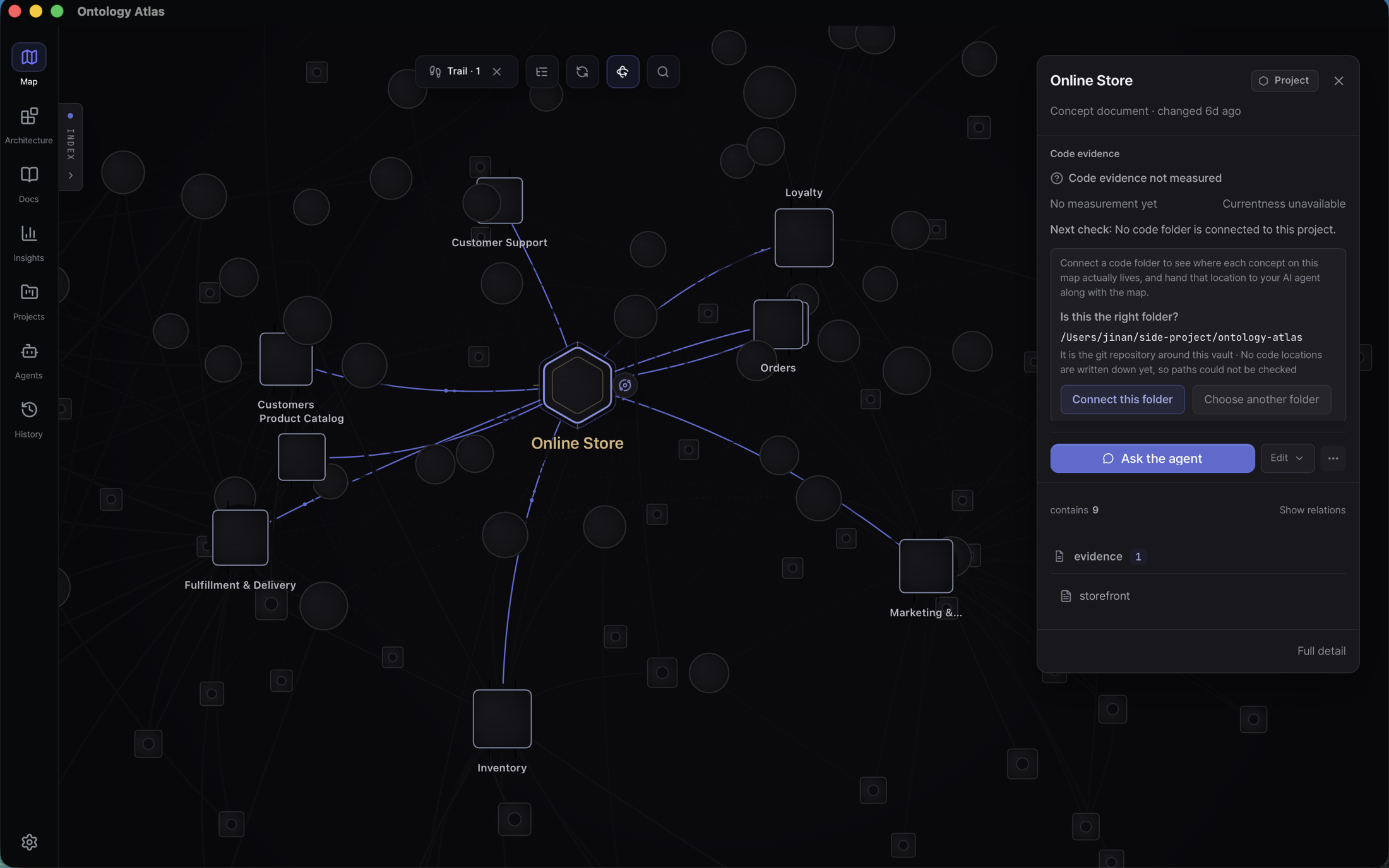
The installed macOS app reading
samples/storefront — an online
store described by Markdown files in a folder. Meaning changes remain visible
in files and Git diffs for a person to inspect, correct, reject, or keep; the
feature inventory is the current behavior
contract.
---
The optional companion is a device-local pixel mini-game powered by your project.
Recorded ontology concepts, resolved relations, implementation links, wiki pages,
and written detail contribute to character levels and skills as the folder updates.
Move with WASD, interact with E, and open inventory (I), skills (K), the expedition
map (M), your journal (J), quests (L), or the creature field guide (N) over the persistent world. The fox studies, rests,
and travels through 36 destinations across six fictional regions, meeting 108 original
creatures. Five-floor expeditions offer three-way blessings, an active dodge,
and a final guardian. A closer pixel combat floor keeps the fox and creature on
the same ground; a visible incoming strike gives Space dodge a timing cue.
The first destination also has a direct, top-down pixel sector. Choose **Explore on
foot** on the map, move with WASD or arrows, investigate with E, and scan with Q.
Meet Curio, follow a friendly signal mote, and read and reflect on a current
project concept to open the exit. Only this first sector has direct traversal;
the other destinations retain the existing automatic expedition loop. Sector
position and encounters save separately by project, while the evidence gate
rechecks that the saved reflection still names a current, uniquely resolved
concept rather than trusting an old clear.
Click or tap a creature to cast a ready knowledge wave; action slots show the
remaining cooldown turns, and Space moves the fox immediately during a warning.
Opening an in-game panel pauses combat until it closes; leaving the game still
uses bounded offline catch-up. Archive Grove, Clockglass Foundry, and Inkwell Marsh
have 54 region-specific dark pixel creatures, with a small overhead target mark and attack warning instead
of large rings across the floor.
Plan a rest, supply, or elite path for the next floor. Twelve
one-time quests reward recorded project work with materials for guaranteed personal
equipment enhancement. Ordinary activities can unlock every forge tier; verified
ACP work offers optional quests with explicit assistance requests. Quest completion
records activity, never meaning acceptance. At camp, learning expeditions (T) follow
a real concept's responsibility and boundaries, inspect a recorded direct dependency
in its declaring document, and save your own explanation or open question. Sources
remain readable inside the game; completion rechecks their saved identity and version.
Learning activity reuses the existing once-per-concept reading and reflection XP,
without certifying understanding. Topics with a saved field note open that note
directly, including its original date and any uncertainty. Re-exploration reads
the current evidence again; viewing a past note grants no additional XP. Project and reading XP unlock
destinations; combat XP does not. Optional auto retry continues while away, with at most
four hours of catch-up. A camp constellation shows the records you have built.
Original personal memories remain intact. Game progress does not judge correctness,
accepted meaning, or coding hours. ACP quest evidence uses current correlated write
receipts; it does not infer live agent status.
## In 30 seconds
When an agent finishes a change, you still need to judge what it understood,
which rules matter, and what needs your attention. File lists and the producing
agent's summary are starting points; they do not by themselves establish that
the system's meaning or boundaries were preserved.
Atlas keeps those answers in an `atlas/` folder of Markdown **inside the
repository**, so meaning is cloned, branched, and reviewed with the code. Each
file's frontmatter declares what it is — `project`, `domain`, `capability`,
`element`, or a linked `document` — and what it points at. That folder is the
whole database.
Atlas compiles that folder into a typed graph. Your coding agent can request
context for a task: recorded capabilities, implementation anchors, declared
dependencies, evidence, and unknowns. You can inspect those same records and
relations in the workbench, open their evidence, and decide which proposed
meaning changes to keep. The files remain available to the next person or
agent, alongside the code in Git.
The goal is understanding and actionable control, with confidence proportionate
to the evidence. A graph path is a declared relationship, not proof of a complete
runtime blast radius. A current source path does not prove its recorded meaning
is correct. Atlas keeps those distinctions visible so missing evidence can lead
to further inspection rather than automatic reassurance. Its five-kind
discriminator and standards boundary live in the
[vault specification](https://github.com/wlsdks/ontology-atlas/blob/HEAD/docs/ONTOLOGY-ATLAS-SPEC.md#2-the-five-authorable-node-kinds-and-reserved-reader-kind).
The Analysis tab opens with visible loading feedback before preparing its views.
In the Mac app, Automations owns recurring review schedules, with the next
run and latest result on each row. Ontology reviews are read-only; document rounds
retain their approved scope. Library → Check history shows document pass results
and links back to Automations to manage a schedule. See the [feature inventory](https://github.com/wlsdks/ontology-atlas/blob/HEAD/docs/FEATURES.md)
for the full execution and review boundaries.
## Use it in the next task
With a populated vault and an MCP connection, ask your agent for the context of
the change you want to make. The current task-aware entry is
`query_ontology` with `operation: "agent_brief"`, `detail: "compact"`, a selected
`project`, and your `task`. It supplies bounded context and follow-up reads;
the coding agent still inspects source and verifies its work.
When meaning changes, review the exact proposal and its evidence, then keep the
accepted Markdown change with the code's Git history. You need not open Atlas
for every task; its map, documents, and change review are there when you need
to understand or correct the recorded meaning. Meaning acceptance, code review,
merge, and deployment are separate decisions. Host support and configured
permissions determine how agent writes reach review; an MCP connection alone
does not enforce every agent's behavior.
**What still needs proof:** reliable meaning reconstruction from unfamiliar
legacy code, a complete task-bound Meaning Diff, and improved outcomes across
successive real tasks remain development and validation work. Current graph,
write-review, and task-context features do not guarantee that an agent's code
change is safe. See the [quality authority map](https://github.com/wlsdks/ontology-atlas/blob/HEAD/docs/ONTOLOGY-QUALITY.md) and
[development priorities](https://github.com/wlsdks/ontology-atlas/blob/HEAD/docs/BACKLOG.md).
## Status — read this before installing
The [download page](https://ontologyatlas.com/en/download/) is the release
authority: a generated record of the published tag, real asset sizes, checksums,
platforms, and signing state. This README pins no tag, so it cannot contradict
the files you are about to install.
[GitHub Releases](https://github.com/wlsdks/ontology-atlas/releases) is the
second direct source.
- **The unsigned Windows beta is a real risk, not a formality.** SmartScreen may
warn about an unknown publisher, and a managed work PC may refuse the installer
outright. [Security](https://github.com/wlsdks/ontology-atlas/blob/HEAD/SECURITY.md) states what is and is not promised.
- **Installing the desktop app installs the agent surface.** Both bundles carry
the compiled MCP server. There is no npm package; every other platform runs the
browser app, the CLI and MCP server from a source checkout, or the MCP server
as an `.mcpb` bundle or a container image ([channels](https://github.com/wlsdks/ontology-atlas/blob/HEAD/mcp/README.md#1-register-with-an-agent)).
- **Every release is a plain version, and the in-app updater takes only those.**
It reads a fixed Pages manifest staged from the newest published release, and
every archive must pass the bundled signature check before installation.
- **Screenshots demonstrate the product journey, not release availability.**
## Where it stands
Not a roadmap. This summarizes behavior documented in the
[feature inventory](https://github.com/wlsdks/ontology-atlas/blob/HEAD/docs/FEATURES.md), the
[specification](https://github.com/wlsdks/ontology-atlas/blob/HEAD/docs/ONTOLOGY-ATLAS-SPEC.md), and the
[decision history](https://github.com/wlsdks/ontology-atlas/blob/HEAD/docs/DECISIONS.md) and [independent record workflow](https://github.com/wlsdks/ontology-atlas/blob/HEAD/docs/records/README.md).
Each worktree adds its own decision/change/pilot fragments with `pnpm record:new`
and `pnpm po:record`. `pnpm test:records` checks composition and writer contracts.
Docs Vault JSON, public copies and the composed `messages/.json` are
ignored build products, materialized by installation and checkout/merge hooks;
use `pnpm docs-vault:build` and `pnpm messages:build` after an installation
with scripts disabled. Copy is edited in `messages//.json`.
**Working today**
- **A Markdown folder is the whole database** — read and written in place, with
no import step, no index to build, and no account.
- **The macOS app**, Developer ID signed and notarized, with the compiled MCP
server inside its bundle, and the hosted web app as a no-install gateway.
- **MCP over stdio** for Claude Code, Cursor, VS Code, Codex, and any other
client, typed and advertised through `tools/list`. [Agent guide](https://github.com/wlsdks/ontology-atlas/blob/HEAD/mcp/README.md).
- **One-button agent setup that ends in a real proof** — paths shown before
writing, then an agent restart and `mcp-verify`. File presence is never
presented as a live connection.
- **A CLI with the same authority as the agent** — scaffold, validate, dry-run
writes, traversal, blast radius, commit preflight, agent handoff.
[CLI reference](https://github.com/wlsdks/ontology-atlas/blob/HEAD/cli/README.md).
- **Every surface reads that one folder** — Map, Architecture, Library,
Insights, Projects, Agents, MCP, and Git History.
- **Saved constellations keep a task's concept set together** — name a set in
Galaxy, record its purpose, reopen the whole set on the map, inspect its real
members in Library, or recover the same read-only context through MCP and CLI.
- **Explore overlooked areas from a selected concept or Concept set** — the macOS
app previews the bound code folder, then gathers a few versioned local
observations with source excerpts, explicit unknowns and an editable investigation
packet. An absent graph edge or changed file is not accepted meaning.
- **Versioned AI analysis kept as local Markdown**, with its evidence and
selectable history, and measured violations instead of an invented
maintainability score. [Analysis records](https://github.com/wlsdks/ontology-atlas/blob/HEAD/docs/contracts/analysis-records.md).
- **Documents of any format gather in the Library**, kept byte for byte, with
wiki pages required to cite their source on every fact.
- **External MCP servers attach to the in-app chat** — one switch per server, off
by default, tokens only in the keychain. Atlas never sits in that path.
- **JSON-LD and GraphML export** off the same deterministic compile artifact, so
the vault opens in rdflib, Protégé, Gephi, Cytoscape, NetworkX, or Neo4j.
- **`init` installs the agent's procedures where the agent runs**, and prints the
one sentence to paste into your own `CLAUDE.md` or `AGENTS.md`. Atlas does not
edit files you wrote.
**Shipping, not settled**
- **Windows x64 is an intentionally unsigned public beta** — same folder and MCP
surface as macOS, no signature.
- **The vault format is v2.0-rc**, an RFC open for comment that documents
behavior already enforced by contract tests here and carries its own kill
criterion. [Specification §0](https://github.com/wlsdks/ontology-atlas/blob/HEAD/docs/ONTOLOGY-ATLAS-SPEC.md#0-rfc-status-and-feedback).
- **Linux has no packaged build** — the browser app or a source checkout, same
vault, fewer screens.
- **Web and desktop do not promise the same screens, and that is not a backlog.**
Git history and offline work are desktop capabilities; the web cannot run git
or native bridges.
What we decided *not* to build is [What this is not](#what-this-is-not).
## The journey
### 1. Open a folder
When several folders are known, the app opens a single list with **Open folder**
and **Create new** above it. The page stays fixed while the folder list scrolls;
folder rows keep their paths, last-use details, and recovery actions together.
At constrained sizes, optional guidance is available through a help dialog.
Choosing Map in the sidebar or with G M shows a live preparation scene,
then reveals the first drawn frame. Section tabs use a flat shared treatment with
a clear bottom selection indicator.
Point the app at a directory of Markdown and it reads it in place. Ask it to
start from your code instead, and it creates exactly one folder inside the
project you picked:
```text
your-repo/
├── src/
├── package.json
└── atlas/ ← the whole ontology, and nothing else
├── project.md one project document
├── domains/ what the product is made of
├── capabilities/ what each area can do
├── elements/ the implementation pieces they work with
├── architecture/ reviewed role and dependency profiles, when you have one
├── sources/ the documents around the code, kept exactly as they arrived
├── wiki/ one page written from those sources, each fact cited
└── .ontology-atlas/ gitignored, local only: bindings, audit log, activity
```
That location is a decision, not a default. A map kept outside the repository
travels on one laptop, and the change to the code lands in a pull request while
the change to its meaning does not. Inside, the two move together in one diff —
so **commit `atlas/`, push it, or copy it to another machine, and the map goes
with it.** The exact path is shown before anything is written, and an existing
`atlas/` is reused and reported rather than overwritten.
Every screenshot below reads [`samples/storefront`](https://github.com/wlsdks/ontology-atlas/blob/HEAD/samples/storefront), an
example folder in this repository; `node cli/src/index.mjs overview
samples/storefront` prints its current census.

**Library → Ontology** opens only the folder's explicitly typed `project`, `domain`,
`capability`, `element`, and `document` nodes without the canvas: preview or edit Markdown,
inspect the frontmatter that becomes the graph, follow backlinks, and jump back to the map.
There is no imported copy to synchronize. Sources, Wiki, Ontology, and Check history share one
Library destination. Ontology contains Concept documents and Concept sets. Concept sets lists saved
map selections, their purpose, and resolved ontology members; each member opens its actual
Ontology document and each set returns
to the whole saved set on the map. An existing `/docs/?slug=…` link to ordinary Markdown opens that exact file in a
single-document compatibility reader with a return to Library. The Ontology tree's name-and-path
search matches localized display names as well as canonical paths.
### 2. Connect your agent

**Agents** finds the coding tools already installed on this computer and opens a
conversation beside the map. **Models** holds what that conversation can call with
no coding tool at all: a local runner by address (Ollama, LM Studio, llama.cpp) or
your own API key kept in the Keychain, plus the count of every transfer recorded in
the folder. **MCP** holds the folder's own connection, the setup for each client,
and the Connectors that attach external servers to that conversation.
**Jev is an optional, experimental check in the macOS app.** Models keeps the
Keychain key and the manual claim check. In Library → Wiki, a person may also
check one cited claim against its current original passage. A blocking preview
shows the exact JSON and explains that it and the authentication key go to
TypeSafe only after Send. The result is advice; it never changes accepted
meaning or writes a file. The [Jev evidence-check guide](https://github.com/wlsdks/ontology-atlas/blob/HEAD/docs/guide/external-judgment.md)
describes both entries.

- **Connect once, with visible scope.** The flow names the folder and config it
will change, and writes plain text you can inspect. Claude Code, Codex, Cursor
and Antigravity get one button each; any other client uses the snippet.
- **Then prove it from the agent's folder.** `mcp-verify` starts the bundled
server, reads the active vault, and reports the real result or failure.
- **The conversation does not stop at the first map.** Up to three next steps
derived from the current vault appear under a completed answer; choosing one
fills the composer for review and never sends or writes on its own.
- **Nothing stays running.** The server speaks stdio, opens no port, and makes no
network request ([Security](https://github.com/wlsdks/ontology-atlas/blob/HEAD/SECURITY.md)).
### 3. Read the map

Selecting a node dims everything unrelated and opens its record without hiding
the node behind the inspector — a visual hierarchy for a person and typed
parents, evidence and actions for an agent, from the same fact. Recent changes
can narrow the map while keeping project and domain context, and Footprints
record the order in which you opened concepts.

Four views keep their questions explicit: **Flat** is the normal 2D map and
**Galaxy** turns every real concept into a stable three-arm sky: the project is
the core, domains anchor contiguous constellations, and their owned concepts
form nearby star clouds. Its default overview hides the relationship mesh so
the groups read first; pointing at or selecting a star reveals only its actual
adjacent relations as luminous filaments. Each star flares on its own intermittent
cadence while its steady brightness still derives from connection count, never
live activity.
Diffuse gas flows gently inside the fixed arms while the stars and their spatial
neighborhoods stay anchored; reduced motion freezes the whole atmosphere.
**Strata** separates kind tiers onto lit, translucent planes, each domain
owning a band of the floors below it, and **Neural** gathers related concepts
around their domains in three dimensions. In both, evidence is light: a concept
whose cited code is current glows, a stale one dims behind an amber ring, and
one the app could not date stays dark behind a dashed ring. A click selects; a
double-click flies to the concept and Esc flies back. Keyboard focus remains visible while following related concepts,
and Fit provides an explicit overview return on touch screens too. Inspecting a
Galaxy concept keeps the expanded constellation in place and smoothly approaches
the selected star in the free canvas beside the inspector, without zooming out a
closer view. Closing restores the prior camera unless you navigated meanwhile.
Every 3D view uses shallow, bounded relation
curves shared by rendering and picking. Changing the view never changes the graph.
### 4. Gather and read documents in the Library

A codebase's meaning is rarely only in the codebase. The plan, the spreadsheet,
the handover note, the page somebody wrote on a wiki — the Library keeps those
exactly as they arrived, under `sources/`, and nothing is parsed on arrival. Each
row carries only what a folder listing can say: format, byte size, and whether it
has been written up. Open one and Atlas says so in as many words — it has never
read the file, and the hash it shows exists because a page claimed the source.
What is written *from* them is the other half, and the counts stay honest about
it: two of these three are **not written up yet**, and the folder says so rather
than presenting one page as coverage. A wiki page cites its source on every fact,
from the same template whether a person or the in-app agent writes it, and
`wiki-validate` names the lines that do not carry a citation rather than grading
the page. **Compile** starts one conversation that reads the sources and writes
the page; the traffic goes from your coding agent straight to its own provider,
which the screen states instead of implying that Atlas sits in the middle.
Markdown source headings open their original cited lines inside Library, including the surrounding passage. No converted file is stored.
**Library → Wiki opens on a question desk.** A question searches Wiki claims and
original passages locally when you press **Find evidence**. Each candidate opens
its page or exact source address; a compact search summary opens the full
coverage and omitted-file detail in one action, and
a matching source hash is not presented as proof that a claim is true. The
existing page browser remains one action away. An attached ACP agent can use
the candidates as leads, re-read originals, and answer with citations; an Ask
turn does not automatically approve Wiki writes. Search and source inspection
work without Jev or an agent. **Summarize as report** explicitly asks ACP to
re-read the originals and organize an answer, cited evidence, disagreements,
and unknowns in a report before the expandable search leads. Local word matching
can miss a question phrased in another language; ACP can still read the originals
on that explicit request. The result is an unreviewed draft, not a
Wiki page until you file it. Its editorial document template can be downloaded
as Markdown or opened in the app's Print dialog to save as PDF; both retain the
question, citations, search coverage, and limits.
Creating a Wiki page opens a centered, background-blocking dialog that previews its live `wiki/.md` path, Markdown draft state, and five required section headings before any write. The current local-work receipt stays visible while earlier receipts remain under History. A successful app write produces one actionable notification; the folder watcher suppresses its matching duplicate.
Library also works without code or ontology nodes. Keep a question and its cited
answer, inspect source changes, request an updated draft through Claude Code or
Codex ACP, and compare before saving a new revision. Earlier answers remain
available. Local Compile has its own read and approval path. See
[retained answers](https://github.com/wlsdks/ontology-atlas/blob/HEAD/docs/contracts/retained-answers.md).
Galaxy can also save the current ontology-node selection as a named constellation
with a purpose. Atlas stores that compatible `v1` task scope in the selected vault,
uses immutable node UIDs for membership, and keeps the manifest's exact
`document.path` only as display context. Library → Ontology → Concept sets shows resolved and
unresolved members without turning membership into an ontology relation. Use
`ontology-atlas constellations [vault]` or
`ontology-atlas constellation [vault]` when an agent session cannot attach
MCP; MCP exposes the equivalent
read-only `list_constellations` and `get_constellation` tools.
The source workbench also offers task-bound ontology review: summary, comparison
and full request details, with separate meaning acceptance and write permission.
You can request a correction without losing a draft or defer a live request and
resume it. Missing or changed comparison evidence stays explicit.
For supported single-document patches in the installed app, exact Markdown
previews and saved meaning decisions can be reopened from the existing History
tab. Writer readback, code checks, merge and deployment remain separate facts.
[Supported scope and limits](https://github.com/wlsdks/ontology-atlas/blob/HEAD/docs/contracts/task-meaning-review.md).
### 5. Plan against reviewed architecture

This screen reads Atlas's own repository rather than the storefront
example, because measured import traffic needs a connected code folder.
Architecture stays separate from the map. It sets what a person reviewed beside
what an agent observed in the code, one role per row, with the difference in the
middle; every stroke states its own sentence, and the same profile always draws
the same picture. **Findings & history** keeps every inspection receipt. Pattern
names such as Feature-Sliced Design, Hexagonal or Clean Architecture are reviewed
declarations: conformance is derived from source evidence, never inferred from
folder names.
### 6. Review a relation beside its node

Atlas shows a directional preview on the map, then a compact review of the
source, type, target, reason, and exact frontmatter fields. **Confirm and write**
is the only point that changes the file.
### 7. Review the change, then record it

Whatever wrote — you, the map editor, the CLI, or an agent over MCP — lands here
first as a diff you read before it becomes history. Above is the change confirmed
in step 6: two frontmatter lines, still unsaved. Git is scoped to the vault, and
files outside the folder you picked are never touched.
The CLI writes the same two lines, says what it would do before touching a file,
and refuses a dependency nobody explained (`$ATLAS` is the entrypoint set in
[Running from source](#running-from-source)):
```console
$ node $ATLAS relate capabilities/order-cancel capabilities/refund dependencies ./storefront --dry-run \
--why "Cancelling a paid order has to give the money back, so cancellation cannot finish without refund processing."
capabilities/order-cancel --dependencies--> capabilities/refund
verdict matches_existing_schema · exists no
schema capability --dependencies--> capability
pattern count 53 · resolved 53 · external 0 · unresolved 0
recommendation safe_to_add · No exact or inverse edge found; capability --dependencies--> capability is an existing schema pattern.
dry-run would write dependencies on capabilities/order-cancel → capabilities/refund (no file changed)
```
Drop the `--why` and it stops rather than guessing one. An edge in a shape the
vault has never used comes back as `new_schema_pattern · review_new_schema`, so a
drifting agent is visible before it writes.
### 8. Keep it healthy

Insights opens on a Brief across concepts, wiki pages, guidance and agent activity.
Choose a subject to inspect its evidence. When Wiki or Guidance cannot yet show
measurements, distinct examples explain source-to-page checks or guidance across
code areas. Select an example to reveal the required setup and its Library or
Harness destination; examples never count as your data or create files.
The Concepts subject shows the folder's measurements and maintenance questions.
**Do next** is one row per kind of finding, and the counts add up to the title,
always. Where a missing back-link can be repaired from two facts already on disk,
one sheet names each file it would touch and nothing is written until you apply.
**Growth** replays the folder's own Git history week by week and stores nothing —
the numbers are recomputed from commits each time the tab opens. A folder with no
commits is told there is no history to show rather than drawn as a row of zeroes,
because a zero would claim the folder was empty.
### 9. Choose a project by its purpose
The project index stays compact: each row shows the project name, its explicitly
authored one-line description, a recent update, and direct routes to details and
the map. Composition and construction controls remain on the project detail page.
## What your agent gets
Ask which recorded dependencies deserve inspection for a change. Atlas follows
declared relationships; their presence alone does not establish human approval
or complete runtime impact:
```console
$ node $ATLAS blast-radius capabilities/mcp-tool-server docs/ontology --depth 2
capabilities/mcp-tool-server — blast radius (depth 2, incoming)
risk unknown · 1 node · 1 relation · 0 cross-domain
impact certainty unknown · declared 1 · rationale 0 · source-backed 0
Counts below follow declared depends_on only. Use reachability/subgraph for structure;
do not read unknown as low risk.
```
- **Focused context, not a repository dump.** A brief carries the project,
domain, evidence, impact boundary, first tools, and stop conditions; for a task
that only reads, `OATLAS_READ_ONLY=1` returns one compact batch.
- **Typed answers.** Paths and reachability explain structure, blast radius
follows declared dependencies only. No graph database, no hosted memory.
- **Writes that survive review.** Analysis is side-effect free by default,
destructive operations dry-run first, renames repair backlinks, and mtime guards
protect concurrent human edits.
The CLI carries the same authority for sessions that cannot attach a connector:
[MCP guide](https://github.com/wlsdks/ontology-atlas/blob/HEAD/mcp/README.md) · [CLI reference](https://github.com/wlsdks/ontology-atlas/blob/HEAD/cli/README.md).
## What we measured, and the mistake we found in it
A paired benchmark gives two sides the same source and question — one with a
prepared vault, one with nothing. The first run looked like a large win, 0.25
against 0.875, until re-scoring showed most of that gap was not a comparison: the
answer key mostly required Atlas's own concept names, which exist only inside the
vault. We had published, in part, a vocabulary test that only one side could sit.
| Subject | The part **both sides** could earn | The part **only Atlas** could earn | What we published before |
|---|---|---|---|
| Greenfield fixture | 0.75 → 1.00 | 0 → 0.83 | 0.25 → 0.875 |
| Brownfield fixture | 0.75 → 1.00 | 0 → 0.57 | 0.28 → 0.74 |
Each cell reads *without Atlas → with Atlas*. The control side named 100% of the
source files it should have named in every run, and the gap left over rests on one
word: the key wanted *excludes*, and an answer saying *"explicitly outside it"*
scored zero.
**So the honest status is that we have not yet measured a difference in answer
quality**, and Atlas was slower — a median of 17 and 33 seconds here, 28.2 and
51.1 in a separate run that carried one change through code, tests, commit, merge
and cleanup on both sides. What it does show is narrower: only the Atlas side
returned names you can look something up by. `capabilities/checkout` is an address
a person or an agent can resolve next session, in another tool, months from now;
"the checkout feature" is not. The re-scoring found a bug on our side too — the
Atlas run dropped its own concept names in a third of the harder cases. Blind
human grading is next; a stronger claim waits on unfamiliar repositories, that
grading, and the measured cost of maintaining a vault. Method and every raw
answer:
[paired findings](https://github.com/wlsdks/ontology-atlas/blob/HEAD/docs/benchmark/FINDINGS-2026-08-31.md) ·
[the correction](https://github.com/wlsdks/ontology-atlas/blob/HEAD/docs/benchmark/FINDINGS-2026-08-31-metric-split.md) ·
[change-flow run](https://github.com/wlsdks/ontology-atlas/blob/HEAD/docs/benchmark/FINDINGS-2026-08-31-change-flow.md) ·
[benchmark log](https://github.com/wlsdks/ontology-atlas/blob/HEAD/docs/benchmark/README.md).
## Why not just use a notes tool
Local Markdown, git diffs, and MCP are table stakes; notes tools such as
[Basic Memory](https://github.com/basicmachines-co/basic-memory) already provide
them. Atlas adds a product ontology and a workbench where people and agents judge
the same facts. If you only need an agent to remember conversations, a notes tool
is lighter.
| | Notes with MCP | Hosted graph memory | Ontology Atlas |
|---|---|---|---|
| Store | Markdown you own | Vendor database | Markdown you own |
| Structure | Freeform notes and links | Vendor-defined types | Project → domain → capability → element, documents, typed relations |
| Graph questions | Note traversal | Graph engine | Blast radius, reachability, cycles, paths, centrality, health |
| Evidence from code | Hand-authored | Corpus ingestion | Bounded read-only proposals; nothing lands until approval |
| Human surface | Notes app | Vendor console | Local Map, Architecture, Library, Insights, Projects, Agents, MCP, History |
The argument and its sources are in [Foundations](https://github.com/wlsdks/ontology-atlas/blob/HEAD/docs/FOUNDATIONS.md).
---
## A vault is just files
Everything below is the contract rather than the tour: how the folder is stored,
what Atlas will never do, and how to run and verify it from source.
One Markdown file is one node. Frontmatter is the machine-readable record; the
body is the explanation a person judges.
```yaml
---
uid: 71890f3e-7b5d-4c0a-8f14-123456789abc # permanent identity, kept through renames
slug: capabilities/token-issue
kind: capability
title: Token issue
domain: domains/auth
path: src/auth/token-service.ts # a path — code evidence
elements:
- elements/jwt-signer # a slug — an implementation-role node
dependencies:
- capabilities/session-refresh # a slug — another node
---
Issues access and refresh tokens for authenticated users.
```
**A path points at code; a slug points at a node.** Mixing them is the most
common first mistake, and `node $ATLAS validate` reports it as a dangling
reference. `uid` is the permanent identity, minted once and kept through a
rename; the slug is the readable current address; a source location belongs in
`path:`, never in a slug. Relations sit on the declaring file the same way, one
frontmatter line from which Atlas derives the edge and its backlink —
`dependencies` directed, `relates` symmetric, so the map never turns similarity
into causality.
The reading spine is small on purpose — `project → domain → capability →
element`, with `document` describing concepts anywhere on it — and an artifact
earns a node only when it helps someone understand a capability, trace impact, or
run the right proof. Curated, not exhaustive. There is **no cap on how many nodes
a vault holds**: a wide hub is a review signal, not a limit, an analyzer's packet
bound keeps one proposal readable and is never a graph bound, a bridge node has
to earn its layer, and an external field trial's ontology is never merged into
this product's vault. Each rule's authority is the
[quality authority map](https://github.com/wlsdks/ontology-atlas/blob/HEAD/docs/ONTOLOGY-QUALITY.md), and the practical test is
[what becomes a node?](https://github.com/wlsdks/ontology-atlas/blob/HEAD/docs/guide/what-becomes-a-node.md).
Three kinds of file share the folder, and only one is the graph:
| Kind | Where | What makes it that | In the graph? |
|---|---|---|---|
| Raw source | `sources/**` | any format, kept exactly as it arrived | no — only `.md` reaches the parser |
| Wiki page | `wiki/**.md` | Markdown with **no `kind:`** | no — `kind:` is what makes a node |
| Ontology node | anywhere else | `kind:` in frontmatter | yes, and only these |
Inside `wiki/`, `_template.md` is the shape every page is held to and `_log.md`
records each compile or check; `_`-prefixed files are furniture, not pages. The
folder is always named `atlas/` ([step 1](#1-open-a-folder)), fixed so a teammate
can say it and an agent's config can point at it without guessing, and
`init --documents` writes the same folder without the node starters for people who
have documents and no code. Full contracts: the
[relations guide](https://github.com/wlsdks/ontology-atlas/blob/HEAD/docs/guide/relations.md) and the
[vault specification](https://github.com/wlsdks/ontology-atlas/blob/HEAD/docs/ONTOLOGY-ATLAS-SPEC.md).
## Local-first, by construction
- **Your disk is the database.** Frontmatter is the graph, confirmed writes go
back to the folder you picked, and Git is the history. There is no other store.
- **No Atlas backend, account, or telemetry.** The web app is a static export; the
desktop app checks the public updater manifest once a day and uploads no vault
content. A connected coding agent talks to its own provider only when you ask;
a model key or the optional Jev check sends only what you press send on, and
each transfer is a line in the folder's `.ontology-atlas/llm-audit.jsonl`.
- **Two ways in, one folder.** The hosted web app can open a local folder through
the File System Access API. The desktop app uses a Tauri bridge to your selected
folder and keeps it open as a workspace.
- **The Tauri macOS shell is a shell, not a silo.** MCP and CLI still read the
selected folder directly, and the bundled server is a file your agent launches
itself, so it keeps working when the app is closed.
## What this is not
- **Not a general-purpose ontology editor.** The ontology describes a codebase; a
business concept belongs there when it explains what that codebase builds, why a
boundary exists, or what a change can affect. The Library takes general sources
and wiki pages with no code nodes at all.
- **Not a code index, and not an IDE.** Grep, language servers, AST indexes and
CodeGraph answer where a symbol lives and what calls it; Atlas replaces none of
them and answers why that artifact matters, which capability it serves, and what
to verify before changing it. An IDE for codebase *meaning* is the useful
analogy, and it stops there: Atlas does not edit, build, run, or debug code.
- **No automatic acceptance of generated knowledge.** Saving a wiki page or answer
preserves it for review; it does not make its claims true or promote it into
accepted ontology meaning.
- **Not an RDF, OWL, SKOS, or SHACL implementation.** The export is a bounded
graph shape; the vault is not an RDF serialization, the validator is not a SHACL
processor, and the query engine is not a reasoner. A persisted relation is a
declared claim, never an entailment; an absent one is a visible gap, never a
negative fact. [Specification §5.2](https://github.com/wlsdks/ontology-atlas/blob/HEAD/docs/ONTOLOGY-ATLAS-SPEC.md#52-standards-boundary).
- **Not a service, and not on npm.** No backend, account, telemetry, daemon, or
port; `npx ontology-atlas` is a 404 and not a future feature. The MCP server
still reaches the ecosystem's registries as a release bundle or a container
image, neither of which is a package registry.
- **Not extensible by running other people's code.** There will be no third-party
plugin runtime. Extension happens through MCP tools, agent skills, and files in
your own vault — things a `git diff` shows you before they run.
- **Still evolving.** The [download page](https://ontologyatlas.com/en/download/)
records current release availability and platform status.
## Running from source
Linux and every other platform without a packaged build run the browser app, or
the CLI and MCP server from a source checkout: Node.js 24 and pnpm, one clone
outside the project you are describing, then `init` inside your own repository
and `mcp-verify` to prove the live connection. The exact commands, the two
required installs, and the reason `init` refuses to run inside the Atlas clone
are in [set up from a source checkout](https://github.com/wlsdks/ontology-atlas/blob/HEAD/cli/README.md#set-up-from-a-source-checkout).
## Documentation
**Use it:** [hosted guide](https://ontologyatlas.com/en/guide/) ·
[features](https://github.com/wlsdks/ontology-atlas/blob/HEAD/docs/FEATURES.md) · [MCP setup](https://github.com/wlsdks/ontology-atlas/blob/HEAD/mcp/README.md) ·
[CLI reference](https://github.com/wlsdks/ontology-atlas/blob/HEAD/cli/README.md)
**Model a vault:** [what becomes a node?](https://github.com/wlsdks/ontology-atlas/blob/HEAD/docs/guide/what-becomes-a-node.md) ·
[relations](https://github.com/wlsdks/ontology-atlas/blob/HEAD/docs/guide/relations.md) ·
[v2 specification](https://github.com/wlsdks/ontology-atlas/blob/HEAD/docs/ONTOLOGY-ATLAS-SPEC.md) ·
[quality authority map](https://github.com/wlsdks/ontology-atlas/blob/HEAD/docs/ONTOLOGY-QUALITY.md)
**Understand it:** [product direction](https://github.com/wlsdks/ontology-atlas/blob/HEAD/docs/PRODUCT-DIRECTION.md) ·
[foundations](https://github.com/wlsdks/ontology-atlas/blob/HEAD/docs/FOUNDATIONS.md) · [architecture](https://github.com/wlsdks/ontology-atlas/blob/HEAD/docs/ARCHITECTURE.md) ·
[security](https://github.com/wlsdks/ontology-atlas/blob/HEAD/SECURITY.md) · [decisions](https://github.com/wlsdks/ontology-atlas/blob/HEAD/docs/DECISIONS.md)
## Contributing
Issues and pull requests are welcome, and the most valuable report today is
pointing Atlas at a real repository and showing where the proposed meaning, the
agent handoff, or the validation falls short.
Read [CONTRIBUTING.md](https://github.com/wlsdks/ontology-atlas/blob/HEAD/CONTRIBUTING.md) first — external pull requests come from
forks, and that is a security boundary rather than a formality. Inside this
repository [AGENTS.md](https://github.com/wlsdks/ontology-atlas/blob/HEAD/AGENTS.md) is canonical for people and agents alike, and
product decisions route through `pnpm po:route -- --help` from change facts
rather than a self-declared risk.
Start with `pnpm checks:changed -- --run`: it picks the focused gates for the
files you changed, runs every recommendation, and stops at the first failure.
Open pull requests as drafts and land them with `pnpm pr:land `, which
queues them for a landing train: up to 20 queued pull requests merge behind one
CI run, and a red train is bisected
([details](https://github.com/wlsdks/ontology-atlas/blob/HEAD/docs/DEVELOPMENT-CHECKS.md)). A pull request already green on its own
head and disjoint from `main` merges at once on the fast path. Branches that must
be resolved together land through `/land-bundle` as one integration branch.
| Command | What it answers |
|---|---|
| `pnpm agents:check` | Each harness's instruction integrity; independent Codex and Claude files need not match |
| `pnpm backlog` · `pnpm backlog:check` | Current task records and concurrent-state conflicts; append a UUID record per worktree observation ([guide](https://github.com/wlsdks/ontology-atlas/blob/HEAD/docs/BACKLOG.md)) |
| `pnpm bundle:plan` · `pnpm bundle:prune` | Land several branches as one: plan the merge (which carry work, shared files, trial conflicts) and afterwards prune the component branches main provably contains. See `/land-bundle` |
| `pnpm checks:changed` | Which gates this change actually needs |
| `pnpm conflicts:scan` | Which open pull requests (and `-- --match=` local branches) change the same files as this branch, and whether a trial merge with each conflicts; read-only, one `gh` call |
| `pnpm decisions:find ` · `pnpm decisions:check` | The decision record to cite or overturn, and whether this change owes one |
| `pnpm doc:new -- --type= --area= --slug=` | A new living document from its template in `docs/.templates/`, at the path its kind decides |
| `pnpm docs:check` | Docs gates, including `pnpm docs:language`, `pnpm source:language`, `pnpm changelog:check`, `pnpm dev-checks:check`, `pnpm docs:meta` |
| `pnpm docs:meta` · `pnpm doc:history -- ` | Whether every living document carries its kind, status and area with pointers that resolve; one document's commits across moves, which is its version |
| `pnpm docs:move` | Moves the documents listed in `docs/.moved.json` and rewrites every reference; rerun it after merging main into an older branch (`-- --check` only reports) |
| `pnpm e2e:durations -- ` | Rewrites the per-file weights that balance the browser shards from downloaded `playwright-timings-*` reports |
| `pnpm e2e:sleeps:check` | A change may not add a fixed `waitForTimeout` to an e2e spec unless a `// measurement window:` note says why |
| `pnpm gates:yield -- --runs=200` | Which CI checks ever failed, per distinct run, from the lane reports `checks.yml` uploads (cached in `~/.cache/atlas-gate-yield`); a row with 50+ runs, no failed run and 60+ days of history reads `no CI failure`, a check to examine rather than delete, since pre-push and `pnpm checks:changed` catches are not in this data. Reports start with the change that added them |
| `pnpm gateway:capture -- --base-url=` | Re-shoots the six app screens the download page shows, Korean and English (`public/gateway/..png`), from a served `pnpm build`, against this repository's own ontology |
| `pnpm knip` | Dead files, exports and types across every scope |
| `pnpm lessons` · `pnpm lessons:check` | Shared harness lessons that are open or verified but not yet fixed; record and review them with `/harness-retro` ([records guide](https://github.com/wlsdks/ontology-atlas/blob/HEAD/docs/records/README.md#harness-lessons)) |
| `pnpm messages:build` · `pnpm messages:check` · `pnpm messages:adopt` | Compose the ignored `messages/.json` from one file per namespace (`messages//.json`), prove it current, and carry a pre-split branch's catalogue edits onto the parts while merging main |
| `pnpm perf:mcp:memory` · `pnpm perf:mcp:memory:check` | Whether the MCP server keeps memory it should release: heap after two forced collections across 50 repeated calls per tool and across moved Git HEADs, on a generated vault; about a minute, kept out of pre-push |
| `pnpm pr:ci ` | Fire CI on a draft now, so a green, disjoint change can take the fast path |
| `pnpm pr:land --plan ` · `pnpm pr:land --conduct` | Dry-run what a landing would do without writing to GitHub, and run trains until the queue is empty |
| `pnpm pr:land ` · `pnpm pr:queue` | Queue a pull request for the landing train (or merge it on the fast path), and show the queue and the train in flight |
| `pnpm typecheck` | Types across every file, with Next's generated route and page types, so the browser build need not check them again |
Rows stay sorted by command, and the reference's entries by area, so two
branches that each add one land on different lines; `pnpm dev-checks:check`
names the line to move and `-- --fix` sorts both.
[Development checks](https://github.com/wlsdks/ontology-atlas/blob/HEAD/docs/DEVELOPMENT-CHECKS.md) is the full gate reference, one
entry per area; [map testability](https://github.com/wlsdks/ontology-atlas/blob/HEAD/docs/engineering/map-testability.md) owns canvas
performance, readability, contrast, and instrumentation.
## License
[MIT](https://github.com/wlsdks/ontology-atlas/blob/HEAD/LICENSE)





