# Native DevTools
**Category:** 💻 Developer Tools
**Repository:** https://github.com/sh3ll3x3c/native-devtools-mcp
**Views:** 0
**Installs:** 0
**Upvotes:** 0
**Directory Page:** https://allmcps.com/mcp/native-devtools
## Description
MCP server for desktop, browser (CDP), and Android automation. Screenshot, OCR, click, type.
## Claude Desktop Quick Installation
Heuristic fallback — verify the package name and runner against the repository README before running it. Uses `npx` (confidence: low):
```json
"mcpServers": {
"native-devtools": {
"command": "npx",
"args": ["-y","native-devtools"]
}
}
```
## Documentation & README
# native-devtools-mcp
> **An MCP server for computer use on native desktop and mobile apps — macOS, Windows, Android, and Chrome/Electron via CDP.**




**Add to your client in one click:**
[](cursor://anysphere.cursor-deeplink/mcp/install?name=native-devtools&config=eyJjb21tYW5kIjogIm5weCIsICJhcmdzIjogWyIteSIsICJuYXRpdmUtZGV2dG9vbHMtbWNwIl19)
[](https://insiders.vscode.dev/redirect/mcp/install?name=native-devtools&config=%7B%22name%22%3A%20%22native-devtools%22%2C%20%22command%22%3A%20%22npx%22%2C%20%22args%22%3A%20%5B%22-y%22%2C%20%22native-devtools-mcp%22%5D%7D)
**Claude Code:** `claude mcp add native-devtools -- npx -y native-devtools-mcp`
`native-devtools-mcp` gives AI agents and MCP clients direct control over native desktop apps, Chrome/Electron browsers, and Android devices — screenshots, OCR, accessibility-first element lookup, input simulation, window management, Chrome DevTools Protocol (CDP), and ADB — all in one local server. Works with [Claude Desktop](https://claude.ai/download), [Claude Code](https://docs.anthropic.com/en/docs/claude-code), [Cursor](https://cursor.com), and other MCP-compatible clients.
## Quickstart
```bash
npx -y native-devtools-mcp
```
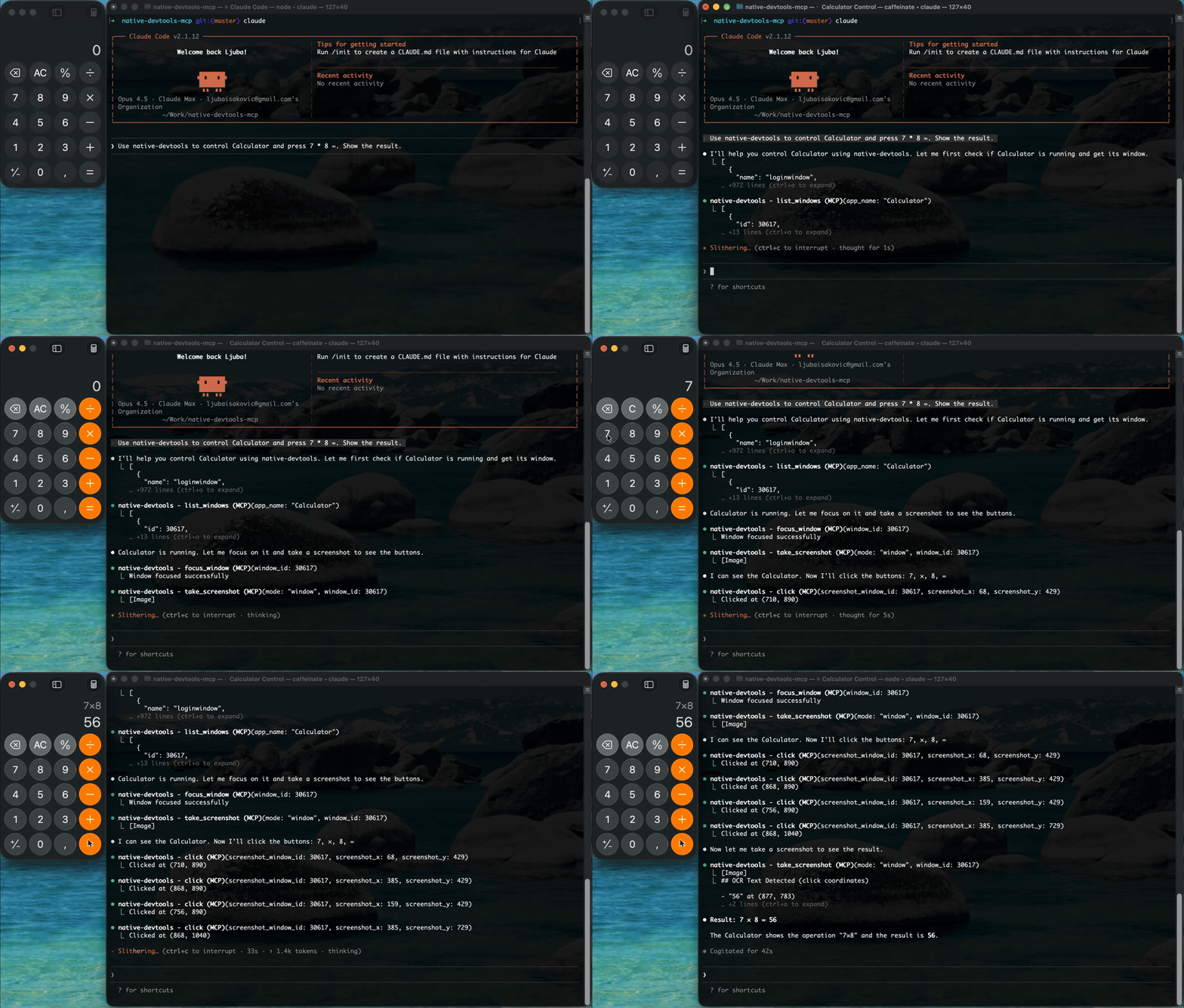
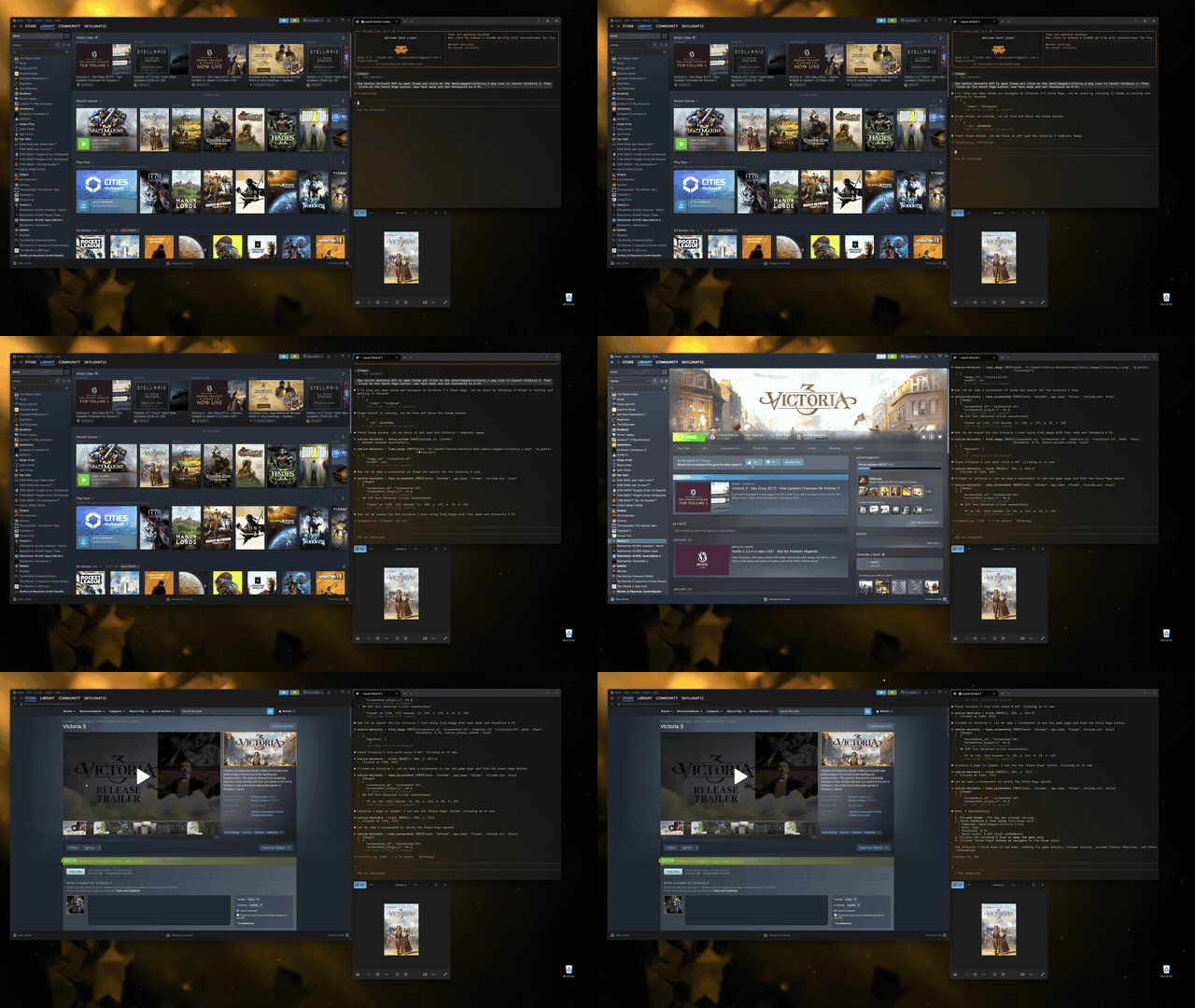
macOS Windows
---
## 🚀 Features
- **👀 Computer Vision:** Screenshots of screens, windows, or regions with built-in OCR (Vision on macOS, Windows Media OCR on Windows).
- **🖱️ Input Simulation:** Click, drag, scroll, type — global coordinates, window-relative, and screenshot-relative targeting.
- **🎯 Element-Precise AX Dispatch (macOS):** `take_ax_snapshot` → `ax_click` / `ax_set_value` / `ax_select` — dispatch against Accessibility-tree elements without moving the mouse or stealing focus. The preferred path for native macOS apps.
- **🌐 Browser Automation (CDP):** Chrome DevTools Protocol for Chrome and Electron apps (Signal, Discord, VS Code, Slack) — DOM-level click, fill, navigate, and JS evaluation without a separate Node.js server.
- **📱 Android (ADB):** Screenshots, uiautomator-based text lookup, input, and app management over USB or Wi-Fi.
- **🧩 Template Matching:** `load_image` + `find_image` for icons, toggles, and custom controls OCR can't identify.
- **🪟 Window Management:** List, focus, launch, and quit apps; record windows as timestamped JPEG frames.
- **🔍 Hover Tracking:** Observe user navigation patterns with dwell-filtered hover events — designed for LLMs watching a user work.
- **🔒 Local & Private:** 100% local execution. Screenshots and input never leave your machine.
## 🧭 Three Approaches to Interaction
Pick the approach that matches your target app.
| Approach | Best for | Key tools |
|-----------------------|--------------------------------------------------------------------------|-------------------------------------------------------------------------|
| **Visual** (universal)| Any app — games, Qt, custom renderers, anything without an AX tree | `take_screenshot`, `find_text`, `click`, `type_text`, `find_image` |
| **AX Dispatch** (macOS — *preferred for native macOS apps*) | AppKit / SwiftUI apps — System Settings, Finder, Mail, Xcode, Notes | `take_ax_snapshot`, `ax_click`, `ax_set_value`, `ax_select` |
| **CDP** (Chrome / Electron) | Web content, Electron apps with `--remote-debugging-port` | `cdp_connect`, `cdp_find_elements`, `cdp_take_dom_snapshot`, `cdp_click`, `cdp_fill` |
> For macOS native apps, **AX Dispatch is the preferred path** — it's element-precise, doesn't move the mouse, and doesn't steal focus. See the [Native App AX Dispatch recipe](https://github.com/sh3ll3x3c/native-devtools-mcp/blob/HEAD/examples/native-app-ax-dispatch-flow.md).
There's also a fourth, niche path: **AppDebugKit** (`app_connect` / `app_query` / `app_click`) for apps instrumented with the AppDebugKit library. Mostly useful for developers testing their own apps.
## 🆚 How it compares
The most honest peers are other **MCP servers for computer use**. This table compares `native-devtools-mcp` against the leading MCP servers and two widely used non-MCP libraries.
| Capability | native-devtools-mcp | [Playwright MCP][pw-mcp] | [Windows-MCP][win-mcp] | [Appium][appium] | [pywinauto][pwa] |
|--------------------------------|:-------------------:|:------------------------:|:----------------------:|:----------------:|:----------------:|
| Native macOS apps | ✅ AX + screenshots | ❌ browser only | ❌ Windows only | ❌ mobile focus | ❌ Windows only |
| Native Windows apps | ✅ UIA + input | ❌ browser only | ✅ | ◐ limited | ✅ |
| Web / DOM automation | ✅ via CDP | ✅ | ◐ via Windows UIA | ◐ mobile-web | ❌ |
| Electron apps | ✅ CDP + AX | ✅ first-class `_electron`| ◐ if UIA exposed | ❌ | ◐ if UIA exposed |
| Android devices (ADB) | ✅ built-in | ◐ experimental | ❌ | ✅ first-class | ❌ |
| MCP-native | ✅ | ✅ | ✅ | ❌ | ❌ |
| Local, no API key | ✅ | ✅ | ✅ | ✅ self-hosted | ✅ |
[pw-mcp]: https://github.com/microsoft/playwright-mcp
[win-mcp]: https://github.com/CursorTouch/Windows-MCP
[appium]: https://github.com/appium/appium
[pwa]: https://github.com/pywinauto/pywinauto
**Where `native-devtools-mcp` stands out:** one local MCP server covering macOS + Windows + Chrome/Electron (CDP) + Android in the same session, plus element-precise macOS AX dispatch that doesn't move the cursor or steal focus.
**Honest limits:**
- **No Linux** (contributions welcome — see [Linux Desktop MCP](https://github.com/BeckhamLabsLLC/linux-desktop-mcp) for an AT-SPI2-based alternative in the meantime)
- **Browser automation is Chrome / Electron only** via CDP — no Firefox, no WebKit (for those, use [Playwright MCP][pw-mcp])
- **Headed only** — depends on real-machine permissions; not a headless CI test grid
- **No iOS**
If you need *just* web automation, [Playwright MCP][pw-mcp] is more mature. If you need *just* mobile (iOS + Android + deep device features), [Appium][appium] is more mature. This server is for the cross-cutting native-desktop + Chrome/Electron + Android case.
## 📦 Installation
The install steps are identical on macOS and Windows.
### Option 1: Run with `npx` (no install needed)
```bash
npx -y native-devtools-mcp
```
### Option 2: Global install
```bash
npm install -g native-devtools-mcp
```
### Option 3: Build from source (Rust)
Click to expand build instructions
**Using the build script** (clones, builds, and runs setup):
```bash
curl -fsSL https://raw.githubusercontent.com/sh3ll3x3c/native-devtools-mcp/master/scripts/build-from-source.sh | bash
```
**Or manually:**
```bash
git clone https://github.com/sh3ll3x3c/native-devtools-mcp
cd native-devtools-mcp
cargo build --release
# Binary: ./target/release/native-devtools-mcp
```
### Manual configuration (without the setup wizard)
Click to expand MCP client config snippets
#### macOS — Claude Desktop
Config file: `~/Library/Application Support/Claude/claude_desktop_config.json`
```json
{
"mcpServers": {
"native-devtools": {
"command": "/Applications/NativeDevtools.app/Contents/MacOS/native-devtools-mcp"
}
}
}
```
#### Windows — Claude Desktop
Config file: `%APPDATA%\Claude\claude_desktop_config.json`
#### Claude Code, Cursor, and other MCP clients
```json
{
"mcpServers": {
"native-devtools": {
"command": "npx",
"args": ["-y", "native-devtools-mcp"]
}
}
}
```
Requires Node.js 18+.
> **macOS permissions:** the server needs **Accessibility** and **Screen Recording** permissions. The setup wizard opens the right System Settings panes for you. Without both, clicks silently fail and screenshots return a black rectangle.
> **Linux is not supported yet.** The server uses platform-specific APIs (Core Graphics + Accessibility on macOS, Win32 + UI Automation on Windows) that don't exist on Linux. Contributions welcome — X11/Wayland screenshot, input, and AT-SPI paths would be a good first issue.
## 🏁 Getting Started
After installing, run the setup wizard:
```bash
npx native-devtools-mcp setup
```
This will:
1. **Check permissions** (macOS) — verifies Accessibility and Screen Recording, opens System Settings if needed.
2. **Detect your MCP clients** — finds Claude Desktop, Claude Code, and Cursor.
3. **Write the configuration** — generates the correct JSON config and offers to write it for you.
Then restart your MCP client and you're ready to go.
> **Claude Desktop on macOS** requires the signed app bundle (Gatekeeper blocks npx). Download `NativeDevtools-X.X.X.dmg` from [GitHub Releases](https://github.com/sh3ll3x3c/native-devtools-mcp/releases), drag to `/Applications`, then run setup — it will detect the app and configure Claude Desktop to use it.
> **VS Code, Windsurf, and other clients:** `setup` doesn't auto-detect these yet. Run `setup` for the permission checks, then see the manual configuration above for the JSON config snippet.
> **Claude Code tip:** To avoid approving every tool call (clicks, screenshots), add this to `.claude/settings.local.json`:
> ```json
> { "permissions": { "allow": ["mcp__native-devtools__*"] } }
> ```
### ⚠️ Operational safety
- **Hands off:** when the agent is "driving" (clicking / typing), don't move your mouse or type. Real hardware inputs conflict with simulated ones and clicks land in the wrong place.
- **Focus matters:** ensure the window you want the agent to use is visible. If a popup steals focus mid-flow, the agent may type into the wrong window unless it re-checks first.
- **Prefer AX Dispatch on macOS** when you want to keep using the machine — AX calls don't move the cursor and don't steal focus from whatever window is active.
## 📚 Recipes and Examples
- [Recipes Index](https://github.com/sh3ll3x3c/native-devtools-mcp/blob/HEAD/examples/README.md)
- [Claude Desktop Setup](https://github.com/sh3ll3x3c/native-devtools-mcp/blob/HEAD/examples/claude-desktop-setup.md) · [Claude Code Setup](https://github.com/sh3ll3x3c/native-devtools-mcp/blob/HEAD/examples/claude-code-setup.md) · [Cursor Setup](https://github.com/sh3ll3x3c/native-devtools-mcp/blob/HEAD/examples/cursor-setup.md)
- [End-to-End Desktop Flow](https://github.com/sh3ll3x3c/native-devtools-mcp/blob/HEAD/examples/end-to-end-desktop-flow.md)
- [Native App AX Dispatch Flow (macOS)](https://github.com/sh3ll3x3c/native-devtools-mcp/blob/HEAD/examples/native-app-ax-dispatch-flow.md) — **preferred for native macOS apps**
- [Native App Click Flow](https://github.com/sh3ll3x3c/native-devtools-mcp/blob/HEAD/examples/native-app-click-flow.md)
- [OCR Fallback and Element Inspection](https://github.com/sh3ll3x3c/native-devtools-mcp/blob/HEAD/examples/ocr-fallback-and-element-inspection.md)
- [Template Matching Flow](https://github.com/sh3ll3x3c/native-devtools-mcp/blob/HEAD/examples/template-matching-flow.md)
- [Android Quickstart](https://github.com/sh3ll3x3c/native-devtools-mcp/blob/HEAD/examples/android-quickstart.md)
## 🌐 Browser Automation (CDP)
Connect to Chrome or Electron apps via the Chrome DevTools Protocol for DOM-level automation — more reliable than coordinate-based clicking for web content.
```bash
# Launch Chrome with remote debugging
launch_app(app_name="Google Chrome", args=["--remote-debugging-port=9222", "--user-data-dir=/tmp/chrome-profile"])
# Connect and automate
cdp_connect(port=9222)
cdp_navigate(url="https://example.com")
cdp_find_elements(query="search") # DOM walker with element UIDs (d1, d2, ...)
cdp_fill(uid="d1", value="search query")
cdp_press_key(key="Enter")
cdp_wait_for(text=["Results"])
```
**18 CDP tools** — DOM snapshot, find elements, click, hover, fill, type, press key, navigate, handle dialogs, manage tabs, evaluate JS, element inspection, and more. Works with Chrome 136+, Chromium, and Electron apps (Signal, Discord, VS Code, Slack). See [`AGENTS.md`](https://github.com/sh3ll3x3c/native-devtools-mcp/blob/HEAD/AGENTS.md) for the full tool reference.
> **Chrome 136+ note:** requires `--user-data-dir=` alongside `--remote-debugging-port` — Chrome silently ignores the debug port with the default profile. Electron apps only need `--remote-debugging-port`.
## 📱 Android Support
Android support is built-in. The server communicates with Android devices over ADB (USB or Wi-Fi), providing screenshots, input simulation, UI element search, and app management.
### Prerequisites
1. **ADB installed** on the host (`brew install android-platform-tools` on macOS, or via [Android SDK](https://developer.android.com/tools/releases/platform-tools)).
2. **USB debugging enabled** on the device (Settings > Developer options > USB debugging).
3. **ADB server running** — starts automatically when you run `adb devices`.
### Tools
All Android tools are prefixed with `android_` and appear dynamically after connecting to a device:
| Tool | Description |
|------|-------------|
| `android_list_devices` | List all ADB-connected devices (always available) |
| `android_connect` | Connect to a device by serial number |
| `android_disconnect` | Disconnect from the current device |
| `android_screenshot` | Capture the device screen |
| `android_find_text` | Find UI elements by text (via uiautomator) |
| `android_click` | Tap at screen coordinates |
| `android_swipe` | Swipe between two points |
| `android_type_text` | Type text on the device |
| `android_press_key` | Press a key (e.g., `KEYCODE_HOME`, `KEYCODE_BACK`) |
| `android_launch_app` | Launch an app by package name |
| `android_list_apps` | List installed packages |
| `android_get_display_info` | Get screen resolution and density |
| `android_get_current_activity` | Get the current foreground activity |
### Typical workflow
```
android_list_devices → find your device serial
android_connect(serial="...") → connect (unlocks android_* tools)
android_screenshot → see what's on screen
android_find_text(text="OK") → locate a button
android_click(x=..., y=...) → tap it
```
Known issues & advanced setup :5555
```
Then use the `:5555` serial in `android_connect`.
**Smoke tests:** verify all Android tools against a real connected device. They are `#[ignore]`d by default:
```bash
cargo test --test android_smoke_tests -- --ignored --test-threads=1
```
Tests must run sequentially since they share a single physical device. The device must be unlocked and awake.
## 🔐 Security & Trust
This tool requires Accessibility and Screen Recording permissions — that's a lot of trust. Here's how to verify it deserves it.
### Verify your binary
```bash
native-devtools-mcp verify
```
Computes the SHA-256 hash of the running binary and checks it against the official checksums published on the [GitHub Releases](https://github.com/sh3ll3x3c/native-devtools-mcp/releases) page. If the hash matches, you're running an unmodified official build.
### Audit the code
[`SECURITY_AUDIT.md`](https://github.com/sh3ll3x3c/native-devtools-mcp/blob/HEAD/SECURITY_AUDIT.md) documents exactly which permissions are used, where in the source code, and includes an LLM audit prompt you can paste into any AI model for an independent security review.
### What this server does NOT do
- **No unsolicited network access.** The server never phones home. Network is only used when the MCP client explicitly invokes `app_connect` (WebSocket to a local debug server) or when you run the `verify` subcommand (fetches checksums from GitHub).
- **No file scanning.** Does not read or index your files. The only file reads are `load_image` (a path the MCP client explicitly provides) and short-lived temp files for screenshots (deleted immediately after capture).
- **No background persistence.** Exits when the MCP client disconnects.
- **No data exfiltration.** Screenshots are returned to the MCP client via stdout, never stored or transmitted elsewhere.
## ❓ FAQ
**Does it work on Linux?** Not yet — macOS, Windows, and Android only. The server uses Core Graphics + Accessibility APIs on macOS and Win32 + UI Automation on Windows. An X11/Wayland + AT-SPI port would be a welcome contribution.
**Does it need an API key?** No. The server runs entirely locally and makes no outbound API calls. Your MCP client may need its own LLM API key (Anthropic, OpenAI, etc.), but the server itself does not.
**How is this different from Claude Computer Use?** Claude Computer Use is an [Anthropic API beta tool](https://docs.anthropic.com/en/docs/build-with-claude/computer-use) — it works with Claude Opus, Sonnet, and Haiku behind a beta header and requires an Anthropic API key. It operates via screenshots + coordinate-based mouse/keyboard actions. `native-devtools-mcp` is model-agnostic (anything that speaks MCP), runs 100% locally with no API dependency, and adds element-precise macOS AX dispatch, Chrome DevTools Protocol, and Android over ADB.
**Does it work with local models (Ollama, LM Studio, etc.)?** Yes — as long as the client speaks MCP. Any MCP-compatible client can connect. Non-MCP clients can wrap the server behind a bridge.
**Is it free / open source?** Yes, MIT-licensed. See [`LICENSE`](https://github.com/sh3ll3x3c/native-devtools-mcp/blob/HEAD/LICENSE).
**Does it record what I'm doing?** No — unless you explicitly call `start_recording`, which writes to a directory you specify and stops on `stop_recording`. Hover tracking likewise runs only while `start_hover_tracking` is active. Nothing is recorded or sent anywhere otherwise.
**How does it compare to Playwright or [Playwright MCP](https://github.com/microsoft/playwright-mcp)?** Playwright is the mature choice for pure web automation — Chromium, Firefox, and WebKit, plus first-class Electron support via `_electron.launch()` and experimental Android automation. Playwright MCP wraps it as an MCP server for AI agents. If you only need web / Electron automation, use Playwright MCP. `native-devtools-mcp` covers native macOS / Windows apps and Android devices in addition to Chrome/Electron, in one local MCP server — which Playwright MCP does not.
## 🏗️ Architecture
```mermaid
graph TD
Client[Claude / LLM Client] <-->|JSON-RPC 2.0| Server[native-devtools-mcp]
Server -->|Direct API| Sys[System APIs]
Server -->|CDP / WebSocket| Chrome[Chrome / Electron]
Server -->|WebSocket| Debug[AppDebugKit]
Server -->|ADB Protocol| Android[Android Device]
subgraph "Your Machine"
Sys -->|Screen/OCR| macOS[CoreGraphics / Vision]
Sys -->|Input| Win[Win32 / SendInput]
Sys -->|Text Search| UIA[UI Automation]
Sys -->|AX Snapshot + Dispatch| AXapi[Accessibility API - macOS]
Chrome -.->|DOM-level| ChromeApp[Web Page / Electron UI]
Debug -.->|Inspect| App[Instrumented App]
end
subgraph "Android Device (USB/Wi-Fi)"
Android -->|screencap| Screen[Screenshots]
Android -->|input| Input[Tap / Swipe / Type]
Android -->|uiautomator| UITree[UI Hierarchy]
end
```
🔧 Technical Details (Under the Hood)
## 🪟 Windows Notes
Works out of the box on **Windows 10/11**.
- Uses standard Win32 APIs (GDI, SendInput).
- `find_text` uses **UI Automation (UIA)** as the primary search mechanism, querying the accessibility tree for element names. This is the same accessibility-first approach used on macOS. Falls back to OCR automatically when UIA finds no matches.
- OCR uses the built-in Windows Media OCR engine (offline).
- **Cannot interact with "Run as Administrator" windows** unless the MCP server itself is also running as Administrator.
- **Screen recording** uses GDI/BitBlt at configurable fps (default 5). For higher fps or game capture, DXGI Desktop Duplication API would provide hardware-accelerated capture — a planned future upgrade.
## 🤖 For AI Agents
Agent-oriented usage — intent definitions, schema examples, reasoning patterns — lives in [**`AGENTS.md`**](https://github.com/sh3ll3x3c/native-devtools-mcp/blob/HEAD/AGENTS.md). It's a compact, token-optimized reference designed for ingestion by LLMs (Claude, Gemini, GPT, local models). If you're an AI agent reading this README to decide whether to use the server, go there next.
## ⭐ Star History
## 📜 License
MIT © [sh3ll3x3c](https://github.com/sh3ll3x3c)