# mq-bridge-app
**Category:** 💻 Developer Tools
**Repository:** https://github.com/marcomq/mq-bridge-app
**GitHub Stars:** 7
**Views:** 0
**Installs:** 0
**Upvotes:** 0
**Directory Page:** https://allmcps.com/mcp/mq-bridge-app
## Description
Move data between databases, queues and files at high throughput, without it entering context
## Claude Desktop Quick Installation
Heuristic fallback — verify the package name and runner against the repository README before running it. Uses `npx` (confidence: low):
```json
"mcpServers": {
"mq-bridge-app": {
"command": "npx",
"args": ["-y","mq-bridge-app"]
}
}
```
## Documentation & README
# mq-bridge-app
> ## This repository has moved
>
> `mq-bridge-app` now lives inside the [`mq-bridge`](https://github.com/marcomq/mq-bridge)
> repository, alongside the engine it runs on:
>
> | | |
> |---|---|
> | **Source** | [`mq-bridge/apps/mq-bridge-app`](https://github.com/marcomq/mq-bridge/tree/main/apps/mq-bridge-app) |
> | **Documentation** | https://marcomq.github.io/mq-bridge/ |
> | **Issues & releases** | https://github.com/marcomq/mq-bridge |
>
> **Nothing about installing or running the app changed.** The crate is still
> `mq-bridge-app`, the binaries are still `mq-bridge-app` and `mqb`, the Docker
> image is still `ghcr.io/marcomq/mq-bridge-app`, the Homebrew formula and cask
> keep their names, and the MCP server is still `io.github.marcomq/mq-bridge-app`.
> Only the source location moved.
>
> This repository is kept read-only for its history, issues, and past releases.
> Anything from v0.4.9 onward is released from `mq-bridge`.



[](LICENSE)
[](https://marcomq.github.io/mq-bridge/)

crossing streams
`mq-bridge-app` is a **fast, single-command ETL and data-movement tool** built in Rust — and, on top of the same engine, a multi-protocol bridge and traffic workbench for messaging.
It ships in **three forms that share one engine and one config format**: a **desktop app** (visual workbench), a **CLI / server** (headless bridge and one-line `copy`), and a **library** (embed the engine in Rust, Python, or Node.js). Design a route once, run it anywhere — no rewrite in between.
Supported integration types include **Kafka**, **RabbitMQ (AMQP)**, **NATS**, **AWS SQS**, **MQTT**, **IBM MQ** (optional), **HTTP**, **gRPC**, **ZeroMQ**, **MongoDB**, **sqlx (MySQL, MariaDB, PostgreSQL)**, and filesystem endpoints.
> 📖 **All documentation lives in the [documentation book](https://marcomq.github.io/mq-bridge/)** — installation, quick start, tutorials, cookbook, connector reference, CLI, MCP, and performance tuning. This README is only a short overview; the book is the single source of truth.
## A quick taste
At its core is a zero-config `copy` command that moves data between databases, queues, and files in a single line of bash — no YAML, no pipeline definition, no code:
```bash
mqb copy \
'postgres://${PGUSER}:${PGPASSWORD}@localhost/db?table=src&sslmode=disable' \
'file://out.jsonl?format=raw' \
--filter 'amount > 100' \
--drain
```
The **scheme selects the endpoint** and **query parameters configure it**, so any source→sink pair (Postgres, MySQL, MariaDB, SQLite, NATS, Redis, MongoDB, files, …) is just one URL each. And it's quick.
Use `--resume` when the source has a safe native position (for example a Kafka
consumer group, MongoDB change-stream cursor, Postgres CDC slot, or an explicitly
configured SQL cursor). The legacy `--from ... --to ...` spelling remains supported.
→ [Quick start](https://marcomq.github.io/mq-bridge/quick-start.html) · [Connectors](https://marcomq.github.io/mq-bridge/connectors/index.html) · [Performance tuning](https://marcomq.github.io/mq-bridge/operations/tuning.html)
## The three ways to run it
Test connections and dial in a route in the Postman-inspired UI, export the JSON/YAML, then run that config as a service or from library code. One engine, one config format.
| Form | What it is | Quick install |
| --- | --- | --- |
| **Desktop app (UI)** | The visual workbench — build/test routes, run request/response traffic, inspect message history | `brew install --cask marcomq/tap/mq-bridge` |
| **CLI / server** | Headless binary: a one-line `copy`, a drain-then-exit batch job, or a long-lived bridge (can also serve the same UI in a browser) | `brew install marcomq/tap/mq-bridge-app` |
| **Library** | The engine embedded in your own code — native **Rust**, **Python**, or **Node.js** bindings | `cargo add` / `pip` / `npm` |
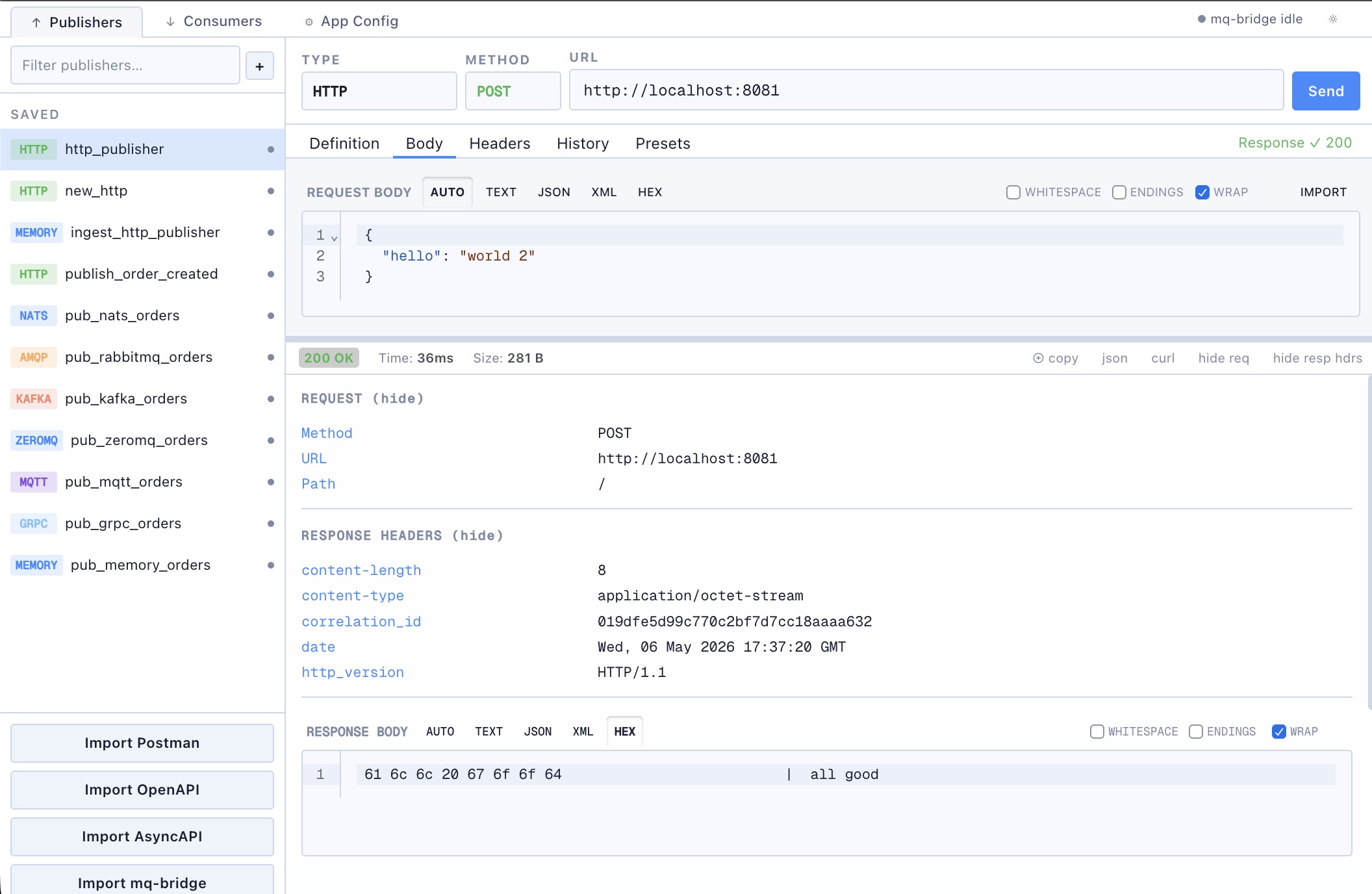
**Learn each form in the book:** [the three ways to run it](https://marcomq.github.io/mq-bridge/getting-started/run-forms.html) · [the desktop / web UI](https://marcomq.github.io/mq-bridge/getting-started/desktop-ui.html) · [CLI commands](https://marcomq.github.io/mq-bridge/reference/cli.html) · [MCP server](https://marcomq.github.io/mq-bridge/MCP.html) · [library bindings](https://marcomq.github.io/mq-bridge/reference/bindings.html).
## Install
`brew` is the quickest path on **macOS and Linux**:
```bash
brew install marcomq/tap/mq-bridge-app # CLI / server
brew install --cask marcomq/tap/mq-bridge # desktop app
```
On **Windows**, install the CLI with `cargo binstall mq-bridge-app`, or download the desktop installer / CLI from the [Releases page](https://github.com/marcomq/mq-bridge/releases). Also available via `cargo install mq-bridge-app` (from source) and the Docker image `ghcr.io/marcomq/mq-bridge-app:latest`.
→ Every install method and platform (including the IBM MQ build and Docker) is in the **[Install guide](https://marcomq.github.io/mq-bridge/INSTALL.html)**; to compile from source see [Building](https://marcomq.github.io/mq-bridge/BUILD.html).
## Use it from an AI agent
The same binary is an MCP server, so an agent can move data without the rows passing through its context:
```bash
mqb mcp install # register with Claude Code / Claude Desktop / Cursor
```
- MCP Registry name: `mcp-name: io.github.marcomq/mq-bridge-app`
→ Tools, transports, and the token-cost measurement: **[MCP server](https://marcomq.github.io/mq-bridge/MCP.html)**.
## Features
- **Multi-protocol bridging** — Kafka, IBM MQ, NATS, AMQP (RabbitMQ), MQTT, AWS SQS, gRPC, ZeroMQ, MongoDB, sqlx (MySQL/MariaDB/PostgreSQL), HTTP, and files. Act as an HTTP server *and* client, with full request-response support.
- **Middleware chains** — retries, dead-letter queues, deduplication, rate limiting, buffering, transforms, weak-join correlation, and more, wrapping any endpoint.
- **Built-in web UI** — Svelte-based management for publishers, consumers, routes, runtime status, presets, and imports; the same UI the CLI serves in a browser.
- **Native plugins** — load an endpoint or middleware this binary never compiled (Pulsar, an in-house transport) from a shared library, via `plugins:` in the config or `--plugin `, and use it by name in routes. No special build needed; plugin paths are read only at startup, so adding one means editing the trusted startup configuration and restarting: [Native plugins](https://marcomq.github.io/mq-bridge/extending/plugins.html).
- **Observability** — structured JSON logging and a Prometheus metrics endpoint.
- **Flexible configuration** — hierarchical files (YAML/JSON/TOML) plus environment variables, suited to Container/Kubernetes.
- **Security & storage** — config security modes (plain / extracted secrets / encrypted config / persistent encrypted history), encryption at rest, and local-first operation.
- **High performance** — Rust + Tokio: low latency, high concurrency, small memory footprint.
## Why not just an API client?
`mq-bridge-app`'s UI overlaps with API clients like Postman, Bruno, Insomnia, and Hoppscotch, but its center of gravity is different: message bridging, runtime operation, and long-lived route management rather than just request composition. Exact feature sets vary by product and edition; this captures the difference in emphasis.
| Capability | mq-bridge | Postman | Bruno | Insomnia | Hoppscotch |
| --- | --- | --- | --- | --- | --- |
| Basic HTTP/API requests | ✓ | ✓ | ✓ | ✓ | ✓ |
| Scripting | — | ✓ | ✓ | ✓ | ✓ |
| Cookie jar | Not yet | ✓ | ✓ | ✓ | ~ |
| Multipart forms | — | ✓ | ✓ | ✓ | ✓ |
| Hex-level payload debugging | ✓ | — | — | — | — |
| Broker pub/sub workflow | ✓ | MQTT | — | — | MQTT |
| Long-lived consumers/routes | ✓ | — | — | — | — |
| Bridge traffic between protocols | ✓ | — | — | — | — |
| Replay messages | ✓ | ~ | — | — | ~ |
| Local-first workspace | ✓ | ~ | ✓ | ✓ | ~ |
| Git-friendly config | ✓ | ~ | ✓ | ✓ | ~ |
| Cloud sync by default | — | ✓ | — | Optional | Optional |
| AI / agent features | — | ✓ | — | ~ | ~ |
| Encrypted config | ✓ | ~ | ~ | ~ | ~ |
Use Postman/Bruno when your main job is crafting and sharing API requests; use `mq-bridge-app` when you need to connect systems, move messages between protocols, inspect live traffic, and manage bridge-style runtime configuration.
## Performance
A CSV → JSONL conversion hit **1,133,786 rows/s**; the same job **through an MCP tool call** ran at **1,176,489 rows/s** while costing an agent a *flat* ~381 tokens regardless of row count, because the rows never enter the model's context.
On a Kafka → file relay using mq-bridge-app's default file format and no transform,
the same engine was up to **65% faster than Sea Streamer**; the native file-format caveats are detailed in the linked benchmark documentation.
→ Full numbers, methodology, and knobs: [Performance tuning](https://marcomq.github.io/mq-bridge/operations/tuning.html) and [`benches/etl/README.md`](https://github.com/marcomq/mq-bridge-app/blob/HEAD/benches/etl/README.md).
## Test on nats / kafka / postgres ....
For testing, [docker-compose files](https://github.com/marcomq/mq-bridge/tree/main/tests/integration/docker-compose) are available for supported backends:
```bash
docker-compose -f https://raw.githubusercontent.com/marcomq/mq-bridge/main/tests/integration/docker-compose/postgres.yml up
```
## How it's built
`mq-bridge-app` uses the [`mq-bridge`](https://github.com/marcomq/mq-bridge) engine *on itself* — the management UI is served through the engine's own HTTP-request/response routing, and the UI form is generated from the Rust config schema (no hand-written form code). See [How the app is built](https://marcomq.github.io/mq-bridge/getting-started/app-architecture.html).
## Status
Active development. Originally the reference implementation and testbed for the [`mq-bridge`](https://github.com/marcomq/mq-bridge) engine. The UI/Tauri layer is a working demo rather than a reference implementation — test before relying on it in production.
## License
MIT — see [LICENSE](https://github.com/marcomq/mq-bridge-app/blob/HEAD/LICENSE).