

Start with your next interface · Get Memi Studio · Read the research
## Quickstart: find your first interface issue Run one non-destructive audit in any frontend repository. It needs no account, API key, Figma file, global install, or daemon. ```bash npx -y @memi-design/cli@latest diagnose . --json --no-write --fail-on none ``` The result carries normalized finding IDs, confidence, provenance, and `file:line` evidence so an agent can act on a specific finding instead of guessing. Give the same context to your coding agent: ```bash npx skills add memi-design/memi --skill audit-frontend-design ``` Then ask: > Audit this frontend before editing it. Prioritize the five changes that will matter most to users, reuse the existing system, and verify the result after the patch. If Memi catches a real interface issue in your project, [share the finding](https://github.com/memi-design/memi/discussions/categories/show-and-tell). Real reports are the most useful signal for what to improve next. ## Cost and offline operation Local source diagnosis uses deterministic rules: **no model call, API key, or model fee**. It checks the repository you provide and returns findings your agent can verify. Installation, CPU time, CI runners, and any agent you choose still have costs. The published research has not established an end-to-end dollar or token savings advantage. Start with one diagnosis, address the highest-confidence finding, and rerun the same check. Use `--agent-context` for a bounded file index instead of sending a whole repository to a model. Its routing is heuristic; a smaller context is not proof of a cheaper successful task. `--files` scopes reported findings without launching Git; it still scans the tree for aggregate statistics. **Published beta:** Install the exact `2.8.0-beta.2` package for the 2.8 frontend workflow. Stable remains `2.7.9`; the beta is not a stable release. See [current release state](https://github.com/memi-design/memi/blob/main/docs/CURRENT_RELEASE.md) and [known limitations](https://github.com/sarveshsea/m-moire/blob/HEAD/docs/trust/KNOWN_LIMITATIONS.md). The [beta2 npm release record](https://github.com/memi-design/memi/blob/main/release-artifacts/npm/2.8.0-beta.2.release.json) identifies its published source and immutable artifact evidence. The [beta1 npm release record](https://github.com/sarveshsea/m-moire/blob/HEAD/release-artifacts/npm/2.8.0-beta.1.release.json) preserves the earlier release's history; it does not validate beta2. The 2.8 locked default and explicit capability contract do not apply retroactively to 2.7.9. ```bash npx -y @memi-design/cli@2.8.0-beta.2 --version npx -y @memi-design/cli@2.8.0-beta.2 agent brief . --frontend --intent "Improve this interface" --json ``` The beta keeps managed security review, SwiftUI parity, and full DesignWorkbench certification explicitly pending. It is not stable or employer-approved. Publication provenance and platform receipts belong to the exact released artifact. The beta prevents local diagnosis from writing project files by default, keeps paid integrations optional, and requires explicit grants for networking, subprocesses, and source report persistence. An npm install needs registry access; offline first-run claims require the separately verified bundle. See the [acceptance ledger](https://github.com/sarveshsea/m-moire/blob/HEAD/docs/trust/ACCEPTANCE_LEDGER.md), [known limitations](https://github.com/sarveshsea/m-moire/blob/HEAD/docs/trust/KNOWN_LIMITATIONS.md), and [release truth](https://github.com/sarveshsea/m-moire/blob/HEAD/docs/trust/RELEASE_TRUTH.md). **The 2.8 frontend workflow:** the beta provides a repository-aware frontend brief, four useful locked MCP tools, validated Figma/Paper evidence inputs, and explicit component-reuse conflicts. See the [frontend workflow](https://github.com/sarveshsea/m-moire/blob/HEAD/docs/FRONTEND_WORKFLOW.md) for runnable beta commands and the [release plan](https://github.com/sarveshsea/m-moire/blob/HEAD/docs/trust/RELEASE_2_8_PLAN.md) for remaining gates. Managed independent security scanning and the reviewed-candidate-audit and swiftui-rendered-rerun receipts remain pending for stable. Paper pixel parity is unassessed. Of 158 inventoried CLI paths, 105 remain deferred; broad grants do not enable them. No complete-task dollar or token savings claim is established. ### What 2.8 changes for frontend agents | In 2.7.9 | In the 2.8 beta | | --- | --- | | Diagnosis, agent briefs, token tools, Figma bridge, and skills already existed. | `agent brief --frontend` joins actual exports, props, CSS/DTCG tokens, and CSF stories in a 2–16 KiB JSON response. | | Harness configuration exposed a broad tool catalog. | Locked stdio starts without sockets or project writes; four read tools are available without grants. | | A design mapping could become stale or a generator warning could be ignored. | Explicit mappings are checked against current exports, required props, token references, and optional source hashes. Registry specs marked as mapped block duplicate generation; a host envelope supplies reuse guidance. | | Paper had no dedicated integration. | Codex can supply selected Paper or Figma context through the same validated envelope; no extra model session or bundled connector is required. | | Static diagnosis could present unassessed categories as passing. | Quality scores cover assessed categories only; coverage and scan omissions are separate. Browser verification remains unassessed until actually run. | The practical benefit is more useful local evidence and clearer failure signals: a brief identifies an existing component before an agent duplicates it, diagnosis distinguishes unchecked categories from assessed findings, and `diagnose --receipt-only` provides a separate metadata-only result without persisting a source report. Regression tests also exposed and corrected candidate defects in bounded file reads, malformed event handling, and failure exit codes. Those corrections improve specific behavior; they do not establish universal design quality, security certification, or lower task cost. Earlier packed results at source `2a6d0e44` are historical evidence for those exact bytes. Later defensive runtime fixes supersede that artifact as a release candidate; each corrected source checkpoint is verified through a separate local package and digest. See the [verification record](https://github.com/memi-design/memi/blob/main/docs/trust/FRONTEND_2_8_VERIFICATION.md) for the source, artifact, and scope of each result. Local candidate receipts remain evidence for their original bytes; they do not replace the published npm record. The repository remains authoritative for code. Memi supplies evidence; Codex edits and runs the project's actual checks. Existing custom CSS and component systems do not need a shadcn migration. This beta deliberately defers many legacy command paths; it is not yet a drop-in upgrade for every 2.7 workflow. ## Put the check on every pull request Copy [`examples/github-actions/memi-design.yml`](https://github.com/sarveshsea/m-moire/blob/HEAD/examples/github-actions/memi-design.yml) into your repository as `.github/workflows/memi-design.yml`. The starter is pinned to the reviewed public Action commit and gives reviewers: - a PR check that fails only on newly introduced interface debt; - a `memi-design-health` artifact with the human-readable report; and - SARIF annotations when the repository grants `security-events: write`. The workflow does not need an API key or a Memi secret. Fork pull requests still receive the check and report; SARIF upload is skipped automatically when GitHub does not grant that permission. If you prefer to configure it by hand, the complete [GitHub Action guide](https://github.com/memi-design/memi/blob/main/docs/GITHUB_ACTION_MARKETPLACE.md) documents every input, output, permission, and evidence file. ## One product layer, three surfaces | Surface | What it is | Status | | --- | --- | --- | | **Memi CLI** | Interface intelligence and deterministic checks for local repositories, agents, and CI. | Available today | | **Memi Studio** | A macOS workbench for bringing project context, agent workflows, and verification together. | [Available today](https://memoire.cv/download) | | **Memi Canvas** | A visual workspace for design-system context and controlled agent proposals. | currently in development | ## See the product | Memi Studio | Memi Canvas — in development | | --- | --- | |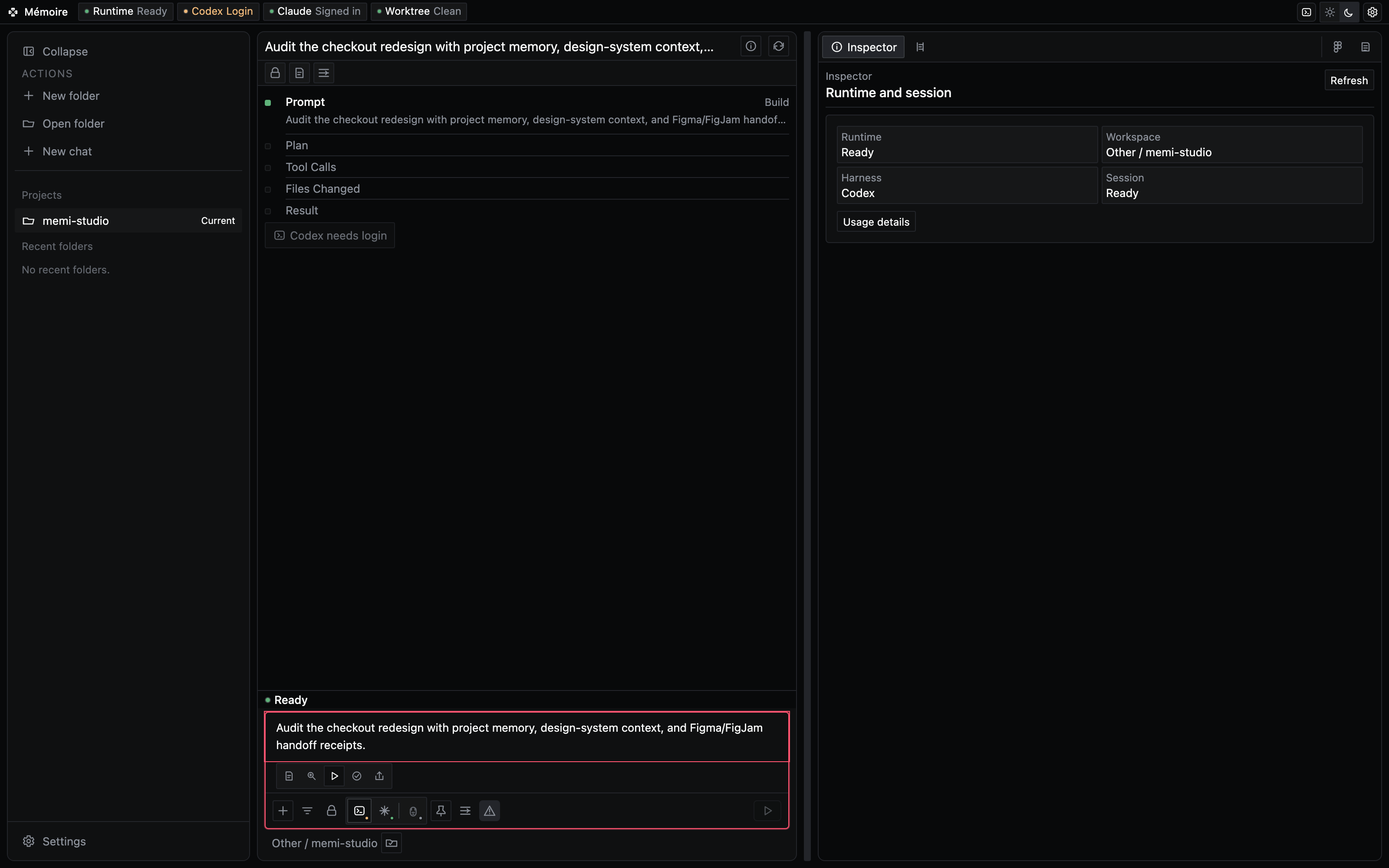 |
| 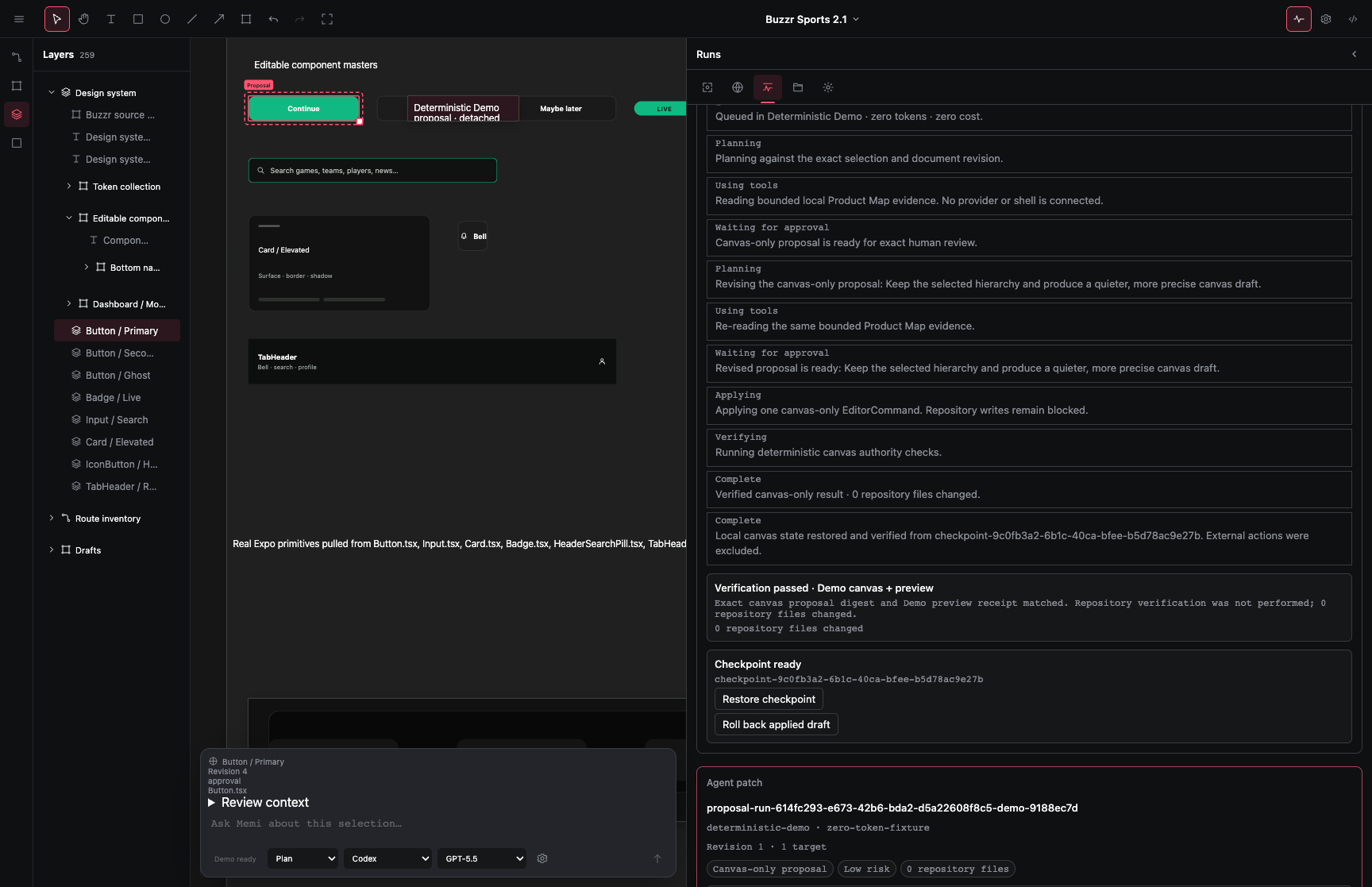 |
| Bring an agent prompt, project memory, and a verification surface into one workbench. | Preview design-system context, inspect a proposal, and keep a human in the loop. This preview shows an active development build, not a released product guarantee. |
## What Memi adds to an agent workflow
| Before the edit | During the edit | Before merge |
| --- | --- | --- |
| Discover components, tokens, routes, states, and accessibility gaps. | Give the agent a scoped brief that names the system it must preserve. | Rerun deterministic checks and surface new interface debt in CI. |
| Need | Start with |
| --- | --- |
| Find UI risks and product-system context | `audit-frontend-design` |
| Plan a change around existing components and tokens | `remember-design-system` |
| Keep new interface debt out of pull requests | `enforce-design-ci` |
| Build and verify native Apple interfaces | `build-swiftui-interface` |
Compatible with the [shadcn registry](https://ui.shadcn.com/docs/registry/getting-started) and [v0 design systems](https://v0.app/docs/design-systems).
## Evidence at a glance
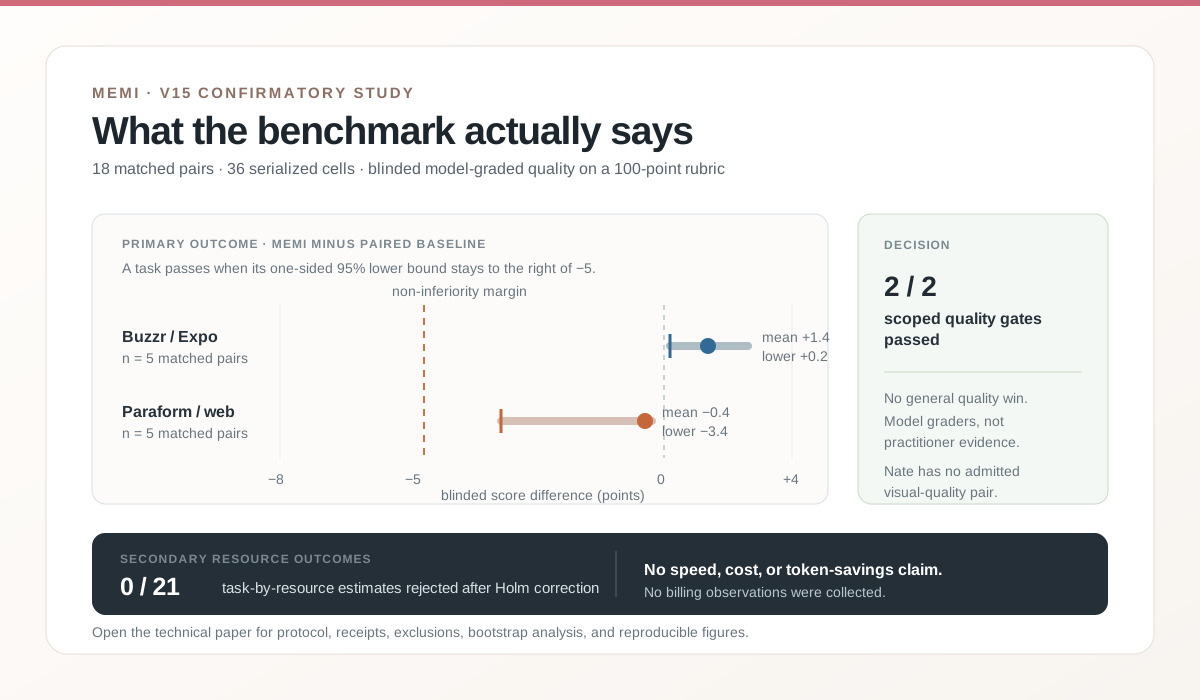
The [V15 confirmatory audit](https://github.com/memi-design/memi/tree/main/docs/research/memi-2.7-prospective-study/v15-2.7.3-confirmatory) is a public technical disclosure, not a leaderboard. It separates receipt admission, rendered design quality, functional acceptance, and resource observations.
| Measured record | Exact reading |
| --- | --- |
| 36 / 36 frozen receipts admitted | Every preregistered agent cell had an auditable receipt. This is receipt admission, not universal performance. |
| **10 complete model-graded matched pairs** | Rendered design-quality comparisons that survived the prespecified screen. This is model-graded evidence, not independent practitioner review. |
| Buzzr / Expo: mean **+1.4**; Paraform / web: mean **−0.4** | The scoped non-inferiority gate passed on both graded task families. It does not establish general superiority. |
| **0 / 21** corrected task-by-resource tests rejected | The study did not establish a speed, cost, or token-use advantage. |
**Separate historical release record:** the 2.7 candidate record reported **2,187 / 2,187** tests passed. It is release evidence, not part of V15 and not proof that every project benefits.
## Benchmarks and paper
|
| Bring an agent prompt, project memory, and a verification surface into one workbench. | Preview design-system context, inspect a proposal, and keep a human in the loop. This preview shows an active development build, not a released product guarantee. |
## What Memi adds to an agent workflow
| Before the edit | During the edit | Before merge |
| --- | --- | --- |
| Discover components, tokens, routes, states, and accessibility gaps. | Give the agent a scoped brief that names the system it must preserve. | Rerun deterministic checks and surface new interface debt in CI. |
| Need | Start with |
| --- | --- |
| Find UI risks and product-system context | `audit-frontend-design` |
| Plan a change around existing components and tokens | `remember-design-system` |
| Keep new interface debt out of pull requests | `enforce-design-ci` |
| Build and verify native Apple interfaces | `build-swiftui-interface` |
Compatible with the [shadcn registry](https://ui.shadcn.com/docs/registry/getting-started) and [v0 design systems](https://v0.app/docs/design-systems).
## Evidence at a glance
The [V15 confirmatory audit](https://github.com/memi-design/memi/tree/main/docs/research/memi-2.7-prospective-study/v15-2.7.3-confirmatory) is a public technical disclosure, not a leaderboard. It separates receipt admission, rendered design quality, functional acceptance, and resource observations.
| Measured record | Exact reading |
| --- | --- |
| 36 / 36 frozen receipts admitted | Every preregistered agent cell had an auditable receipt. This is receipt admission, not universal performance. |
| **10 complete model-graded matched pairs** | Rendered design-quality comparisons that survived the prespecified screen. This is model-graded evidence, not independent practitioner review. |
| Buzzr / Expo: mean **+1.4**; Paraform / web: mean **−0.4** | The scoped non-inferiority gate passed on both graded task families. It does not establish general superiority. |
| **0 / 21** corrected task-by-resource tests rejected | The study did not establish a speed, cost, or token-use advantage. |
**Separate historical release record:** the 2.7 candidate record reported **2,187 / 2,187** tests passed. It is release evidence, not part of V15 and not proof that every project benefits.
## Benchmarks and paper