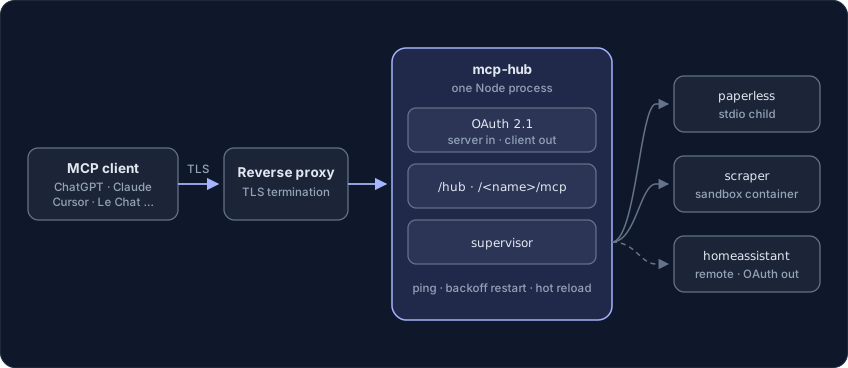
# mcp-hub
**Category:** 💻 Developer Tools
**Repository:** https://github.com/ni-c/mcp-hub
**Views:** 0
**Installs:** 0
**Upvotes:** 0
**Directory Page:** https://allmcps.com/mcp/mcp-hub
## Description
Many stdio MCP servers from one container, published over HTTPS with OAuth 2.1 for any MCP client
## Claude Desktop Quick Installation
Heuristic fallback — verify the package name and runner against the repository README before running it. Uses `npx` (confidence: low):
```json
"mcpServers": {
"mcp-hub": {
"command": "npx",
"args": ["-y","mcp-hub"]
}
}
```
## Documentation & README
# mcp-hub
[](https://github.com/ni-c/mcp-hub/actions/workflows/ci.yml)
[](https://scorecard.dev/viewer/?uri=github.com/ni-c/mcp-hub)
[](https://glama.ai/mcp/servers/ni-c/mcp-hub)
[](https://www.npmjs.com/package/@ni-c/mcp-hub)
[](https://github.com/ni-c/mcp-hub/pkgs/container/mcp-hub)
[](https://mcp-hub.ni-c.de)
[](https://github.com/sponsors/ni-c)
A dual-era [Model Context Protocol](https://modelcontextprotocol.io) (MCP) gateway: it
serves many stdio MCP servers from **one container**, published over HTTPS, and speaks
**both MCP revisions on every endpoint** — `2026-07-28` and `2025-11-25`. The client
picks, and cannot tell which one it is on from the answers. On the 2026 revision that
includes **elicitation** — a child server's question reaches the person at the far end
instead of dying at the gateway
([how](https://mcp-hub.ni-c.de/guide/elicitation)) — and **subscriptions**: the hub
serves `subscriptions/listen` to its clients and subscribes to its children on
whichever revision _they_ speak, so a server that has never heard of it still reaches
a client that speaks nothing else
([how](https://mcp-hub.ni-c.de/guide/subscriptions)).
Lets MCP clients that cannot spawn a local process — ChatGPT connectors, Claude on
the Web and in Code, Mistral Le Chat, Cursor, LibreChat and any other
Streamable-HTTP client — reach every server behind it, with a built-in OAuth 2.1
login protected by a single password, plus long-lived API tokens for clients that
cannot do OAuth (OpenAI Responses API, xAI API, Gemini API). Per-client recipes:
[client compatibility](https://mcp-hub.ni-c.de/guide/client-compatibility).

**Want to poke at it first?** [`demo/`](https://github.com/ni-c/mcp-hub/blob/HEAD/demo/) is a throwaway hub with three
fake servers — `docker compose up -d`, then point the
[MCP Inspector](https://mcp-hub.ni-c.de/guide/demo#mcp-inspector) or
[MCPJam](https://mcp-hub.ni-c.de/guide/demo#mcpjam) at it. Nothing to
configure, nothing to clean up but a volume.
## Why
Wrapping each stdio MCP server in its own auth-proxy container costs a full
image, an OAuth stack, a hostname and a compose stack _per server_. mcp-hub
replaces N containers with one process:
- **Config is exactly Claude Code's `mcpServers` format** — copy entries 1:1.
- **Path-based routing**: `https://host/paperless`, `https://host/homeassistant`, …
- **`/hub` aggregate**: register a _single_ connector and reach every server
through 6 meta-tools (`list_servers`, `list_tools`, `get_tool_schema`,
`call_tool`, `wake_server`, `sleep_server`) without flooding the model
context with N×tools schemas.
- **Per-server tool filtering**: `allowTools` / `denyTools` on any server decide
which of its tools the hub exposes — exact names or `list_*` prefixes. A
filtered tool is hidden from `tools/list` _and_ refused if a client calls it
anyway, before the server is even woken, so a client holding a stale schema
cannot reach it.
- **Also without HTTP**: `mcp-hub --stdio` serves that same aggregate on
stdin/stdout for clients that can only spawn a local process (Claude Desktop,
Codex, …) — same `mcp.json`, no TLS, no reverse proxy, no login. Auth exists
for the network endpoints; over stdio the trust boundary is the local user.
- **On-demand lifecycle**: stdio and docker servers start when used and sleep
after 60 idle minutes, answering `initialize`/`tools/list` from a persistent
snapshot meanwhile — a dozen servers cost only the memory of the ones in
use. `keepAlive: true` exempts a server, `IDLE_TIMEOUT_MINUTES=0` the hub.
- **CIMD-first OAuth 2.1**: clients identify themselves with a [Client ID
Metadata Document](https://mcp-hub.ni-c.de/guide/client-registration) — the
registration-free path the MCP spec now prefers — including `private_key_jwt`
against the keys in their own document (metadata-document clients only). RFC
7591 dynamic registration stays advertised beside it for older clients,
`mcp-hub-admin clients add` issues credentials by hand for anything that can
do neither, and `CLIENT_REGISTRATION` turns either mechanism off.
- **OAuth outwards, too**: a remote server that speaks OAuth gets an `oauth`
block instead of a static header. The hub registers itself — with credentials
the upstream issued, via RFC 7591, or with its own client metadata document —
then obtains and refreshes the token. `client_credentials` upstreams need no
attention at all; where a person must sign in, `mcp-hub-admin upstream login`
prints one URL. An upstream that needs re-authorizing shows up as one server
`unauthorized`, not as a confusing 401 in your client.
- **Supervision**: children are pinged and restarted with exponential backoff
when they die. A down server answers 503, not silence; a crash-looping
server nobody uses is parked instead of restarted forever.
- **Hot reload**: edits to `mcp.json` start/stop/restart only the affected
servers.
- **Stateless Streamable HTTP**: no session state, so claude.ai's
reconnect-without-DELETE behaviour cannot leak processes or memory.
- **Dual-era**: every endpoint — `/hub`, `//mcp` and `--stdio` — answers
MCP `2026-07-28` and `2025-11-25` alike; the client picks and cannot tell
from the answers which it got. On the 2026 revision that includes
**elicitation**: a server asking the user something returns the question
rather than pushing it, so it reaches the person at the far end instead of
dying at the gateway. The hub attributes it to the server that asked, strips
what could lie about that, drops embedded sampling and roots requests, and
seals the resumption state against the call it belongs to. `passthrough:
"off"` withdraws one server's right to ask;
[details](https://mcp-hub.ni-c.de/guide/elicitation).
- **Change notifications, in both eras**: a client opens a
`subscriptions/listen` stream and hears when a child's tools, prompts or
resources change. The hub subscribes to each child the way that child
understands — `subscriptions/listen` to a 2026 server, `resources/subscribe`
to a 2025 one — so the era gap is the gateway's problem rather than either
end's. The state is the open response, not a session table, so this costs the
stateless design nothing. A sleeping server watches nothing and is told to
re-read on waking; `subscriptions: "off"` withdraws one server's right to
push; [details](https://mcp-hub.ni-c.de/guide/subscriptions).
- **Lightweight by design**: one Node process, no database (state is one JSON
file plus a signing key under `/data`), six runtime dependencies, and
multi-arch images — a stated project goal is to run comfortably on a
single-board computer like a Raspberry Pi.
## Servers to run behind it
The hub is server-agnostic — it serves any stdio MCP server whose entry fits
Claude Code's `mcpServers` format, which is most of them. These nineteen are
built and maintained alongside it, so their documentation carries the hub entry
you need and their tool filters line up with the hub's own `allowTools` /
`denyTools`:
| Server | npm | What it reaches |
| ---------------------------------------------------------------------- | --------------------------------- | ------------------------------------------------------------------------------ |
| [audiobookshelf-mcp](https://audiobookshelf-mcp.ni-c.de) | `audiobookshelf-mcp` | Audiobookshelf — libraries, listening progress, collections and playlists |
| [caldav-mcp](https://caldav-mcp.ni-c.de) | `@ni-c/caldav-mcp` | CalDAV — events, tasks and journal entries on any server that speaks it |
| [calibreweb-mcp](https://calibreweb-mcp.ni-c.de) | `calibreweb-mcp` | Calibre-Web — read-only library access through the OPDS feed |
| [carddav-mcp](https://carddav-mcp.ni-c.de) | `@ni-c/carddav-mcp` | CardDAV — contacts, groups and photos on any server that speaks it |
| [freshrss-mcp](https://freshrss-mcp.ni-c.de) | `@ni-c/freshrss-mcp` | FreshRSS — feeds, categories and articles as plain text, not stream ids |
| [google-search-console-mcp](https://google-search-console-mcp.ni-c.de) | `@ni-c/google-search-console-mcp` | Google Search Console — properties, sitemaps, search analytics, URL inspection |
| [healthchecks-mcp](https://healthchecks-mcp.ni-c.de) | `healthchecks-mcp` | Healthchecks — cron and uptime checks, and why one failed |
| [hetzner-dns-mcp](https://hetzner-dns-mcp.ni-c.de) | `hetzner-dns-mcp` | Hetzner Cloud DNS — zones, record sets and BIND import/export |
| [imap-mcp](https://imap-mcp.ni-c.de) | `@ni-c/imap-mcp` | IMAP mailboxes — read, search, organise and draft mail; it cannot send |
| [linkwarden-mcp](https://linkwarden-mcp.ni-c.de) | `linkwarden-mcp` | Linkwarden — bookmarks, collections and the article text it preserved |
| [mealie-mcp](https://mealie-mcp.ni-c.de) | `@ni-c/mealie-mcp` | Mealie — recipes, meal plans, shopping lists and cookbooks |
| [ntfy-mcp](https://ntfy-mcp.ni-c.de) | `@ni-c/ntfy-mcp` | ntfy — publish and update notifications, manage users and topic access |
| [opengist-mcp](https://opengist-mcp.ni-c.de) | `opengist-mcp` | Opengist — gists, revisions, commit history and raw files |
| [osm-mcp](https://osm-mcp.ni-c.de) | `osm-mcp` | OpenStreetMap — geocoding, routing, isochrones and POI search |
| [rustpad-mcp](https://rustpad-mcp.ni-c.de) | `rustpad-mcp` | Rustpad — collaborative pads edited through real OT, not overwrites |
| [smtp-mcp](https://smtp-mcp.ni-c.de) | `@ni-c/smtp-mcp` | SMTP — sends mail, behind a recipient allowlist and a human confirmation |
| [wg-easy-mcp](https://wg-easy-mcp.ni-c.de) | `wg-easy-mcp` | wg-easy v15+ — the full WireGuard client lifecycle |
| [wikijs-mcp](https://wikijs-mcp.ni-c.de) | `@ni-c/wikijs-mcp` | Wiki.js — search, read and edit pages, plus assets, users and groups |
| [woodpecker-ci-mcp](https://woodpecker-ci-mcp.ni-c.de) | `@ni-c/woodpecker-ci-mcp` | Woodpecker CI — repositories, pipelines, logs, secrets and crons |
Each one runs perfectly well on its own over stdio. Put them behind the hub when
you want them reachable from a client that cannot spawn a local process, or when
you would rather register one connector than nineteen.
## Configuration
`/config/mcp.json` — identical to Claude Code (`${VAR}` expands from the
container environment; unknown fields are ignored by Claude Code, so the file
stays interchangeable). Install stdio server binaries at a reviewed, exact
version in your image; do not download mutable packages at runtime:
```json
{
"mcpServers": {
"paperless": {
"command": "paperless-mcp",
"args": [],
"env": { "PAPERLESS_API_TOKEN": "${PAPERLESS_API_TOKEN}" }
},
"homeassistant": {
"type": "http",
"url": "http://homeassistant:8123/api/mcp",
"headers": { "Authorization": "Bearer ${HA_TOKEN}" }
},
"private-thing": { "command": "some-mcp", "args": [], "hub": false },
"paperless-readonly": {
"command": "paperless-mcp",
"allowTools": ["search_*", "get_document"],
"denyTools": ["delete_document"]
},
"untrusted": {
"type": "docker",
"image": "ghcr.io/example/untrusted-mcp@sha256:0123456789abcdef0123456789abcdef0123456789abcdef0123456789abcdef",
"network": "none",
"memory": "256m"
}
}
}
```
Stdio servers (`command`/`args`/`env`) are spawned as supervised child
processes. Remote servers (`type: "http"` or `"sse"` with `url` and optional
`headers`) are connected as MCP clients with the configured headers injected
on every request — the same supervision (ping, backoff reconnect, hot reload)
applies. An upstream that speaks OAuth gets an `oauth` block instead of a
header: the hub registers itself (statically, via RFC 7591 or via a client
metadata document), obtains the token and refreshes it, with one browser visit
started from the admin CLI where the grant needs a person.
`"hub": false` hides a server from the `/hub` aggregate; its own path keeps
working. `allowTools` / `denyTools` cut finer and apply to every kind of
server: a filtered tool is absent from both `tools/list` and `/hub`, and is
refused if called anyway — before the server is woken.
Reserved names: `mcp`, `hub`, `authorize`, `token`, `register`,
`login`, `consent`, `health`, `livez`, `revoke`, `upstream`, `.well-known`.
All stdio children share the hub's Unix user and can read its mounted files.
Only install fully trusted stdio servers. A server with a different trust level
belongs in its own container — and it does not have to speak HTTP to get there:
- `type: "docker"` — the hub creates the container and talks **stdio across the
container boundary** over the Docker API. No HTTP listener, no bearer token,
no bridge process in the image. The hub itself never gets the Docker socket:
a separate `mcp-hub-docker-proxy` container holds it and allows only the
container operations `mcp.json` describes — nothing privileged, no host
mounts, no other images. Credentials can live with the proxy (`secretsFrom`)
so the hub process never holds them — and rotating one is just an edit: the
proxy watches the file and recreates the sandbox with the new values.
- `type: "unix"` / `"tcp"` — you start the container, the hub connects to a
socket. Costs the hub no privileges at all, and a Unix socket reaches a
sandbox running with `network_mode: none`.
Both carry the newline-delimited JSON-RPC the specification asks custom
transports to reuse. See [sandboxing](https://mcp-hub.ni-c.de/guide/sandboxing)
and [SECURITY.md](https://github.com/ni-c/mcp-hub/blob/HEAD/SECURITY.md).
For a custom image, pin every package to an exact version:
```dockerfile
FROM ghcr.io/ni-c/mcp-hub:0.10.0 # pin @sha256: in production
USER root
RUN npm install -g your-mcp-package@1.2.3
USER node
```
### Environment
| Variable | Required | Description |
| ------------------------------- | ------------------- | ----------------------------------------------------------------------------------------------------------------------------- |
| `EXTERNAL_URL` | yes | Public base URL, e.g. `https://mcp.example.net` (no path) |
| `PASSWORD_HASH` | one of | bcrypt hash of the login password (`htpasswd -bnBC 10 "" 'pw' \| tr -d ':\n'`) |
| `PASSWORD` | one of | plain-text alternative to `PASSWORD_HASH` |
| `TRUSTED_PROXIES` | no | comma-separated IPs/CIDRs allowed to set `X-Forwarded-*` (see below) |
| `RESOURCE_BOUND_TOKENS` | no | RFC 8707 tokens bound to `/hub` or one `//mcp`, default `true`; set `false` only to keep pre-0.5 unbound tokens working |
| `DEFAULT_RESOURCE` | no | server name (or `hub`) to bind tokens to when a client sends no `resource` parameter; unset → such requests are refused |
| `MCP_BODY_LIMIT` | no | authenticated MCP JSON body limit, default `1mb` |
| `MCP_REQUESTS_PER_MINUTE` | no | limit per OAuth client, default `120` |
| `MCP_MAX_CONCURRENT_REQUESTS` | no | in-flight request limit per OAuth client, default `4` |
| `MCP_MAX_CONCURRENT_STREAMS` | no | open SSE listening streams per OAuth client — one per connected session, default `32` |
| `HTTP_HEADERS_TIMEOUT_MS` | no | Node HTTP header timeout, default `10000` |
| `HTTP_REQUEST_TIMEOUT_MS` | no | complete request timeout, default `310000` (slightly above the tool-call timeout) |
| `PORT` | no | listen port (default 80 in the image, 3000 outside) |
| `CONFIG_PATH` | no | default `/config/mcp.json` |
| `DATA_PATH` | no | default `/data` |
| `LOG_FILE` | no | additionally mirror all log output into this file, e.g. `/data/mcp-hub.log` (see below) |
| `CLIENT_REGISTRATION` | no | which mechanisms a client may use for a `client_id`: `cimd`, `dcr` or both (default) |
| `CIMD_ALLOWED_ORIGINS` | no | bare https origins whose metadata documents are accepted; unset → any |
| `CIMD_ALLOW_PRIVATE_ADDRESSES` | no | local development only; relaxes the SSRF guard, warns on every start |
| `DCR_MAX_CLIENTS` | no | ceiling on stored dynamic registrations, default `500` |
| `DCR_PENDING_TTL_HOURS` | no | how long a never-approved registration is kept, default `24` |
| `DCR_INACTIVE_DAYS` | no | how long an unused approved registration is kept, default `90` |
| `IDLE_TIMEOUT_MINUTES` | no | idle minutes before an on-demand server sleeps, default `60`; `0` disables it |
| `TOOL_CACHE_PATH` | no | snapshots of sleeping servers, default `/tool-cache.json` |
| `MCP_CALL_TIMEOUT_MS` | no | deadline for one forwarded tool call, default `300000` |
| `MCP_RESET_TIMEOUT_ON_PROGRESS` | no | let progress notifications extend that deadline, default `false` |
| `DOCKER_HOST` | with docker servers | the **policy proxy's** socket; a direct daemon socket fails closed |
The full table, including what applies in stdio mode, is in the
[environment reference](https://mcp-hub.ni-c.de/reference/environment).
`/data` holds the Ed25519 JWT key, registered OAuth clients, approvals and
refresh tokens. **Mount it as a volume** — recreating it invalidates every
connector authorization.
Every access token is bound to one resource. The OAuth client includes the
resource advertised by the endpoint's RFC 9728 document — no client-side
configuration needed — and the resulting token is valid only there: a token for
`/paperless/mcp` cannot call `/hub`, `/health` or another server. The shorter
`/` route is canonicalized to `//mcp`.
`RESOURCE_BOUND_TOKENS=false` turns this off and is a migration mode for
deployments from 0.4 and earlier, where tokens were issued without a resource
and reach every path. The hub logs a warning while it is set. Removing it
invalidates those unbound tokens, so every connector authorizes once more.
`TRUSTED_PROXIES` decides what `req.ip` is, and therefore what the login rate
limiter counts. List **only** your own reverse proxy, and make sure it
_overwrites_ `X-Forwarded-For` rather than appending to it — otherwise a
client can supply its own address and rotate it to sidestep the per-IP limit.
If the variable is unset, every request appears to come from the proxy and
per-IP limiting degrades to a single global counter (the hub logs a warning
at startup). A global cap of 100 failures per 15 minutes applies either way.
## Running
### Option A — prebuilt image from GHCR (recommended)
Published on every push to `main` and every `vX.Y.Z` release tag, for
`linux/amd64` and `linux/arm64`. Browse the versions on the
[package page](https://github.com/ni-c/mcp-hub/pkgs/container/mcp-hub).
```sh
docker pull ghcr.io/ni-c/mcp-hub:0.10.0
```
Tags: `latest` (tip of `main`), `X.Y.Z` and `X.Y` (releases), and
`sha-` for a specific build.
Use a version tag instead of `latest` for controlled updates. For an immutable
deployment, record the resolved digest from `docker image inspect` and use
`ghcr.io/ni-c/mcp-hub:@sha256:` in Compose.
With compose, copy the example and point it at the image instead of building:
```yaml
services:
mcp-hub:
image: ghcr.io/ni-c/mcp-hub:0.10.0 # replaces `build: .`; pin a digest in production
# ...rest of docker-compose.example.yml unchanged
```
```sh
cp docker-compose.example.yml docker-compose.yml # adjust, swap build → image
mkdir -p config && cp mcp.json.example config/mcp.json # adjust
mkdir -p data && sudo chown -R 1000:1000 data # container runs as uid 1000
docker compose up -d
```
Or without compose:
```sh
mkdir -p data && sudo chown -R 1000:1000 data # container runs as uid 1000
docker run -d --name mcp-hub \
-p 127.0.0.1:7690:80 \
-e EXTERNAL_URL="https://mcp.example.net" \
-e PASSWORD_HASH="$(htpasswd -bnBC 10 '' 'yourpassword' | tr -d ':\n')" \
-e TRUSTED_PROXIES="192.168.1.0/24" \
-v "$PWD/config:/config:ro" \
-v "$PWD/data:/data" \
ghcr.io/ni-c/mcp-hub:0.10.0
```
Update to a newer image with `docker compose pull && docker compose up -d`
(or `docker pull …`, then recreate the container).
### Option B — build from source
```sh
cp docker-compose.example.yml docker-compose.yml # adjust
mkdir -p config && cp mcp.json.example config/mcp.json # adjust
docker compose up -d --build
```
### Option C — npm (without a container)
```sh
CONFIG_PATH=./mcp.json DATA_PATH=./data PASSWORD_HASH='...' \
npx @ni-c/mcp-hub
```
Installs as [`@ni-c/mcp-hub`](https://www.npmjs.com/package/@ni-c/mcp-hub)
(the unscoped npm name belongs to an unrelated project) and provides the
`mcp-hub` and `mcp-hub-admin` binaries. The container remains the recommended
deployment — it provides the isolation, read-only root filesystem and resource
limits that SECURITY.md assumes.
Reverse-proxy requirements: TLS termination, WebSockets/SSE allowed (proxy
buffering off, a request timeout above 310 seconds, a request-body limit at or
below `MCP_BODY_LIMIT`, and pass `X-Forwarded-Proto`/`Host`.
Connect a client: add `https:///hub` (or `https:////mcp`
for one server) as a custom connector — in ChatGPT (developer mode), Claude
Web, Mistral Le Chat, Cursor, LibreChat or any other OAuth-capable MCP client —
and log in once with the password. Claude Code:
`claude mcp add -t http name https:////mcp`. API-only clients
(OpenAI Responses API, xAI, Gemini API) use an admin-minted token instead —
see [client compatibility](https://mcp-hub.ni-c.de/guide/client-compatibility).
Each client is confirmed once. Entering the password approves the client that
asked; while a login session is still valid, a client you have not seen before
gets an explicit _Approve / Deny_ page instead of a code. Approved clients
reconnect silently from then on.
List clients or revoke one. The CLI shares `/data` with the running hub and
both sides re-read the state file before they touch it, so this works against a
live container — a revocation takes effect on the next request:
```sh
docker exec mcp-hub node /app/dist/admin.js clients list
docker exec mcp-hub node /app/dist/admin.js clients revoke CLIENT_ID
docker exec mcp-hub node /app/dist/admin.js clients delete CLIENT_ID
docker exec mcp-hub node /app/dist/admin.js clients prune --dry-run
```
Revocation removes the approval and all refresh tokens and immediately rejects
already-issued access tokens. The next connection needs explicit approval.
`delete` goes further and removes the registration itself, and `prune` applies
the [registration lifecycle rules](https://mcp-hub.ni-c.de/guide/client-registration)
on demand — registrations that were never approved expire after a day, unused
ones after 90 days, and a dynamically registered client can also remove its own
registration through RFC 7592.
For clients that cannot do OAuth at all — the OpenAI Responses API, the xAI
API, Gemini's `mcp_server` tool, plain-header clients — the same CLI mints
long-lived, resource-bound API tokens:
```sh
docker exec mcp-hub node /app/dist/admin.js tokens create --resource hub --days 90 --label "openai"
docker exec mcp-hub node /app/dist/admin.js tokens list
docker exec mcp-hub node /app/dist/admin.js tokens revoke TOKEN_ID
```
The token is printed once and never stored; `tokens revoke` takes effect
immediately. Per-client recipes:
[client compatibility](https://mcp-hub.ni-c.de/guide/client-compatibility).
## Endpoints
| Path | Auth | Purpose |
| -------------------------------------------------------------------- | -------------------------- | ----------------------------------------------------------------- |
| `/`, `//mcp` | Bearer | Streamable HTTP endpoint of one server |
| `/hub` | Bearer | aggregate endpoint with the 6 meta-tools |
| `/livez` | none | minimal process liveness (`200`) |
| `/health` | Bearer | per-server status (`200` all up / `503` degraded) |
| `/authorize`, `/token`, `/register`, `/login`, `/consent`, `/revoke` | — | OAuth 2.1 · CIMD + DCR |
| `/register/` | registration token | RFC 7592: a client reads, changes or removes its own registration |
| `/upstream/callback` | signed state + hub session | where an upstream returns after `upstream login` |
| `/.well-known/mcp-hub-client/.json` | none | the hub's own client metadata document, one per `cimd` upstream |
| `/.well-known/oauth-authorization-server[/…]` | none | RFC 8414 metadata |
| `/.well-known/oauth-protected-resource[/…]` | none | RFC 9728 metadata (path-scoped) |
## Notes & limitations
- Change notifications (`listChanged`, resource updates) are carried on
`2026-07-28` via `subscriptions/listen`, whose state is the open response
rather than a session table. A `2025-11-25` client is offered neither, because
that revision needs a channel the stateless transport does not keep — so the
capability is withheld instead of announced and dropped. An on-demand server
watches nothing while it sleeps; the subscription is re-established on the
next wake and the client is told to re-read.
- Elicitation travels end to end on `2026-07-28`: it is a result rather than a
push. Sampling and log messages are not forwarded.
- Access tokens are opaque and last 15 minutes. Revoking a client takes effect
on its next request rather than when the token expires — the token is a
reference to a stored record, so withdrawing it is a deletion. Refresh tokens
rotate; replaying one that was already rotated away is treated as a leak and
revokes the whole grant, access tokens included.
- Upstream auth is fully decoupled from the hub's own OAuth: an expired
upstream token just marks that one server `down` (503 on its path, visible
in `/health`) — clients never see the upstream's 401.
- One login can approve multiple connectors, but each token is valid only for
its requested server or `/hub`. Registration remains open as the MCP
specification intends; a client only receives codes after confirmation and
only at the confirmed redirect target.
- Failed logins are rate-limited (10/15 min per IP) and logged as
`mcp-hub: authentication failure from ` for fail2ban.
- Auth pages deny framing and carry a restrictive CSP. MCP bodies are parsed
only after bearer verification and are bounded by size, per-client request
rate and per-client concurrency.
### Logging to a file for fail2ban
`LOG_FILE=/data/mcp-hub.log` mirrors every log line into that file, one line
per entry with an ISO-8601 UTC prefix, while leaving the console output alone —
so `docker logs` keeps working. A jail then reads the file directly:
```ini
# /etc/fail2ban/filter.d/mcp-hub-auth.conf
[Definition]
failregex = mcp-hub: authentication failure from \s*$
mcp-hub: login rate limit exceeded from \s*$
mcp-hub: consent with an invalid CSRF token from \s*$
ignoreregex =
```
Only the hub's own lines are mirrored — the stdio children inherit stderr
directly, so their output stays in the container log and the file stays small.
Rotate it with logrotate (`copytruncate`, since the hub holds the file open).
Why not read the container's own logs instead: the Docker `json-file` path
contains the container ID and changes on every recreate, and the `journald`
driver maps **all** stderr to priority `err` — since an MCP server must keep
stdout free for the protocol and therefore logs to stderr, every ordinary line
would show up as a system error and drown out host monitoring.
Bans belong in the `DOCKER-USER` chain (`banaction = iptables-allports`) when
the hub is published through a container-based reverse proxy: that traffic
arrives via DNAT and `FORWARD`, and never passes `INPUT`.
## Development
```sh
npm install
npm test # vitest: config, OAuth flow, proxy E2E, hub, hot reload
npm run dev # tsx, needs EXTERNAL_URL/PASSWORD/CONFIG_PATH/DATA_PATH
```