# mcp-bastion [Health: Active]

**Category:** 🔒 Security  
**Repository:** https://github.com/Gowthaman90/mcp-bastion  
**GitHub Stars:** 6  
**npm Downloads (last month):** 1841  
**Views:** 0  
**Installs:** 0  
**Upvotes:** 0  
**Directory Page:** https://allmcps.com/mcp/mcp-bastion

## Description
Reliability + security proxy for MCP: runtime tool-security and a compliance-mapped audit trail.

## Claude Desktop Quick Installation
Install path detected from listing signals. Uses `npx` (confidence: high):

```json
"mcpServers": {
  "mcp-bastion": {
    "command": "npx",
    "args": ["-y","mcp-bastion","--config","bastion.config.json"]
  }
}
```

## Documentation & README

<div align="center">

# 🛡️ mcp-bastion

**A reliability &amp; security proxy for the Model Context Protocol (MCP).**

_Self-healing connections, runtime tool-security, and a compliance-mapped audit trail for your MCP servers._

[![npm version](https://img.shields.io/npm/v/mcp-bastion.svg?color=cb3837&logo=npm)](https://www.npmjs.com/package/mcp-bastion)
[![npm downloads](https://img.shields.io/npm/dm/mcp-bastion.svg?color=cb3837)](https://www.npmjs.com/package/mcp-bastion)

[![MCP Registry](https://img.shields.io/badge/MCP_Registry-listed-6f42c1)](https://registry.modelcontextprotocol.io/v0.1/servers?search=io.github.Gowthaman90/mcp-bastion)

[![Measured coverage](https://img.shields.io/badge/mcp--defense--bench-63%25_coverage-2ea44f)](https://github.com/Gowthaman90/mcp-defense-bench)
[![CI](https://github.com/Gowthaman90/mcp-bastion/actions/workflows/ci.yml/badge.svg)](https://github.com/Gowthaman90/mcp-bastion/actions/workflows/ci.yml)
[![License](https://img.shields.io/badge/license-Apache--2.0-blue.svg)](./LICENSE)

[![Node](https://img.shields.io/badge/node-%3E%3D18-brightgreen.svg)](https://nodejs.org)
[![TypeScript](https://img.shields.io/badge/TypeScript-strict-3178c6.svg)](https://www.typescriptlang.org/)
[![PRs welcome](https://img.shields.io/badge/PRs-welcome-brightgreen.svg)](#contributing)

<br/>

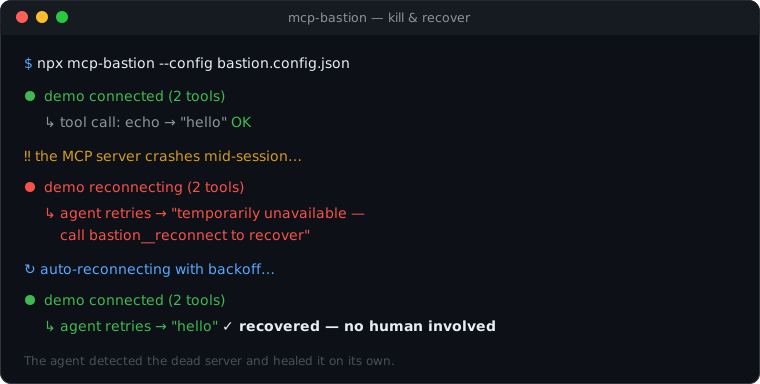
<img src="./assets/demo.svg" alt="mcp-bastion: an MCP server crashes mid-session and the agent recovers it automatically" width="760">

</div>

---

`mcp-bastion` sits between your MCP client (Claude Code, Cursor, Cline, Windsurf, Zed, Claude
Desktop, or any MCP-compliant agent) and your MCP servers. It is **client-agnostic** — it works with
any compliant client through configuration alone, with zero client-specific code — and **non-invasive**:
your servers run unchanged, and removing Bastion is a one-line config revert.

📦 **Package:** [`mcp-bastion` on npm](https://www.npmjs.com/package/mcp-bastion) · 🗂️ **Official MCP Registry:** `io.github.Gowthaman90/mcp-bastion`

🔒 **Security, measured:** on the open, vendor-neutral [mcp-defense-bench](https://github.com/Gowthaman90/mcp-defense-bench), Bastion covers **63% of the MCP attack surface (15.0/24 vectors; 11 enforced)** at zero false positives — the broadest of the proxies measured.

📖 **Launch story:** [Medium](https://medium.com/p/e74f638e9e15) · [dev.to](https://dev.to/gowthaman90/the-mcp-reliability-security-gap-and-an-open-source-proxy-that-fills-it-3ppo)

👤 **Created & maintained by [Gowthaman Arumugam](https://github.com/Gowthaman90)** — Independent Researcher. Companion benchmark: [mcp-defense-bench](https://github.com/Gowthaman90/mcp-defense-bench).

## Contents

- [Why](#why)
- [How it works](#how-it-works)
- [Features](#features)
- [Quick start](#quick-start)
- [Demo](#demo)
- [Control tools](#control-tools)
- [Configuration](#configuration)
- [Transports](#transports)
- [Runtime security](#runtime-security)
- [Audit & compliance](#audit--compliance)
- [Client setup](#client-setup)
- [Architecture](#architecture)
- [Development](#development)
- [Roadmap](#roadmap)
- [Contributing](#contributing)
- [Security](#security)
- [License](#license)

## Why

When an MCP server disconnects mid-session, the agent only sees a generic _"No such tool available"_
error — **indistinguishable from a tool that never existed** — and it cannot reconnect; only a human
can. Long agent sessions silently lose capabilities and fail in confusing ways.

Bastion closes that gap. It health-checks every server, auto-reconnects with backoff, and — crucially —
exposes control tools so the **agent itself** can inspect connection health and recover a dropped
server without human intervention.

> Bastion now spans three layers: **reliability** (v0.1), **runtime security** (v0.2 — tool pinning /
> rug-pull & poisoning detection), and **audit & compliance** (v0.3 — pluggable sinks mapped to NIST
> AI RMF / OWASP LLM Top 10). See the [roadmap](#roadmap).

## How it works

Today your client connects **directly** to each server. With Bastion, your client connects to
**Bastion**, which connects to those same servers on your behalf — so it sits in the tool-call path
and can add reliability (and, later, security) transparently.

```
Before:   Client ─▶ server A / server B / server C

After:    Client ─▶ mcp-bastion ─▶ server A
                                  ─▶ server B
                                  ─▶ server C
```

Bastion is a standard MCP **server** to your client and a standard MCP **client** to each upstream.
Because it speaks the protocol faithfully, it works with every compliant client automatically — the
only per-client difference is where you put a few lines of config.

## Features

- 🔌 **Client-agnostic** — one binary, config-only integration; no per-client plugins.
- ♻️ **Self-healing** — health checks + capped exponential-backoff auto-reconnect for stdio servers.
- 🧭 **Agent-recoverable** — `bastion__status` and `bastion__reconnect` let the agent detect and fix
  drops itself, instead of hitting an opaque "no such tool" wall.
- 🧩 **Transparent aggregation** — merges many servers into one, with per-server tool namespacing to
  prevent collisions and tool-shadowing.
- 💬 **Legible failures** — a dropped server yields an actionable message, not a crash.
- 🛡️ **Runtime security** _(new in v0.2)_ — pins each tool's definition and blocks "rug pulls" (a
  server changing a tool after approval); heuristically inspects descriptions for poisoning; detects
  cross-server shadowing. See [Runtime security](#runtime-security).
- 📝 **Audit & compliance** _(new in v0.3, opt-in)_ — structured, integrity-hash-chained audit events to
  pluggable sinks (console / file / webhook), mapped to NIST AI RMF & OWASP LLM Top 10. See
  [Audit & compliance](#audit--compliance).
- 🪶 **Non-invasive & reversible** — your servers run unchanged; uninstall is a config revert.
- 🧱 **Enterprise-grade codebase** — strict TypeScript, layered architecture, ESLint + Prettier, and
  unit + end-to-end tests.

## Quick start

Bastion is published on npm as [`mcp-bastion`](https://www.npmjs.com/package/mcp-bastion) — the
`npx` command below fetches it automatically, so there's nothing to install first.

**1. Add Bastion to your client**, pointing it at a config file:

```jsonc
// your client's mcpServers config
{
  "mcpServers": {
    "bastion": {
      "command": "npx",
      "args": ["-y", "mcp-bastion", "--config", "bastion.config.json"],
    },
  },
}
```

**2. List your real servers in `bastion.config.json`** (moved verbatim from the client):

```jsonc
{
  "servers": {
    "github": { "command": "npx", "args": ["-y", "@modelcontextprotocol/server-github"] },
    "filesystem": {
      "command": "npx",
      "args": ["-y", "@modelcontextprotocol/server-filesystem", "/path/to/dir"],
    },
  },
  "reconnect": { "auto": true },
  "healthCheck": { "enabled": true },
}
```

**3. Restart your client.** Your tools now appear namespaced (e.g. `github__create_issue`) alongside
Bastion's control tools. See [`bastion.config.example.json`](./bastion.config.example.json) for the
full set of options.

> 🔒 **Security is on by default.** Out of the box, Bastion runs the `balanced` enforcement profile:
> it **blocks** high-confidence attacks (rug-pulls, argument/command injection, cross-server
> exfiltration) and **warns** on heuristic ones (description/response
> poisoning), while redacting leaked secrets from tool results. Set `security.enforcementProfile` to
> `observe` (warn-only) or `strict` (block-all), or tune any individual control — see
> [Runtime security](#runtime-security).

## Demo

See the whole thing in action — a server crashing mid-session and healing itself:

```bash
npm run demo
```

It boots Bastion in front of a server that crashes on command, shows the agent getting an actionable
"reconnect" message instead of a cryptic error, and then the connection auto-recovering with no human
involved. To record it as a GIF: `asciinema rec demo.cast -c "npm run demo" && agg demo.cast assets/demo.gif`.

## Control tools

Bastion injects control tools so the agent can manage connections and review security itself, using
only standard MCP calls:

| Tool                  | Purpose                                                                                                    |
| --------------------- | ---------------------------------------------------------------------------------------------------------- |
| `bastion__status`     | Health of every proxied server: connected / disconnected / reconnecting / failed, tool counts, last error. |
| `bastion__reconnect`  | Reconnect a named server (argument: `{ "server": "<name>" }`) without human intervention.                  |
| `bastion__security`   | Per-tool security report: pin status (approved vs changed), poisoning findings, and shadowing.             |
| `bastion__compliance` | Audit summary of recent activity mapped to NIST AI RMF / OWASP LLM Top 10 (requires `audit.enabled`).      |

> **Re-approval is operator-only.** Clearing a rug-pull block is a security authority, so it is **not** an
> agent-callable tool — a prompt-injected agent must not be able to re-approve the very tool it was blocked
> from. A changed tool stays blocked until an operator clears it out-of-band; `bastion__approve` is not
> advertised and a client call to it is refused.

## Configuration

| Key                            | Type                       | Default              | Description                                          |
| ------------------------------ | -------------------------- | -------------------- | ---------------------------------------------------- |
| `servers`                      | map                        | —                    | Upstream servers to proxy (required, at least one).  |
| `servers.<name>.command`       | string                     | —                    | Executable to launch (e.g. `npx`, `node`).           |
| `servers.<name>.args`          | string[]                   | `[]`                 | Arguments to `command`.                              |
| `servers.<name>.env`           | map                        | —                    | Env overrides merged over the process env.           |
| `servers.<name>.cwd`           | string                     | —                    | Working directory for the spawned process.           |
| `reconnect.auto`               | boolean                    | `true`               | Auto-reconnect after an unexpected disconnect.       |
| `reconnect.maxRetries`         | number                     | `10`                 | Max attempts before giving up (`-1` = unlimited).    |
| `reconnect.initialBackoffMs`   | number                     | `500`                | Initial backoff, doubled each attempt.               |
| `reconnect.maxBackoffMs`       | number                     | `30000`              | Backoff ceiling.                                     |
| `healthCheck.enabled`          | boolean                    | `true`               | Enable periodic liveness probing.                    |
| `healthCheck.intervalMs`       | number                     | `30000`              | Interval between probes.                             |
| `healthCheck.timeoutMs`        | number                     | `5000`               | Per-probe timeout.                                   |
| `namespace.strategy`           | `prefix` \| `passthrough`  | `prefix`             | How upstream tool names are exposed.                 |
| `namespace.separator`          | string                     | `__`                 | Separator used by the `prefix` strategy.             |
| `security.pinTools`            | boolean                    | `true`               | Pin tool definitions and detect later changes.       |
| `security.onRugPull`           | `block` \| `warn`          | `block`              | Action when a pinned tool's definition changed.      |
| `security.inspectDescriptions` | boolean                    | `true`               | Run poisoning heuristics on tool descriptions.       |
| `security.onPoisoning`         | `block` \| `warn`          | `warn`               | Action on a high-severity poisoning finding.         |
| `audit.enabled`                | boolean                    | `false`              | Record an audit event for every tool call.           |
| `audit.includeArgs`            | `none`\|`redacted`\|`full` | `none`               | How tool arguments are recorded.                     |
| `audit.tamperEvident`          | boolean                    | `false`              | Hash-chain events so tampering is detectable.        |
| `audit.sinks`                  | array                      | console              | Destinations: `console`, `file`, `webhook`, `otlp`.  |
| `servers.<name>.transport`     | `stdio` \| `http`          | `stdio`              | Local subprocess or remote endpoint.                 |
| `servers.<name>.url`           | string                     | —                    | Remote MCP URL (required for `http`).                |
| `servers.<name>.headers`       | map                        | —                    | Headers for `http` upstreams (e.g. `Authorization`). |
| `listen.mode`                  | `stdio` \| `http`          | `stdio`              | Serve Bastion over stdio or Streamable HTTP.         |
| `listen.host` / `listen.port`  | string / number            | `127.0.0.1` / `3000` | Bind address for `http` mode.                        |

## Transports

Bastion speaks two transports on **both** faces:

- **stdio** (default) — the client spawns Bastion, and Bastion spawns local servers.
- **Streamable HTTP** — connect to **remote** MCP servers (`servers.<name>` with `transport: "http"`,
  a `url`, and optional auth `headers`), and/or **serve** Bastion over HTTP to multiple/remote clients
  (`listen.mode: "http"`, or `--http <port>`).

HTTP upstreams configured without an authentication header are flagged (`authenticated: false`) in
`bastion__status` and warned at connect time.

## Runtime security

_New in v0.2._ Bastion adds a security layer in the tool-call path (an interceptor pipeline), enabled
by default:

- **Rug-pull detection (tool pinning).** Each tool's definition is pinned on first use. If a server
  later changes that definition, the tool is blocked (`onRugPull: "block"`) until an operator reviews it
  and re-approves it out-of-band (operator-only — not an agent-callable tool). This catches a server that
  looks benign at install time and turns malicious afterward.
- **Poisoning inspection.** Tool names and descriptions are scanned for manipulation heuristics
  (instruction override, secret access, data exfiltration, covert instructions, embedded directives,
  hidden/zero-width characters). Because heuristics can false-positive, the default is `warn` (logged
  and reported, not blocked); set `onPoisoning: "block"` to enforce.
- **Shadowing.** When two servers expose a tool with the same name, it's surfaced in the report.

Review everything with the `bastion__security` tool. These checks apply to local stdio servers today;
authentication checks for remote servers arrive with HTTP transport support.

## Audit & compliance

_New in v0.3, opt-in._ Enable `audit` to record a structured, versioned event for every tool call —
including calls blocked by the security layer:

```jsonc
"audit": {
  "enabled": true,
  "includeArgs": "redacted",     // none | redacted | full
  "tamperEvident": true,          // integrity hash-chain (detects naive edits; unkeyed, not signed)
  "sinks": [
    { "type": "file", "path": "./bastion-audit.jsonl" },
    { "type": "webhook", "url": "https://collector.example/v1/audit" }
  ]
}
```

- **Pluggable sinks.** `console` (stderr JSONL), `file` (JSONL append), `webhook` (batched POST), and
  `otlp` (native OpenTelemetry logs export — point it at an OTel Collector to fan out to any SIEM/cloud
  backend). The sink interface makes new destinations additive.
- **Compliance mapping.** Each event is mapped to **NIST AI RMF** functions and **OWASP LLM Top 10**
  categories; `bastion__compliance` returns an aggregate report of recent activity.
- **Integrity hash chain.** With `tamperEvident`, events are linked by a SHA-256 hash chain, and the
  exported `verifyChain` helper detects naive or partial edits within an intact log. The chain is
  **unkeyed**: a party who can rewrite the log file can recompute a consistent chain, and truncating the
  most-recent events links cleanly — so treat this as corruption-detection, **not** cryptographic
  tamper-proofing. For stronger guarantees, ship events to an append-only external sink (webhook / OTLP →
  a WORM store or SIEM). Keyed/signed attestation is on the roadmap.
- **Redaction (best-effort).** Arguments are omitted by default; `includeArgs: "redacted"` keeps structure
  while masking values under known credential key-names and common secret patterns. It is a heuristic, not
  a guarantee — a secret under an unrecognized key can still be recorded, so prefer `none` for
  high-sensitivity deployments.

## Standards alignment

Every security check maps to recognized frameworks — the **NIST AI Risk Management Framework** (a U.S.
federal standard), the **OWASP Top 10 for LLM (2025)** and **Agentic (2026)** Applications, and
**STRIDE**. The full per-check mapping (with reference links to the MCP-security literature the checks
are drawn from) is in **[docs/CHECKS-MAPPING.md](docs/CHECKS-MAPPING.md)**.

Coverage is measured independently — bastion is scored against a 22-vector attack surface by the
vendor-neutral [mcp-defense-bench](https://github.com/Gowthaman90/mcp-defense-bench) benchmark, with a
public [leaderboard and framework mapping](https://gowthaman90.github.io/mcp-defense-bench/).

## Client setup

The steps are identical for every client — only the **config file location** differs:

| Client         | Where to add the `bastion` entry                   |
| -------------- | -------------------------------------------------- |
| Claude Code    | project `.mcp.json` (or `claude mcp add`)          |
| Cursor         | `~/.cursor/mcp.json` or project `.cursor/mcp.json` |
| Claude Desktop | `claude_desktop_config.json`                       |
| Cline          | `cline_mcp_settings.json`                          |
| Windsurf       | `~/.codeium/windsurf/mcp_config.json`              |

> **Gradual adoption:** you don't have to route every server through Bastion — put only your flaky or
> untrusted servers behind it and leave the rest connected directly.

## Architecture

Bastion is organized into clear layers with a one-directional dependency flow, so each concern is
independently testable and easy to evolve:

```
src/
├── cli.ts              # thin CLI entrypoint (parse → wire → serve)
├── index.ts            # public library API
├── errors.ts           # error hierarchy (BastionError, …)
├── config/             # schema (Zod) + loader
├── core/               # domain: upstream connection lifecycle, aggregation & routing
├── proxy/              # client-facing MCP server + control tools
├── observability/      # logging (audit sinks in v0.3)
└── internal/           # small cross-cutting utilities
```

Design details — including the client-agnostic rationale, the interceptor pipeline, and the audit-sink
strategy — live in the project's design docs.

## Development

```bash
npm install
npm run check      # format:check + lint + typecheck + test (the full gate)
npm test           # unit + end-to-end (in-memory transport) tests
npm run build      # bundle to dist/ (CLI + library)
npm run dev -- --config bastion.config.json
```

| Script                    | Does                                |
| ------------------------- | ----------------------------------- |
| `build`                   | Bundle CLI + library with `tsup`.   |
| `dev`                     | Run the CLI from source with `tsx`. |
| `typecheck`               | `tsc --noEmit` (strict).            |
| `lint` / `lint:fix`       | ESLint (flat config).               |
| `format` / `format:check` | Prettier.                           |
| `test` / `test:watch`     | Vitest.                             |
| `check`                   | Everything above, as one gate.      |

## Roadmap

| Version     | Theme                  | Highlights                                                                                |
| ----------- | ---------------------- | ----------------------------------------------------------------------------------------- |
| **v0.1** ✅ | **Reliability**        | Aggregating proxy, auto-reconnect, `bastion__status` / `__reconnect`.                     |
| **v0.2** ✅ | **Runtime security**   | Tool-definition pinning (rug-pull detection), poisoning inspection, shadowing detection.  |
| **v0.3** ✅ | **Audit & compliance** | Pluggable audit sinks (console / file / webhook), NIST AI RMF / OWASP LLM Top 10 mapping. |

Both **stdio** and **Streamable HTTP** transports are supported (see [Transports](#transports)).

## Contributing

Contributions are very welcome — this project is built to be community-owned. Please read
**[CONTRIBUTING.md](./CONTRIBUTING.md)** for the dev setup, project layout, and PR workflow, and our
**[Code of Conduct](./CODE_OF_CONDUCT.md)**.

In short: open an issue for non-trivial changes, keep PRs focused with tests, and make sure
`npm run check` passes (CI runs it on Node 18/20/22). Good first areas: additional client setup
recipes, more upstream test fixtures, and Streamable HTTP transport support.

## Security

`mcp-bastion` is security-adjacent software, so we hold it to a high bar. Please report
vulnerabilities privately — **do not open a public issue**. See **[SECURITY.md](./SECURITY.md)** for
the disclosure process.

## License

[Apache-2.0](./LICENSE) © Gowthaman Arumugam and mcp-bastion contributors