# leakferret [Health: Active]
**Category:** 🔒 Security
**Repository:** https://github.com/leakferrethq/leakferret
**GitHub Stars:** 5
**Views:** 0
**Installs:** 0
**Upvotes:** 0
**Directory Page:** https://allmcps.com/mcp/leakferret
## Description
Context-aware secret scanner: lets an AI agent scan, verify, and rewrite secrets before committing.
## Claude Desktop Quick Installation
Install path detected from listing signals. Uses `npx` (confidence: high):
```json
"mcpServers": {
"leakferret": {
"command": "npx",
"args": ["-y","@leakferret/mcp"]
}
}
```
## Documentation & README





**MCP-native secret scanner — verified findings, agent-applied rewrites.**
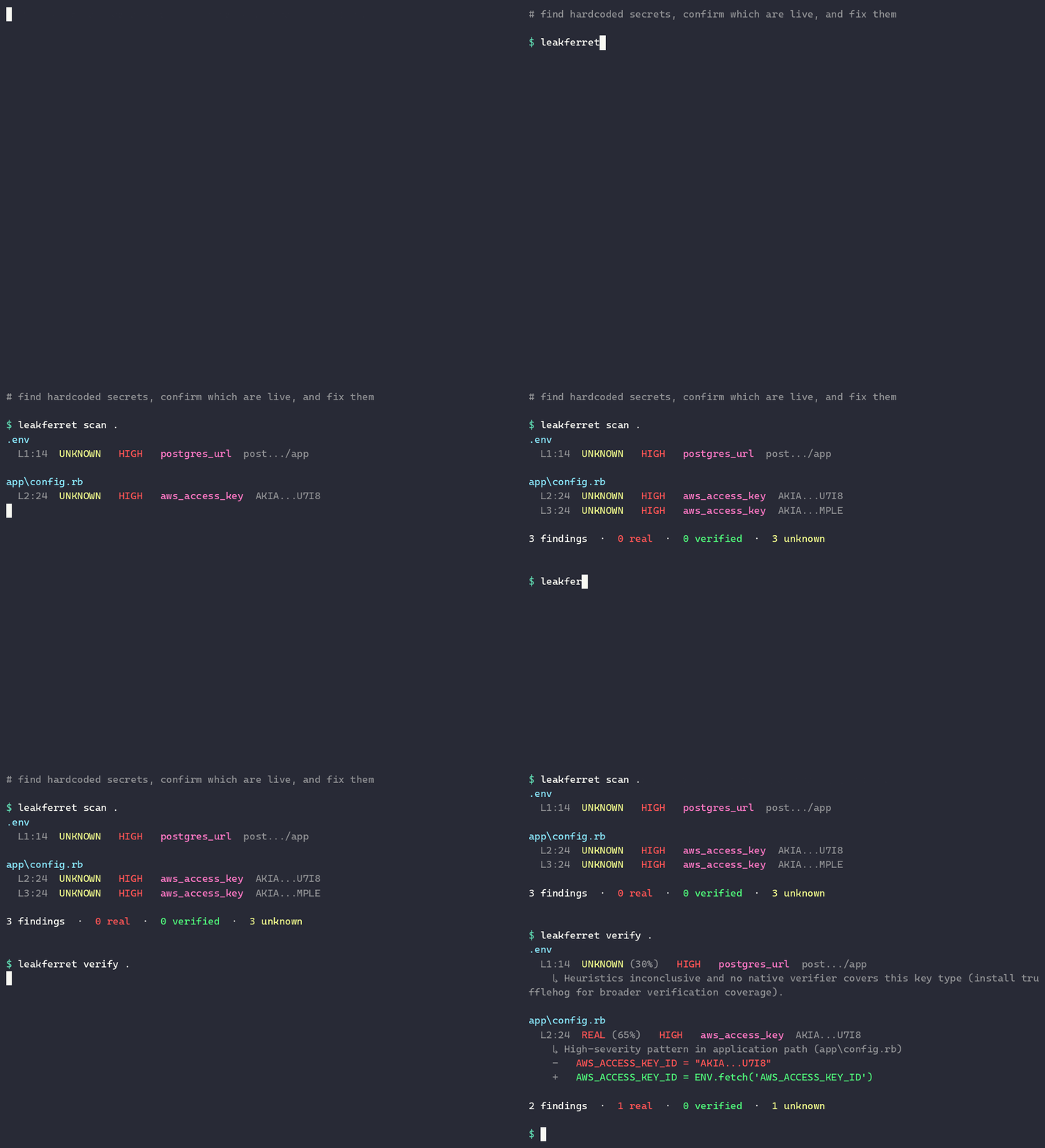
leakferret is one fast Rust binary that is engine, CLI, and MCP server. It finds
hardcoded secrets in your code, **calls the provider to confirm which ones are
actually live**, and **rewrites the leak in place** to read from an environment
variable. It runs in your terminal, in CI, and as a tool your coding agent calls
before it commits — and the raw secret never leaves your machine.
---
## What it looks like
Say you accidentally commit a real key, plus the usual noise:
```env
# .env — every key below is fabricated for this example
STRIPE_SECRET_KEY=sk_live_FAKE_example_not_a_real_key # fabricated
GITHUB_TOKEN=ghp_FAKE_example_not_a_real_token # fabricated
SENDGRID_API_KEY=${SENDGRID_API_KEY} # a reference — not a leak
ADMIN_PASSWORD=changeme # a placeholder — not a leak
AWS_ACCESS_KEY_ID=AKIAIOSFODNN7EXAMPLE # AWS's public docs example
```
`leakferret verify` calls each provider and tells you what is **real and live** —
and stays quiet on the rest:
```text
$ leakferret verify .
.env
L2 UNKNOWN CRITICAL stripe_secret sk_l..._key
L3 VERIFIED CRITICAL github_token ghp_...oken ← live, rotate it now
2 findings · 1 verified · 1 unknown
```
The keys above are fabricated, so the `VERIFIED` line illustrates what a
genuinely live key reports — on these examples both would be `UNKNOWN`.
The `${SENDGRID_API_KEY}` reference, the `changeme` placeholder, and the
well-known `AKIAIOSFODNN7EXAMPLE` example are recognized and **left out** — that
precision is the point. Then `leakferret rewrite --apply` rewrites the
hardcoded key **in your code** (it leaves `.env` files alone — there's nothing
sensible to rewrite a secret *to* there):
```diff
# app/billing.rb (fabricated example)
- Stripe.api_key = "sk_live_FAKE_example_not_a_real_key" # fabricated
+ Stripe.api_key = ENV.fetch("STRIPE_API_KEY")
```
…and appends `STRIPE_API_KEY=` to `.env.example` with a seed command for your
secret manager. **Find → confirm live → fix**, with almost no false alarms.
> The full secret value never leaves your machine. Only a redacted
> `AKIA...4XYZ` preview is ever written to a report, log, or network message.
---
## Quick start
Install however you like — every package ships the same prebuilt binary.
```bash
# Ruby gem
gem install leakferret
# npm (CLI)
npm i -g @leakferret/cli
# Go
go install github.com/leakferrethq/leakferret-go/cmd/leakferret@latest
# Native binary — download from GitHub Releases, unpack, and put it on $PATH:
# https://github.com/leakferrethq/leakferret/releases
# Rust, from source
cargo install leakferret-cli
```
Then scan the current directory:
```bash
leakferret scan .
```
`scan` respects `.gitignore` and also reads dotfiles such as `.env`. Add
`--git` to walk commit history instead of the working tree.
> Every wrapper honors a `LEAKFERRET_BIN` environment variable pointing at a
> local binary, for offline or development use.
---
## How it works
leakferret runs findings through a five-station pipeline. Each station only
sees what it needs, and the raw secret never advances past disk.
1. **Scan** — a fast regex pre-filter over your files, across **60+ secret
types**. Respects `.gitignore`, reads dotfiles like `.env`, and (with
`--git`) walks history.
2. **Catalog** — every candidate is checked against a signed database of
*known-public* example credentials: Stripe test keys,
`AKIAIOSFODNN7EXAMPLE`, jwt.io samples, RFC examples. Matches are marked
**FIXTURE** so documented examples never raise a false alarm. The catalog is
bundled with the binary and can be refreshed and signature-verified.
3. **Classify** — each remaining candidate gets a verdict: **REAL**,
**FIXTURE**, or **UNKNOWN**. This runs offline by default (path rules plus
dummy-marker heuristics), or asks the host editor or agent's own language
model — no extra API key, no added cost.
4. **Verify** — makes a single harmless API call to the provider to confirm a
key is **LIVE**. Around **25 providers** are covered natively (AWS SigV4,
GitHub, GitLab, Stripe, OpenAI, Anthropic, Slack, Twilio, SendGrid, Mailgun,
Datadog, Heroku, npm, PyPI, DigitalOcean, Hugging Face, Groq, Replicate,
Notion, Postman, Figma, Linear, Square, Shopify, Databricks), with a
trufflehog binary fallback for the rest. The call goes straight from your machine to the
provider — leakferret has no servers.
5. **Rewrite** — swaps a hardcoded literal for an environment-variable lookup
(`ENV.fetch` / `os.environ` / `process.env`), appends a line to
`.env.example`, and prints seed commands for your secret manager (env,
Vault, Doppler, AWS Secrets Manager, or Infisical).
A **baseline** stores one-way HMAC fingerprints of known findings — never the
raw secret — so CI can fail only on *new* leaks.
---
## Use it with AI agents (MCP)
MCP (Model Context Protocol) is the open standard for giving coding agents
tools. Agents hardcode secrets too, and nobody reviews their diffs line by
line — leakferret lets the agent self-check before it commits.
Start the server over JSON-RPC on stdio:
```bash
npx @leakferret/mcp
```
Add it to your `mcpServers` config (Claude Desktop, Cursor, Continue,
Claude Code):
```json
{
"mcpServers": {
"leakferret": {
"command": "npx",
"args": ["@leakferret/mcp"]
}
}
}
```
For **Claude Code**, save that block as `.mcp.json` in your project root, or add
it with one command:
```bash
claude mcp add leakferret -- npx -y @leakferret/mcp
```
If you installed the native binary, you can point at it directly instead:
```json
{
"mcpServers": {
"leakferret": {
"command": "leakferret",
"args": ["mcp"]
}
}
}
```
leakferret is also listed in the [MCP Registry](https://registry.modelcontextprotocol.io)
as `io.github.leakferrethq/leakferret`, so registry-aware clients can discover it.
Tools exposed: `scan_repository`, `classify_candidates`, `verify_finding`,
`propose_rewrite`, and `baseline_diff`. A `classify` prompt is also provided so
an agent can classify candidates inline using the model it already has. Two
read-only resources expose the engine's catalog as context: `leakferret://secret-types`
(every detectable pattern) and `leakferret://verifiers` (the live-verification providers).
---
## How it compares
| | gitleaks | trufflehog | detect-secrets | GitGuardian | leakferret |
| ---------------------------- | :------: | :--------: | :------------: | :---------: | :--------: |
| Live provider verification | — | ✓ | — | ✓ | ✓ |
| In-place env-var rewrite | — | — | — | — | ✓ |
| MCP server for AI agents | — | — | — | — | ✓ |
| Baseline (fail only on new) | — | — | ✓ | ✓ | ✓ |
| SARIF / Code Scanning | ✓ | ✓ | — | ✓ | ✓ |
| Free, local, no account | ✓ | ✓ | ✓ | — | ✓ |
gitleaks is the fastest pre-commit regex blocker. trufflehog set the bar for live
verification. detect-secrets owns the baseline-a-legacy-repo workflow. GitGuardian is
the paid platform with the broadest detectors and a dashboard. leakferret does the
regex pre-filter, verifies which keys are live, rewrites the leak to an env var, and
runs as an MCP server so coding agents check their own diffs. Full writeup:
[leakferret.com/compare](https://leakferret.com/compare/).
---
## CLI reference
```text
leakferret scan Regex pre-filter only (no classifier, no verifier)
leakferret verify Scan + classify + provider verification
leakferret rewrite Scan + classify + propose/apply ENV-fetch rewrites
leakferret org Scan every public repo owned by a GitHub user/org
leakferret baseline Manage the per-repo fingerprint baseline
leakferret catalog Load and inspect the fixture catalog
leakferret mcp Start the MCP server on stdio
```
Scan a whole GitHub account or org in one go (handy for finding leaks across all
your public repos before someone else does):
```bash
leakferret org leakferrethq # all public repos for that owner
leakferret org myco --token "$GITHUB_TOKEN" --format sarif > leaks.sarif
```
Common flags:
```bash
# scan
leakferret scan . # working tree
leakferret scan . --git # scan HEAD's commit history
leakferret scan . --git --all # scan every branch / tag
leakferret scan . --git --since HEAD~50 # bounded history window
# verify
leakferret verify . # best-effort verification
leakferret verify . --verify-mode none --fail-on any # offline gate: exit 1 on any finding
leakferret verify . --only-verified # emit only confirmed-live keys
leakferret verify . --verify-mode ever-verified # fail on historical leaks
leakferret verify . --verifier-timeout-secs 10
# rewrite
leakferret rewrite . --apply # write ENV.fetch in place
leakferret rewrite . --dry-run-diff # show the diff, touch nothing
leakferret rewrite . --check # CI mode: exit 1 if rewrites pending
leakferret rewrite . --apply --include-unknown # also fix UNKNOWN (unconfirmed) candidates
leakferret rewrite . --backend doppler # seed cmds for your manager
# baseline (scan/verify are read-only — they never write to your repo)
leakferret baseline init # create .leakferret-baseline.json (gitignores the salt)
leakferret verify . --update-baseline # record current findings into the baseline
leakferret baseline show
leakferret baseline ignore --fingerprint # acknowledge a finding
# catalog
leakferret catalog info
leakferret catalog test "sk_test_4eC39..." # deterministic FIXTURE verdict
leakferret catalog refresh # fetch + signature-verify update
```
Shared flags on `scan` / `verify` / `rewrite`: `--format`, `--show-fixtures`,
`--exclude `, `--only `, `--only-verified`,
`--fail-on `.
`--backend` accepts `env`, `vault`, `doppler`, `aws-secrets-manager`,
`infisical`.
---
## Block commits locally (pre-commit hook)
Catch a secret before it is ever committed. From your repo root:
```bash
cat > .git/hooks/pre-commit <<'HOOK'
#!/bin/sh
# Offline secret scan (no network). Blocks the commit on any finding.
leakferret verify . --verify-mode none --fail-on any || {
echo "leakferret blocked this commit. Bypass: git commit --no-verify"
exit 1
}
HOOK
chmod +x .git/hooks/pre-commit
```
`--verify-mode none` keeps it fully offline; `--fail-on any` exits non-zero on
any non-fixture finding (documented examples like `AKIAIOSFODNN7EXAMPLE` are
still ignored). Pair it with `leakferret baseline init` so the hook only blocks
on *new* secrets. To share the hook with a team, commit it to `.githooks/` and
run `git config core.hooksPath .githooks` once.
The hook runs on **any** git client — the terminal, GitHub Desktop, the
VS Code Source Control panel, JetBrains, and so on — because they all run git's
pre-commit hook. A blocked commit shows the leakferret output in that client's
"commit failed" dialog.
**A pre-commit hook is a local convenience, not a wall.** Anyone — or any AI
agent — can skip it with `git commit --no-verify`, and git offers no way to
forbid that locally. So treat the hook as fast feedback, and make the
[GitHub Action](https://github.com/leakferrethq/leakferret-action) (or the same
`leakferret verify` step in your CI) the **enforcing** gate: it runs
server-side on every push and pull request, where `--no-verify` can't reach it.
---
## Output formats
Choose with `--format`:
- **pretty** — colored terminal output (default).
- **json** — structured findings for scripting and pipelines.
- **sarif** — for GitHub Code Scanning. The GitHub Action wrapper
(`leakferrethq/leakferret-action@v1`) uploads it for you.
---
## Privacy guarantee
This is the trust story, and a dedicated test enforces it:
> The full secret value lives only on disk. It is **never** written into any
> report, log, network message, or model prompt. Only a redacted first-4 +
> last-4 preview (for example `AKIA...4XYZ`) ever leaves the process.
Verification sends the key straight from your machine to the provider.
leakferret has no servers and collects nothing. Baselines store one-way HMAC
fingerprints, never the raw secret.
**One operational caveat about `verify`.** Verification makes a real,
authenticated request per candidate, so it lands in the key owner's own audit
log — an AWS STS `GetCallerIdentity` shows up in CloudTrail, a GitHub token
check shows up as token use, and so on. Point `verify` only at repositories
whose secrets are yours to test; running it against someone else's code means
authenticating into their accounts and leaving traces there. To scan with no
network calls at all, use `leakferret scan` instead of `verify`, or pass
`--verify-mode none`.
---
## How it compares
- **gitleaks** is a fast regex scanner. leakferret matches that pre-filter and
adds provider verification, so you act on live keys instead of triaging
regex noise.
- **trufflehog** verifies secrets against providers. leakferret matches that
too — and adds the MCP/agent layer and the agent-applied rewrite that neither
competitor has. The signed fixture catalog also keeps known-public example
keys from being reported as live.
---
## Platforms
Prebuilt binaries for v0.1.6:
- `x86_64-unknown-linux-gnu`
- `x86_64-apple-darwin`
- `aarch64-apple-darwin`
- `x86_64-pc-windows-msvc`
- `aarch64-pc-windows-msvc`
---
## Verifying the binaries
Every release tarball is signed with [Sigstore](https://www.sigstore.dev/) /
cosign — keyless, via GitHub OIDC — and ships a matching `*.cosign.bundle`. You
can prove a download was built by this repository's release workflow and was
never tampered with:
```bash
cosign verify-blob \
--bundle leakferret-0.1.6-x86_64-unknown-linux-gnu.tar.gz.cosign.bundle \
--certificate-identity-regexp 'https://github.com/leakferrethq/leakferret/.*' \
--certificate-oidc-issuer https://token.actions.githubusercontent.com \
leakferret-0.1.6-x86_64-unknown-linux-gnu.tar.gz
```
Each tarball also ships a `.sha256` for a basic integrity check.
---
## Links
- Website:
- Source:
- Catalog data:
- Wrappers: [ruby](https://github.com/leakferrethq/leakferret-ruby) ·
[go](https://github.com/leakferrethq/leakferret-go) ·
[npm](https://github.com/leakferrethq/leakferret-npm) ·
[action](https://github.com/leakferrethq/leakferret-action) ·
[vscode](https://github.com/leakferrethq/leakferret-vscode)
- Maintainer: Maria Khan <missusk@protonmail.com>
## License
MIT for the engine, CLI, MCP server, and all language wrappers.
CC-BY-SA-4.0 for the fixture catalog data.
[trufflehog](https://github.com/trufflesecurity/trufflehog) is an optional,
user-installed AGPL-3.0 tool that leakferret invokes as a separate process for
fallback verification. It is not bundled, modified, or redistributed. See
[`NOTICE`](https://github.com/leakferrethq/leakferret/blob/HEAD/NOTICE).