# kotlin-lib-mcp

**Category:** 💻 Developer Tools  
**Repository:** https://github.com/aoreshkov/kotlin-lib-mcp  
**Views:** 0  
**Installs:** 0  
**Upvotes:** 0  
**Directory Page:** https://allmcps.com/mcp/kotlin-lib-mcp

## Description
Exposes the public API, KDoc and sources of Maven-published Kotlin/Java libraries to MCP clients

## Claude Desktop Quick Installation
Heuristic fallback — verify the package name and runner against the repository README before running it. Uses `npx` (confidence: low):

```json
"mcpServers": {
  "kotlin-lib-mcp": {
    "command": "npx",
    "args": ["-y","kotlin-lib-mcp"]
  }
}
```

## Documentation & README

# kotlin-lib-mcp

[![CI](https://github.com/aoreshkov/kotlin-lib-mcp/actions/workflows/ci.yml/badge.svg)](https://github.com/aoreshkov/kotlin-lib-mcp/actions/workflows/ci.yml)
[![CodeQL](https://github.com/aoreshkov/kotlin-lib-mcp/actions/workflows/codeql.yml/badge.svg)](https://github.com/aoreshkov/kotlin-lib-mcp/actions/workflows/codeql.yml)
[![Release](https://img.shields.io/github/v/release/aoreshkov/kotlin-lib-mcp)](https://github.com/aoreshkov/kotlin-lib-mcp/releases/latest)
[![License](https://img.shields.io/badge/license-Apache--2.0-blue.svg)](LICENSE)

[![Kotlin](https://img.shields.io/badge/kotlin-2.4-7F52FF.svg?logo=kotlin)](https://kotlinlang.org)
[![GitHub MCP Registry](https://img.shields.io/badge/GitHub_MCP_Registry-listed-24292F.svg?logo=github)](https://github.com/mcp/aoreshkov/kotlin-lib-mcp)

Give your AI agent the **real sources** of any Maven-published Kotlin/Java library.

An [MCP](https://modelcontextprotocol.io) server that, on request, downloads the sources of a
library (e.g. `io.ktor:ktor-client-core:3.5.1`), parses them with the Kotlin **Analysis API**
(standalone K2/FIR mode), and exposes structured information — public API surface, KDoc,
dependencies/metadata, raw source + search — to MCP clients: Claude Code, Claude Desktop,
IntelliJ IDEA (AI Assistant / Junie), VS Code and GitHub Copilot. An optional Compose Desktop
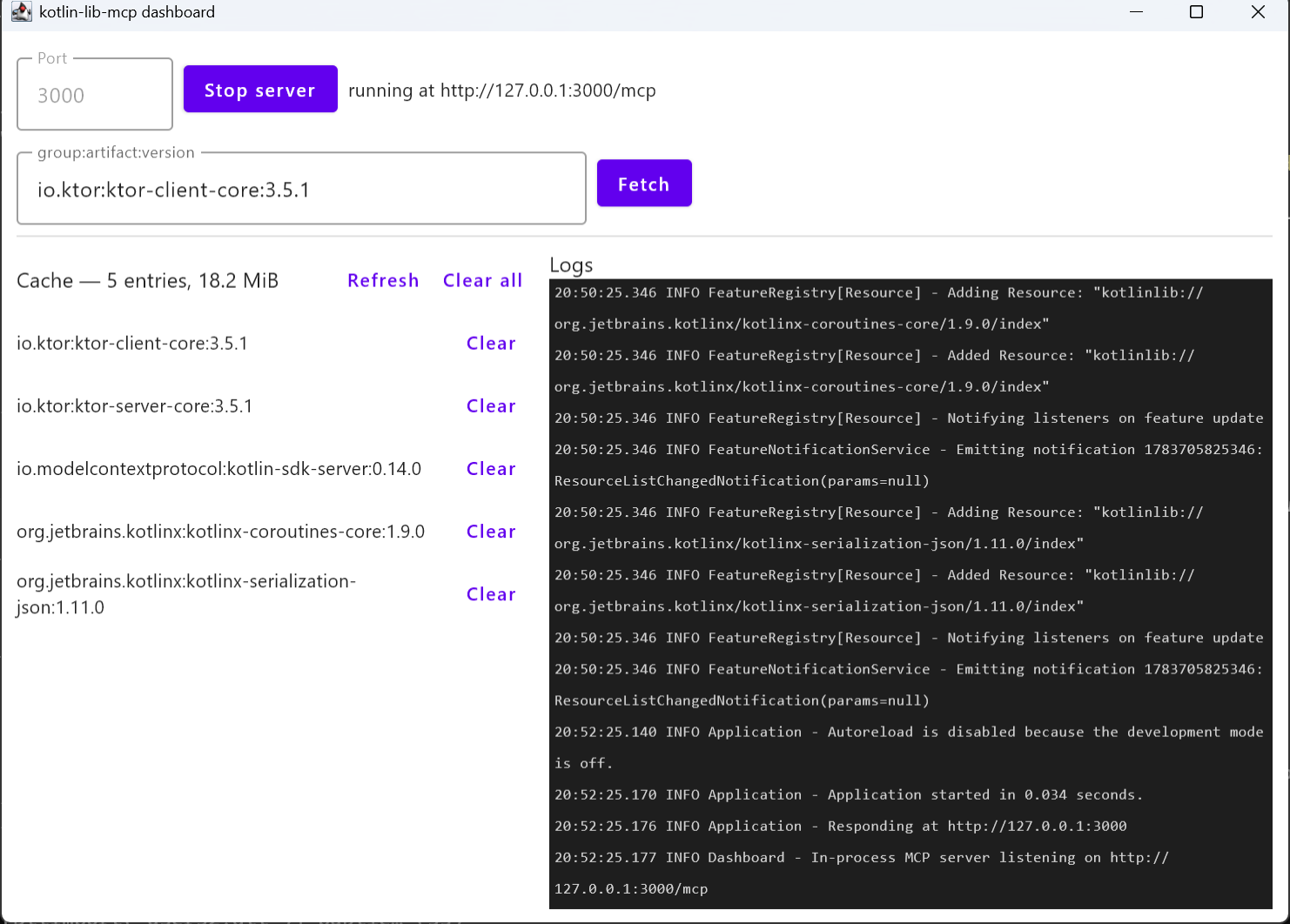
dashboard runs the same server in-process.

**[Ten tools](#tools)** — `fetch_library` · `list_packages` · `list_declarations` ·
`get_api_signature` · `get_kdoc` · `get_source` · `search_source` · `get_dependencies` ·
`list_versions` · `get_latest_version` — plus MCP resources and a prompt.

[<img src="https://img.shields.io/badge/VS_Code-Install_Server-0098FF?style=flat-square" alt="Install in VS Code">](https://insiders.vscode.dev/redirect?url=vscode%3Amcp%2Finstall%3F%257B%2522name%2522%253A%2522kotlin-lib%2522%252C%2522command%2522%253A%2522docker%2522%252C%2522args%2522%253A%255B%2522run%2522%252C%2522-i%2522%252C%2522--rm%2522%252C%2522-v%2522%252C%2522kotlin-lib-mcp-cache%253A%252Fhome%252Fmcp%252F.cache%2522%252C%2522ghcr.io%252Faoreshkov%252Fkotlin-lib-mcp%2522%255D%257D)

[<img src="https://img.shields.io/badge/VS_Code_Insiders-Install_Server-24bfa5?style=flat-square" alt="Install in VS Code Insiders">](https://insiders.vscode.dev/redirect?url=vscode-insiders%3Amcp%2Finstall%3F%257B%2522name%2522%253A%2522kotlin-lib%2522%252C%2522command%2522%253A%2522docker%2522%252C%2522args%2522%253A%255B%2522run%2522%252C%2522-i%2522%252C%2522--rm%2522%252C%2522-v%2522%252C%2522kotlin-lib-mcp-cache%253A%252Fhome%252Fmcp%252F.cache%2522%252C%2522ghcr.io%252Faoreshkov%252Fkotlin-lib-mcp%2522%255D%257D)

Those install the Docker image. For Claude Code, IntelliJ IDEA, or to run the release zip without
Docker, see [Quick start](#quick-start-no-build-required).
<!-- mcp-name: io.github.aoreshkov/kotlin-lib-mcp -->

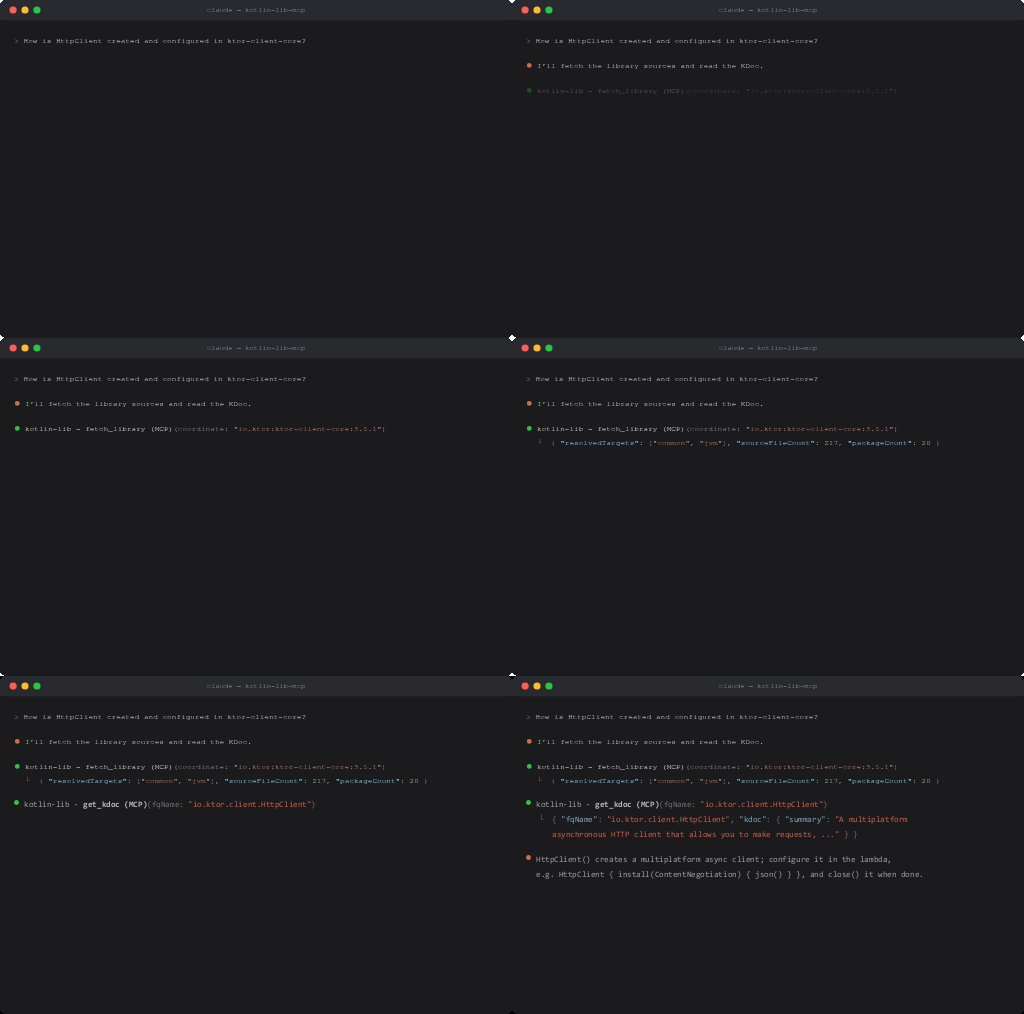
![Claude Code fetching a library and reading KDoc via kotlin-lib-mcp](assets/demo.gif)

<details><summary>Compose Desktop dashboard</summary>

![The dashboard: in-process MCP server, pre-warm form, cache browser and live logs](assets/dashboard.png)

</details>

## Why this and not a docs-lookup server?

Most documentation MCP servers scrape rendered doc sites or feed the model pre-digested
summaries. This one works from the **published sources jar** — the ground truth:

- **Resolved signatures, not regex guesses.** Declarations are analyzed with the same
  Analysis API that powers the Kotlin IDE, so `get_api_signature` returns real, type-resolved
  signatures (with graceful best-effort fallback when transitive dependencies are missing).
- **KMP-aware.** Kotlin Multiplatform libraries publish per-target sources jars; these are
  resolved properly via `.module` Gradle metadata, and every symbol is tagged with its targets.
- **KDoc as data.** Summaries, descriptions and tags are extracted per declaration — not
  whole HTML pages.
- **Exact version you asked for, offline after the first fetch.** Everything is cached on
  disk keyed by `group/artifact/version`; no re-downloads, no drift between the docs and the
  version you actually depend on.
- **Raw source when you need it.** `get_source` and bounded `search_source` let the agent
  read the actual implementation, not just the API.

## Quick start (no build required)

**Option 1 — Claude Code plugin.** The server plus skills that make Claude reach for it, two
commands (`/kotlin-lib:api`, `/kotlin-lib:migrate`) and a setup helper. Needs Docker:

```
/plugin marketplace add aoreshkov/kotlin-lib-mcp
/plugin install kotlin-lib@kotlin-lib-mcp
```

See [`plugin/README.md`](plugin/README.md) for what it bundles.

**Option 2 — release zip.** Download the latest
[release](https://github.com/aoreshkov/kotlin-lib-mcp/releases/latest), unzip (needs a
Java 21+ runtime), then:

```sh
claude mcp add kotlin-lib -- /path/to/kotlin-lib-mcp-server-<version>/bin/server --transport stdio
```

**Option 3 — Docker.**

```sh
claude mcp add kotlin-lib -- docker run -i --rm -v kotlin-lib-mcp-cache:/home/mcp/.cache ghcr.io/aoreshkov/kotlin-lib-mcp
```

**Option 4 — IntelliJ IDEA / Android Studio.** JetBrains IDEs are MCP clients too — which is where
most Kotlin gets written. Open **Settings | Tools | AI Assistant | Model Context Protocol (MCP)**,
click **Add**, pick the **stdio** transport and paste:

```json
{
  "mcpServers": {
    "kotlin-lib": {
      "command": "docker",
      "args": ["run", "-i", "--rm", "-v", "kotlin-lib-mcp-cache:/home/mcp/.cache", "ghcr.io/aoreshkov/kotlin-lib-mcp"]
    }
  }
}
```

Choose global or project level, **Apply**, and the tools appear in the AI Assistant chat. Junie
takes the same JSON in its own MCP settings. Swap `command`/`args` for the release-zip launcher
(`bin/server --transport stdio`) if you'd rather not use Docker.

**Option 5 — MCP Registry.** The server is published to the
[official MCP registry](https://registry.modelcontextprotocol.io) as
`io.github.aoreshkov/kotlin-lib-mcp`, and listed in the
[GitHub MCP Registry](https://github.com/mcp/aoreshkov/kotlin-lib-mcp); registry-aware clients can
install it from there.

Or in `.mcp.json` / Claude Desktop config:

```json
{
  "mcpServers": {
    "kotlin-lib": {
      "command": "C:/path/to/kotlin-lib-mcp-server-<version>/bin/server.bat",
      "args": ["--transport", "stdio"]
    }
  }
}
```

For remote use, run the http transport (`--transport http --port 3000`) and point the client
at `http://127.0.0.1:3000/mcp` — DNS-rebinding protection admits localhost hosts by default;
`--allowed-host`/`--allowed-origin` extend the allowlist for non-localhost deployments.

CLI flags: `--transport stdio|http`, `--port <int>` (default 3000), `--allowed-host <host>` /
`--allowed-origin <url>` (repeatable; extend the http transport's localhost-only defaults),
`--cache-dir <path>`, `--repo <url>` (repeatable; Maven Central is the default),
`--forward-logs-to-client` (opt into mirroring logs to the client; off by default, stderr-only),
`--otel` (opt into OTLP/HTTP trace export; off by default — see [Telemetry](#telemetry)), `--help`.

## Tools

All tools take a Maven `coordinate` (`group:artifact:version`). Call **`fetch_library`** first —
it downloads, extracts and analyzes the sources once; every other tool answers from the cached
index. `fetch_library`, `list_versions` and `get_latest_version` also accept `group:artifact`, and
`fetch_library` accepts `group:artifact:latest` to resolve the latest stable release.

| Tool | Purpose |
|---|---|
| `fetch_library` | Download + analyze + cache; returns a summary. Idempotent. Version may be omitted or `latest` |
| `list_packages` | Packages with declaration counts and KMP targets |
| `list_declarations` | Declarations with signatures; filter by `package` and `visibility` |
| `get_api_signature` | Resolved signature of one declaration by FQ name |
| `get_kdoc` | KDoc (summary, description, tags) of one declaration |
| `get_source` | Raw source of a file (`path`) or one declaration (`fqName`) |
| `search_source` | Substring/regex search; bounded, returns `file:line` snippets |
| `get_dependencies` | Dependency tree from `.pom`/`.module`; bounded `depth` |
| `list_versions` | Published versions from `maven-metadata.xml`, newest-first |
| `get_latest_version` | Latest stable release (and newest overall) from `maven-metadata.xml` |

Every tool ships the metadata the MCP spec encourages clients to use: a display `title`,
**behavior annotations** (`readOnlyHint: true` everywhere except `fetch_library`, which is
additive-only — `destructiveHint: false`, `idempotentHint: true`; tools that reach Maven
repositories set `openWorldHint: true`, cache-only tools `false`), a typed **`outputSchema`**
derived from the response DTO's serializer, and an **icon**. Results carry both pretty-printed JSON
text and the matching `structuredContent` object, so structured-output clients and plain-text
clients see the same payload.

`fetch_library` also reports **progress notifications** (download → analyze → cache) when the
client sends a `progressToken`. Logs go to **stderr** by default (which the spec blesses for all
stdio logging); the deprecated MCP **logging capability** — mirroring logs to clients as
`notifications/message` (respecting `logging/setLevel`) — is **opt-in** via `--forward-logs-to-client`,
for stdio clients that surface MCP log messages but drop stderr.

### Elicitation

When `fetch_library` is called without a version (`io.ktor:ktor-client-core`, or `…:latest`) it has
to guess. If the client advertised the **`elicitation`** capability, it asks instead: an
`elicitation/create` **form-mode** request carrying a single-select version picker — the titled
`oneOf` shape from SEP-1330, with the latest stable release pre-selected as the schema `default`.

| The user | The server |
|---|---|
| **accepts** a version | fetches exactly that one |
| **declines** | fetches the latest stable release, as it always did |
| **cancels** (dismissed the dialog) | downloads nothing and returns a tool error saying to call `fetch_library` again with an explicit `group:artifact:version` |

There is no flag: capability negotiation *is* the opt-in. A client that advertises nothing — or
advertises **url-mode only**, which servers must not answer with a form — keeps the previous silent
latest-stable behavior exactly. Only public Maven version numbers are ever requested, so form mode
is appropriate; URL mode exists for credentials and third-party authorization, and is deliberately
unused here. Accepted values are validated against the offered list before they reach a repository
URL, and a client that errors mid-question falls back to the default rather than failing the fetch.

Under `--tasks`, a task-augmented `fetch_library` parks in the **`input_required`** status while the
question is outstanding and returns to `working` once answered; the `elicitation/create` carries the
`io.modelcontextprotocol/related-task` `_meta` tying it to the task.

### Tasks

Pass **`--tasks`** to accept task-augmented `tools/call` for `fetch_library` (SEP-1686) and answer
`tasks/get` / `tasks/result` / `tasks/list` / `tasks/cancel`. Works on both transports.

Task records are **persisted** under `<cache-dir>/tasks`, so a completed task and its result are
still retrievable after the server restarts. A task that was still running when the server stopped
comes back as `failed` — its work did not survive, only the record did. Records are dropped once
their TTL elapses (10 minutes by default, 1 hour maximum).

> **Task IDs are bearer tokens for tasks that outlive their session.** A task belongs to the MCP
> session that created it, and while that session is connected no other session can read, list or
> cancel it. But a session ID is per-connection: after a restart your client reconnects with a new
> one, so a recovered task is instead reachable by **anyone presenting its exact task ID**. That is
> the model the MCP spec prescribes for servers with no authorization context — which this one is,
> being loopback-first with no auth — and task IDs are 122-bit `SecureRandom` UUIDs accordingly.
> `tasks/list` never returns recovered tasks, only the calling session's own. If you expose this
> server beyond loopback, put authentication in front of it.

> **Note on concurrency.** A server-initiated request from inside a tool call only works because the
> SDK dispatches inbound requests concurrently once the session is initialized — otherwise the
> client's reply would be stuck behind the very handler waiting for it. Besides making elicitation
> possible, this means `ping`, `tasks/get` and `notifications/cancelled` are answered promptly
> during a long `fetch_library` instead of queueing behind it, and a `fetch_library` the client
> cancels actually stops.

## Telemetry

Pass **`--otel`** to export a trace span for every MCP request (`tools/call`, `resources/read`,
`prompts/get`, `completion/complete`) over **OTLP/HTTP**. It is off by default, and off means
inert: no SDK, no exporter threads, no network.

Configuration is the standard OpenTelemetry environment surface — there are no bespoke flags:

```bash
export OTEL_EXPORTER_OTLP_ENDPOINT=http://localhost:4318   # '/v1/traces' is appended for you
export OTEL_SERVICE_NAME=kotlin-lib-mcp                    # this is also the default
export OTEL_RESOURCE_ATTRIBUTES=deployment.environment=dev
server --transport stdio --otel
```

The protocol defaults to `http/protobuf`, the endpoint to `http://localhost:4318`, and the
exporter uses the JDK's built-in HTTP client (no OkHttp on the classpath). Everything is
overridable: `OTEL_EXPORTER_OTLP_HEADERS` for a hosted collector's API key, `OTEL_TRACES_EXPORTER`,
`OTEL_BSP_SCHEDULE_DELAY`, and so on.

> **Endpoint gotcha.** With the generic `OTEL_EXPORTER_OTLP_ENDPOINT`, `/v1/traces` is appended
> automatically. With the per-signal `OTEL_EXPORTER_OTLP_TRACES_ENDPOINT`, the URL is used
> **as-is** — you must spell out the path yourself. This is the most common OTLP misconfiguration.

Spans follow the [MCP semantic conventions][mcp-semconv]: named `{method} {target}` (e.g.
`tools/call fetch_library`), `SpanKind.SERVER`, and carrying `mcp.method.name`, `gen_ai.tool.name`,
`mcp.session.id`, and `network.transport` (`pipe` for stdio, `tcp` for http). A tool that returns
`isError` is marked `error.type=tool_error`. Inbound trace context is picked up from the JSON-RPC
`params._meta` bag (`traceparent`/`tracestate`, per [SEP-414][sep-414]), so a client that traces
its own work gets one connected trace.

Those `mcp.*` and `gen_ai.*` attributes are still **Development** status upstream and may be
renamed — one more reason the whole feature is opt-in.

[mcp-semconv]: https://github.com/open-telemetry/semantic-conventions-genai/blob/main/docs/gen-ai/mcp.md
[sep-414]: https://modelcontextprotocol.io/community/seps/414-request-meta

**Resources:** each cached library is readable at
`kotlinlib://{group}/{artifact}/{version}/index` (the parsed index as JSON); the list updates as
libraries are fetched, and the same URI shape is published as a **resource template**, so any
cached coordinate is directly addressable. **Prompt:** `explain_public_api(coordinate, package?)`
renders an explanation request grounded in the cached signatures and KDoc.

**Icons:** the server, every tool, the prompt and the library-index resource/template each declare
an [SEP-973][sep-973] icon, so a client can show the surface visually instead of as a wall of
snake\_case. They are inlined as **`data:` URIs** rather than hosted URLs — a stdio server has no
origin, and the spec asks consumers to prefer same-origin icons and fetch them without credentials,
so inlining removes the third-party fetch entirely and keeps the icons working offline and inside
the container image. The payload is **PNG**, the one format icon-rendering clients *must* support
(`image/svg+xml` is only a SHOULD, and the spec warns it may carry executable content). The glyphs
are drawn by [`tools/src/main/kotlin/GenerateIcons.kt`](tools/src/main/kotlin/GenerateIcons.kt)
(`./gradlew :tools:generateIcons`) and kept small —
about 800 bytes encoded each, since they ride in every `tools/list`.

[sep-973]: https://modelcontextprotocol.io/specification/2025-11-25/basic#icons

## Building from source

```sh
./gradlew build                                    # build everything
./gradlew test                                     # unit tests
./gradlew :server:run --args="--transport stdio"   # local MCP over stdio (default)
./gradlew :server:run --args="--transport http --port 3000"   # Streamable HTTP at /mcp
./gradlew :dashboard:run                           # Compose Desktop UI
./gradlew :server:installDist                      # standalone launcher in server/build/install/server/bin
```

Requires JDK 21 (resolved automatically via Gradle toolchains).

| Module | What it is |
|---|---|
| `core/` | KMP library: domain model + ports (`commonMain`); Maven fetcher, zip extractor, Analysis API analyzer, on-disk cache (`jvmMain`) |
| `server/` | JVM app: MCP tools/resources/prompts + stdio and Streamable HTTP transports |
| `dashboard/` | Compose Desktop control panel embedding the server (optional) |
| `tools/` | Asset generators (icon PNGs, social preview card). Never shipped; nothing depends on it |

## Cache

Downloads and the parsed index live under the OS cache dir + `kotlin-lib-mcp`
(`%LOCALAPPDATA%\kotlin-lib-mcp` on Windows, `~/Library/Caches/kotlin-lib-mcp` on macOS,
`$XDG_CACHE_HOME/kotlin-lib-mcp` elsewhere), keyed by `group/artifact/version` — browsable and
safe to delete. `--cache-dir` overrides it. Under `--tasks`, task records live in a `tasks/`
subdirectory of the same root.

## Notes

- **stdio rule:** stdout carries only MCP protocol frames; all logging goes to stderr
  (Kermit → SLF4J → Logback, `logback.xml`).
- Kotlin and the Analysis API artifacts are version-locked in `gradle/libs.versions.toml` —
  bump them together. Symbols whose types can't be resolved (missing transitive deps) degrade
  to `bestEffort: true` PSI signatures instead of failing.

## Privacy

**Nothing about you is collected, stored remotely, or shared.** There is no analytics, no
phone-home, no account, and no credential of any kind.

- **What leaves your machine.** Only requests to the Maven repositories you point it at (Maven
  Central by default, `--repo` to change): the `maven-metadata.xml`, `.pom`/`.module` metadata and
  sources jar for the coordinates you ask about. Those repositories see the coordinate and your IP,
  under their own privacy policies. Pulling the Docker image likewise talks to GHCR. That is the
  complete list of outbound traffic.
- **What it reads.** Downloaded library sources only. It does not read, index or transmit your
  project's code — it has no access to it.
- **What it stores, and where.** Downloaded artifacts and the parsed index, on your disk only,
  under the OS cache directory (see [Cache](#cache)) or `--cache-dir`. Under `--tasks`, task
  records live in a `tasks/` subdirectory. Nothing is written anywhere else.
- **Retention.** Cached libraries stay until you delete them — the directory is browsable and safe
  to remove at any time. Task records are dropped once their TTL elapses (10 minutes by default,
  1 hour maximum).
- **Logs.** stderr on your machine. `--forward-logs-to-client` (opt-in) mirrors them to your MCP
  client; `--otel` (opt-in) exports trace spans to the OTLP collector *you* configure, and carries
  no personal data — method names, tool names, session id, transport. Both are off by default.
- **Contact.** Questions: [open an issue](https://github.com/aoreshkov/kotlin-lib-mcp/issues).
  Security or privacy reports: [private vulnerability reporting](SECURITY.md).

## Contributing

Contributions welcome — see [CONTRIBUTING.md](CONTRIBUTING.md). Release history lives in
[CHANGELOG.md](CHANGELOG.md); security reports go through
[private vulnerability reporting](SECURITY.md).

## Support

If `kotlin-lib-mcp` saves you time, consider
[sponsoring its maintenance](https://github.com/sponsors/aoreshkov). Sponsorship funds
keeping the Analysis API version-lock current with new Kotlin releases and the
supply-chain-hardened release pipeline. Every tier is appreciated.

## License

[Apache-2.0](LICENSE)