# KIAgent [Health: Active]
**Category:** 🗄️ Databases
**Repository:** https://github.com/edjafarov/kiagent-core
**GitHub Stars:** 7
**Views:** 0
**Installs:** 0
**Upvotes:** 0
**Directory Page:** https://allmcps.com/mcp/kiagent
## Description
Your mail, chats and documents indexed into a local SQLite corpus, served to AI clients over MCP.
## Claude Desktop Quick Installation
Heuristic fallback — verify the package name and runner against the repository README before running it. Uses `npx` (confidence: low):
```json
"mcpServers": {
"kiagent": {
"command": "npx",
"args": ["-y","kiagent"]
}
}
```
## Documentation & README

KIAgent
Your personal AI brain — local, open source, speaks MCP.
Website ·
Download ·
Architecture docs


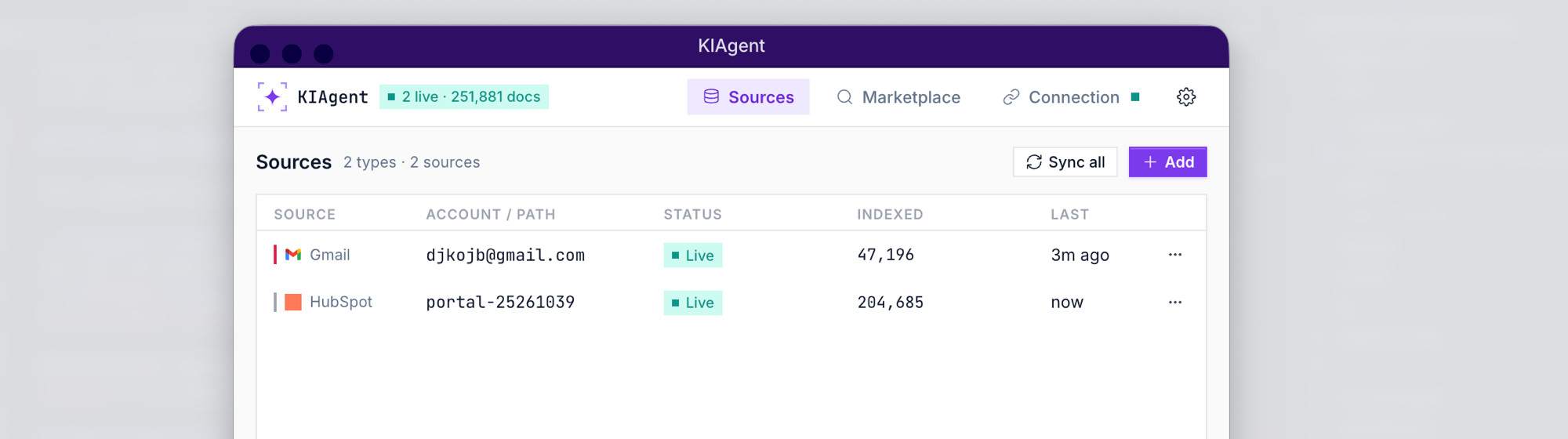
Everyone is building the company a brain — a knowledge layer that ingests everything an organization knows, so AI can answer and act with real context. **KIAgent is that layer for you personally.** A company brain lives in someone else's cloud and belongs to your employer; your personal AI brain runs on your own machine, works with whatever AI you choose, and is yours forever.
Concretely, KIAgent is a desktop app that ingests your personal data — mail, documents, chats, notes — on your own machine, stores it in a local database, and serves it to AI assistants over [MCP](https://modelcontextprotocol.io). Everything stays on your computer: ingestion, parsing, OCR and vision all run locally — with on-device inference powered by [llama.cpp](https://github.com/ggml-org/llama.cpp) — so your AI assistant can know your world without your data ever leaving your machine.
At its core, KIAgent is a **platform**: a small set of host capabilities (MCP, database, local LLM, filesystem, web access) wired together by an ingestion engine, plus a plugin/extension system that lets sandboxed connectors use those capabilities to bring in new data sources.
```mermaid
flowchart TB
GMAIL(["Gmail"])
DRIVE(["Drive"])
SLACK(["Slack"])
NOTION(["Notion"])
MORE(["…"])
PLUGINS["Plugins / extensions"]
WEB["Web"]
LLM["Local LLM"]
FS["Filesystem"]
DB[("DB")]
MCP["MCP"]
GMAIL --> PLUGINS
DRIVE --> PLUGINS
SLACK --> PLUGINS
NOTION --> PLUGINS
MORE --> PLUGINS
PLUGINS <--> WEB
PLUGINS <--> LLM
PLUGINS <--> FS
PLUGINS <--> DB
DB --> MCP
classDef service fill:#e8f0fe,stroke:#4285f4,color:#1a3c78
classDef core fill:#e6f4ea,stroke:#34a853,color:#1e4620
classDef hub fill:#fce8e6,stroke:#ea4335,color:#7a1c14,stroke-width:2px
class GMAIL,DRIVE,SLACK,NOTION,MORE service
class WEB,LLM,FS,DB,MCP core
class PLUGINS hub
```
Plugins sit at the center: each one connects to a third-party service (Gmail, Drive, Slack, Notion, ...) or the local filesystem, pulls your data in, uses the local LLM to process it, and lands it in the database — which MCP then serves to AI assistants. Access is mediated and permission-gated; plugins never touch these capabilities directly.
## This repo: kiagent-core
This repository is the MIT-licensed core that KIAgent is built from, in the same spirit as VS Code and Code-OSS:
- **kiagent-core** (this repo) — the open-source core. `npm run package:oss` produces an unbranded `kiagent-core` build you can run and redistribute under the MIT license.
- **[KIAgent](https://localkiagent.com/)** — the branded, signed product built from this core and distributed at [localkiagent.com/download](https://localkiagent.com/download).
OAuth-backed sources (Gmail, Microsoft) read client credentials from the environment at build time — see `.env.example` / CI secrets. Forks and OSS builds supply their own OAuth client IDs.
## Main components
- **Ingestion engine** (`src/main/core/engine`) — pulls batches from sources on a cadence, converts raw items (mail, PDFs, images) into indexed documents, and commits them to the store. Built-in sources live in `src/main/sources` (Gmail, IMAP, Microsoft 365, local folders).
- **Database** (`src/main/core/store`, `src/main/db`) — a SQLite corpus (better-sqlite3) holding documents, metadata and search indexes, written by the app and read by the MCP processes.
- **MCP server** (`src/main/core/mcp`, `src/main/mcp`) — exposes the corpus to AI assistants over two transports sharing one tool registry: an HTTP server inside the app, and a standalone stdio entry point that clients like Claude Desktop spawn directly.
- **Local LLM** (`src/main/providers/local-llm`, `src/main/providers/apple-vision`) — on-device inference via a bundled [llama.cpp](https://github.com/ggml-org/llama.cpp) server (backend auto-detection, curated model tiers) plus native OCR/vision helpers for scanned documents and images.
- **Filesystem** — local-folder ingestion, model storage, temp workspaces for conversion workers (`src/main/workers`, `src/main/converter`).
- **Web** — outbound HTTP for source APIs, OAuth flows (`src/main/auth`, `src/main/platform/oauth-providers.ts`), and marketplace downloads.
- **Plugin / extension system** (`src/main/platform`, `src/main/marketplace`) — connectors run in isolated host processes with a manifest-declared, permission-gated view of the platform (sources, auth, storage, network). A GitHub-backed marketplace handles discovery, install and updates. A second, privileged tier lets a product build ship first-party extensions inside the app package itself — see [`docs/architecture/extension-platform.md`](https://github.com/edjafarov/kiagent-core/blob/HEAD/docs/architecture/extension-platform.md) for the full model, including the bundled/`unsafe.mainProcess` tier and `product.json`.
- **Renderer** (`src/renderer`) — the React UI: source setup, marketplace, MCP connection status, settings and logs.
## Developing
```bash
npm install
npm start # run in development (hot reload)
```
Other useful scripts:
```bash
npm test # jest test suites
npm run lint # eslint + prettier
npm run typecheck # tsc, no emit
npm run package # build a distributable
npm run package:oss # build an unbranded kiagent-core distributable
npm run vendor:inference # fetch llama.cpp server + build vision helper
```
## Repository layout
```
src/main Electron main process: engine, store, MCP, platform, sources, providers
src/renderer React UI (screens: Sources, Marketplace, Connection, Settings)
src/shared Contracts and UI primitives shared across processes
concept/ Types-only blueprint for the core redesign
docs/ Design specs and implementation plans
native/ Native helper sources (vision/OCR)
scripts/ Build and vendoring scripts
```
## MCP directories
KIAgent is published on the [official MCP registry](https://registry.modelcontextprotocol.io/v0/servers?search=kiagent) as `com.localkiagent/kiagent` (see [`server.json`](https://github.com/edjafarov/kiagent-core/blob/HEAD/server.json)) and listed on Glama:
[](https://glama.ai/mcp/servers/edjafarov/kiagent-core)
## Acknowledgements
KIAgent's on-device inference is powered by **[llama.cpp](https://github.com/ggml-org/llama.cpp)**, created by Georgi Gerganov and maintained by the ggml-org community (MIT license). The app bundles prebuilt `llama-server` binaries from the official llama.cpp releases (`npm run vendor:inference` fetches them at build time). Running capable models privately on consumer hardware is only practical because of their work — thank you.
## License
MIT — see [LICENSE](https://github.com/edjafarov/kiagent-core/blob/HEAD/LICENSE).