# keyward [Health: Active]
**Category:** 💻 Developer Tools
**Repository:** https://github.com/arturayupov/keyward
**GitHub Stars:** 1
**Views:** 0
**Installs:** 0
**Upvotes:** 0
**Directory Page:** https://allmcps.com/mcp/keyward
## Description
Local encrypted secret broker for AI agents: request keys by name, approve each use over MCP.
## Claude Desktop Quick Installation
Heuristic fallback — verify the package name and runner against the repository README before running it. Uses `npx` (confidence: low):
```json
"mcpServers": {
"keyward": {
"command": "npx",
"args": ["-y","keyward"]
}
}
```
## Documentation & README
keyward
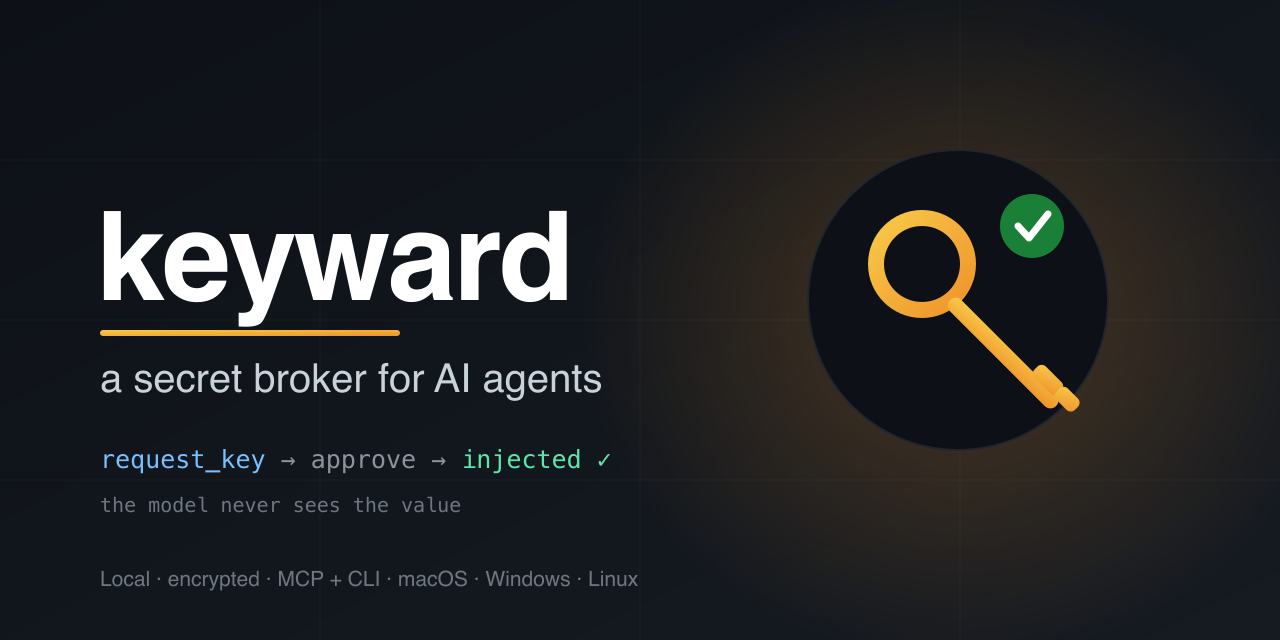
Store your API keys once. Let any AI tool request them with your approval — without ever seeing the value.




---
keyward is an open-source, local, encrypted **secret broker for AI coding agents**. Instead of pasting API keys into chat (where they leak into context and transcripts) or re-entering the same key in every new session, project, and IDE, you keep your keys in one encrypted vault. When Claude Code, Cursor, Gemini CLI, or any [MCP](https://modelcontextprotocol.io)-capable tool needs a key, it **requests it by name**, you **approve that single request** in a native OS prompt, and keyward **injects only that key** into your project. The model never receives the value.
## The problem
1. **Leaking keys into AI chat** — paste a key into a prompt and it lands in context, transcripts, and logs.
2. **Re-entry tax** — you type the same key again in every new session, project, IDE, and machine.
3. **Scattered `.env` files** — no single source of truth; you forget which key lives where.
4. **Zero control** — an agent can read or grab every secret at once instead of the one it needs.
5. **Tool lock-in friction** — switch IDE or model and you redo all key setup.
## How it works
```
AI tool ──request_key("STRIPE_KEY", project)──▶ keyward ──native approval──▶ you
│ approved
◀── "injected STRIPE_KEY → ./.env" ─────────┘ (value never shown to the model)
```
- **Vault** — an [age](https://age-encryption.org)-encrypted file (`~/.keyward/vault.age`, `0600`). The master key lives in the **OS keystore** (macOS Keychain / Windows Credential Manager / Linux libsecret), never on disk in plaintext.
- **Two faces** — an **MCP server** (`list_keys`, `request_key`) for AI tools, and a **`keyward` CLI** for everything else.
- **Out-of-band approval** — the approval dialog is fired by keyward itself, not rendered in the agent's stream, so the agent **cannot** auto-approve. Choose *Approve once*, *Approve for session*, or *Deny*.
- **Value-free by construction** — `list_keys` returns names only; `request_key` returns a confirmation; the audit log records the decision but never the value.
## Install
```bash
# Homebrew (macOS / Linux)
brew install arturayupov/tap/keyward
# Scoop (Windows)
scoop bucket add arturayupov https://github.com/arturayupov/scoop-bucket
scoop install keyward
# Go
go install github.com/arturayupov/keyward/cmd/keyward@latest
```
Pre-built binaries (macOS/Windows/Linux, amd64+arm64) are also attached to each [release](https://github.com/arturayupov/keyward/releases). See [INSTALL.md](https://github.com/arturayupov/keyward/blob/HEAD/INSTALL.md) for per-OS notes (incl. Linux libsecret) and [TROUBLESHOOTING.md](https://github.com/arturayupov/keyward/blob/HEAD/TROUBLESHOOTING.md) if something doesn't work.
## Quickstart
```bash
# 1. create the encrypted vault (master key goes into your OS keystore)
keyward init
# 2. import keys you already have scattered in .env files
keyward import ~/projects
# 3. point your AI tool at keyward's MCP server (see below), then just ask:
# "use my STRIPE_KEY for this project" → approve the prompt → done
```
### Use it as an MCP server
keyward is a standard **stdio MCP server**, registered the same way as the
official MCP servers. Two steps:
**1. Install the binary** (once) — `go install` above, or Homebrew/Scoop (soon),
or a [release](https://github.com/arturayupov/keyward/releases) binary.
**2. Register it with your AI tool:**
```bash
# Claude Code — one command:
claude mcp add keyward -- keyward serve-mcp
```
Or add it to the config by hand (`~/.claude.json`, or a project `.mcp.json`):
```json
{ "mcpServers": { "keyward": { "command": "keyward", "args": ["serve-mcp"] } } }
```
Cursor, Windsurf, Cline, and other MCP clients use the same `command`/`args`
shape in their MCP settings. Restart the tool and ask it to use a key by name.
> **Why not "paste a repo URL"?** No MCP client auto-installs a server from a
> GitHub link — by design, clients won't run arbitrary remote code. keyward is
> also intentionally **local** (it needs your OS keystore and writes to your
> local files), so it isn't a remote/hosted URL server. The two steps above are
> the standard, secure install path. Full walkthrough in [USAGE.md](https://github.com/arturayupov/keyward/blob/HEAD/USAGE.md).
## CLI reference
| Command | Description |
|---|---|
| `keyward init` | Create the encrypted vault and master key |
| `keyward import [root]` | Import secrets from `.env` files under `root`, grouped by project |
| `keyward add NAME --ns NS` | Add/update one secret, value read from stdin (for non-`.env` creds) |
| `keyward ls [--ns NS]` | List key names and namespaces (**never values**) |
| `keyward inject NAME --ns NS --into PATH` | Inject one key into a target env file (prompts for approval) |
| `keyward serve-mcp` | Run the MCP server over stdio |
## Security model
- The secret **value is never returned to the AI agent** — `request_key` injects it into a target file and returns only a confirmation.
- The value is **never written to the audit log** (`~/.keyward/audit.jsonl` records tool, key, namespace, target, decision — no value) and **never printed** by `ls`/`inject`.
- Approval is **out-of-band**: a native OS dialog the agent cannot click. All dialog backends **fail closed** — any error or cancellation is a **Deny**.
- The vault is **encrypted at rest** with `age`; the master key lives in the OS keystore.
These invariants are enforced by automated tests. Details and threat model in [SECURITY.md](https://github.com/arturayupov/keyward/blob/HEAD/SECURITY.md).
## How it compares
| | keyward | envchain | pass / sops | 1Password CLI |
|---|---|---|---|---|
| Encrypted local store | ✅ | ✅ (Keychain) | ✅ | ✅ (cloud) |
| **Agent requests a key by name** | ✅ | ❌ | ❌ | ❌ |
| **Per-request human approval** | ✅ | ❌ | ❌ | ❌ |
| **Value never reaches the model** | ✅ | n/a | n/a | n/a |
| MCP server for AI tools | ✅ | ❌ | ❌ | ❌ |
| Open source | ✅ (MIT) | ✅ | ✅ | ❌ |
The encrypted-storage problem is solved; keyward adds the missing **agent-facing, approval-gated broker** on top. See [docs/comparisons](https://github.com/arturayupov/keyward/blob/HEAD/docs/comparisons/) for honest long-form comparisons (including when each alternative is the better choice).
## Roadmap
Full detail in [ROADMAP.md](https://github.com/arturayupov/keyward/blob/HEAD/ROADMAP.md). Highlights:
- **v0.2** — signed/notarized binaries (no keystore prompt), Homebrew/Scoop, biometric approval (Touch ID / Windows Hello), Windows ACL hardening.
- **v1.0** — tray/menubar app, per-key policy & allowlists, rotation reminders, `target: "env"` injection.
- **v2.0** — encrypted multi-device sync (user-owned backend), team mode.
## Contributing
Contributions welcome — see [CONTRIBUTING.md](https://github.com/arturayupov/keyward/blob/HEAD/CONTRIBUTING.md). Found a security issue? See [SECURITY.md](https://github.com/arturayupov/keyward/blob/HEAD/SECURITY.md) for responsible disclosure.
## License
[MIT](https://github.com/arturayupov/keyward/blob/HEAD/LICENSE) © 2026 Artur Ayupov