# graphpilot-oss/graphpilot [Health: Active]
**Category:** 🧠 Knowledge & Memory
**Repository:** https://github.com/graphpilot-oss/graphpilot
**GitHub Stars:** 15
**npm Downloads (last month):** 182
**Views:** 2
**Installs:** 0
**Upvotes:** 0
**Directory Page:** https://allmcps.com/mcp/graphpilot-oss-graphpilot
## Description
Structural memory for coding agents. Indexes TypeScript/JavaScript repos and exposes callers, callees, blast-radius impact, and symbol locations over MCP — with file:line@sha evidence anchors and branch-aware differential impact — so agents answer "who calls X?" / "what breaks if I change X?" without re-reading files. Local-only, zero telemetry, Apache-2.0. npx @graphpilot-oss/graphpilot mcp
## Claude Desktop Quick Installation
Install path detected from listing signals. Uses `npx` (confidence: high):
```json
"mcpServers": {
"graphpilot": {
"command": "npx",
"args": ["-y","@graphpilot-oss/graphpilot"]
}
}
```
## Documentation & README

GraphPilot
Structural memory for coding agents.
A refactor-safe, branch-aware, evidence-backed code graph that runs entirely on your machine.





Quickstart ·
Tools ·
How it works ·
Editor setup ·
Limitations ·
Benchmarks

---
## What it is
GraphPilot is a local CLI + MCP server that indexes your TypeScript/JavaScript repo into a structural graph (symbols, callers, callees, blast radius) and exposes it to coding agents — Claude Code, Cursor, Cline, Windsurf, Continue — so they stop re-`grep`ping the same files every conversation.
The problem it solves: agents burn tokens, hallucinate function names, and miss structural relationships ("what calls this?", "what breaks if I rename it?") because each session starts from zero. GraphPilot is the persistent structural memory in between.
**Token cost drops. Hallucinations drop. Refactors get safer.**
Put a real coding agent (claude-sonnet-4-5) on **40 structural questions about fastify** — a ~300-file Node.js framework — and give it nothing but file reads. Then hand it GraphPilot's four tools and ask the same 40. The agent with GraphPilot uses **61 % fewer tokens**, costs **$3.68 instead of $8.88 — $5.20 saved per session** — and gets **more** of them right, not fewer (37 correct vs 33). Same model, same questions, same repo; the only change is whether the structural index is there. [Reproduce it →](https://github.com/graphpilot-oss/graphpilot/blob/HEAD/benchmark/README.md)
A separate correctness benchmark backs the savings with precision: on 10 standardized structural queries GraphPilot scores **F1 0.89 vs grep's 0.42** while reading **99.9 % fewer bytes** (721 B vs 528 KB), and the byte-cost win holds at scale — indexing **microsoft/TypeScript** (601 files, 17 k symbols, 70 k call edges in 10 s) gives **sub-millisecond queries** and a **99.99 % bytes-read reduction**. [Full methodology →](https://github.com/graphpilot-oss/graphpilot/blob/HEAD/bench/README.md)
## One binary, two modes
GraphPilot ships as a single npm package (`@graphpilot-oss/graphpilot`) with two runtime modes — most users run both.
| Mode | Command | What it does |
| -------------- | -------------------------- | ---------------------------------------------------------------------------- |
| **CLI** | `graphpilot index ` | Walks your repo, builds the structural graph, writes it to `~/.graphpilot/` |
| | `graphpilot watch ` | Keeps the graph fresh (~10 ms per file save) |
| | `graphpilot status ` | Health probe — when the graph was last refreshed, file/symbol/edge counts |
| **MCP server** | `graphpilot mcp` | Speaks MCP over stdio — your coding agent calls into this to query the graph |
**The flow:** the **CLI** builds the index once (and `watch` keeps it warm). The **MCP server** is what your coding agent talks to — you never invoke it yourself, you just point your agent's MCP config at `graphpilot mcp` once and the agent spawns it on every session.
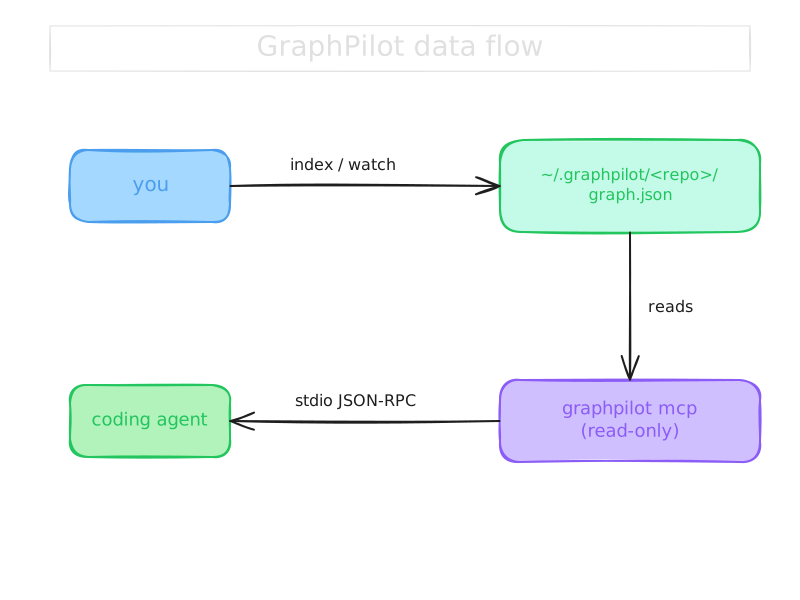
If you only want CLI access to your code graph (no agent), run `graphpilot index` and then `graphpilot stats` / inspect `graph.json` directly. If you only want the agent integration, you still need to run `graphpilot index` once — the MCP server is read-only against the on-disk graph.
## What makes it different
Other code-graph tools treat your repo as a static blob: index once, query forever, no branch awareness, no proof of where an answer came from. GraphPilot is built around three properties none of them ship:
- 🔍 **Evidence anchors.** Every tool response carries `file:line @ sha` on every symbol and call site. The agent can quote the anchor verbatim and you can verify it instantly — hallucinations get exposed the moment you jump to the line.
- 🌿 **Differential impact.** Pass `since: ` to `gp_impact` and the result is filtered to files your branch actually touches. PR-scoped refactor analysis in one call instead of `git diff | xargs grep`.
- 🪵 **Worktree-aware by default.** Two `git worktree add`-ed branches naturally produce two separate indexes — no manual config. Run `graphpilot index ./src/feature` from a subdir and it transparently re-roots to the worktree top. Opt out with `--no-worktree`.
Add to that: **local-first** (no telemetry, no remote calls, enforced by an ESLint policy on `src/` itself), **deterministic** (same repo → same graph), **sub-second incremental** updates via watch mode.
## Quickstart
**Prerequisites**
- Node.js ≥ 20 (`node --version` to check)
- An MCP-capable coding agent (Claude Code, Cursor, Cline, Windsurf, or Continue)
- A TypeScript or JavaScript repo to index
End-to-end time: ~3 minutes.
**1. Install the CLI**
```bash
npm install -g @graphpilot-oss/graphpilot
# or: pnpm add -g @graphpilot-oss/graphpilot
# or one-shot, no install: npx @graphpilot-oss/graphpilot
```
Verify it landed on your `PATH`:
```bash
graphpilot --version
# → 0.1.0
```
If you see `command not found: graphpilot`, your global npm bin is not on `PATH`. Run `npm config get prefix` and add `/bin` to your shell's `PATH`, or use the `npx` form above.
**2. Build the structural index for your repo**
Run this once per project. It walks your source tree, parses each TS/JS file with tree-sitter, extracts symbols + call edges, and writes the graph to `~/.graphpilot//graph.json`.
```bash
graphpilot index ~/code/my-app
```
Expect a one-line summary like `indexed 412 files · 3,981 symbols · 7,204 edges · 1.8s`.
**3. Wire it into your coding agent**
GraphPilot speaks MCP over stdio. Add this server entry to your agent's MCP config — every supported client uses the same two-line shape:
```json
{
"mcpServers": {
"graphpilot": {
"command": "graphpilot",
"args": ["mcp"]
}
}
}
```
Where this file lives depends on the client (`~/.cursor/mcp.json`, `~/.claude.json`, Cline's settings panel, etc.). Pre-made configs with the exact file path for each agent are in [`examples/`](https://github.com/graphpilot-oss/graphpilot/blob/HEAD/examples/) — copy the one for your client.
Restart the agent. It now has four new tools: `gp_recall`, `gp_callers`, `gp_impact`, `gp_index` — see [The four tools](#the-four-tools) below for what each one does and when the agent should reach for it.
**4. Try it**
Ask your agent a structural question instead of letting it grep:
> _"Use gp_impact to show me everything that breaks if I rename `parseToken`."_
You should see a response with `file:line @ sha` anchors you can click straight to. If the agent doesn't reach for the tool, prompt explicitly: "use the `gp_` MCP tools." If it can't see them at all, the MCP config wasn't picked up — run `graphpilot doctor` to pinpoint why (or see [`docs/troubleshooting.md`](https://github.com/graphpilot-oss/graphpilot/blob/HEAD/docs/troubleshooting.md)), then restart the agent.
**5. Keep the index fresh as you edit (optional but recommended)**
```bash
graphpilot watch ~/code/my-app
```
Sub-10 ms incremental updates on each file save. Leave it running in a terminal tab.
**6. Drop per-editor routing rules into your repo (optional)**
```bash
graphpilot init
```
Auto-detects which editors you have installed (Cursor, Claude Code, Cline, Windsurf, Continue) and writes the matching rules file (`.cursorrules`, `CLAUDE.md`, etc.) to the current directory. The rules teach the agent to reach for `gp_*` tools before grep.
```bash
graphpilot init --all # write rules for every supported editor
graphpilot init --client cursor # one editor only
graphpilot init --dry-run # preview without writing
```
Full 5-minute walkthrough with screenshots: [`docs/quickstart.md`](https://github.com/graphpilot-oss/graphpilot/blob/HEAD/docs/quickstart.md).
## The four tools
GraphPilot exposes four MCP tools. Each one answers a structural question your agent would otherwise solve by grepping and reading files.
### `gp_recall` — find a symbol by name
Use this when the agent asks "where is X defined?" or needs to locate a function before reasoning about it.
- **Input:** `{ query, limit?, substring?, path? }`
- **Returns:** symbols matching the name (exact case-insensitive by default; `substring: true` for partial matches), each with `file:line @ sha`.
- **Replaces:** `grep -rn "function X"` plus reading each hit to find the real definition.
```text
Agent: gp_recall({ query: "parseToken" })
→ parseToken (function) — src/auth.ts:42 @ a1b2c3d
export function parseToken(raw: string): Token | null
```
### `gp_callers` — list callers (or callees)
Use this when the agent needs to know "who calls X?" or "what does X call?" — the two fundamental questions of refactoring.
- **Input:** `{ symbol, direction?: 'callers' | 'callees', limit?, includeUnresolved?, path? }`
- **Returns:** every call edge where the symbol is target (callers) or source (callees), with anchors.
- **Replaces:** `grep -rn "X("` followed by manual filtering of comments, strings, and renamed shadows.
```text
Agent: gp_callers({ symbol: "authenticate", direction: "callers" })
→ login → authenticate — src/routes/login.ts:18 @ a1b2c3d
→ refreshSession → authenticate — src/session.ts:64 @ a1b2c3d
```
### `gp_impact` — blast radius in one call
Use this when the agent asks "what breaks if I rename X?" or "what depends on this?" — the single most expensive question an agent normally solves.
- **Input:** `{ symbol, depth? (1–5, default 3), since?, path? }`
- **Returns:** direct callers, transitive callers grouped by BFS depth, tests likely affected, public-API flag, summary stats.
- **Killer feature:** pass `since: 'main'` and the result is scoped to files your branch actually touches — PR-scoped refactor review without `git diff` gymnastics.
```text
Agent: gp_impact({ symbol: "extractSymbols", depth: 2, since: "main" })
→ Direct callers (2): indexDirectory, applyUpdate
→ Depth-2 callers (1): cmdIndex
→ Tests affected (3): tests/indexer.test.ts, tests/symbols.test.ts, tests/cli.test.ts
→ Public API: no
```
### `gp_index` — refresh from inside the agent
Use this after the agent (or the user) has made a batch of structural edits and wants the graph to reflect them without dropping to a shell.
- **Input:** `{ path? }`
- **Returns:** re-indexes the repo and invalidates the per-path query cache.
- **Pairs with:** `graphpilot watch` for sub-10 ms incremental updates between explicit re-indexes.
## How it works
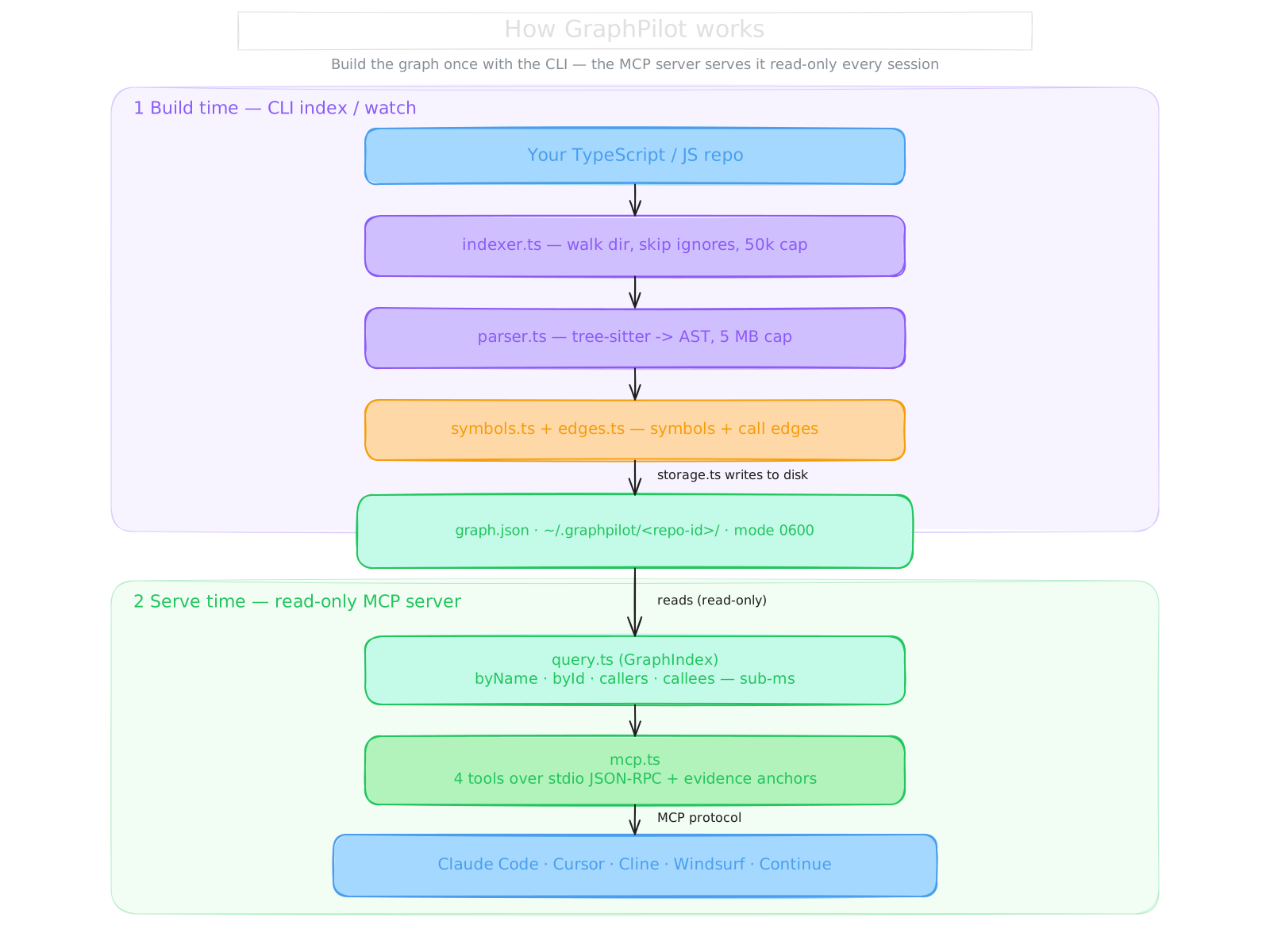
Data flow is one-way: source → tree → symbols + edges → JSON → query → agent. GraphPilot never modifies your code.
Full pipeline writeup with file references: [`docs/architecture.md`](https://github.com/graphpilot-oss/graphpilot/blob/HEAD/docs/architecture.md).
## When to use which tool
| If the agent is about to… | Reach for… | Why |
| --------------------------------------- | ------------------------------ | ----------------------------------------------------- |
| `grep` for a function by name | `gp_recall` | One call, no false positives from comments or strings |
| Read 20 files looking for "who calls X" | `gp_callers` | Pre-computed reverse index, sub-millisecond |
| Plan a rename or signature change | `gp_impact` | Direct + transitive + tests + public-API in one call |
| Review a PR's structural blast radius | `gp_impact({ since: 'main' })` | Differential — only callers your branch touches |
| Re-grep after editing several files | `gp_index` | Incremental: lets the next call see your edits |
For string literals, error messages, config values, or anything in a language other than TS/JS: **stay with grep.** GraphPilot indexes code structure, not text.
## Editor setup
GraphPilot speaks MCP over stdio, so it works with any MCP-capable client. Ready-to-paste configs live in `examples/`:
| Client | Folder |
| ----------------------------- | ------------------------------------------------ |
| **Claude Code** (Anthropic) | [`examples/claude-code/`](https://github.com/graphpilot-oss/graphpilot/blob/HEAD/examples/claude-code/) |
| **Cursor** | [`examples/cursor/`](https://github.com/graphpilot-oss/graphpilot/blob/HEAD/examples/cursor/) |
| **Cline** (VS Code extension) | [`examples/cline/`](https://github.com/graphpilot-oss/graphpilot/blob/HEAD/examples/cline/) |
| **Windsurf** (Codeium) | [`examples/windsurf/`](https://github.com/graphpilot-oss/graphpilot/blob/HEAD/examples/windsurf/) |
| **Continue.dev** | [`examples/continue/`](https://github.com/graphpilot-oss/graphpilot/blob/HEAD/examples/continue/) |
| Any other MCP client | See [`docs/mcp-setup.md`](https://github.com/graphpilot-oss/graphpilot/blob/HEAD/docs/mcp-setup.md) |
Each folder contains: a `README.md` walkthrough, a sample config file with the exact JSON to paste, and (where the client supports it) a routing template so the agent automatically reaches for GraphPilot on structural questions.
## Privacy & security
GraphPilot is **local-first by promise and by build gate**.
- **No telemetry, no remote calls, ever.** Verifiable: `src/` has zero `http`, `fetch`, `axios`, or analytics imports — enforced by an ESLint rule plus a meta-test that proves the rule fires on every banned import.
- **No `child_process`, no `exec`, no `spawn`.** Git facts are read directly from `.git/` via pure-JS helpers.
- **Source code never leaves your machine.** Only structural metadata (names, locations, signatures, call relationships) lives in `~/.graphpilot/`.
- **Signatures are redacted** for common secret patterns (OpenAI/Anthropic `sk-`, GitHub `ghp_`/`ghs_`, AWS `AKIA`, JWTs, PEM headers, Slack/Stripe tokens) before they're written to disk.
- **Strict file permissions:** dir `0o700`, files `0o600`.
- **Schema validation on load:** tampered or corrupt `graph.json` falls back to "no index" rather than poisoning the agent.
- **Hand-rolled input validators** on every MCP tool — unknown fields are rejected, every field type-checked, numbers range-checked, strings length-capped.
Threat model and per-defence test references live in [`docs/architecture.md`](https://github.com/graphpilot-oss/graphpilot/blob/HEAD/docs/architecture.md). Report security issues per [`SECURITY.md`](https://github.com/graphpilot-oss/graphpilot/blob/HEAD/SECURITY.md).
## Limitations
GraphPilot v0.1 makes deliberate trade-offs to ship small and sharp:
- **TS/JS only.** Python, Rust, Go, Java are out of scope for v1. Python is demand-gated for v0.2 / v0.3.
- **Name-based resolver** (no import-path tracking, no type-based method dispatch). Expected resolution rate: ~25–35 % of edges resolve to in-repo symbols; the rest are stdlib / third-party. That's enough because the questions agents actually ask (_"who calls X in my repo?"_) are the ones the dumb resolver answers correctly.
- **No semantic search.** `gp_recall` is name-only. "Find code similar to this snippet" is deferred until 30+ users ask for it.
- **No `.graphpilotignore`** yet (defaults skip `node_modules`, `dist`, `build`, `.git`, `coverage`, `.next`, `.nuxt`, `.cache`, `out`, `*.d.ts`).
- **Single repo per query.** Workspace abstraction is on the v1.x roadmap.
Full list with mitigations: [`docs/limitations.md`](https://github.com/graphpilot-oss/graphpilot/blob/HEAD/docs/limitations.md).
## FAQ
**Does it send my code anywhere?**
No. There is no network code in `src/`, no telemetry, no update check. An ESLint rule blocks adding any of those at the build gate.
**Will it slow down my editor?**
The MCP server is idle until your agent calls a tool. Tool calls are sub-millisecond after the first lazy load. Watch mode adds ~3–10 ms per file save.
**What happens to the graph when I switch branches?**
If you use `git worktree`, you automatically get a separate graph per worktree. On a single working copy that you switch with `git checkout`, the graph reflects the last `gp_index` (or watch-mode updates). Run `gp_index` after a branch switch to refresh.
**Do I need to re-index every session?**
No. The graph persists at `~/.graphpilot//graph.json`. Re-index after sweeping changes; otherwise, watch mode keeps it fresh incrementally.
**Why TypeScript/JavaScript first?**
That's where the maintainer's pain was, and tree-sitter-typescript covers TS, TSX, JSX, and JS in a single grammar. Python is the next likely addition; vote with a GitHub Discussion.
**How does this compare to LSP?**
LSPs are scoped to one editor and one buffer at a time, and they re-compute on each query. GraphPilot is editor-agnostic, persists across sessions, and answers structural questions (who-calls, blast-radius) that LSPs don't expose uniformly.
**The agent can't see the tools / something's not working.**
Run `graphpilot doctor` — it checks Node, `PATH`, the index, the MCP handshake, and per-client config in one shot. Symptom-by-symptom fixes live in [`docs/troubleshooting.md`](https://github.com/graphpilot-oss/graphpilot/blob/HEAD/docs/troubleshooting.md).
## Documentation
- [`docs/quickstart.md`](https://github.com/graphpilot-oss/graphpilot/blob/HEAD/docs/quickstart.md) — 5-minute walkthrough
- [`docs/mcp-setup.md`](https://github.com/graphpilot-oss/graphpilot/blob/HEAD/docs/mcp-setup.md) — per-client config reference
- [`docs/troubleshooting.md`](https://github.com/graphpilot-oss/graphpilot/blob/HEAD/docs/troubleshooting.md) — symptom-indexed fixes (start with `graphpilot doctor`)
- [`docs/architecture.md`](https://github.com/graphpilot-oss/graphpilot/blob/HEAD/docs/architecture.md) — pipeline writeup with file refs
- [`docs/limitations.md`](https://github.com/graphpilot-oss/graphpilot/blob/HEAD/docs/limitations.md) — v1 caveats (read this)
- [`bench/README.md`](https://github.com/graphpilot-oss/graphpilot/blob/HEAD/bench/README.md) — benchmark methodology + results
- [`examples/`](https://github.com/graphpilot-oss/graphpilot/blob/HEAD/examples/) — ready-to-paste configs for every supported client
## Contributing
GraphPilot is small, opinionated, and accepting contributions. Start with [`CONTRIBUTING.md`](https://github.com/graphpilot-oss/graphpilot/blob/HEAD/CONTRIBUTING.md) — especially the _"What we are NOT doing in v1"_ section before you propose a feature.
Found a security issue? Please follow [`SECURITY.md`](https://github.com/graphpilot-oss/graphpilot/blob/HEAD/SECURITY.md) instead of opening a public issue.
## License
[Apache-2.0](https://github.com/graphpilot-oss/graphpilot/blob/HEAD/LICENSE). Copyright 2026 Akshay Sharma — [codewithakki@gmail.com](mailto:codewithakki@gmail.com)