# Google Search Console [Health: Active]
**Category:** 🔎 Search & Data Extraction
**Repository:** https://github.com/ni-c/google-search-console-mcp
**GitHub Stars:** 0
**Views:** 0
**Installs:** 0
**Upvotes:** 0
**Directory Page:** https://allmcps.com/mcp/google-search-console-4
## Description
MCP server for Google Search Console: properties, sitemaps, search analytics and URL inspection
## Claude Desktop Quick Installation
Install path detected from listing signals. Uses `npx` (confidence: high):
```json
"mcpServers": {
"google-search-console": {
"command": "npx",
"args": ["-y","@ni-c/google-search-console-mcp"]
}
}
```
## Documentation & README
# google-search-console-mcp
[](https://github.com/ni-c/google-search-console-mcp/actions/workflows/ci.yml)
[](https://scorecard.dev/viewer/?uri=github.com/ni-c/google-search-console-mcp)
 [](https://glama.ai/mcp/servers/ni-c/google-search-console-mcp)
[](https://glama.ai/mcp/servers/ni-c/google-search-console-mcp)
[](https://www.npmjs.com/package/@ni-c/google-search-console-mcp)
[](https://github.com/ni-c/google-search-console-mcp/pkgs/container/google-search-console-mcp)
[](https://mcp-hub.ni-c.de)
[](https://google-search-console-mcp.ni-c.de)
[](https://github.com/sponsors/ni-c)
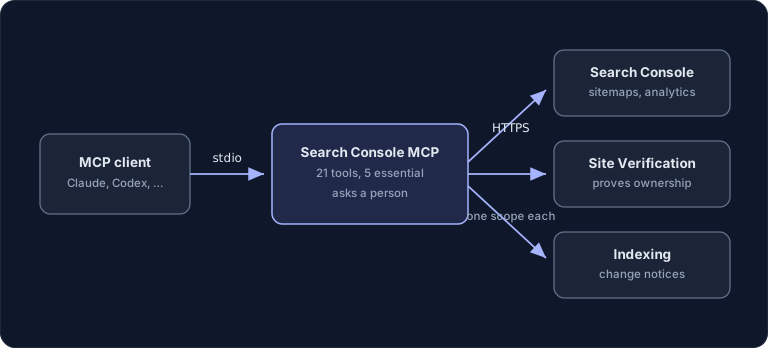
A [Model Context Protocol](https://modelcontextprotocol.io) (MCP) server for
[Google Search Console](https://search.google.com/search-console/about), the
service that tells you how Google sees your site — this reads it and sets it up.
Lets MCP clients like Claude Code, Claude Desktop or Codex create a property and
prove ownership of it, submit and refresh sitemaps, ask what any URL's index
status is, and query the whole Performance report — with the irreversible
operations put to a person first and the write tools switchable off
entirely.
21 tools is the ceiling, not the floor: `GSC_ALLOW_TOOLS=essential` registers a
curated five instead, and a model picks the right tool far more reliably from
five than from 21 — see
[choosing which tools load](#choosing-which-tools-load).
## What makes it different
**It can actually create a working property.** Getting one takes four steps in a
fixed order — obtain a verification token, place it in DNS or on the page,
verify ownership, add the property — and nothing in Google's APIs enforces that
order. Calling `sites.add` first _succeeds_ and leaves a property that appears in
every listing and answers 403 for every piece of data, which looks like a
permissions bug and is not. `setup_site` reports which step is missing and hands
over the exact DNS record to paste. Servers that expose `sites.add` alone can
only add properties somebody already verified by hand.
**Three APIs, not one.** Search Console v1 is ten methods and does not include
ownership. Site Verification is a separate service with its own scope, its own
host and an incompatible way of naming the same site —
`sc-domain:example.com` there is `{type: INET_DOMAIN, identifier: example.com}`,
and passing the property spelling straight through is accepted and verifies a
domain literally called `sc-domain:example.com`. The Indexing API is a third.
All three are covered, and the translation between them is in
`src/site-identity.ts`.
**The numbers are right.** Search analytics come back as a table with totals
where CTR is computed from the totals rather than averaged across rows, and
average position is weighted by impressions. Unweighted, a thousand rare queries
ranking 80th drag a property's real average of 12 up into the nineties. The
result also says plainly that the rows do not sum to the property total when the
query dimension is used — Google withholds rare queries for anonymity, commonly a
third or more of all impressions, and a total printed without that caveat is a
number people will quote.
**It knows where these APIs are sharp.** The trailing slash on
`https://example.com/` is mandatory and its absence is a 403; a domain property
and a URL-prefix property for the same site are different properties with
different data, so a bare hostname is refused rather than guessed at; days are
counted in **Pacific Time**, so a `last7days` computed in UTC asks for a day
Google has no data for; the `hour` dimension silently returns nothing without
`dataState: HOURLY_ALL`; Google omits empty arrays entirely, so a fresh
credential's property list arrives as `{}`; and the Indexing API returns 200 for
any owned URL while only acting on JobPosting and BroadcastEvent pages.
## Requirements
- Node.js 22 or newer (or the container image)
- A Google credential — a service account key, an OAuth2 refresh token, or
application default credentials
- The APIs you intend to use enabled in a Google Cloud project: **Search
Console API**, and separately **Site Verification API** and **Indexing API**
## Configuration
The server starts without credentials and lists its tools; every call then fails
with setup instructions rather than a Google error. That is deliberate, so
registries and sandbox inspectors can introspect it.
| Variable | Description |
| -------------------------------- | -------------------------------------------------------------------------------------------------------------- |
| `GSC_SERVICE_ACCOUNT_KEY` | Service account key as raw JSON, or base64-encoded JSON |
| `GSC_SERVICE_ACCOUNT_KEY_FILE` | Path to a service account key file. Alternative to the above — setting both is an error |
| `GSC_CLIENT_ID` | OAuth2 client id |
| `GSC_CLIENT_SECRET` | OAuth2 client secret |
| `GSC_REFRESH_TOKEN` | OAuth2 refresh token. All three OAuth2 variables are required together |
| `GOOGLE_APPLICATION_CREDENTIALS` | Application default credentials, used when no `GSC_` credential is set |
| `GSC_SITE_URL` | Default property, e.g. `sc-domain:example.com` or `https://example.com/`. Makes `site_url` optional everywhere |
| `GSC_ALLOWED_SITES` | Comma-separated properties this server may touch at all; anything else is refused |
| `GSC_READ_ONLY` | `true` (or `1`/`yes`) registers only the twelve read tools |
| `GSC_ALLOW_TOOLS` | Comma-separated tool names, a `list_*` prefix, or `essential` |
| `GSC_DENY_TOOLS` | Same shape, subtracted from whatever the allow list left |
| `ELICITATION` | `false` replaces the approval dialog with the two-call token. **Not prefixed** |
Credentials are tried in that order — explicit beats ambient. A **partial** OAuth
triple is a startup error rather than a reason to fall through to application
default credentials, because that fallback would quietly run the server as
whatever account the machine is logged into.
### Which credential
A **service account** is the recommended one: it sees only the properties you
explicitly add it to, and revoking it does not touch anyone's Google account.
Add its `client_email` under Settings → Users and permissions in Search Console,
or give it ownership with `verify_site`. Note that the Indexing API requires
**owner**, not full user.
An **OAuth2 refresh token** acts as the person who consented and sees everything
they see. Its scopes were fixed at consent time and cannot be widened later.
### Choosing which tools load
Every visible tool costs context on every request, and a model picks the right
one far more reliably from five than from 21. Two variables narrow the list:
```sh
GSC_ALLOW_TOOLS=essential # the curated five
GSC_ALLOW_TOOLS='list_*,get_site' # exact names, or one trailing *
GSC_DENY_TOOLS='delete_*' # subtracted from whatever allow left
```
`essential` is `list_sites`, `get_site`, `list_sitemaps`,
`query_search_analytics` and `inspect_url` — everything needed to look at a
property, and nothing that changes it.
An entry that matches no tool **stops the server** with the list of real names.
An ignored typo would otherwise leave a tool missing from `tools/list` with
nothing pointing at the cause, and nobody traces an absence back to an
environment variable.
If you run several of these servers at once, [mcp-hub](https://mcp-hub.ni-c.de) is
the other answer — its `/hub` endpoint replaces every server's tools with six
meta-tools.
Narrowing the list also narrows the credential: the OAuth scopes this server
requests are derived from the tools that are actually registered, so a server
denied the Indexing tools never asks for the Indexing scope.
## Installation
### Claude Code
```sh
claude mcp add google-search-console -- npx -y @ni-c/google-search-console-mcp
```
### Claude Desktop
```json
{
"mcpServers": {
"google-search-console": {
"command": "npx",
"args": ["-y", "@ni-c/google-search-console-mcp"],
"env": {
"GSC_SERVICE_ACCOUNT_KEY_FILE": "/path/to/key.json",
"GSC_SITE_URL": "sc-domain:example.com"
}
}
}
}
```
### Codex
```toml
[mcp_servers.google-search-console]
command = "npx"
args = ["-y", "@ni-c/google-search-console-mcp"]
[mcp_servers.google-search-console.env]
GSC_SERVICE_ACCOUNT_KEY_FILE = "/path/to/key.json"
GSC_SITE_URL = "sc-domain:example.com"
```
### Docker
```sh
docker run --rm -i \
-v /path/to/key.json:/key.json:ro \
-e GSC_SERVICE_ACCOUNT_KEY_FILE=/key.json \
-e GSC_SITE_URL=sc-domain:example.com \
ghcr.io/ni-c/google-search-console-mcp
```
### Through mcp-hub
A client that cannot spawn a local process — ChatGPT connectors, Claude on the web,
Cursor, LibreChat — reaches google-search-console-mcp through [mcp-hub](https://mcp-hub.ni-c.de): one
container serves many stdio MCP servers over Streamable HTTP, with an OAuth 2.1 login
behind a single password and long-lived tokens for the clients that cannot do OAuth. Its
`/hub` endpoint puts every server behind six meta-tools, so one connector reaches all of
them without N×tool schemas in the model's context, and it speaks both protocol revisions
— a question this server asks travels through it to the person at the far end.
Its `/config/mcp.json` uses Claude Code's format, so the entry is the one you already
have:
```json
{
"mcpServers": {
"google-search-console": {
"command": "npx",
"args": ["-y", "@ni-c/google-search-console-mcp"],
"env": {
"GSC_SERVICE_ACCOUNT_KEY": "…",
"GSC_SITE_URL": "sc-domain:example.com"
}
}
}
}
```
`allowTools` and `denyTools` there are the hub's **own** per-server filter, which is not
the same thing as `*_ALLOW_TOOLS` in `env` — the difference, and the mistake it invites,
are in the [client guide](https://google-search-console-mcp.ni-c.de/guide/clients#through-mcp-hub).
## Tools
`site_url` is optional on every tool that takes it when `GSC_SITE_URL` is set.
Every tool declares an `outputSchema` and answers with `structuredContent`
alongside the text block, so a client can use the result without parsing prose.
`query_search_analytics` keeps its rendered table in the text block and puts the
rows themselves in the structured half; six tools that answered with a sentence
now answer with fields too.
Every tool that reports Google's data carries `untrusted: true` and
`source: "search-console"` as fields. _"It is only search data"_ is exactly the
wrong intuition: a search query is a string a member of the public typed into
Google, and a page title comes from the crawled site. Six tools are without the
marker, because their answer is a property this server was given and a fact it
established: `add_site`, `delete_site`, `submit_sitemap`, `submit_sitemaps`,
`delete_sitemap` and `unverify_site`.
### Properties and ownership
| Tool | What it does |
| ------------------------ | ---------------------------------------------------------------------------------------------------------------------- |
| `setup_site` | Reports which of the four setup steps a property is missing, with the DNS record or meta tag to place. Changes nothing |
| `list_sites` | Every property this credential can see, with its permission level |
| `get_site` | One property — the way to settle which of the two spellings exists |
| `add_site` | Adds a property. Does **not** verify ownership |
| `delete_site` 👤 | Removes a property and its history |
| `list_verified_sites` | Sites this credential has proven ownership of, with all owners |
| `get_verified_site` | One of them by its opaque resource id |
| `get_verification_token` | The token, and exactly where to put it. Claims nothing |
| `verify_site` | Checks for the placed token and records ownership |
| `unverify_site` 👤 | Gives up ownership |
| `update_site_owners` | Replaces the owner list. `method: "patch"` uses PATCH, which behaves identically |
### Sitemaps
| Tool | What it does |
| ------------------- | -------------------------------------------------------------- |
| `list_sitemaps` | Submitted sitemaps, with download times, URL counts and errors |
| `get_sitemap` | One sitemap — where a submission's errors actually appear |
| `submit_sitemap` | Submits or refreshes one. There is no separate update call |
| `submit_sitemaps` | Up to 50 in one call, with per-entry results |
| `delete_sitemap` 👤 | Removes one |
### Search analytics and indexing
| Tool | What it does |
| ------------------------ | ------------------------------------------------------------------------------------------------------------------ |
| `query_search_analytics` | The Performance report: clicks, impressions, CTR and position by any dimensions, with filters and relative periods |
| `inspect_url` | What Google knows about one URL — index status, canonicals, crawl time, rich results |
| `inspect_urls` | Up to 20 URLs, condensed to verdicts |
| `get_indexing_status` | Indexing API notification history for a URL |
| `request_indexing` | Notifies Google a URL changed. Only acts on JobPosting and BroadcastEvent pages |
## Not exposed, on purpose
`urlTestingTools.mobileFriendlyTest` is still in Google's discovery document and
the service behind it was switched off in December 2023. A tool for it could only
ever return an error, so there is not one.
## Safety
**Four operations ask a person.** `delete_site`, `delete_sitemap`,
`unverify_site` and `update_site_owners` raise a real dialog through MCP
elicitation where the client supports it — one the model cannot answer on its
behalf. Where it does not, they refuse the first call and return a short-lived
token bound to those exact arguments, and say so rather than implying somebody
approved. Either way the approval is bound to the property, so one issued for one
cannot be replayed against another. `update_site_owners` is in that list because
the list it takes is the complete owner list afterwards — one well-formed call
removes everyone else, and nothing here can put them back.
`ELICITATION=false` takes the fallback path deliberately; it never removes the
guard. See
[Asking a person](https://google-search-console-mcp.ni-c.de/guide/approval).
**Everything from the APIs is marked untrusted.** Search queries are strings the
public typed into Google; page titles and crawl diagnostics come from whoever
runs the crawled site. Someone who wants a model to act on their instructions can
put them in a page title and wait to be crawled. The two sentences of a
confirmation prompt are built only from values the server derived; a sitemap URL
or an owner list is quoted below them as data.
**The allowlist has no exemptions.** `GSC_ALLOWED_SITES` is enforced wherever a
tool names a property, and separately on the two shapes that do not name one: the
Indexing API tools match the page URL against the list the way Search Console
scopes a property, and the verification tools resolve their opaque resource id to
a property before acting on it. Both listings filter to the allowlist and say how
many entries they withheld.
**Read-only goes below the tool layer.** `GSC_READ_ONLY=true` does not register
the write tools _and_ requests `webmasters.readonly` instead of `webmasters`, so
a write is impossible even if a tool tried.
**Credentials never leak into output.** They are deleted from the environment
after start-up, never sent to a redirect target, and a rejected value is
described rather than echoed — including when it is a key pasted into
`GSC_ALLOW_TOOLS`, `GSC_SITE_URL` or `ELICITATION` by mistake, and including the
access token itself, which is checked before it becomes a header.
**What Google sends is held to a shape.** The status of a response is decided
before its body is read, every field a result promises is checked at the
boundary — a row that is not an object is dropped, a `null` site block is not a
site, an empty `200` is an empty record — and text is stripped of control
characters on the way out. Results are budgeted in both channels, caller strings
have ceilings, and a batch call stops after two minutes and says how far it got.
See [Security](https://google-search-console-mcp.ni-c.de/guide/security).
## Documentation
The full guide, tool reference and security notes live at
**[google-search-console-mcp.ni-c.de](https://google-search-console-mcp.ni-c.de)** (source in [`docs/`](https://github.com/ni-c/google-search-console-mcp/blob/HEAD/docs/)).
## Development
```sh
npm install
npm test # no network — every test runs against a stubbed fetch
npm run lint
npm run build
```
See [CONTRIBUTING.md](https://github.com/ni-c/google-search-console-mcp/blob/HEAD/CONTRIBUTING.md).
## Releasing
Update `CHANGELOG.md`, bump the version in `package.json` and `server.json`, then
push a signed tag:
```sh
git tag -s v0.1.0 -m 'v0.1.0' && git push origin main v0.1.0
```
`release.yml` runs the suite, publishes to npm with provenance through a trusted
publisher, pushes the multi-arch image to GHCR and updates the MCP registry entry.
## Contributing
Issues, discussions and pull requests are welcome — see
[CONTRIBUTING.md](https://github.com/ni-c/google-search-console-mcp/blob/HEAD/CONTRIBUTING.md). For vulnerabilities please use
[private reporting](https://github.com/ni-c/google-search-console-mcp/security/advisories/new)
rather than a public issue; the policy is in [SECURITY.md](https://github.com/ni-c/google-search-console-mcp/blob/HEAD/SECURITY.md).
## License
[MIT](https://github.com/ni-c/google-search-console-mcp/blob/HEAD/LICENSE) © Willi Thiel

## What makes it different
**It can actually create a working property.** Getting one takes four steps in a
fixed order — obtain a verification token, place it in DNS or on the page,
verify ownership, add the property — and nothing in Google's APIs enforces that
order. Calling `sites.add` first _succeeds_ and leaves a property that appears in
every listing and answers 403 for every piece of data, which looks like a
permissions bug and is not. `setup_site` reports which step is missing and hands
over the exact DNS record to paste. Servers that expose `sites.add` alone can
only add properties somebody already verified by hand.
**Three APIs, not one.** Search Console v1 is ten methods and does not include
ownership. Site Verification is a separate service with its own scope, its own
host and an incompatible way of naming the same site —
`sc-domain:example.com` there is `{type: INET_DOMAIN, identifier: example.com}`,
and passing the property spelling straight through is accepted and verifies a
domain literally called `sc-domain:example.com`. The Indexing API is a third.
All three are covered, and the translation between them is in
`src/site-identity.ts`.
**The numbers are right.** Search analytics come back as a table with totals
where CTR is computed from the totals rather than averaged across rows, and
average position is weighted by impressions. Unweighted, a thousand rare queries
ranking 80th drag a property's real average of 12 up into the nineties. The
result also says plainly that the rows do not sum to the property total when the
query dimension is used — Google withholds rare queries for anonymity, commonly a
third or more of all impressions, and a total printed without that caveat is a
number people will quote.
**It knows where these APIs are sharp.** The trailing slash on
`https://example.com/` is mandatory and its absence is a 403; a domain property
and a URL-prefix property for the same site are different properties with
different data, so a bare hostname is refused rather than guessed at; days are
counted in **Pacific Time**, so a `last7days` computed in UTC asks for a day
Google has no data for; the `hour` dimension silently returns nothing without
`dataState: HOURLY_ALL`; Google omits empty arrays entirely, so a fresh
credential's property list arrives as `{}`; and the Indexing API returns 200 for
any owned URL while only acting on JobPosting and BroadcastEvent pages.
## Requirements
- Node.js 22 or newer (or the container image)
- A Google credential — a service account key, an OAuth2 refresh token, or
application default credentials
- The APIs you intend to use enabled in a Google Cloud project: **Search
Console API**, and separately **Site Verification API** and **Indexing API**
## Configuration
The server starts without credentials and lists its tools; every call then fails
with setup instructions rather than a Google error. That is deliberate, so
registries and sandbox inspectors can introspect it.
| Variable | Description |
| -------------------------------- | -------------------------------------------------------------------------------------------------------------- |
| `GSC_SERVICE_ACCOUNT_KEY` | Service account key as raw JSON, or base64-encoded JSON |
| `GSC_SERVICE_ACCOUNT_KEY_FILE` | Path to a service account key file. Alternative to the above — setting both is an error |
| `GSC_CLIENT_ID` | OAuth2 client id |
| `GSC_CLIENT_SECRET` | OAuth2 client secret |
| `GSC_REFRESH_TOKEN` | OAuth2 refresh token. All three OAuth2 variables are required together |
| `GOOGLE_APPLICATION_CREDENTIALS` | Application default credentials, used when no `GSC_` credential is set |
| `GSC_SITE_URL` | Default property, e.g. `sc-domain:example.com` or `https://example.com/`. Makes `site_url` optional everywhere |
| `GSC_ALLOWED_SITES` | Comma-separated properties this server may touch at all; anything else is refused |
| `GSC_READ_ONLY` | `true` (or `1`/`yes`) registers only the twelve read tools |
| `GSC_ALLOW_TOOLS` | Comma-separated tool names, a `list_*` prefix, or `essential` |
| `GSC_DENY_TOOLS` | Same shape, subtracted from whatever the allow list left |
| `ELICITATION` | `false` replaces the approval dialog with the two-call token. **Not prefixed** |
Credentials are tried in that order — explicit beats ambient. A **partial** OAuth
triple is a startup error rather than a reason to fall through to application
default credentials, because that fallback would quietly run the server as
whatever account the machine is logged into.
### Which credential
A **service account** is the recommended one: it sees only the properties you
explicitly add it to, and revoking it does not touch anyone's Google account.
Add its `client_email` under Settings → Users and permissions in Search Console,
or give it ownership with `verify_site`. Note that the Indexing API requires
**owner**, not full user.
An **OAuth2 refresh token** acts as the person who consented and sees everything
they see. Its scopes were fixed at consent time and cannot be widened later.
### Choosing which tools load
Every visible tool costs context on every request, and a model picks the right
one far more reliably from five than from 21. Two variables narrow the list:
```sh
GSC_ALLOW_TOOLS=essential # the curated five
GSC_ALLOW_TOOLS='list_*,get_site' # exact names, or one trailing *
GSC_DENY_TOOLS='delete_*' # subtracted from whatever allow left
```
`essential` is `list_sites`, `get_site`, `list_sitemaps`,
`query_search_analytics` and `inspect_url` — everything needed to look at a
property, and nothing that changes it.
An entry that matches no tool **stops the server** with the list of real names.
An ignored typo would otherwise leave a tool missing from `tools/list` with
nothing pointing at the cause, and nobody traces an absence back to an
environment variable.
If you run several of these servers at once, [mcp-hub](https://mcp-hub.ni-c.de) is
the other answer — its `/hub` endpoint replaces every server's tools with six
meta-tools.
Narrowing the list also narrows the credential: the OAuth scopes this server
requests are derived from the tools that are actually registered, so a server
denied the Indexing tools never asks for the Indexing scope.
## Installation
### Claude Code
```sh
claude mcp add google-search-console -- npx -y @ni-c/google-search-console-mcp
```
### Claude Desktop
```json
{
"mcpServers": {
"google-search-console": {
"command": "npx",
"args": ["-y", "@ni-c/google-search-console-mcp"],
"env": {
"GSC_SERVICE_ACCOUNT_KEY_FILE": "/path/to/key.json",
"GSC_SITE_URL": "sc-domain:example.com"
}
}
}
}
```
### Codex
```toml
[mcp_servers.google-search-console]
command = "npx"
args = ["-y", "@ni-c/google-search-console-mcp"]
[mcp_servers.google-search-console.env]
GSC_SERVICE_ACCOUNT_KEY_FILE = "/path/to/key.json"
GSC_SITE_URL = "sc-domain:example.com"
```
### Docker
```sh
docker run --rm -i \
-v /path/to/key.json:/key.json:ro \
-e GSC_SERVICE_ACCOUNT_KEY_FILE=/key.json \
-e GSC_SITE_URL=sc-domain:example.com \
ghcr.io/ni-c/google-search-console-mcp
```
### Through mcp-hub
A client that cannot spawn a local process — ChatGPT connectors, Claude on the web,
Cursor, LibreChat — reaches google-search-console-mcp through [mcp-hub](https://mcp-hub.ni-c.de): one
container serves many stdio MCP servers over Streamable HTTP, with an OAuth 2.1 login
behind a single password and long-lived tokens for the clients that cannot do OAuth. Its
`/hub` endpoint puts every server behind six meta-tools, so one connector reaches all of
them without N×tool schemas in the model's context, and it speaks both protocol revisions
— a question this server asks travels through it to the person at the far end.
Its `/config/mcp.json` uses Claude Code's format, so the entry is the one you already
have:
```json
{
"mcpServers": {
"google-search-console": {
"command": "npx",
"args": ["-y", "@ni-c/google-search-console-mcp"],
"env": {
"GSC_SERVICE_ACCOUNT_KEY": "…",
"GSC_SITE_URL": "sc-domain:example.com"
}
}
}
}
```
`allowTools` and `denyTools` there are the hub's **own** per-server filter, which is not
the same thing as `*_ALLOW_TOOLS` in `env` — the difference, and the mistake it invites,
are in the [client guide](https://google-search-console-mcp.ni-c.de/guide/clients#through-mcp-hub).
## Tools
`site_url` is optional on every tool that takes it when `GSC_SITE_URL` is set.
Every tool declares an `outputSchema` and answers with `structuredContent`
alongside the text block, so a client can use the result without parsing prose.
`query_search_analytics` keeps its rendered table in the text block and puts the
rows themselves in the structured half; six tools that answered with a sentence
now answer with fields too.
Every tool that reports Google's data carries `untrusted: true` and
`source: "search-console"` as fields. _"It is only search data"_ is exactly the
wrong intuition: a search query is a string a member of the public typed into
Google, and a page title comes from the crawled site. Six tools are without the
marker, because their answer is a property this server was given and a fact it
established: `add_site`, `delete_site`, `submit_sitemap`, `submit_sitemaps`,
`delete_sitemap` and `unverify_site`.
### Properties and ownership
| Tool | What it does |
| ------------------------ | ---------------------------------------------------------------------------------------------------------------------- |
| `setup_site` | Reports which of the four setup steps a property is missing, with the DNS record or meta tag to place. Changes nothing |
| `list_sites` | Every property this credential can see, with its permission level |
| `get_site` | One property — the way to settle which of the two spellings exists |
| `add_site` | Adds a property. Does **not** verify ownership |
| `delete_site` 👤 | Removes a property and its history |
| `list_verified_sites` | Sites this credential has proven ownership of, with all owners |
| `get_verified_site` | One of them by its opaque resource id |
| `get_verification_token` | The token, and exactly where to put it. Claims nothing |
| `verify_site` | Checks for the placed token and records ownership |
| `unverify_site` 👤 | Gives up ownership |
| `update_site_owners` | Replaces the owner list. `method: "patch"` uses PATCH, which behaves identically |
### Sitemaps
| Tool | What it does |
| ------------------- | -------------------------------------------------------------- |
| `list_sitemaps` | Submitted sitemaps, with download times, URL counts and errors |
| `get_sitemap` | One sitemap — where a submission's errors actually appear |
| `submit_sitemap` | Submits or refreshes one. There is no separate update call |
| `submit_sitemaps` | Up to 50 in one call, with per-entry results |
| `delete_sitemap` 👤 | Removes one |
### Search analytics and indexing
| Tool | What it does |
| ------------------------ | ------------------------------------------------------------------------------------------------------------------ |
| `query_search_analytics` | The Performance report: clicks, impressions, CTR and position by any dimensions, with filters and relative periods |
| `inspect_url` | What Google knows about one URL — index status, canonicals, crawl time, rich results |
| `inspect_urls` | Up to 20 URLs, condensed to verdicts |
| `get_indexing_status` | Indexing API notification history for a URL |
| `request_indexing` | Notifies Google a URL changed. Only acts on JobPosting and BroadcastEvent pages |
## Not exposed, on purpose
`urlTestingTools.mobileFriendlyTest` is still in Google's discovery document and
the service behind it was switched off in December 2023. A tool for it could only
ever return an error, so there is not one.
## Safety
**Four operations ask a person.** `delete_site`, `delete_sitemap`,
`unverify_site` and `update_site_owners` raise a real dialog through MCP
elicitation where the client supports it — one the model cannot answer on its
behalf. Where it does not, they refuse the first call and return a short-lived
token bound to those exact arguments, and say so rather than implying somebody
approved. Either way the approval is bound to the property, so one issued for one
cannot be replayed against another. `update_site_owners` is in that list because
the list it takes is the complete owner list afterwards — one well-formed call
removes everyone else, and nothing here can put them back.
`ELICITATION=false` takes the fallback path deliberately; it never removes the
guard. See
[Asking a person](https://google-search-console-mcp.ni-c.de/guide/approval).
**Everything from the APIs is marked untrusted.** Search queries are strings the
public typed into Google; page titles and crawl diagnostics come from whoever
runs the crawled site. Someone who wants a model to act on their instructions can
put them in a page title and wait to be crawled. The two sentences of a
confirmation prompt are built only from values the server derived; a sitemap URL
or an owner list is quoted below them as data.
**The allowlist has no exemptions.** `GSC_ALLOWED_SITES` is enforced wherever a
tool names a property, and separately on the two shapes that do not name one: the
Indexing API tools match the page URL against the list the way Search Console
scopes a property, and the verification tools resolve their opaque resource id to
a property before acting on it. Both listings filter to the allowlist and say how
many entries they withheld.
**Read-only goes below the tool layer.** `GSC_READ_ONLY=true` does not register
the write tools _and_ requests `webmasters.readonly` instead of `webmasters`, so
a write is impossible even if a tool tried.
**Credentials never leak into output.** They are deleted from the environment
after start-up, never sent to a redirect target, and a rejected value is
described rather than echoed — including when it is a key pasted into
`GSC_ALLOW_TOOLS`, `GSC_SITE_URL` or `ELICITATION` by mistake, and including the
access token itself, which is checked before it becomes a header.
**What Google sends is held to a shape.** The status of a response is decided
before its body is read, every field a result promises is checked at the
boundary — a row that is not an object is dropped, a `null` site block is not a
site, an empty `200` is an empty record — and text is stripped of control
characters on the way out. Results are budgeted in both channels, caller strings
have ceilings, and a batch call stops after two minutes and says how far it got.
See [Security](https://google-search-console-mcp.ni-c.de/guide/security).
## Documentation
The full guide, tool reference and security notes live at
**[google-search-console-mcp.ni-c.de](https://google-search-console-mcp.ni-c.de)** (source in [`docs/`](https://github.com/ni-c/google-search-console-mcp/blob/HEAD/docs/)).
## Development
```sh
npm install
npm test # no network — every test runs against a stubbed fetch
npm run lint
npm run build
```
See [CONTRIBUTING.md](https://github.com/ni-c/google-search-console-mcp/blob/HEAD/CONTRIBUTING.md).
## Releasing
Update `CHANGELOG.md`, bump the version in `package.json` and `server.json`, then
push a signed tag:
```sh
git tag -s v0.1.0 -m 'v0.1.0' && git push origin main v0.1.0
```
`release.yml` runs the suite, publishes to npm with provenance through a trusted
publisher, pushes the multi-arch image to GHCR and updates the MCP registry entry.
## Contributing
Issues, discussions and pull requests are welcome — see
[CONTRIBUTING.md](https://github.com/ni-c/google-search-console-mcp/blob/HEAD/CONTRIBUTING.md). For vulnerabilities please use
[private reporting](https://github.com/ni-c/google-search-console-mcp/security/advisories/new)
rather than a public issue; the policy is in [SECURITY.md](https://github.com/ni-c/google-search-console-mcp/blob/HEAD/SECURITY.md).
## License
[MIT](https://github.com/ni-c/google-search-console-mcp/blob/HEAD/LICENSE) © Willi Thiel