# devcontainer-mcp [Health: Active]
**Category:** 💻 Developer Tools
**Repository:** https://github.com/aniongithub/devcontainer-mcp
**GitHub Stars:** 27
**Views:** 1
**Installs:** 0
**Upvotes:** 0
**Directory Page:** https://allmcps.com/mcp/devcontainer-mcp
## Description
Manage dev container environments via MCP (Docker, DevPod, Codespaces).
## Tools
Capabilities this server exposes over MCP:
- **auth_status** — Check auth for a provider — returns handles, accounts, scopes
- **auth_login** — Initiate login or refresh scopes — browser + device code flow
- **auth_select** — Switch the active account for a provider
- **auth_logout** — Revoke credentials for an account
- **devpod_up** — Create and start a workspace from a git URL, local path, or image
- **devpod_stop** — Stop a running workspace
- **devpod_delete** — Delete a workspace and its resources
- **devpod_build** — Build a workspace image without starting it
- **devpod_status** — Get workspace state (`Running`, `Stopped`, `Busy`, `NotFound`)
- **devpod_list** — List all workspaces with IDs, sources, providers, and status
- **devpod_ssh** — Execute a command inside a workspace via SSH
- **devpod_logs** — Get workspace logs
- **devpod_provider_list** — List all configured providers
- **devpod_provider_add** — Add a new provider
- **devpod_provider_delete** — Remove a provider
- **devpod_context_list** — List all contexts
- **devpod_context_use** — Switch to a different context
- **devpod_container_inspect** — Docker inspect — labels, ports, mounts, state
- **devpod_container_logs** — Stream container logs via Docker API
- **devpod_file_read** — Read file content with optional line range
- **devpod_file_write** — Create or overwrite a file (auto-creates parent dirs)
- **devpod_file_edit** — Surgical string replacement — old_str → new_str
- **devpod_file_list** — List directory contents (non-hidden, 2 levels deep)
- **devcontainer_up** — Create and start a local dev container
- **devcontainer_exec** — Execute a command inside a running dev container
- **devcontainer_build** — Build a dev container image
- **devcontainer_read_config** — Read merged devcontainer configuration as JSON
- **devcontainer_list_configs** — Discover all devcontainer.json files in a workspace (single + multi-container)
- **devcontainer_stop** — Stop a dev container (via Docker API)
- **devcontainer_remove** — Remove a dev container and its resources
- **devcontainer_status** — Get dev container state by workspace folder
- **devcontainer_file_read** — Read file content with optional line range
- **devcontainer_file_write** — Create or overwrite a file (auto-creates parent dirs)
- **devcontainer_file_edit** — Surgical string replacement — old_str → new_str
- **devcontainer_file_list** — List directory contents (non-hidden, 2 levels deep)
- **codespaces_create** — Create a new codespace for a repository
- **codespaces_list** — List your codespaces with state and machine info
- **codespaces_ssh** — Execute a command inside a codespace via SSH
- **codespaces_stop** — Stop a running codespace
- **codespaces_delete** — Delete a codespace
- **codespaces_view** — View detailed codespace info (state, machine, config)
- **codespaces_ports** — List forwarded ports with visibility and URLs
- **codespaces_file_read** — Read file content with optional line range
- **codespaces_file_write** — Create or overwrite a file (auto-creates parent dirs)
- **codespaces_file_edit** — Surgical string replacement — old_str → new_str
- **codespaces_file_list** — List directory contents (non-hidden, 2 levels deep)
## Claude Desktop Quick Installation
Heuristic fallback — verify the package name and runner against the repository README before running it. Uses `npx` (confidence: low):
```json
"mcpServers": {
"devcontainer-mcp": {
"command": "npx",
"args": ["-y","devcontainer-mcp"]
}
}
```
## Documentation & README
# devcontainer-mcp
[](https://github.com/aniongithub/devcontainer-mcp/actions/workflows/ci.yml)
[](https://www.anionline.me/devcontainer-mcp)
**Give your AI agent its own dev environment — not yours.**
`devcontainer-mcp` is an MCP server that lets AI coding agents create, manage, and work inside [dev containers](https://containers.dev/) across three backends: local Docker, [DevPod](https://devpod.sh/), and [GitHub Codespaces](https://github.com/features/codespaces). The agent builds, tests, and ships code in an isolated container — your laptop stays clean.
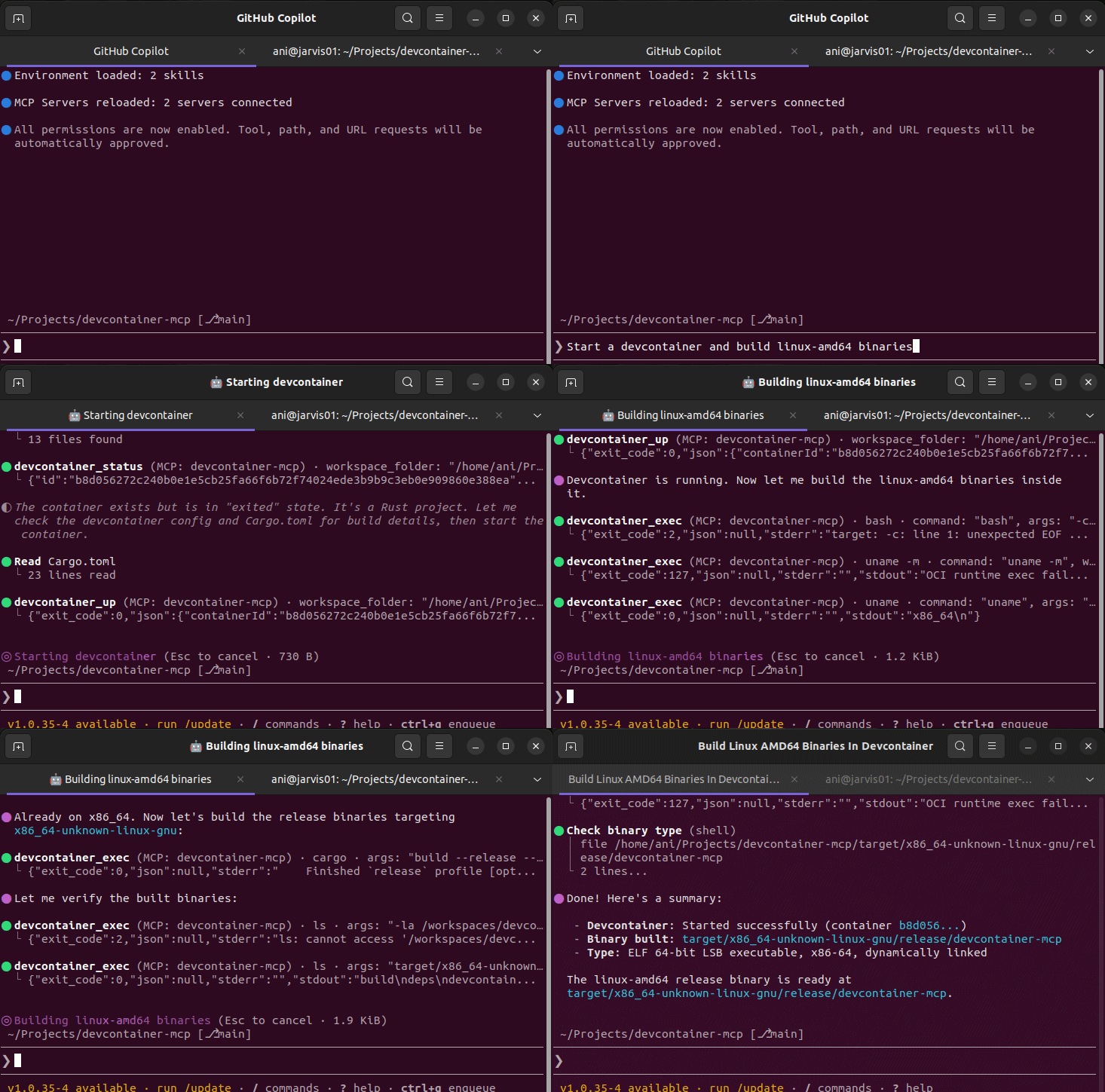
> Works with **GitHub Copilot**, **Claude**, **Cursor**, **opencode**, and any MCP-compatible client.
## The Problem
When AI agents write code, they need to run it somewhere. Today that means your host machine:
- 🔴 **Host contamination** — agents install packages, modify PATH, leave behind build artifacts
- 🔴 **"Works on my machine"** — agents assume your local toolchain matches production
- 🔴 **No isolation** — one project's dependencies break another
- 🔴 **Security risk** — agents run arbitrary commands with your user privileges
- 🔴 **Hardware constraints** — you're limited to your local machine's resources
## The Solution
The [devcontainer spec](https://containers.dev/) already defines reproducible, container-based dev environments. Every major project ships a `.devcontainer/devcontainer.json`. But AI agents can't use them — until now.
`devcontainer-mcp` exposes **45 MCP tools** that let any AI agent:
1. **Spin up** a dev container from any repo — locally, on a cloud VM, or in Codespaces
2. **Run commands** inside the container — builds, tests, linting, anything
3. **Manage the lifecycle** — stop, restart, delete when done
4. **Authenticate** against cloud providers — GitHub, AWS, Azure, GCP — without ever seeing a raw token
```
Agent: "Let me build this project..."
→ auth_status("github") → picks account
→ codespaces_create(auth: "github-you", repo: "your/repo")
→ codespaces_ssh(auth: "github-you", codespace: "...", command: "cargo build")
→ ✅ Built in the cloud. Your laptop did nothing.
```
## Quick Install
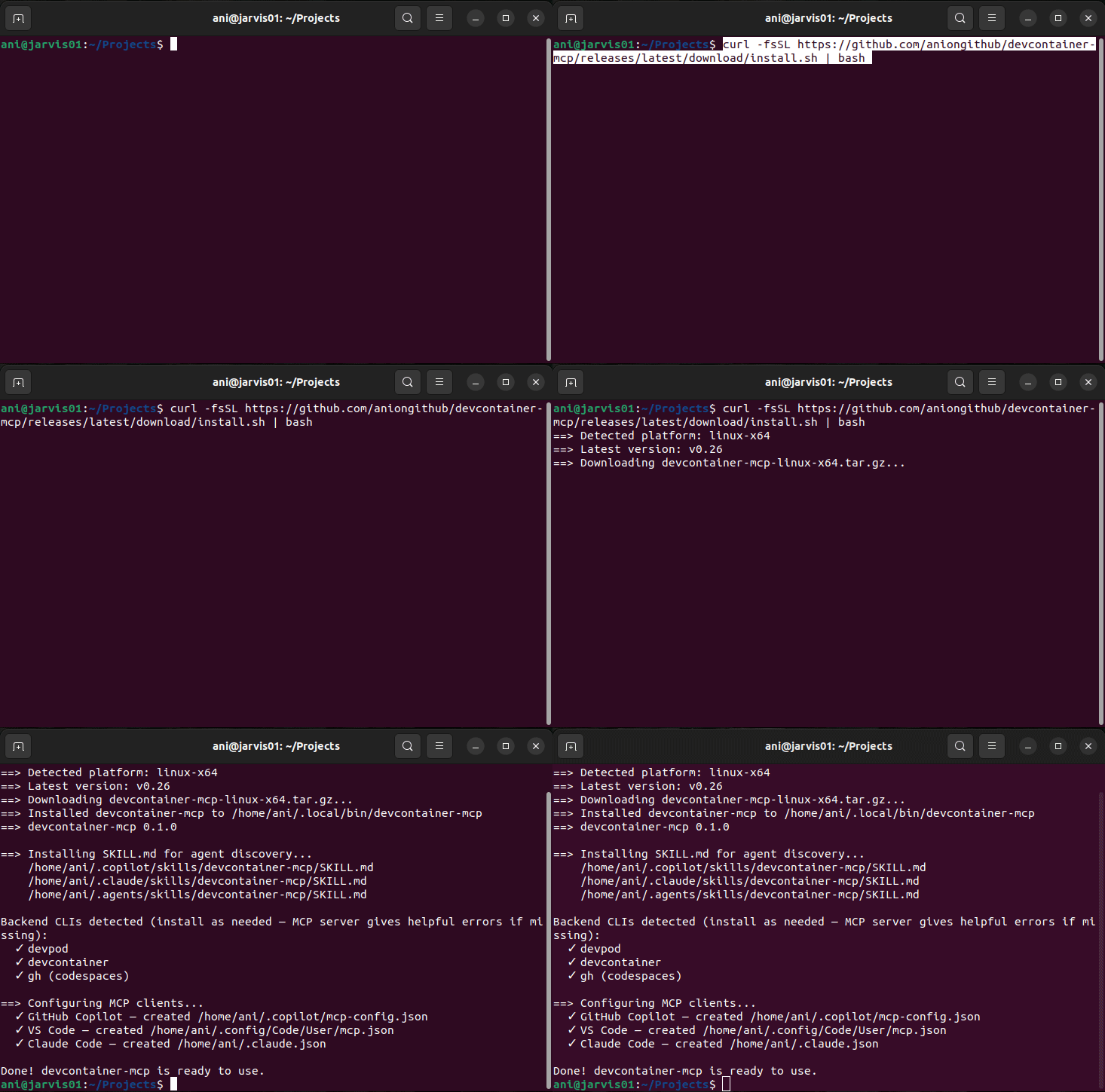
### Linux / macOS
```bash
curl -fsSL https://raw.githubusercontent.com/aniongithub/devcontainer-mcp/main/install.sh | bash
```
### Windows (via WSL)
```powershell
Invoke-RestMethod https://github.com/aniongithub/devcontainer-mcp/releases/latest/download/install.ps1 | Invoke-Expression
```
> **How it works:** The binary runs inside WSL; MCP clients on Windows launch it via `wsl ~/.local/bin/devcontainer-mcp serve`. The stdio transport works transparently across the WSL boundary. WSL 2 is required — install it with `wsl --install` if you haven't already.
Backend CLIs (`devpod`, `devcontainer`, `gh`) are detected at runtime — if one is missing, the MCP server returns a helpful error with install instructions.
Binaries available for **linux-x64**, **linux-arm64**, **darwin-x64**, and **darwin-arm64**.
## Host Protection & Opt-Out
The installer configures two agent hooks (Claude Code & GitHub Copilot CLI) that activate **only** in a directory containing `.devcontainer/devcontainer.json`:
- **`devcontainer-guard`** (PreToolUse) — blocks shell/command execution on the host so the agent routes builds, tests, and runs through the MCP tools instead. Host-safe commands (`git`, `gh`) are allowlisted, and both hooks *fail open* — if `jq` is missing or a payload can't be parsed, commands are allowed rather than blocked.
- **`devcontainer-skill-loader`** (SessionStart) — injects the `SKILL.md` usage guide as context.
### Turning it off for a repo
Sometimes a project ships a stale or unmaintained `.devcontainer` that you don't actually want to route work through. To disable both hooks for that repo, drop a marker file at the repo root:
```bash
touch .devcontainer-mcp-disable
```
When `.devcontainer-mcp-disable` is present, the guard allows host commands through and the skill-loader skips context injection — the agent works locally as if no devcontainer were declared. Commit it (or add it to `.gitignore` for a local-only opt-out).
**One-off bypass:** to run a single host command without disabling the guard, include `USER_CONFIRMED_HOST_OPERATION=1` anywhere in the command.
## Architecture
```mermaid
graph TD
A[AI Agent / MCP Client] -->|stdio JSON-RPC| B[devcontainer-mcp]
subgraph "devcontainer-mcp"
B --> C[33 MCP Tools]
C --> D[Auth Broker]
C --> E[devcontainer-mcp-core]
end
D -->|opaque handles| C
E -->|subprocess| F[DevPod CLI]
E -->|subprocess| G[devcontainer CLI]
E -->|subprocess| H[gh CLI]
E -->|bollard API| I[Docker Engine]
F --> J[Docker / K8s / Cloud VMs]
G --> K[Local Docker]
H --> L[GitHub Codespaces]
```
## Three Backends, One Interface
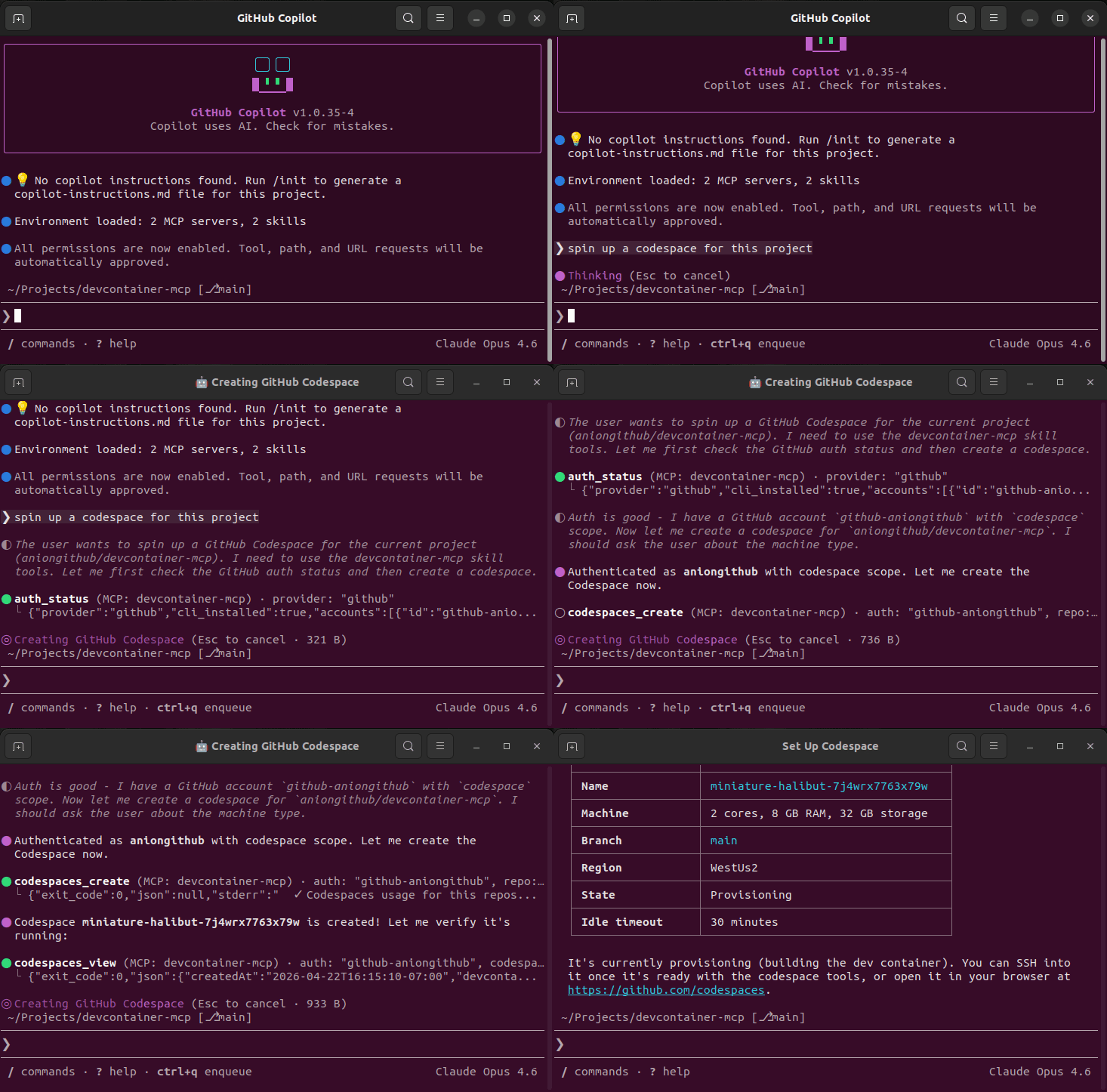
| Backend | Best for | Requires | Auth needed? |
|---------|----------|----------|:---:|
| **devcontainer CLI** (`devcontainer_*`) | Local Docker — fast, simple | [@devcontainers/cli](https://github.com/devcontainers/cli) + Docker | No |
| **DevPod** (`devpod_*`) | Multi-cloud: Docker, K8s, AWS, Azure, GCP | [DevPod CLI](https://devpod.sh) | Optional (cloud providers) |
| **Codespaces** (`codespaces_*`) | GitHub-hosted cloud environments | [gh CLI](https://cli.github.com/) | Yes (`auth` handle) |
## Auth Broker
The agent never sees raw tokens. Instead:
1. **`auth_status(provider)`** — list available accounts and scopes
2. **`auth_login(provider, scopes?)`** — initiate login, opens browser, handles device codes
3. **`auth_select(id)`** — switch the active account
4. **`auth_logout(id)`** — revoke credentials
Codespaces tools require an auth handle (e.g. `"github-aniongithub"`). The MCP server resolves it to the real token on each call via the CLI's native keyring.
Supported providers: **GitHub**, **AWS**, **Azure**, **GCP**, **Kubernetes**
## MCP Tools (46 total)
### Auth (4 tools)
| Tool | Description |
|------|-------------|
| `auth_status` | Check auth for a provider — returns handles, accounts, scopes |
| `auth_login` | Initiate login or refresh scopes — browser + device code flow |
| `auth_select` | Switch the active account for a provider |
| `auth_logout` | Revoke credentials for an account |
### DevPod (19 tools)
| Tool | Description |
|------|-------------|
| `devpod_up` | Create and start a workspace from a git URL, local path, or image |
| `devpod_stop` | Stop a running workspace |
| `devpod_delete` | Delete a workspace and its resources |
| `devpod_build` | Build a workspace image without starting it |
| `devpod_status` | Get workspace state (`Running`, `Stopped`, `Busy`, `NotFound`) |
| `devpod_list` | List all workspaces with IDs, sources, providers, and status |
| `devpod_ssh` | Execute a command inside a workspace via SSH |
| `devpod_logs` | Get workspace logs |
| `devpod_provider_list` | List all configured providers |
| `devpod_provider_add` | Add a new provider |
| `devpod_provider_delete` | Remove a provider |
| `devpod_context_list` | List all contexts |
| `devpod_context_use` | Switch to a different context |
| `devpod_container_inspect` | Docker inspect — labels, ports, mounts, state |
| `devpod_container_logs` | Stream container logs via Docker API |
| `devpod_file_read` | Read file content with optional line range |
| `devpod_file_write` | Create or overwrite a file (auto-creates parent dirs) |
| `devpod_file_edit` | Surgical string replacement — old_str → new_str |
| `devpod_file_list` | List directory contents (non-hidden, 2 levels deep) |
### devcontainer CLI (12 tools)
| Tool | Description |
|------|-------------|
| `devcontainer_up` | Create and start a local dev container |
| `devcontainer_exec` | Execute a command inside a running dev container |
| `devcontainer_build` | Build a dev container image |
| `devcontainer_read_config` | Read merged devcontainer configuration as JSON |
| `devcontainer_list_configs` | Discover all devcontainer.json files in a workspace (single + multi-container) |
| `devcontainer_stop` | Stop a dev container (via Docker API) |
| `devcontainer_remove` | Remove a dev container and its resources |
| `devcontainer_status` | Get dev container state by workspace folder |
| `devcontainer_file_read` | Read file content with optional line range |
| `devcontainer_file_write` | Create or overwrite a file (auto-creates parent dirs) |
| `devcontainer_file_edit` | Surgical string replacement — old_str → new_str |
| `devcontainer_file_list` | List directory contents (non-hidden, 2 levels deep) |
### GitHub Codespaces (11 tools) — require `auth` handle
| Tool | Description |
|------|-------------|
| `codespaces_create` | Create a new codespace for a repository |
| `codespaces_list` | List your codespaces with state and machine info |
| `codespaces_ssh` | Execute a command inside a codespace via SSH |
| `codespaces_stop` | Stop a running codespace |
| `codespaces_delete` | Delete a codespace |
| `codespaces_view` | View detailed codespace info (state, machine, config) |
| `codespaces_ports` | List forwarded ports with visibility and URLs |
| `codespaces_file_read` | Read file content with optional line range |
| `codespaces_file_write` | Create or overwrite a file (auto-creates parent dirs) |
| `codespaces_file_edit` | Surgical string replacement — old_str → new_str |
| `codespaces_file_list` | List directory contents (non-hidden, 2 levels deep) |
## MCP Server Configuration
### Linux / macOS
```json
{
"mcpServers": {
"devcontainer-mcp": {
"command": "devcontainer-mcp",
"args": ["serve"]
}
}
}
```
### Windows (WSL bridge)
```json
{
"mcpServers": {
"devcontainer-mcp": {
"command": "wsl",
"args": ["~/.local/bin/devcontainer-mcp", "serve"]
}
}
}
```
## Prerequisites
Install backend CLIs as needed — the MCP server detects them at runtime and returns helpful errors if missing:
- **devcontainer CLI**: `npm install -g @devcontainers/cli` + [Docker](https://docs.docker.com/get-docker/)
- **DevPod**: [DevPod CLI](https://devpod.sh/docs/getting-started/install) + Docker (or another provider)
- **Codespaces**: [GitHub CLI](https://cli.github.com/) — auth is handled by the `auth_login` tool
## Self-Healing
When `devcontainer_up`, `devpod_up`, or `codespaces_create` fails, the full build output (including errors) is returned to the agent. The agent can read the error, fix the `Dockerfile` or `devcontainer.json`, and retry — making the dev environment a **dynamic, agent-managed asset** rather than a static prerequisite.
## Multi-container workspaces
The devcontainer spec supports [connecting to multiple containers](https://code.visualstudio.com/remote/advancedcontainers/connect-multiple-containers) in one workspace by placing per-service configs at `.devcontainer//devcontainer.json`, each pointing at a shared `docker-compose.yml`. `devcontainer-mcp` supports this pattern end-to-end:
- **Discovery** — `devcontainer_list_configs` returns every config it finds (root `.devcontainer.json`, `.devcontainer/devcontainer.json`, and each `.devcontainer/*/devcontainer.json`) with its kind (`image` / `dockerfile` / `compose`), service name, and absolute path.
- **Targeting** — Every devcontainer tool (`up`, `exec`, `build`, `stop`, `remove`, `status`, `read_config`, `file_*`) accepts an optional `config` parameter pointing at a specific `devcontainer.json`. Single-container workflows continue to work unchanged — `config` defaults to whatever the devcontainer CLI auto-detects.
- **Ambiguity handling** — When a workspace has multiple configs and no `config` is provided, lookup-style tools (`status`, `exec`, `stop`, `remove`, `file_*`) return a structured `Ambiguous` result listing every matching container so the agent can pick the right one. `status` reports this as `{"state":"Ambiguous","candidates":[...],"hint":"..."}`.
- **Robust container matching** — Sibling compose containers are identified via `com.docker.compose.service` + `com.docker.compose.project.config_files` (not the unreliable `devcontainer.local_folder` label, which is only stamped on the first container).
## Development
This project eats its own dogfood — development happens inside its own devcontainer.
```bash
# Using the devcontainer CLI
devcontainer up --workspace-folder .
devcontainer exec --workspace-folder . cargo build --workspace
devcontainer exec --workspace-folder . cargo test --workspace
devcontainer exec --workspace-folder . cargo build --release -p devcontainer-mcp
# Or using DevPod
devpod up . --id devcontainer-mcp --provider docker --open-ide=false
devpod ssh devcontainer-mcp --command "cd /workspaces/devcontainer-mcp && cargo build --workspace"
```
### CI/CD
- **Pull Requests** — `cargo check`, `cargo test`, `cargo clippy`, `cargo fmt` run automatically
- **Releases** — Creating a GitHub release builds binaries for all 4 platforms
## License
[MIT](https://github.com/aniongithub/devcontainer-mcp/blob/HEAD/LICENSE)