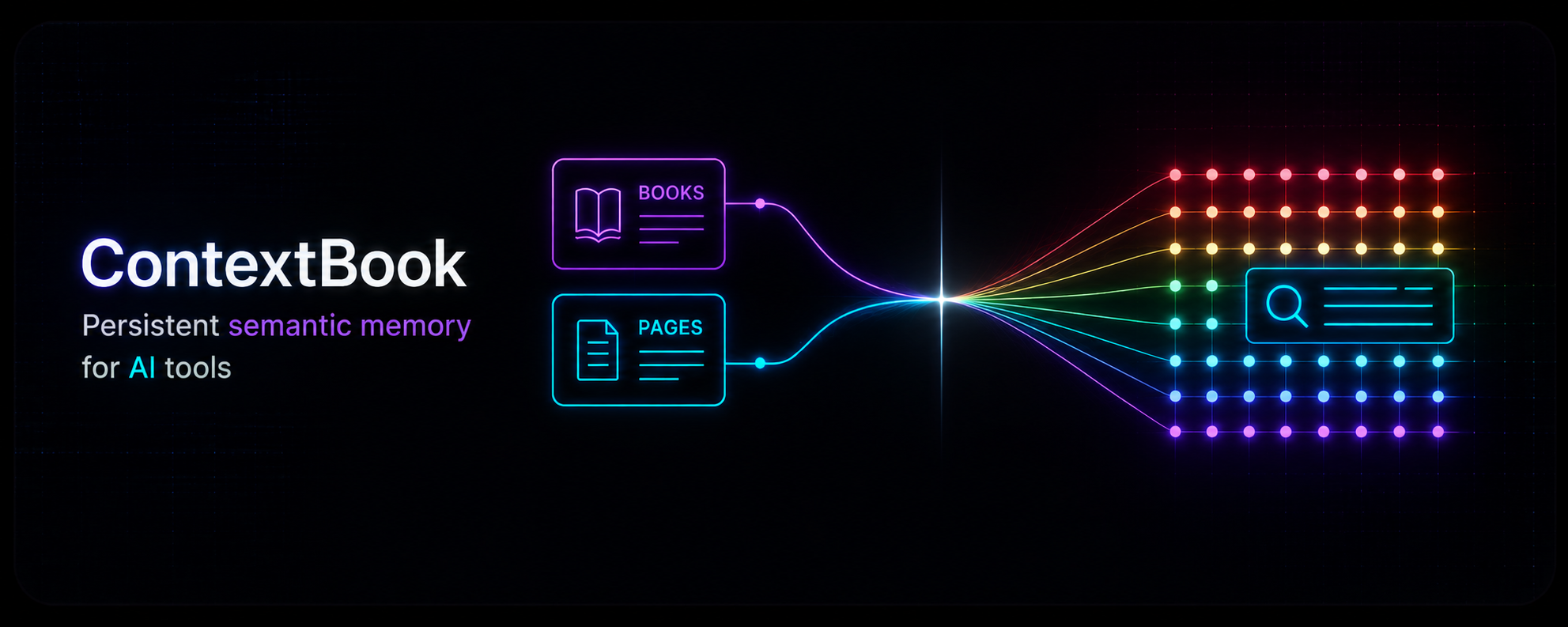
 **Stop re-explaining yourself to Agents. Give it the right context, right when needed.**
LLMs are stateless — each conversation starts from scratch. ContextBook gives your AI tools a persistent, searchable knowledge library to draw the right context when they need it. No bloatware, no pre-loaded junk. Just the right information, at the right time.
## How It Works
```mermaid
flowchart LR
AI["🤖 AI Clients\nClaude · Cursor · Windsurf"]
Browser["🌐 Browser Dashboard"]
MCP["🔌 MCP Server :8081\n8 Bearer-authenticated tools"]
API["⚙️ REST API :8080\nOAuth 2.0 · Books · Pages · Search"]
DB["🗄️ PostgreSQL\npgvector · pg_trgm"]
VOYAGE["🧠 Voyage AI\nvoyage-4 (1024-dim)"]
AI -- "MCP · Bearer Token" --> MCP
Browser -- "Session · HTTP JSON" --> API
MCP --- DB
API --- DB
API -- "OAuth 2.0 PKCE" --> AI
DB --- VOYAGE
```
Two Go binaries share a PostgreSQL database:
- **API server** (`cmd/api`) — the control plane: user login, OAuth 2.0, dashboard, book/page CRUD
- **MCP server** (`cmd/mcp`) — the data plane: 8 MCP tools for AI agents, protected by Bearer tokens
## MCP Tools
All tools require a valid Bearer token and are scoped to the authenticated user.
| Tool | Description |
|------|-------------|
| `book_create_or_update` | Create a Book or update its metadata |
| `book_list` | Paginated list of Book metadata |
| `book_get` | Retrieve all pages of a Book |
| `page_insert` | Push an atomic page into a Book; embeds immediately |
| `page_update` | Replace a page's content; re-embeds |
| `page_delete` | Remove a page (indices not re-numbered) |
| `page_search` | Semantic search across all Books |
| `readme` | Returns the usage guide (call once per session) |
## Quick Start
### Prerequisites
- Go 1.26+
- Node.js 22+
- PostgreSQL 16+ with [pgvector](https://github.com/pgvector/pgvector) and `pg_trgm`
- A [Voyage AI](https://www.voyageai.com/) API key
### 1. Set up the database
```sql
CREATE DATABASE contextbook_db;
\c contextbook_db
CREATE EXTENSION IF NOT EXISTS vector;
CREATE EXTENSION IF NOT EXISTS pg_trgm;
```
Migrations run automatically on API server startup.
### 2. Configure environment
```bash
cp .env.example backend/.env
# Edit backend/.env — set DATABASE_URL, API_KEY_SALT, VOYAGE_API_KEY
```
### 3. Run the backend
```bash
cd backend
go run ./cmd/api/main.go # API + dashboard (:8080)
go run ./cmd/mcp/main.go # MCP server (:8081)
```
### 4. Run the frontend (optional)
```bash
cd frontend
npm install && npm run dev # Vite dev server on :5173
```
### 5. Connect an AI client
For **Cursor** (`.cursor/mcp.json`):
```json
{
"mcpServers": {
"contextbook": {
"url": "http://localhost:8081/mcp"
}
}
}
```
For any MCP-compatible client, point the server URL to `http://localhost:8081/mcp`.
## Documentation
- [Backend README](https://github.com/aditya201551/context-book/blob/HEAD/backend/README.md) — API routes, auth flows, database schema, MCP tools, configuration
- [Frontend README](https://github.com/aditya201551/context-book/blob/HEAD/frontend/README.md) — components, routing, design system, development setup
- [Architecture](https://github.com/aditya201551/context-book/blob/HEAD/architecture.md) — full system overview with Mermaid diagrams
## Project Structure
```
context-book/
├── backend/
│ ├── cmd/api/main.go REST API + auth server
│ ├── cmd/mcp/main.go MCP tool server
│ └── internal/
│ ├── api/ REST handlers + routes
│ ├── auth/ OAuth 2.0 PKCE, sessions, SSO
│ ├── context/ Book/Page business logic
│ ├── db/ pgx queries + migrations
│ ├── embedding/ Voyage AI client
│ ├── logger/ slog + HTTP access logging
│ └── mcp/ 8 MCP tool handlers
├── frontend/ React 19 + Vite + TypeScript SPA
│ └── src/
│ ├── App.tsx Router + app shell
│ ├── lib/api.ts HTTP client
│ └── components/ UI components
├── Dockerfile API server container
├── Dockerfile.mcp MCP server container
└── go.work Go workspace
```
## Contributing
1. Fork the repository
2. Create a feature branch (`git checkout -b feature/my-feature`)
3. Make your changes
4. Ensure the backend compiles (`cd backend && go build ./cmd/api ./cmd/mcp`)
5. Ensure the frontend builds (`cd frontend && npm run build`)
6. Commit and push
7. Open a Pull Request
## License
MIT — see the [LICENSE](https://github.com/aditya201551/context-book/blob/HEAD/LICENSE) file for details.
**Stop re-explaining yourself to Agents. Give it the right context, right when needed.**
LLMs are stateless — each conversation starts from scratch. ContextBook gives your AI tools a persistent, searchable knowledge library to draw the right context when they need it. No bloatware, no pre-loaded junk. Just the right information, at the right time.
## How It Works
```mermaid
flowchart LR
AI["🤖 AI Clients\nClaude · Cursor · Windsurf"]
Browser["🌐 Browser Dashboard"]
MCP["🔌 MCP Server :8081\n8 Bearer-authenticated tools"]
API["⚙️ REST API :8080\nOAuth 2.0 · Books · Pages · Search"]
DB["🗄️ PostgreSQL\npgvector · pg_trgm"]
VOYAGE["🧠 Voyage AI\nvoyage-4 (1024-dim)"]
AI -- "MCP · Bearer Token" --> MCP
Browser -- "Session · HTTP JSON" --> API
MCP --- DB
API --- DB
API -- "OAuth 2.0 PKCE" --> AI
DB --- VOYAGE
```
Two Go binaries share a PostgreSQL database:
- **API server** (`cmd/api`) — the control plane: user login, OAuth 2.0, dashboard, book/page CRUD
- **MCP server** (`cmd/mcp`) — the data plane: 8 MCP tools for AI agents, protected by Bearer tokens
## MCP Tools
All tools require a valid Bearer token and are scoped to the authenticated user.
| Tool | Description |
|------|-------------|
| `book_create_or_update` | Create a Book or update its metadata |
| `book_list` | Paginated list of Book metadata |
| `book_get` | Retrieve all pages of a Book |
| `page_insert` | Push an atomic page into a Book; embeds immediately |
| `page_update` | Replace a page's content; re-embeds |
| `page_delete` | Remove a page (indices not re-numbered) |
| `page_search` | Semantic search across all Books |
| `readme` | Returns the usage guide (call once per session) |
## Quick Start
### Prerequisites
- Go 1.26+
- Node.js 22+
- PostgreSQL 16+ with [pgvector](https://github.com/pgvector/pgvector) and `pg_trgm`
- A [Voyage AI](https://www.voyageai.com/) API key
### 1. Set up the database
```sql
CREATE DATABASE contextbook_db;
\c contextbook_db
CREATE EXTENSION IF NOT EXISTS vector;
CREATE EXTENSION IF NOT EXISTS pg_trgm;
```
Migrations run automatically on API server startup.
### 2. Configure environment
```bash
cp .env.example backend/.env
# Edit backend/.env — set DATABASE_URL, API_KEY_SALT, VOYAGE_API_KEY
```
### 3. Run the backend
```bash
cd backend
go run ./cmd/api/main.go # API + dashboard (:8080)
go run ./cmd/mcp/main.go # MCP server (:8081)
```
### 4. Run the frontend (optional)
```bash
cd frontend
npm install && npm run dev # Vite dev server on :5173
```
### 5. Connect an AI client
For **Cursor** (`.cursor/mcp.json`):
```json
{
"mcpServers": {
"contextbook": {
"url": "http://localhost:8081/mcp"
}
}
}
```
For any MCP-compatible client, point the server URL to `http://localhost:8081/mcp`.
## Documentation
- [Backend README](https://github.com/aditya201551/context-book/blob/HEAD/backend/README.md) — API routes, auth flows, database schema, MCP tools, configuration
- [Frontend README](https://github.com/aditya201551/context-book/blob/HEAD/frontend/README.md) — components, routing, design system, development setup
- [Architecture](https://github.com/aditya201551/context-book/blob/HEAD/architecture.md) — full system overview with Mermaid diagrams
## Project Structure
```
context-book/
├── backend/
│ ├── cmd/api/main.go REST API + auth server
│ ├── cmd/mcp/main.go MCP tool server
│ └── internal/
│ ├── api/ REST handlers + routes
│ ├── auth/ OAuth 2.0 PKCE, sessions, SSO
│ ├── context/ Book/Page business logic
│ ├── db/ pgx queries + migrations
│ ├── embedding/ Voyage AI client
│ ├── logger/ slog + HTTP access logging
│ └── mcp/ 8 MCP tool handlers
├── frontend/ React 19 + Vite + TypeScript SPA
│ └── src/
│ ├── App.tsx Router + app shell
│ ├── lib/api.ts HTTP client
│ └── components/ UI components
├── Dockerfile API server container
├── Dockerfile.mcp MCP server container
└── go.work Go workspace
```
## Contributing
1. Fork the repository
2. Create a feature branch (`git checkout -b feature/my-feature`)
3. Make your changes
4. Ensure the backend compiles (`cd backend && go build ./cmd/api ./cmd/mcp`)
5. Ensure the frontend builds (`cd frontend && npm run build`)
6. Commit and push
7. Open a Pull Request
## License
MIT — see the [LICENSE](https://github.com/aditya201551/context-book/blob/HEAD/LICENSE) file for details.