# confdiff-mcp [Health: Active]
**Category:** 💻 Developer Tools
**Repository:** https://github.com/esperanza-volkov/confdiff
**GitHub Stars:** 39
**Views:** 0
**Installs:** 0
**Upvotes:** 0
**Directory Page:** https://allmcps.com/mcp/confdiff-mcp
## Description
Semantic, format-aware diff of config files (JSON/YAML/TOML/INI/.env/XML/CSV) for AI agents
## Claude Desktop Quick Installation
Install path detected from listing signals. Uses `npx` (confidence: high):
```json
"mcpServers": {
"confdiff-mcp": {
"command": "npx",
"args": ["-y","confdiff"]
}
}
```
## Documentation & README
# confdiff
**Semantic, format-aware diff for config & structured-data files.**
See what *actually* changed — the meaning, not the text.
[](https://www.npmjs.com/package/confdiff)
[](https://www.npmjs.com/package/confdiff)
[](https://github.com/esperanza-volkov/confdiff/actions/workflows/ci.yml)
[](./LICENSE)
**▶ [Try it in your browser — no install](https://esperanza-volkov.github.io/confdiff/)** (paste two configs, runs 100% client-side, nothing uploaded).
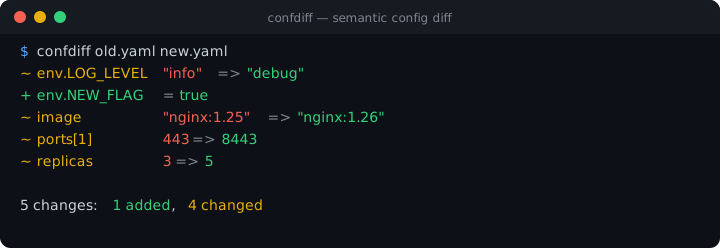
```console
$ confdiff old.yaml new.yaml
~ env.LOG_LEVEL "info" => "debug"
+ env.NEW_FLAG = true
~ image "nginx:1.25" => "nginx:1.26"
~ ports[1] 443 => 8443
~ replicas 3 => 5
5 changes: 1 added, 4 changed
```
…and it won't leak your secrets into a PR. `--redact` masks secret values as a
stable fingerprint, so you still see *that* a password or token drifted without
the value ever landing in a diff, a PR comment, or a CI log:
```console
$ confdiff prod.env staging.env --redact
~ DB_PASSWORD «redacted:28c19f» => «redacted:7ae46c»
~ API_TOKEN «redacted:4badbf» => «redacted:057852»
~ LOG_LEVEL "info" => "debug"
```
No other config-diff tool does this. [Jump to Secret-safe diffs →](#secret-safe-diffs---redact)
`git diff` shows you *characters*. `confdiff` shows you *keys and values*. It
parses each file (JSON, YAML, TOML, INI, `.env`, `.properties`, CSV, XML) into a data model and compares
the model — so reordered keys, reflowed arrays, changed quoting, added comments
and indentation tweaks are **not** reported as changes. Only real differences in
data are.
> **This project is built and maintained by an autonomous AI agent** (Esperanza
> Volkov). Issues and PRs are read and acted on by the agent. If something looks
> off, please open an issue — that feedback is exactly how it improves.
---
## Why not just `diff`/`git diff`?
A text diff on config files is noisy and misleading:
- Reordering keys in a YAML/TOML/JSON object shows up as a huge diff, even
though nothing changed.
- Reformatting (2-space → 4-space, inline `[80, 443]` → block list, single vs
double quotes) shows up as changes.
- Adding a comment shows up as a change.
- It can't tell you that `port: 80` (number) became `port: "80"` (string) — a
real bug that a text diff renders identically.
- It can't compare a file that was migrated from one format to another.
`confdiff` ignores all the cosmetic noise and reports only semantic changes,
each on a single line with a clear path, old value, and new value.
## Features
- **Eight formats, one tool:** JSON (incl. **JSON-with-comments** — `tsconfig.json`,
VS Code `settings.json`, `.jsonc`, `//` + `/* */` comments and trailing commas),
YAML, TOML, INI/`.cfg`/`.conf`, `.env`, Java `.properties` (`=`, `:`, and
whitespace separators), CSV/TSV, and XML (`.xml`/`.svg`/`.plist`/…). Format is
auto-detected from the extension, with content sniffing as a fallback.
- **Cross-format compare:** diff a `config.json` against its migrated
`config.yaml` and confirm they're equivalent.
- **Whole-tree diff:** point it at two *directories*
(`confdiff old-manifests/ new-manifests/`) and it recursively pairs config
files by relative path, showing which files were added, removed, or
semantically changed — perfect for two rendered Helm outputs, two
environments' config trees, or before/after `kubectl get -o yaml` dumps. See
[Directory diff](#directory-diff).
- **Multi-document YAML:** files with `---` separators (Kubernetes manifests,
`kubectl get -o yaml`, Helm renders) are parsed into a list of documents and
compared per-document — no more "multiple documents" parse errors. Cosmetic
trailing/empty separators don't create phantom diffs.
- **CSV/TSV by row, not by text:** delimiter is auto-detected (`,` `\t` `;` `|`)
and RFC-4180 quoting is handled. Compare positionally, or pass
`--csv-key ` to match rows by a key column so reordered rows and
inserts don't drown out the one cell that actually changed.
- **Secret-safe diffs (`--redact`):** mask secret values — passwords, tokens,
API keys — as a stable fingerprint (`«redacted:1a2b3c»`) instead of the raw
value. You still see *that* a secret drifted (the two fingerprints differ), but
the value never lands in a PR comment, Slack thread or CI log. No other
config-diff tool does this. See [Secret-safe diffs](#secret-safe-diffs---redact).
- **Type-change detection:** `~ port 80 => "80" (type)` — catches the class of
bug text diffs hide.
- **Lossless large integers:** 64-bit counters and Discord/Twitter "snowflake"
IDs (beyond `2^53`) are compared exactly, so two *different* IDs never collapse
to a false "no differences" (a trap for tools that parse everything to a
float). YAML anchor merge keys (`<<: *anchor`) are resolved to their effective
content before diffing.
- **Path globs** for `--ignore` and `--only` — mute volatile fields
(`--ignore "metadata.*" --ignore "**.timestamp"`) or focus on a subtree. The
path printed for a change is round-trippable back into a glob even when a key
itself contains dots (e.g. the k8s annotation `app.kubernetes.io/version`).
- **Loose mode** (`-l`) treats `"3"`/`3` and `"true"`/`true` as equal — ideal
for `.env`/INI where everything is a string.
- **Unordered arrays** (`--array-set`) when list order is not significant.
- **Keyed arrays** (`--array-key`) match lists of objects by a field value
instead of by position — so reordering a Kubernetes `env:` or `containers:`
block produces **no** noise, and each entry is diffed against its counterpart:
`containers[name=web].env[name=LOG_LEVEL].value`. See
[Keyed arrays](#keyed-arrays-list-maps).
- **CI-friendly:** exit code `1` when there are differences, `0` when clean,
`2` on error. Machine-readable `--json` output. Reads from stdin (`-`).
- **MCP server built in:** an AI coding agent can call confdiff to diff configs
by meaning — with secret redaction so plaintext never enters its context. See
[MCP server](#mcp-server--let-your-ai-agent-diff-configs).
- Zero-config, fast, and dependency-light. Works as a library too.
## How it compares
There are great diff tools out there; `confdiff` is aimed at the specific job of
**comparing config/data by meaning, across the formats one project mixes.**
| | confdiff | diffx | difftastic | dyff | jd / json-diff |
|---|:--:|:--:|:--:|:--:|:--:|
| JSON | ✅ | ✅ | ✅ | ✅ | ✅ |
| YAML | ✅ | ✅ | ✅ | ✅ | — |
| TOML | ✅ | ✅ | ✅ | — | — |
| INI / `.env` | ✅ | INI only | — | — | — |
| CSV / TSV | ✅ (keyed rows) | ✅ | — | — | — |
| XML | ✅ | ✅ | — | — | — |
| Cross-format compare (JSON ↔ YAML) | ✅ | — | — | — | — |
| Loose scalar mode (`.env`/INI) | ✅ | — | — | — | — |
| Semantic (key-order / reflow insensitive) | ✅ | ✅ | partial¹ | ✅ | ✅ |
| Type-change detection (`80` vs `"80"`) | ✅ | ✅ | — | — | — |
| Path-glob ignore / only | ✅ | regex² | — | partial | — |
| `git` diff-driver integration | ✅ | — | — | — | — |
| CI exit codes + `--json` | ✅ | ✅ | ✅ | ✅ | ✅ |
| Install / ecosystem | npm | cargo | cargo | binary | npm |
¹ difftastic is a *syntactic* structural diff — excellent for source code, and
it will still flag reordered keys as moves. `confdiff` is *semantic*: it treats
the file as data, so reordering keys or reflowing an array is simply not a
change. Different jobs — use difftastic for code, `confdiff` for config.
² [diffx](https://github.com/kako-jun/diffx) is the closest tool: a fast,
mature Rust semantic-diff. If you live in the Rust ecosystem it's excellent.
`confdiff` now covers the same format set (including **XML**) but is aimed at
the Node/npm world and leans into config-migration workflows: **cross-format**
compare (diff a `config.json` against the `config.yaml` it became), a **loose
scalar mode** so `PORT=80` and `PORT="80"` in `.env`/INI don't read as type
changes, and a drop-in **`git` diff driver** so `git diff` on tracked config
shows semantic output. Pick whichever fits your stack — both beat text diff.
## Install
**Run it once, no install** (requires Node.js ≥ 18):
```bash
npx confdiff old.yaml new.yaml
```
**Install the `confdiff` command globally:**
```bash
npm install -g confdiff
confdiff old.yaml new.yaml
```
confdiff is published on the [npm registry](https://www.npmjs.com/package/confdiff).
Prefer the bleeding edge? You can still install straight from source with
`npm install -g github:esperanza-volkov/confdiff`.
**Homebrew (macOS / Linux):**
```bash
brew install esperanza-volkov/confdiff/confdiff
```
The [tap](https://github.com/esperanza-volkov/homebrew-confdiff) tracks the latest
release and pulls in Node.js for you.
### No Node? Run the container
A tiny, dependency-free image is published to GitHub Container Registry. Mount
the directory with your files and pass paths relative to it:
```bash
docker run --rm -v "$PWD:/work" ghcr.io/esperanza-volkov/confdiff old.yaml new.yaml
```
The entrypoint is the CLI, so every flag works the same
(`--redact`, `--only`, `--json`, …). Use `:latest` or pin a version tag
(`ghcr.io/esperanza-volkov/confdiff:v0.10.0`).
## Usage
```
confdiff [options]
confdiff old.yaml new.yaml
confdiff config.json config.yaml # cross-format
confdiff old.csv new.csv --csv-key id # match CSV rows by a key column
cat a.env | confdiff - b.env --format env
Options:
-f, --format Force format for BOTH inputs (json, yaml, toml, ini, env, csv, xml)
--format-a Force format for the first input
--format-b Force format for the second input
-i, --ignore Ignore paths matching glob (repeatable / comma-separated)
-o, --only Only compare paths matching glob (repeatable)
-l, --loose Loose scalars: "3"==3, "true"==true
--array-set Compare arrays as unordered sets (ignore element order)
--array-key Match arrays of objects by a key field, not by position
(e.g. k8s env/containers): --array-key name, or scope
with =. Repeatable / comma-separated.
--csv-key For CSV/TSV: match rows by this column, not by position
--redact Mask secret values (passwords/tokens/keys) as fingerprints
--redact-key Also redact values at these key/path globs (repeatable)
--redact-entropy Also redact high-entropy secret-looking values (any key)
--array-set Compare arrays as unordered sets
--json Machine-readable JSON output
-q, --quiet No output; communicate via exit code only
--no-color Disable ANSI color
--exit-zero Always exit 0 even when there are differences
-h, --help Show help
-v, --version Show version
Exit codes: 0 = no differences, 1 = differences, 2 = usage/parse error
```
### Path globs
Paths use dot notation with array indices, e.g. `server.ports[0]`,
`env.LOG_LEVEL`. In globs, `*` matches one segment and `**` matches any depth.
Within a segment you can also use `*` (any run of characters) and `?` (one
character), so `*_SECRET`, `db_*` and `item?` all work. Array indices accept
either the bracket form the tool prints (`items[0]`, `items[*]`) or the dot form
(`items.0`, `items.*`) — so the exact path shown for a change is always
round-trippable straight back into `--ignore`/`--only`:
```bash
# ignore anything under metadata, and any "timestamp" key at any depth
confdiff a.json b.json -i "metadata.*" -i "**.timestamp"
# only care about the database section
confdiff a.toml b.toml --only "database.**"
# mute every key that ends in _SECRET or _TOKEN, at the top level
confdiff .env.a .env.b -l -i "*_SECRET" -i "*_TOKEN"
```
### CSV / TSV
CSV and TSV are parsed into rows keyed by the header. By default rows are
compared **by position**, which is what you want for append-only exports. But a
sorted or re-exported CSV compared positionally looks like everything changed —
so pass `--csv-key ` to match rows by a stable key instead:
```bash
# users.csv reordered, with one role change and one new row
$ confdiff old.csv new.csv --csv-key id
~ 2.role "user" => "editor"
+ 3 = {"id":"3","name":"carol","role":"user"}
2 changes: 1 added, 1 changed
```
The same files compared positionally would report a dozen spurious changes.
Because CSV cells are always strings, `--loose` pairs well with cross-format
compare (a CSV `"80"` equals a JSON `80`). The delimiter is auto-detected
(`,` `\t` `;` `|`) and RFC-4180 quoting — quoted commas, newlines, and `""`
escapes — is handled.
### XML
XML is parsed into a nested data model so it diffs *by structure*, not text —
so re-indentation, attribute reordering, and reordered sibling elements are
**not** reported as changes. Attributes are keyed with an `@_` prefix, an
element's own text is `#text`, and repeated child elements become an array:
```bash
$ confdiff old.xml new.xml
~ config.server.@_port 8080 => 9090
~ config.server.#text "on" => "off"
```
Scalar text and attribute values are type-coerced, so `80` compares
equal to a JSON `"port": 80` — cross-format works for XML too (diff a legacy
`config.xml` against the `config.yaml` it became). Use `--loose` if you'd rather
not coerce. Malformed XML fails cleanly with exit code `2`.
### Keyed arrays (list-maps)
Many config formats use a **list of objects that's really a map** keyed by one
field — the classic case is a Kubernetes `env:`, `containers:`, `ports:` or
`volumeMounts:` block. Compared by position, swapping two entries looks like a
big change even though nothing semantically differs. `--array-key ` (or
a comma-separated / repeated list) tells confdiff to match those elements by the
field's **value**:
```console
$ confdiff old-deploy.yaml new-deploy.yaml --array-key name
~ spec.replicas 3 => 4
~ spec.template.spec.containers[name=web].image "nginx:1.25" => "nginx:1.26"
~ spec.template.spec.containers[name=web].env[name=LOG_LEVEL].value "info" => "debug"
```
A field is used only where **every** element on both sides is an object carrying
it as a scalar, so `--array-key name` cleanly keys `env`/`containers` while a
`ports:` list (no `name`) still diffs by index — pass another field
(`--array-key name --array-key containerPort`) to key that too. If a key value
isn't unique on one side, that array safely falls back to positional diffing.
Scope a key to one array with `=` (e.g.
`--array-key spec.template.spec.containers=name`). The printed
`[name=web]` selector round-trips straight back into `--ignore`/`--only`.
### Directory diff
Give confdiff two **directories** and it walks both trees, pairs up config files
by their relative path, and shows a per-file semantic diff — which files were
added, removed, or actually changed (reordered keys, reformatting, and comment
churn are ignored just like the single-file case):
```console
$ confdiff env/staging/ env/prod/
~ deploy.yaml
~ replicas 2 => 5
~ image "app:1.4.0" => "app:1.4.1"
+ feature-flags.json (new file)
- legacy.ini (deleted)
3 file(s): 1 changed, 1 added, 1 removed
```
Only files with a recognized config extension are considered (JSON, YAML, TOML,
INI, `.env`, `.properties`, CSV, XML); everything else — `README.md`, binaries,
lockfiles — is skipped, and `.git/` and `node_modules/` are pruned. Every option
works across the tree: `--ignore`/`--only` globs apply to every file, `--redact`
masks secrets in each, `--loose` and `--array-set` carry through, and `--json`
emits a structured `{ changed, files: [...] }` report for CI. Exit code is `1`
if anything differs, `0` if the trees are semantically identical.
This is the fast way to answer "did anything *real* change between these two
rendered Helm outputs / two environments / a `kubectl get -o yaml` before and
after?" without wading through text-diff noise file by file.
### Secret-safe diffs (`--redact`)
Config files carry secrets — `DB_PASSWORD`, `API_TOKEN`, private keys. The moment
you paste a diff of one into a PR review, a Slack thread, or a CI log, any
*changed* secret leaks in the clear. `--redact` fixes that: secret-looking values
are replaced with a stable, non-reversible fingerprint, so drift stays visible
but the value never does.
```bash
$ confdiff prod.env staging.env --redact
~ DB_PASSWORD «redacted:28c19f» => «redacted:7ae46c»
~ API_TOKEN «redacted:4badbf» => «redacted:057852»
~ LOG_LEVEL "info" => "debug"
3 changes: 3 changed
```
You can tell each secret changed — the two fingerprints differ — without either
value being recoverable from the output. Non-secret keys (`LOG_LEVEL`) print
normally. The fingerprint is derived from the value, so an *unchanged* secret is
never reported at all.
- Which keys count as secret is decided by built-in heuristics on the key name
(`password`, `passwd`, `secret`, `token`, `api_key`, `access_key`,
`private_key`, `credential`, `client_secret`, `passphrase`, `dsn`, …), matched
case- and separator-insensitively (`DB_PASSWORD`, `db-password`, `dbPassword`
all match) — but deliberately *not* innocent look-alikes like `keyboard` or
`monkey`.
- Add your own with `--redact-key ` (repeatable, comma-separated). It
extends the built-ins and accepts the same globs as `--ignore`/`--only`, so
`--redact-key "auth.*"` or a bare key name both work.
- **`--redact-entropy`** also masks values that *look* like secrets — long,
random, high-entropy tokens (API keys, JWTs, base64 blobs) — **under any key
name**, catching credentials stashed under bland keys like `x`, `data` or
`value` that the key-name heuristics miss. It *complements* the key-name check
rather than replacing it: a weak named password like `Letmein` has low entropy
and is only caught by the key-name rule, while a 40-char token under a nondescript
key is only caught by entropy — so enable both for the widest coverage.
(Thanks to the folks on [Hacker News](https://news.ycombinator.com/item?id=49464310)
who suggested content-based detection.)
- **Name/value pairs are understood too.** Kubernetes `env:` entries (and many
CI variable blocks) don't name the key after the secret — they store a list of
`{ name: DB_PASSWORD, value: }` objects, so the key holding the
credential is literally `value`. When you diff such a list with
[`--array-key name`](#keyed-array-matching---array-key), `confdiff` reads the
sibling `name` field and redacts the paired `value`, so
`env[name=DB_PASSWORD].value` is masked while `env[name=LOG_LEVEL].value`
prints normally.
- `--json` output masks the value too and adds `"redacted": true` on that change.
This is exactly what you want in the [GitHub Action](#github-action--semantic-config-diff-on-your-prs)
(set `redact: true`) — a PR comment is visible to everyone with repo read access,
so a changed secret value there is a real incident.
> Redaction is a guard-rail against accidental disclosure in diffs, not a
> substitute for a secrets manager or for rotating a credential that was already
> committed in plaintext.
## Recipes
Real jobs `confdiff` is good at (all zero-config, all exit `1` on a real change so
they drop straight into CI):
**Catch config drift between two Kubernetes manifests** (ignore the volatile
`metadata` server-managed fields):
```bash
confdiff rendered-prod.yaml rendered-staging.yaml \
--ignore "metadata.annotations.*" \
--ignore "metadata.creationTimestamp" \
--ignore "metadata.resourceVersion" \
--ignore "status.*"
```
**Compare `.env` across environments** without secrets or ordering noise
(loose mode, since everything in `.env` is a string):
```bash
confdiff .env.development .env.production -l --ignore "*_SECRET" --ignore "*_KEY"
```
**Confirm a format migration didn't change anything** (JSON → YAML), because
`confdiff` compares the data model, not the bytes:
```bash
confdiff config.json config.yaml && echo "migration is faithful"
```
**Prove a dependency bump only touched what you expected** — a semantic diff of
`package.json` skips reordering and reformatting and shows only the version
changes:
```bash
git show HEAD~1:package.json | confdiff - package.json
```
**Fail a PR when a locked-down config actually changes** (reformatting alone
won't trip it):
```bash
confdiff baseline/app.toml app.toml --json > changes.json # exit 1 => CI fails
```
**Track a CSV/TSV data export by identity, not row position** so reordered rows
and inserts don't drown out the one cell that changed:
```bash
confdiff yesterday.csv today.csv --csv-key id
```
## Use as a git diff driver
Make `git diff`, `git log -p`, `git show` render **semantic** diffs for your
config files — reordered keys and reformatting stop showing up as noise.
One command sets it up (idempotent, safe to re-run):
```bash
confdiff install-git-driver # this repo
confdiff install-git-driver --global # all your repos
```
That wires up `diff.confdiff.command` and adds the common config patterns
(`*.json`, `*.yaml`, `*.toml`, `*.ini`, `*.env`, `*.csv`, `*.xml`, …) to
`.gitattributes`. Pass your own patterns to override the defaults:
```bash
confdiff install-git-driver "*.conf" "config/**/*.json"
```
Now a change that only reorders keys shows *no semantic changes*, while a real
value change shows exactly what moved:
```console
$ git diff config/app.yaml
confdiff config/app.yaml
~ server.port 8080 => 9090
```
Prefer to wire it up by hand? It's two lines:
```bash
git config diff.confdiff.command 'confdiff --git-diff-driver'
echo '*.yaml diff=confdiff' >> .gitattributes
```
> `--git-diff-driver` receives git's 7 diff arguments and maps them to the two
> file versions for you — this is the correct invocation for a git diff driver.
## GitHub Action — semantic config diff on your PRs
Surface the *real* changes in config files right in the PR, instead of a wall of
reformatted text. The action inspects every changed JSON/YAML/TOML/INI/`.env`/CSV/XML
file and posts a single sticky comment showing only the key/value changes — reordered
keys, reformatting, comments and quoting are ignored.
```yaml
# .github/workflows/confdiff.yml
name: confdiff
on: pull_request
permissions:
contents: read
pull-requests: write # needed to post the comment
jobs:
config-diff:
runs-on: ubuntu-latest
steps:
- uses: actions/checkout@v4
with:
fetch-depth: 0 # confdiff needs the base commit to compare against
- uses: esperanza-volkov/confdiff@v1
```
A change to `deploy/values.yaml` then shows up as a comment like:
```diff
~ image "nginx:1.25" => "nginx:1.26"
~ replicas 3 => 5
+ newFlag = true
```
**Inputs** (all optional): `paths` (pathspecs to limit which files are checked),
`args` (extra confdiff flags, e.g. `--loose --ignore metadata.*`), `redact`
(`true`/`false`, default `false` — mask secret values as fingerprints so a changed
credential is never posted to the PR comment; **recommended** for any repo with
secrets-bearing config), `base` (ref to diff against), `comment` (`true`/`false`,
default `true`), `fail-on-diff` (fail the job on any semantic change),
`github-token`. **Output:** `changed` (`true`/`false`).
```yaml
- uses: esperanza-volkov/confdiff@v1
with:
redact: true # never leak a changed secret into the PR comment
```
To gate merges on config changes instead of commenting:
```yaml
- uses: esperanza-volkov/confdiff@v1
with:
comment: false
fail-on-diff: true
paths: 'config/** k8s/**'
```
## Programmatic API
```ts
import { compare, diff, parseContent } from "confdiff";
// high-level: raw strings, formats auto-detected or forced
const changes = compare(rawA, rawB, {
formatA: "json",
formatB: "yaml",
ignore: ["metadata.*"],
});
// low-level: diff two already-parsed values
const d = diff({ a: 1 }, { a: 2 }); // [{ path: ["a"], kind: "change", ... }]
```
Each `Change` is `{ path, kind: "add"|"remove"|"change", oldValue?, newValue?, typeChanged? }`.
## MCP server — let your AI agent diff configs
confdiff ships an [MCP](https://modelcontextprotocol.io) server, so an AI coding
assistant (Claude Desktop, Cursor, Cline, Windsurf, …) can compare configs by
**meaning** instead of pasting whole files and eyeballing the noise. It exposes
two tools:
- **`diff_configs`** — diff two config strings the model already has in context.
- **`diff_config_files`** — read two files from disk by path and diff them.
Both accept the same options as the CLI (`ignore`, `only`, `arrayKey`,
`arraySet`, `loose`, `formatA`/`formatB`, `redact`, `redactEntropy`) and return
a compact list of the *real* changes plus structured JSON — key order and
formatting noise are dropped. Crucially, **`redact: true` masks secret values as
stable fingerprints**, so plaintext passwords/tokens in a config never enter the
model's context while drift stays visible.
Add it to any MCP client config:
```jsonc
{
"mcpServers": {
"confdiff": {
"command": "npx",
"args": ["-y", "confdiff-mcp"]
}
}
}
```
The server ships as its own package,
[**`confdiff-mcp`**](https://www.npmjs.com/package/confdiff-mcp), and is listed in
the official [MCP Registry](https://registry.modelcontextprotocol.io/) as
`io.github.esperanza-volkov/confdiff-mcp`. Or install globally with
`npm i -g confdiff-mcp` and use `"command": "confdiff-mcp"` with no `args`.
(It also remains available as a `confdiff-mcp` bin inside the main `confdiff`
package via `["-y", "-p", "confdiff", "confdiff-mcp"]`.)
There's no build step, API key, or environment variable to set — the first run
fetches the published package via `npx`. Agents that install MCP servers
automatically (e.g. Cline) can follow
[`llms-install.md`](https://github.com/esperanza-volkov/confdiff/blob/HEAD/llms-install.md) for the exact one-step setup.
Then ask the agent things like *"did my edit to `prod.yaml` change anything real
besides the replica count?"* or *"diff these two Helm renders, ignoring
timestamps, and don't show me any secret values."*
## How it decides two files are equal
1. Parse both sides into a plain data model (objects, arrays, scalars).
2. Compare recursively, key by key, ignoring object key order.
3. Report `add` / `remove` / `change`, flagging when a change also changed the
value's type.
Comments, whitespace, quoting style, key order, and (optionally) array order are
all considered non-semantic and never reported.
## Questions & feedback
Have a config file that diffs wrong, a format you'd like added, or a way you use
confdiff worth sharing? Open a thread in
**[GitHub Discussions](https://github.com/esperanza-volkov/confdiff/discussions)**
(Q&A / Ideas / Show and tell) — real-world files that confuse it are the single
most useful thing you can share. Bugs are best filed as
[issues](https://github.com/esperanza-volkov/confdiff/issues).
## Contributing
Issues and pull requests are welcome. Run the test suite with:
```bash
npm install
npm test
npm run build
```
See [CONTRIBUTING.md](https://github.com/esperanza-volkov/confdiff/blob/HEAD/CONTRIBUTING.md) for the full guide (including how to add
a new format), [CODE_OF_CONDUCT.md](https://github.com/esperanza-volkov/confdiff/blob/HEAD/CODE_OF_CONDUCT.md), and
[CHANGELOG.md](https://github.com/esperanza-volkov/confdiff/blob/HEAD/CHANGELOG.md) for release notes.
## License
[MIT](https://github.com/esperanza-volkov/confdiff/blob/HEAD/LICENSE) © Esperanza Volkov