# codearia-sieve
**Category:** 💻 Developer Tools
**Repository:** https://github.com/AntonG87/codearia-sieve
**Views:** 0
**Installs:** 0
**Upvotes:** 0
**Directory Page:** https://allmcps.com/mcp/codearia-sieve
## Description
Web pages into decision-ready state: dates, numbers with units, budgeted chunks. No model, no key.
## Claude Desktop Quick Installation
Heuristic fallback — verify the package name and runner against the repository README before running it. Uses `npx` (confidence: low):
```json
"mcpServers": {
"codearia-sieve": {
"command": "npx",
"args": ["-y","codearia-sieve"]
}
}
```
## Documentation & README
codearia-sieve
Parses a web page into the exact format a decision model needs.
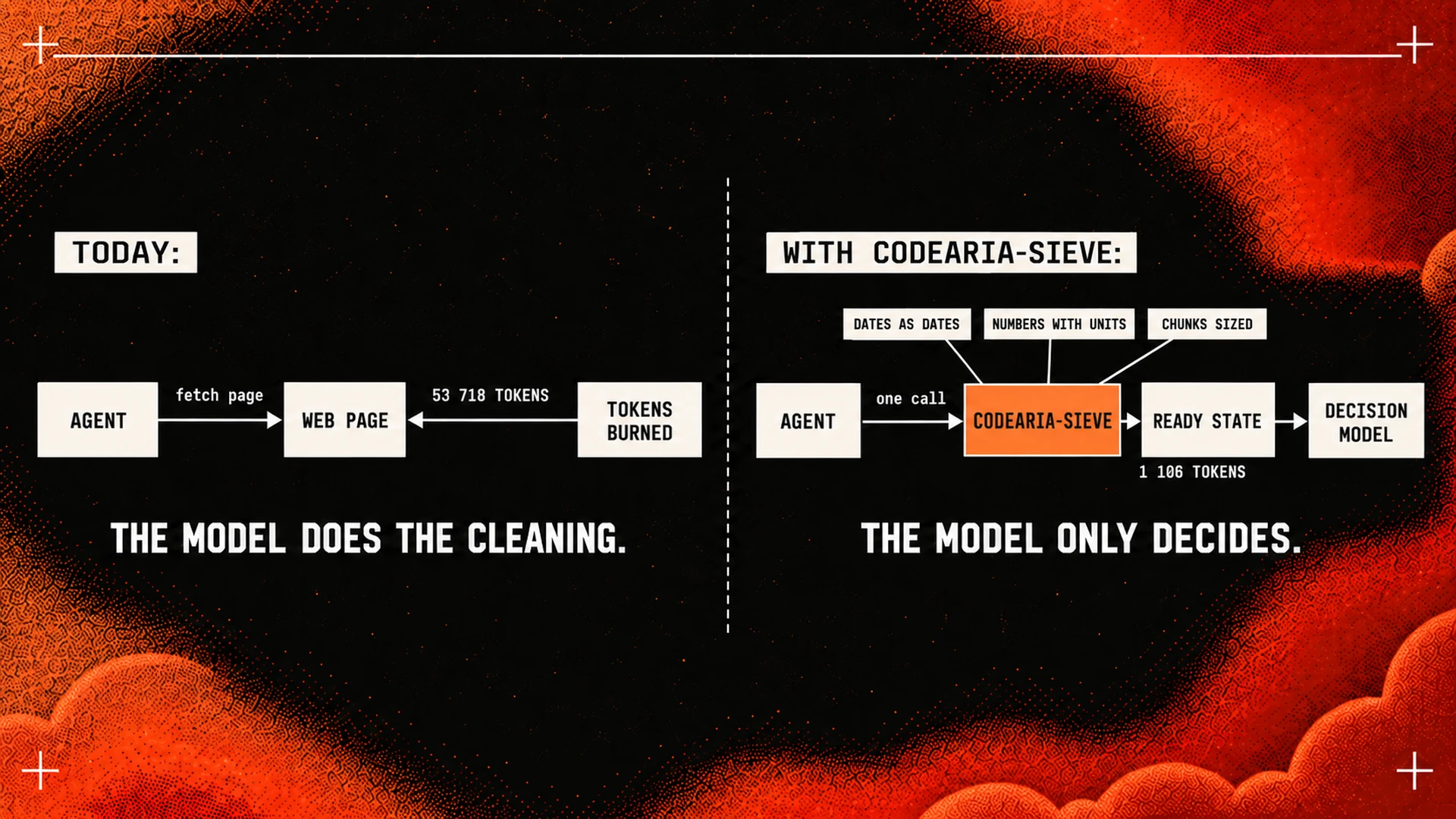
Dates as dates. Numbers with units. Text in chunks that fit the model's window, each pointing back to where it came from.
One call — and the token bill, before and after.
```sh
npx codearia-sieve # MCP server for Claude Code, Cursor and any agent
npm i codearia-sieve # or the library
```
Measured, not promised. A live run over random pages picked the same day — fresh news from RSS feeds in several languages, random Wikipedia articles, docs, blogs, government sites, recipes, shops. Every row is in bench/analytics/, and npm run analytics reruns the whole thing. The output was then put in front of a decision model: see Checked by a judge.
## What it does
An agent that needs a web page fetches the whole thing: navigation, cookie banner, footer, ad slots, a megabyte of framework markup. Then a model paid per token digs through the pile for one paragraph.
**codearia-sieve does the digging before the model sees anything** — and returns the page as *state*, not prose:
**Dates become dates**
`"Published September 15, 2026"` → `"2026-09-15"`.
Read from JSON-LD, meta tags and `
**Numbers become facts**
`"$42 per billion tokens"` → `{ value: 42, unit: "USD_per_billion" }`.
Works in nine languages; the decimal comma follows the page's language. A number without a unit is not a fact. A year is never a fact.
**Text becomes chunks that fit**
Each chunk knows its size in tokens and characters, the blocks it was built from, and the `#anchor` on the page where a decision can be checked.
Everything else — menus, footers, banners, tag rows, "read more" — is removed, and with `trace: true` you get the list of what was removed and why.
## Who it is for
**People who build agents and have seen the bill.** Every fetched page costs tens of thousands of tokens before the agent has read a word of it. Median page in the sample: 53 718 tokens in, 1 106 out.
**People who run cheap decision models.** Classifiers, rankers, System One models like [Jev](https://docs.typesafe.ai/models) that judge instead of write. They are nearly free and very fast, and they have hard edges: they cannot count, they read dates as text, and their accuracy drops as irrelevant material fills the context. Every "page to markdown" tool prepares input for a reader. This one prepares input for a judge.
**People who need answers they can check.** A verdict from scraped text is unprovable unless each piece points back to its source. Here every fact names its block and every chunk carries an anchor.
## How it works
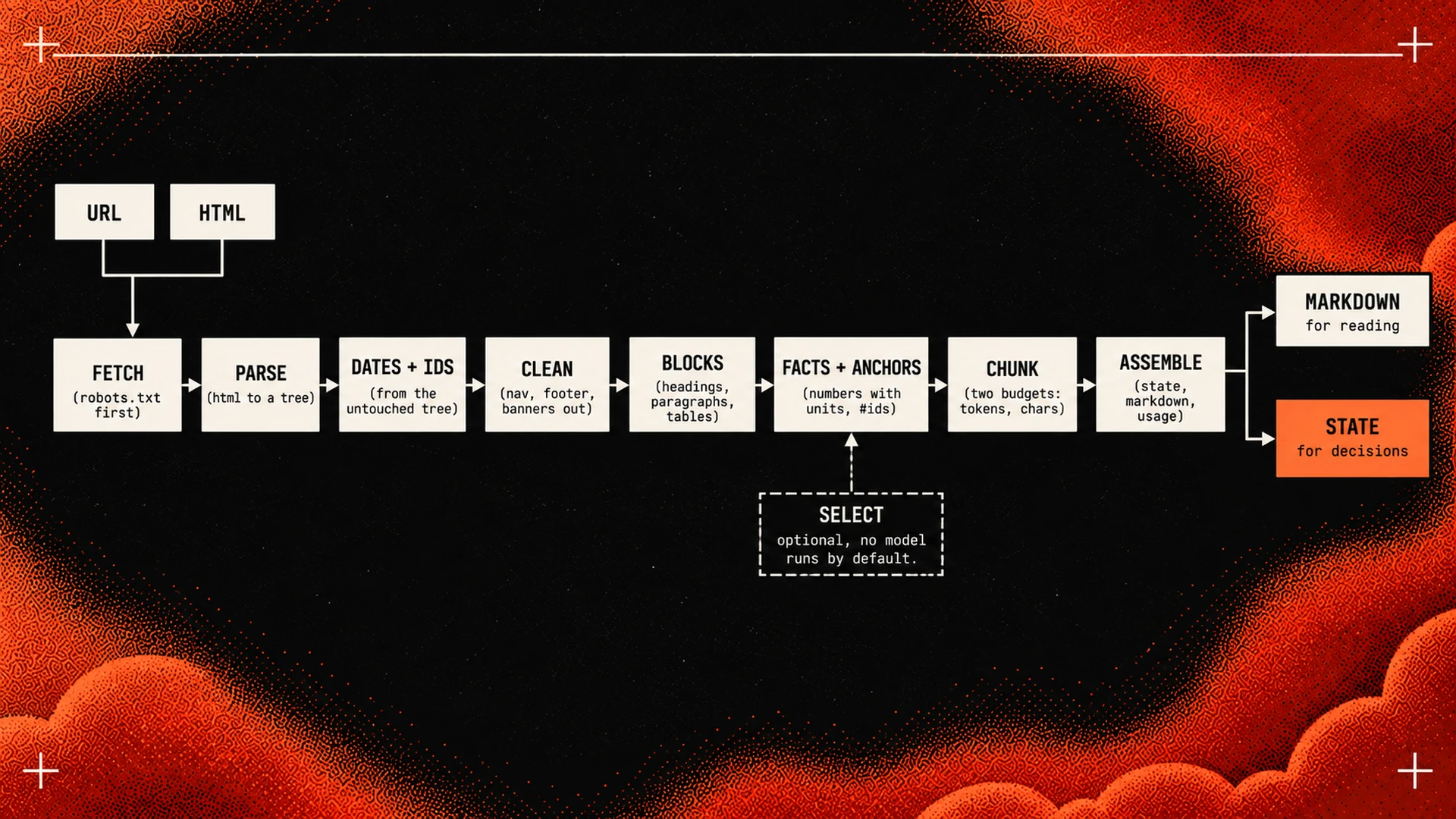
Eight steps of ordinary code. No model runs unless you plug one in. The same HTML gives the same JSON, byte for byte.
1. **Fetch** — `robots.txt` first; a refusal is reported, not bypassed. Plain HTTP, honest user agent.
2. **Parse** — HTML into a DOM with `linkedom`. No browser.
3. **Dates and ids from the untouched tree** — cleaning strips ``, bylines and attributes, so both are read before it runs.
4. **Clean** — Defuddle removes chrome; Readability takes over if it comes back empty. Inline elements get a space first, so `20 Sept10 min` never becomes `202610 min`.
5. **Blocks** — headings, paragraphs, lists, tables, code, quotes, in order, with positional ids. Old pages set with `
` become paragraphs too; table rows keep their column headers.
6. **Facts and anchors** — ids restored; numbers become facts only beside a unit; ranges keep both ends.
7. **Chunk** — greedy, in order, under two budgets at once: 20 000 tokens and 50 000 characters by default.
8. **Assemble** — `state`, `markdown`, `usage`, `warnings`, and the trace on request.
What the result looks like
```ts
const r = await sieve({ kind: 'url', url: 'https://docs.typesafe.ai/models' });
r.state.title // "Models"
r.state.facts[0] // { value: 42, unit: "USD_per_billion", label: "price_btok_mtok",
// context: "Price (per Btok / per Mtok) | jev-1.13.0: $42 / $0.042", from: "b3" }
r.state.facts[1] // { value: 0.042, unit: "USD_per_million", … } — paired by position
r.state.chunks[0] // { id: "c1", tokens: 1210, chars: 5357, anchor: "Current models",
// headings: ["Current models", "Pricing", …], blocks: ["b1", …, "b36"], text: "…" }
r.usage // { rawTokens: 127413, stateTokens: 1211,
// visibleChars: 4939, stateChars: 5357, chunks: 1, ms: 1503 }
r.warnings // []
r.markdown // the same article, for a human or a generative model
```
Expected outcomes never throw. They come back as warnings, each named:
| Warning | Meaning |
|---|---|
| `robots-disallowed` | the site asks crawlers to stay out; we did not fetch |
| `blocked` | a bot challenge or a refusal (403, 405, 429, "Just a moment…"), with the status |
| `http-error` | a 404 or a 500 that still rendered an error page; not the page you asked for |
| `paywall` | the page marks its article as not free; you got the teaser |
| `empty-without-js` | the article container is empty and a script would fill it |
| `thin-content` | a big page that yielded little prose — a front page, a listing |
| `block-split` | one block exceeded the budget and was cut on sentence boundaries |
| `facts-capped` | the page has more facts than the 500 listed — a long fee schedule, say |
## Use it from an agent
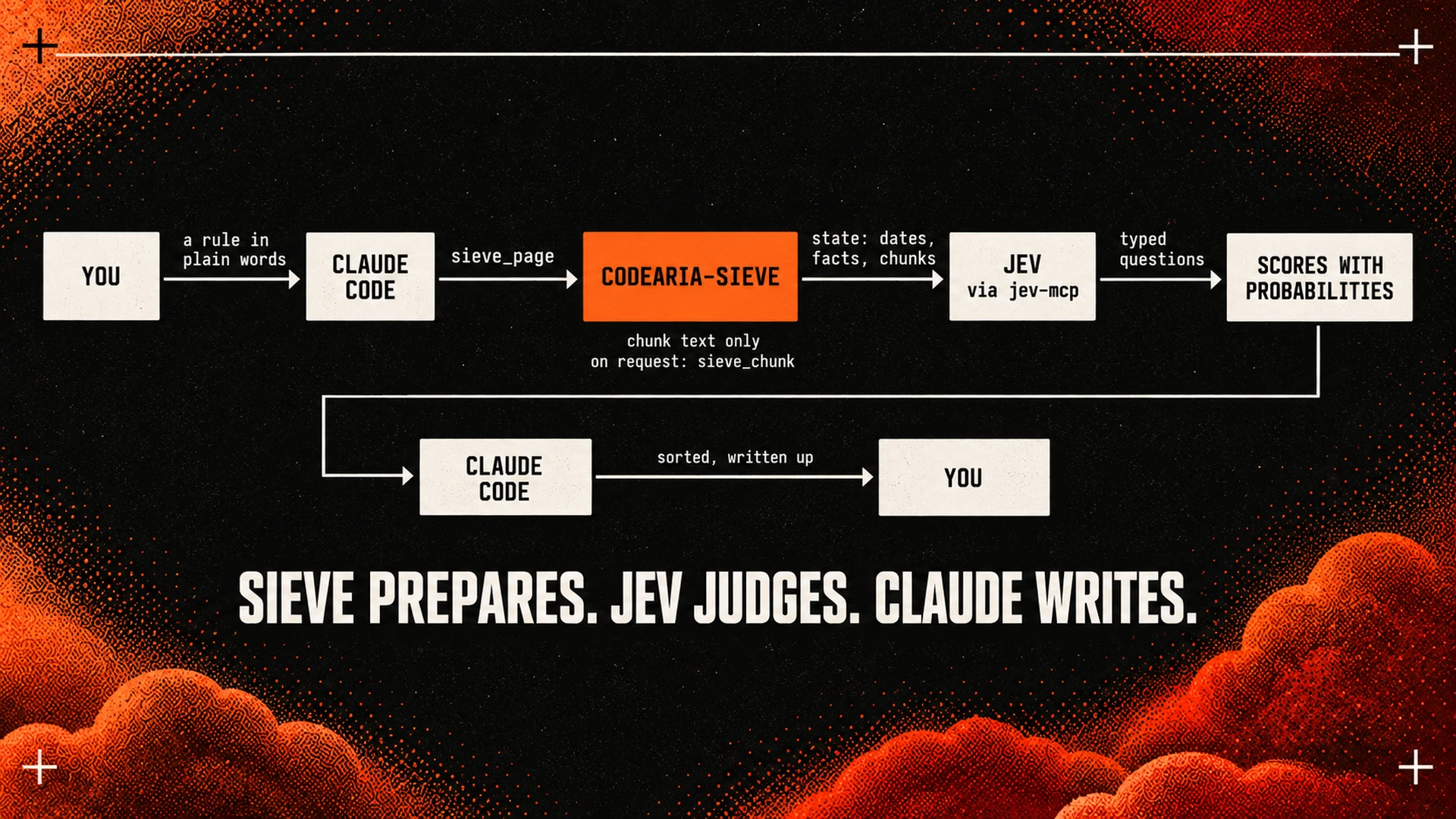
You say what you want in plain words. The agent finds the pages, calls `sieve_page` for each, hands the state to a decision model with a typed question, and writes up the result. **Sieve prepares. The judge judges. The agent writes.**
```json
{ "mcpServers": { "sieve": { "command": "npx", "args": ["-y", "codearia-sieve"] } } }
```
Listed in the [official MCP Registry](https://registry.modelcontextprotocol.io/?search=codearia-sieve) as `io.github.AntonG87/codearia-sieve`; clients that read the registry can install it by name.
**`sieve_page`** — `url` or `html`
Returns typed `structuredContent` with an output schema: `source`, `state`, `usage`, `warnings`. In the default `summary` mode chunks carry sizes, anchors and their headings but **no text** — the agent sees the outline of what exists without paying for it. `mode: "full"` and `mode: "markdown"` when you want everything.
**`sieve_chunk`** — `url`, `id`
The text of one chunk from the last result for that URL, no refetch. Overview first, then only what is needed — the tool applies its own idea to itself.
Pairs with [`jev-mcp`](https://github.com/jkudish/jev-mcp): chunks are sized to fit its fields, so state goes straight into a typed question.
## Checked by a judge
The claim is that a decision model gets *better* input from Sieve than from raw text. So the output was handed to one. [`examples/jev.ts`](https://github.com/AntonG87/codearia-sieve/blob/HEAD/examples/jev.ts) drives both MCP servers with the official client — `codearia-sieve` prepares six pages (API docs, a release note, two Wikipedia articles in two languages, two pricing pages), [Jev](https://docs.typesafe.ai/models) judges them through `jev-mcp`. Same run, 21 September 2026:
| Question to Jev | Input from Sieve | Result |
|---|---|---|
| `jev_classify` — what kind of page is this? | title + head of the first chunk, under the tool's 2 000-char limit | 6 of 6 correct; 5 auto, 1 flagged for review — a page that is both docs and a rate card |
| `jev_verify` — is each extracted fact really on the page? | every fact as a claim, its chunks as evidence | **11 of 11 verified, all auto**, confidence 0.86–1.0 |
| `jev_extract` — when was it published? | first chunk, a date regex, a description | agrees with Sieve where the page states a date; Sieve also reads JSON-LD and ``, which Jev never sees |
The first pass of this test did its job the other way round: Jev sent three facts to review and contradicted one. All four traced to Sieve — a table row labelled by its column header instead of its row header, two rates in one header left unpaired, and a Russian bibliographic "256 с." read as seconds. Fixed, tested, rerun: 11 of 11. A judge that can tell you when your parser is wrong is the point of the whole pairing.
```sh
TYPESAFE_API_KEY=… node --experimental-strip-types examples/jev.ts
```
## Use it as a library
```ts
import { sieve } from 'codearia-sieve';
await sieve({ kind: 'url', url }); // fetch it
await sieve({ kind: 'html', html, url }); // already have it; url only for anchors
await sieve(input, {
budget: { maxTokens: 8000, maxChars: 30000 }, // chunk limits
trace: true, // everything discarded, and why
tokenizer: myTokenizer, // o200k by default; swap for your model's
fetcher: myFetcher, // your transport, or a file reader in tests
now: () => fixedDate, // injected clock: identical output on identical input
selector: mySelector, task: 'is this about pricing?', // relevance judge; nothing runs without one
});
```
`parseDate`, `findDates` and the vendor limits (`JEV`, `JEV_MCP`, `DEFAULT_BUDGET`) are exported too.
## Where it stops
- **Front pages, listings and product pages** have no article to find. You get the headlines and a `thin-content` warning, not a fake win.
- **Articles rendered by JavaScript** come back as `empty-without-js` when the container is empty. A site that ships a teaser and streams the rest cannot be told apart without a browser; you get the teaser.
- **Text-heavy pages save less.** A whole novel saves 22 %, an RFC 84 %: there is no wrapping to remove and the text is kept in full. That is the tool working.
- **A pricing grid is not a table.** A fact knows the block it came from, not the plan column it sits under; Sieve does not guess the pairing. Send the chunk — a pricing page is about a thousand tokens after cleaning — and let the judge read it: [`examples/pricing-watch.ts`](https://github.com/AntonG87/codearia-sieve/blob/HEAD/examples/pricing-watch.ts).
- **Tokens are counted with o200k** as an approximation. Pages over a megabyte get a sampled count and `usage.rawTokensEstimated: true`.
## Develop
```sh
npm install
npm test # 71 tests, offline, a few seconds
npm run demo -- # the token bill for one page
npm run bench # the 20-page benchmark set
npm run analytics # the 56-page random sample: rows, CSV, summary
```
Design notes — [vision](https://github.com/AntonG87/codearia-sieve/blob/HEAD/docs/01-vision.md) and [architecture](https://github.com/AntonG87/codearia-sieve/blob/HEAD/docs/02-architecture.md) — are in [`docs/`](https://github.com/AntonG87/codearia-sieve/blob/HEAD/docs/).