# capad-xyz/searchts [Health: Active]
**Category:** 🔎 Search & Data Extraction
**Repository:** https://github.com/capad-xyz/searchts
**GitHub Stars:** 2
**Views:** 2
**Installs:** 0
**Upvotes:** 0
**Directory Page:** https://allmcps.com/mcp/capad-xyz-searchts
## Description
Keyless web access for AI agents: an escalating open-source unlocker (browser-fingerprint fetch → JS-render relay → stealth browser) reads bot-walled pages as clean Markdown, plus multi-provider web search with rank fusion, subtitles-first video transcripts, and page asset grabbing. No API keys; ships a reproducible benchmark.
## Claude Desktop Quick Installation
Install path detected from listing signals. Uses `uvx` (confidence: high):
```json
"mcpServers": {
"searchts": {
"command": "uvx",
"args": ["--from"]
}
}
```
## Documentation & README
# searchts
**The missing layer between AI and the web.** A Python CLI and library that lets an AI agent read and search the internet, fronted by a fully open-source "unlocker" that gets through common bot-walls with no paid proxy and no API key.
[](https://github.com/capad-xyz/searchts/actions/workflows/pytest.yml)
[](https://pypi.org/project/searchts/)
[](https://pypi.org/project/searchts/)
[](https://pepy.tech/projects/searchts)
[](https://github.com/capad-xyz/searchts/blob/main/LICENSE)
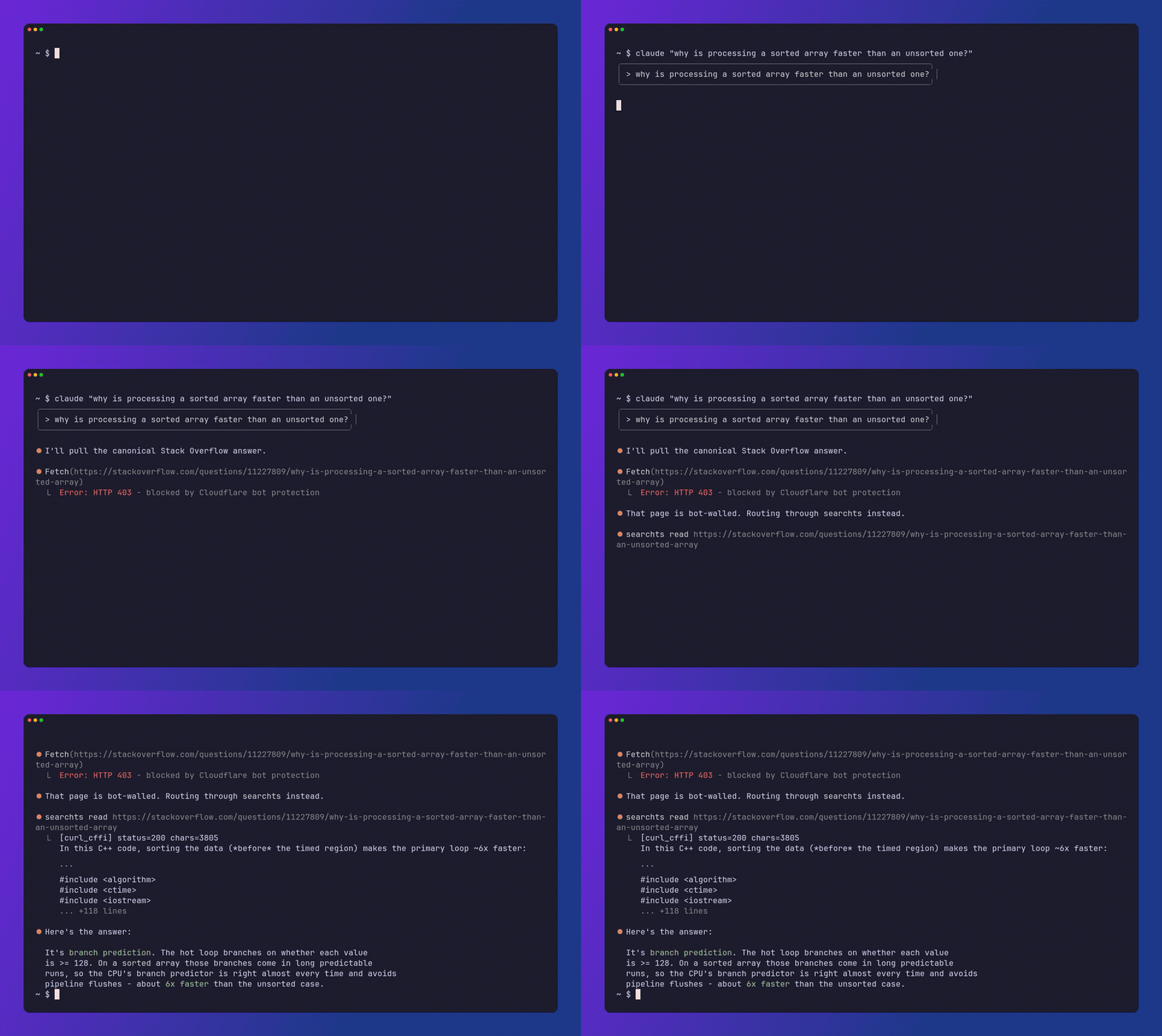
▶ Watch the full 1-minute demo
## Why searchts?
- Reads pages behind common bot walls
- Reads complete ChatGPT / Claude / Gemini / Grok / Poe / DeepSeek / Perplexity / Copilot shared conversations
- Works with Claude, Codex, and MCP agents
- Extracts clean Markdown, ready to feed a model
- Searches the web without API keys
- Downloads a page's assets (images, fonts, palette)
- Transcribes videos, subtitles-first
## Why it's free
AI agents constantly need to read web pages, but the naive way they fetch is trivially blocked by modern anti-bot systems (Cloudflare, PerimeterX, DataDome). Paid unlocker services solve this, but the thing they really charge for is a large pool of clean residential IP addresses. `searchts` runs on your own machine, from your own connection, at personal volume, so it sidesteps that cost and gets through most of those walls for free.
## The unlocker
`searchts` reads any URL through an escalating ladder and stops at the first tier that returns real content:
1. **curl_cffi**: a fetch that impersonates a real Chrome's TLS/JA3 and HTTP2 fingerprint. Beats user-agent and fingerprint filters. Fast, local, private.
2. **Jina Reader**: a JavaScript-rendering relay (`r.jina.ai`), for pages that only fill in content after running JS. **Default on** — the target URL is sent to Jina's servers on this rung. Opt out with `SEARCHTS_NO_JINA=1` or config `jina: false` (local curl + stealth only).
3. **stealth browser**: an undetected headless Chromium (patchright), launched lazily only when the cheaper tiers fail, for live JS / Cloudflare managed challenges.
If no tier comes back with real content, an optional human-in-the-loop step opens a real browser so you can clear the page once and continue. That covers interactive CAPTCHAs and soft walls alike: a login page served as HTTP 200 is not a challenge, but it is still a page only a human gets past. Block detection is phrase-based (not vendor-name based), so legitimate pages that merely embed a bot-sensor script are not falsely rejected. Content is extracted to clean Markdown with `trafilatura`.
**Walls (F12 playbook, not a bypass):** fail loud on login/challenge/thin. Do not cut a release that claims Reddit/LinkedIn now read (**N7**). Order: stealth already retries `page.content` after a navigation race (**P3.11**) → next is a persistent Chromium profile so clearance can survive across reads (**F1**, not shipped) → then `--human` / device session for extras only (**F7**, never silent, never inside `read_url`). Never paid residential as default (**N1**). Never a keyed commercial unlocker as default (**N3**).
## AI-chat share links
Share links from AI chat apps are a special kind of hard: the conversation never appears in the page HTML as extractable text, so generic readers (and most AI agents' built-in fetch) return an empty shell or a fragment cut off mid-chat. `searchts read` recognizes these URLs and decodes each provider's own data channel instead, returning the **complete conversation** as role-labeled Markdown — keyless, no login:
| Provider | Share URL | How it's read |
|----------|-----------|---------------|
| ChatGPT | `chatgpt.com/share/…`, `chatgpt.com/s/…` | turbo-stream payload embedded in the page |
| Claude | `claude.ai/share/…` | keyless snapshot API (behind Cloudflare) |
| Gemini | `gemini.google.com/share/…` | keyless batchexecute RPC |
| Grok | `grok.com/share/…`, `x.com/i/grok/share/…` | keyless share-links API |
| Poe | `poe.com/s/…` | `__NEXT_DATA__` payload embedded in the page |
| DeepSeek | `chat.deepseek.com/share/…` | stealth render, scrolled to the end |
| Perplexity | `perplexity.ai/search/…`, `perplexity.ai/page/…` | stealth render, scrolled to the end |
| Copilot | `copilot.microsoft.com/shares/…`, `…/shares/pages/…` | stealth render, scrolled to the end |
The first five need no browser. The last three are JavaScript shells with
nothing in the initial HTML, so those reuse the stealth tier: wait for the
conversation to render, auto-scroll until the page height stops changing (list
virtualization will otherwise truncate a long chat), then expand the collapsed
sections before reading. The benchmark currently covers the five that read
without a browser and passes all five; the three that need one are not in it
yet.
ChatGPT issues two shapes: `/share/` for a whole conversation, and the
newer `/s/_` short links for a single shared turn (`t_` thread,
`m_` message, `dr_` deep research, `cd_` Codex). Both are read.
Each provider is a drop-in plugin module (`searchts/share_extractors/`); if a provider changes its format, extraction falls back to the normal unlocker ladder instead of failing.
## Install
Keep it (global isolated CLI, MCP extra included):
```bash
pipx install "searchts[mcp]"
```
Try it without installing (one-shot, copy-paste):
```bash
uvx --from "searchts[mcp]" searchts
```
venv / packaging only (not the recommended path for the CLI):
```bash
python -m venv .venv
source .venv/bin/activate # Windows: .venv\Scripts\activate
pip install "searchts[mcp]"
# optional stealth-browser extra, still venv-only:
# pip install "searchts[browser]" && patchright install chromium
```
## Quickstart
```bash
searchts read https://en.wikipedia.org/wiki/Ada_Lovelace # fetch a page as clean Markdown
searchts search "open source vector db" # multi-provider web search (keyless by default)
searchts transcribe https://youtu.be/... # transcript of a YouTube/TikTok/Instagram/Reddit video
searchts grab https://example.com # download a page's assets + extract palette/fonts
searchts get https://example.com/logo.png # download one asset (image/PDF/font/file)
searchts doctor # see what is configured and working
```
`read` flags: `--json`, `--backend `, `--human` (hand off a CAPTCHA or login wall to a real browser), `--scrub` (redact injection).
`search` flags: `-n `, `--json`, `--provider `. Content goes to stdout (pipeable); status to stderr.
`grab` flags: `--out `, `--kinds `, `--read` (also save page.md), `--max `, `--json`.
## Use it from your AI agent
Add searchts to your agent in one line - as an MCP server, or as a Claude Code slash command:
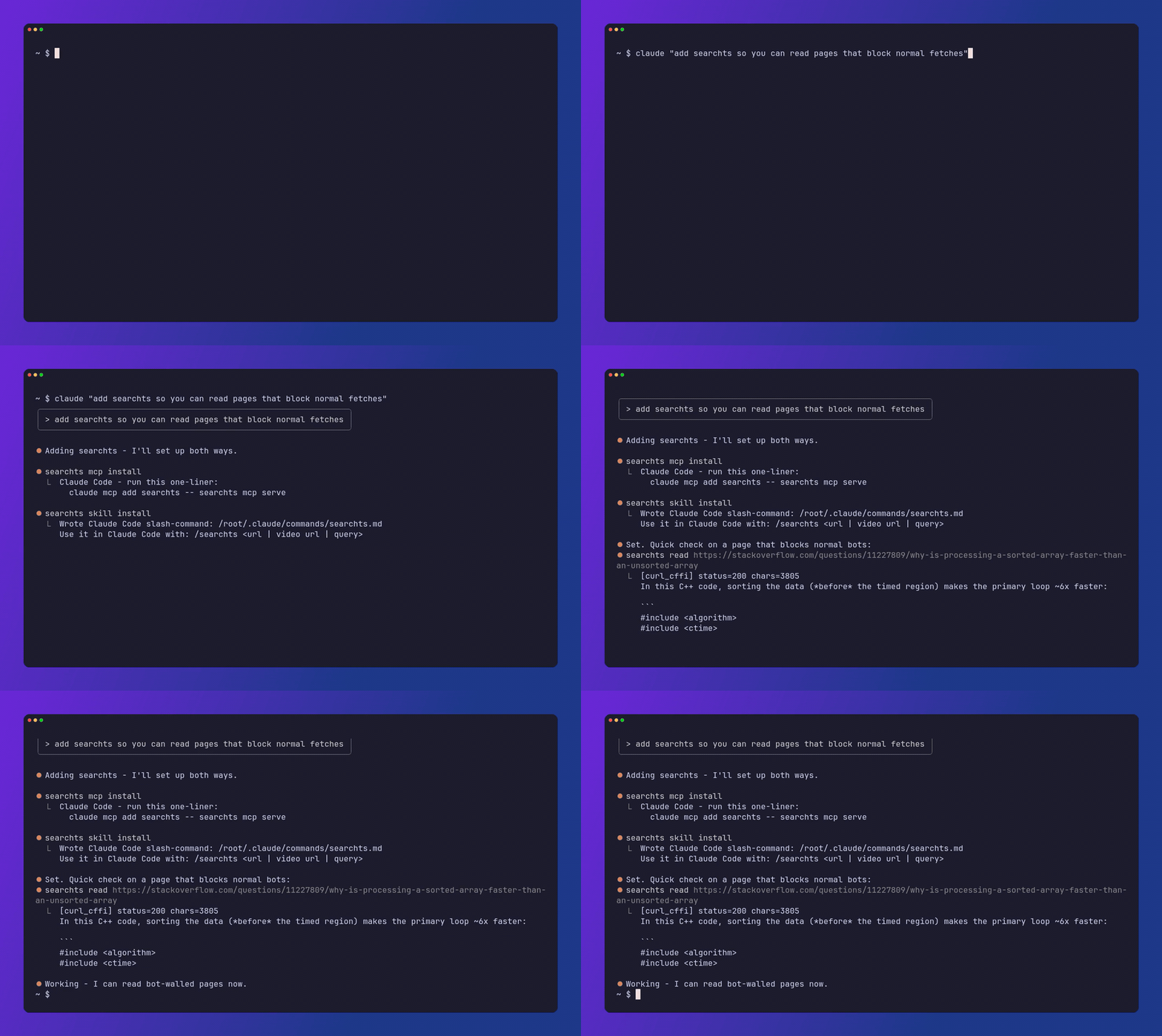
Two ways, both one command:
```bash
# 1) MCP: always-on read_url + web_search + fetch_asset + grab_site + get_status
# Try / no install / Claude cannot see PATH:
claude mcp add searchts -- uvx --from "searchts[mcp]" searchts mcp serve
# Keep (after pipx install "searchts[mcp]"):
# claude mcp add searchts -- searchts mcp serve
# Desktop / Cursor JSON: `searchts mcp install` (or uvx the same serve command)
# First read: Wikipedia — example.com is thinner than _MIN_CHARS and looks like a failed install.
# 2) Slash command: type /searchts in Claude Code
searchts skill install # writes ~/.claude/commands/searchts.md
```
See the [MCP server reference](https://github.com/capad-xyz/searchts/blob/main/docs/mcp.md) for all five tools (`read_url`, `web_search`, `fetch_asset`, `grab_site`, `get_status`), their inputs and outputs, and when to use each.
## Features
- **Escalating open-source unlocker**: curl_cffi, then Jina Reader, then a stealth browser.
- **Multi-provider search with rank fusion**: DuckDuckGo (keyless default), plus SearXNG, Exa, Brave, and Tavily when configured; results merged with reciprocal rank fusion and de-duplicated.
- **Video transcription**: yt-dlp audio plus Whisper for YouTube, TikTok, Instagram, and Reddit videos.
- **Asset + design grabber**: `searchts grab ` downloads a page's images/icons/css/fonts and extracts a color palette plus the fonts in use; `searchts get ` pulls a single asset. Both go through the same escalating unlock ladder, so they work on fingerprint-gated CDNs, not just open ones.
- **Prompt-injection scrubbing**: strips invisible/bidi characters, flags injection indicators, optional redaction, so untrusted page content is safer to feed a model.
- **Per-domain backend memory**: remembers which tier worked per domain and tries it first (`SEARCHTS_NO_MEMORY=1` to disable).
- **Jina opt-out**: the JS-render relay is on by default; `SEARCHTS_NO_JINA=1` (or `jina: false` in `~/.searchts` config) skips it so URLs never hit `r.jina.ai`.
- **Surfaces**: a CLI, an MCP server (`read_url`, `web_search`, `fetch_asset`, `grab_site`, `get_status`), and a Python library.
## Use as a library
```python
from searchts import unlocker
r = unlocker.fetch("https://example.com")
print(r.backend, r.status, r.text)
from searchts.search import search
for hit in search("open source vector db", max_results=5):
print(hit.title, hit.url)
```
## Does it actually work?
Rather than take our word for it, searchts ships a reproducible **two-suite** benchmark: it runs the unlocker over two page sets and reports how many it read — keyless — and which tier carried each.
- **Smoke** — a small public page set (control, open docs, AI-chat share links). A regression canary, *not* evidence about hard bot-walls.
- **Walled** — real vendors that restrict bots (Reddit, LinkedIn login wall, a Cloudflare/DataDome-class site, X, Booking). A short body under the unlocker's minimum-content threshold is a fail, not a pass; expected walled failures are reported honestly, not papered over with 100%.
These two are reported **separately** on purpose — the smoke number is not "does it work on walls." See [benchmarks/README.md](https://github.com/capad-xyz/searchts/blob/main/benchmarks/README.md).
```bash
python -m benchmarks.run # both suites, print a scorecard
python -m benchmarks.run --suite walled # the real walled pass rate only
python -m benchmarks.run --out docs/ # write docs/scorecard.md + results.json
```
Latest run: [docs/scorecard.md](https://github.com/capad-xyz/searchts/blob/main/docs/scorecard.md). Add your own targets — see [benchmarks/README.md](https://github.com/capad-xyz/searchts/blob/main/benchmarks/README.md).
> The numbers only mean something from a **residential** connection: a datacenter IP (or a VPN that reshapes your TLS fingerprint) blocks the fast curl_cffi tier more than a real user sees.
## How it works, and its limits
- It runs from your own residential IP at personal volume, which is why it needs no paid proxy pool. It is a personal-grade research tool, not a mass-scraping system.
- Interactive CAPTCHAs (DataDome / Turnstile press-and-hold) and login walls are the honest ceiling. Use `--human` for those.
- Some platforms (notably Instagram, and YouTube in 2026) may need your browser cookies or fail intermittently; that is platform-side.
- Anti-bot systems evolve; this is an arms race and the techniques may need occasional updates. Respect each site's terms of service and use responsibly.
## Configuration
Search works with no keys (DuckDuckGo). Everything else is optional, via `searchts configure` or a `.env` (see `.env.example`):
- **Search providers**: Exa, Brave, Tavily API keys, or a self-hosted `SEARXNG_URL`, for more and better results.
- **Transcription**: a Groq or OpenAI (Whisper) key, plus `ffmpeg` and `yt-dlp`.
- **GitHub token** for higher rate limits.
Run `searchts doctor` to check what is configured and working.
## Optional integrations
The core is `read` / `search` / `transcribe`. Every `searchts read` goes through
`unlocker.fetch` — there is no per-platform router. `searchts doctor` only probes
whether optional CLIs (`gh`, `twitter-cli`, `opencli`, `mcporter`) are on PATH
and authenticated. Presence is not a claim that searchts reads those sites
through those CLIs.
## Roadmap
See [ROADMAP.md](https://github.com/capad-xyz/searchts/blob/main/ROADMAP.md) for where searchts is headed — and what's deliberately out of scope.
## Credits
`searchts` builds on and extends [Agent-Reach](https://github.com/Panniantong/Agent-Reach) (MIT), reusing its channel, installer, and diagnostics architecture. The escalating open-source unlocker, multi-provider search with rank fusion, prompt-injection scrubbing, per-domain backend memory, the human-in-the-loop CAPTCHA flow, the video transcript channels, the `read_url` / `web_search` MCP tools, and the `read` / `search` CLI commands are additions in `searchts`. Thanks to the original authors.
## License
MIT. See [LICENSE](https://github.com/capad-xyz/searchts/blob/main/LICENSE). Original portions Copyright (c) 2025 Agent Eyes; modifications and additions Copyright (c) 2026 capad-xyz.
---
Built by [capad](https://github.com/capad-xyz). Questions or feedback: open an issue or email oss@capad.fyi.
> *Fun fact: "searchts" doesn't officially abbreviate anything. Off the record, it stands for "search this shit".*