
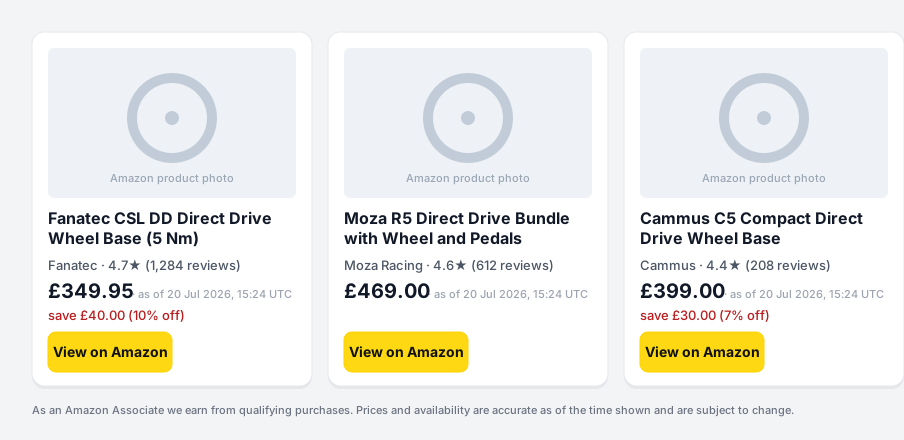
One "make a grid of these" and you get this - styles inlined, tag in every link, disclosure at the bottom. Paste it and move on.
> **Quick nav** > > [Who it's for](#who-its-for) · [How you'll actually use it](#how-youll-actually-use-it) · [Getting your API key](#getting-your-api-key) · [Install](#install) · [Environment variables](#environment-variables) · [Tools](#tools) · [Output formats](#output-formats) · [Styling](#styling-the-cards) · [Associates compliance](#associates-compliance) · [Troubleshooting](#troubleshooting) --- ## Who it's for - **Affiliate bloggers and niche-site owners** who live in round-ups and "best X for Y" posts, and want the product embeds done in seconds instead of by hand. - **Content and SEO teams** who need consistent, on-brand product cards across a lot of articles, without a developer wiring up the API each time. - **Newsletter writers** on Substack, Ghost or beehiiv who just want clean HTML they can drop into an issue. - **Anyone migrating off PA-API 5.0** who needs a working replacement now that the old endpoint is gone. You don't need to know what an API is to use it - if you can add an MCP server to Claude and paste your Associates keys once, you're set. The [key bit](#getting-your-api-key) is having an eligible Associates account. --- ## How you'll use it The whole thing is built around a conversation, not a form. You describe what you're writing about, Claude searches and summarises, and it only spits out HTML when you actually ask for the embed. Here's the shape of it. ### 1. Find products for a post > *"Find me the best direct-drive racing wheels under £500"* Claude runs `search_items` and comes back with a plain summary - no HTML yet: > *Found 8 direct-drive wheels under £500. The ones worth a look:* > *• Fanatec CSL DD (£349) - well reviewed, 5 Nm motor* > *• Moza R5 Bundle (£469) - comes with pedals, 5.5 Nm* > *• Cammus C5 (£399) - compact* > *Want me to build an embeddable grid for these?* ### 2. Build the card or grid > *"Yes, make a grid of the top three"* Now it switches to `format: 'html-grid'` and returns a complete HTML document. Images, prices, savings, stars, your tag, the "as of" timestamp, the disclosure footer. All of it. Paste and you're done. ### 3. Restyle it without burning your rate limit This is the bit that saves you. The Creators API has real rate limits (roughly a request a second to start with, climbing as you drive more sales), so you don't want to re-query Amazon every time you fancy a different colour. You don't have to. Claude keeps the data from the last call and re-renders locally: > *"Same grid, but dark cards and hotpink buttons"* ```json { "response": { "searchResult": { "items": [ /* from the previous call */ ] } }, "format": "html-grid", "customStyles": ".amzn-card{background:#0f172a;color:#f1f5f9} .amzn-card__cta{background:hotpink;color:#111}" } ``` Twenty style tweaks, zero extra API calls. Iterate on the look as much as you like. ### 4. Look up specific ASINs > *"Get me the current details for B09B2SBHQK, B08N5M7S6K and B0BZC6YR7Q"* Claude calls `get_items` and summarises the three. One thing worth knowing: the API doesn't promise to return items in the order you asked for them, and it quietly drops any ASIN it can't find (those land in a separate `errors` array). Claude matches on the `asin` field so you don't have to think about it. ### 5. List colour and size variations > *"What colours does the Echo Show 5 come in?"* That's `get_variations` - it lists the child products of a parent ASIN, each with its own price. --- ## Getting your API key This is where most people get stuck, so I'll be straight with you: **the Creators API isn't open to everyone, and there's a sales gate.** Worth knowing before you spend an afternoon on it. ### What you need first - An **approved Amazon Associates account** for the marketplace you're targeting (a `.com` account won't work against `.co.uk` - the credentials are tied to a region). - **At least 10 qualifying shipped sales in the trailing 30 days.** This is the one that catches people. If your account dips under 10 sales across any rolling 30-day window, access gets suspended until you're back over the line. New or quiet accounts simply won't have API access yet. - You have to be the **primary account owner**. Secondary users on an Associates account can't see the Creators API page or generate keys. In my experience this trips up teams more than anything else. - **Node.js 20 or newer** on the machine running the MCP. ### Where to create the credentials Sign in to [Associates Central](https://affiliate-program.amazon.com/), open the **Tools** menu, and pick **Creators API** - or just go straight to [affiliate-program.amazon.com/creatorsapi](https://affiliate-program.amazon.com/creatorsapi). Then it's three steps. **1. Create a Creators API application** 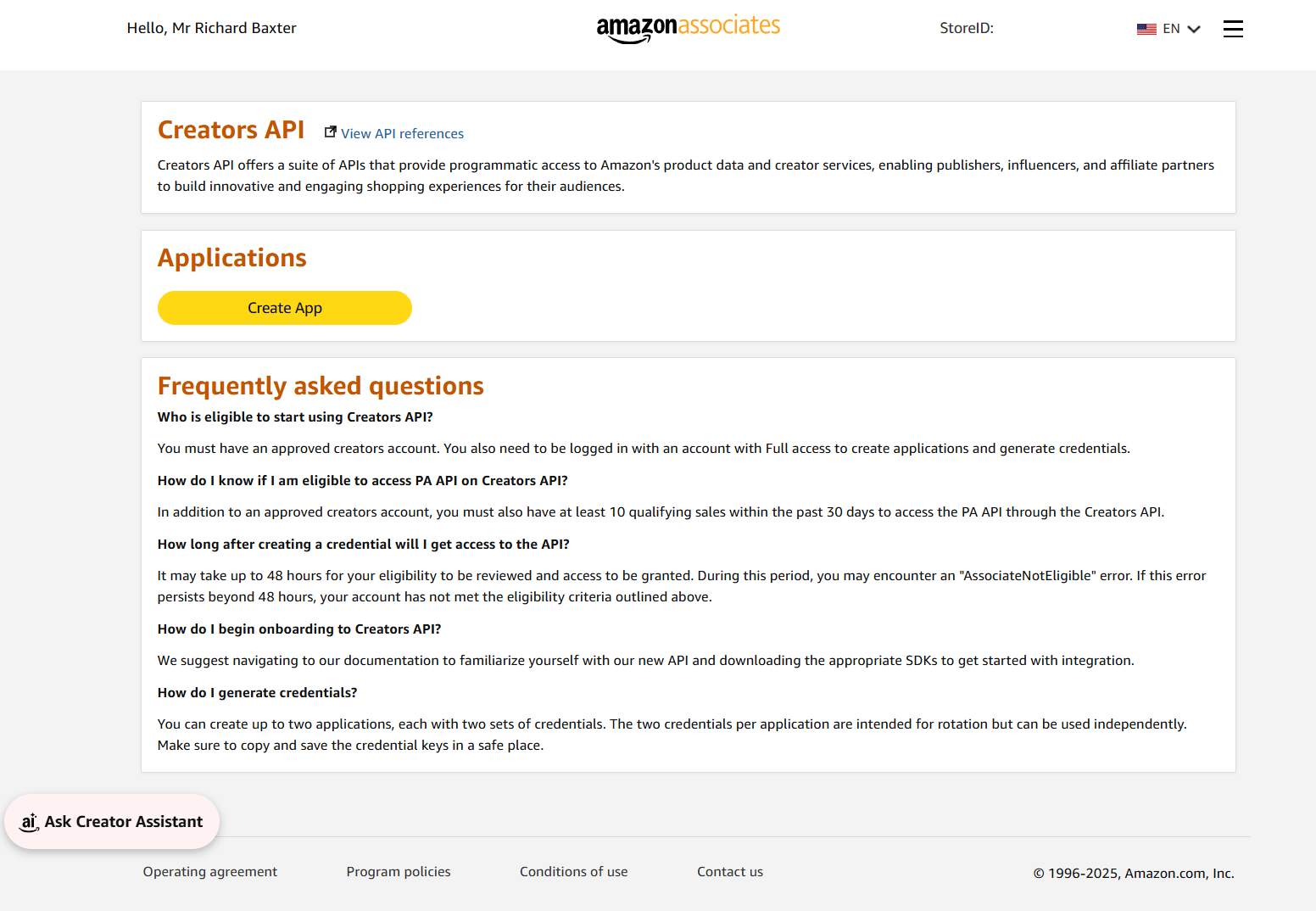 **2. Name it and pick your region** The region you choose here decides your `AMAZON_CREDENTIAL_VERSION` (NA = `3.1`, EU = `3.2`, FE = `3.3` - full table [below](#credential-version-by-region)). Pick the region that matches the marketplace you actually write for. 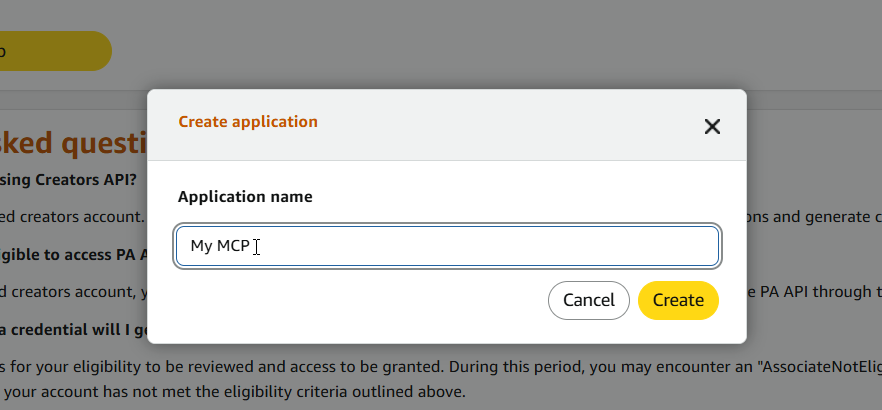 **3. Copy the Credential ID and Secret** Amazon generates a Login with Amazon (v3.x) credential pair. Copy both - the ID goes in `AMAZON_CLIENT_ID`, the secret in `AMAZON_CLIENT_SECRET`. These never leave your own machine. The MCP server talks to Amazon directly; nothing is sent to Houtini or anyone else. 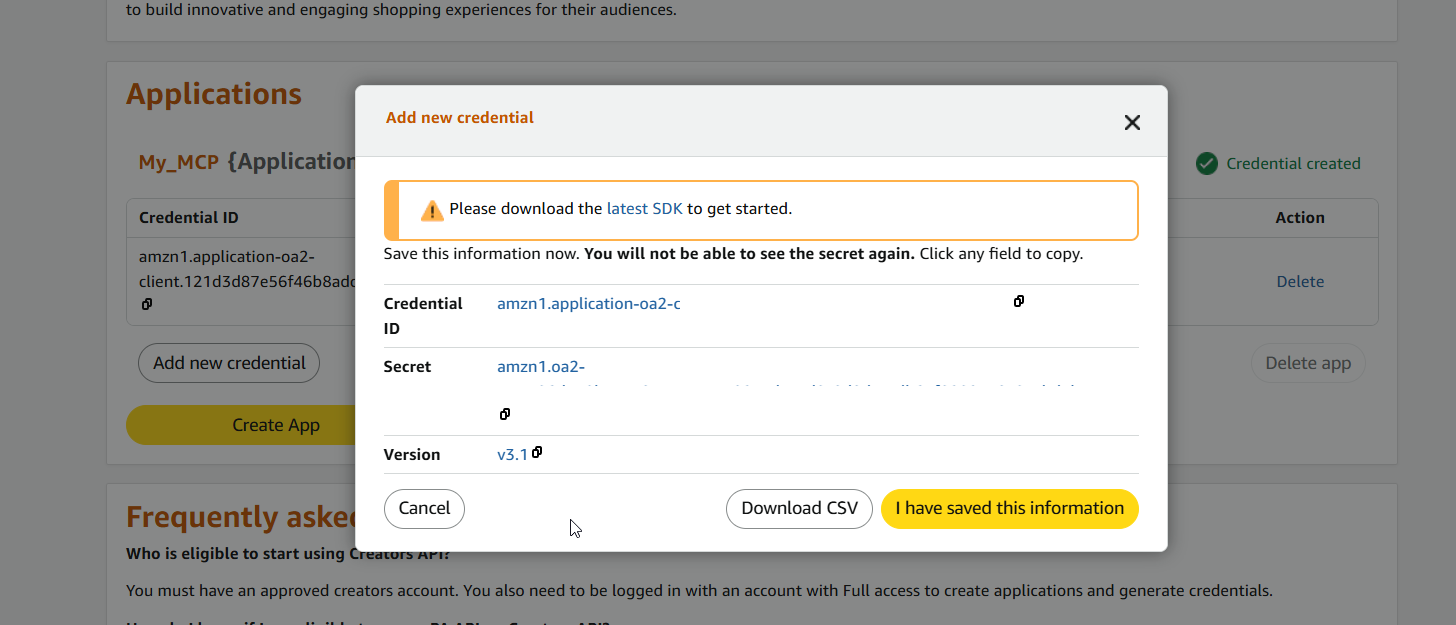 > **On older v2.x credentials:** if you set an app up before early 2026 you might have v2.x Cognito credentials lying around. They don't work here. Create a fresh Login with Amazon application to get v3.x keys - the server checks on startup and refuses v2.x with a message telling you exactly this, so you won't be left guessing. --- ## Install You don't clone anything to use it - `npx` pulls the published package. You just need your five environment variables to hand. ### Claude Desktop Open your config file: - **Windows:** `%APPDATA%\Claude\claude_desktop_config.json` - **macOS:** `~/Library/Application Support/Claude/claude_desktop_config.json` ```json { "mcpServers": { "amazon-creators": { "command": "npx", "args": ["-y", "@houtini/amazon-creators-mcp"], "env": { "AMAZON_CLIENT_ID": "amzn1.application-oa2-client.xxxxxxxxxxxxxxxxxxxxxxxxxxxxxxxx", "AMAZON_CLIENT_SECRET": "amzn1.oa2-cs.v1.xxxxxxxxxxxxxxxxxxxxxxxxxxxxxxxxxxxxxxxxxxxxxxxxxxxxxxxxxxxxxxx", "AMAZON_PARTNER_TAG": "yourtag-20", "AMAZON_CREDENTIAL_VERSION": "3.1", "AMAZON_MARKETPLACE": "www.amazon.com" } } } } ``` Restart Claude Desktop, then say *"find me \[whatever you're writing about\] on Amazon"* and you're off. ### Claude Code (CLI) ```bash claude mcp add \ -e AMAZON_CLIENT_ID=amzn1.application-oa2-client.xxx \ -e AMAZON_CLIENT_SECRET=amzn1.oa2-cs.v1.xxx \ -e AMAZON_PARTNER_TAG=yourtag-20 \ -e AMAZON_CREDENTIAL_VERSION=3.1 \ -e AMAZON_MARKETPLACE=www.amazon.com \ -s user amazon-creators -- npx -y @houtini/amazon-creators-mcp ``` Check it took with `claude mcp get amazon-creators` - you want to see `Status: Connected`. --- ## Environment variables | Variable | Required | Example | Notes | |---|---|---|---| | `AMAZON_CLIENT_ID` | Yes | `amzn1.application-oa2-client.…` | "Credential Id" from your Creators API app | | `AMAZON_CLIENT_SECRET` | Yes | `amzn1.oa2-cs.v1.…` | "Secret" from the same place | | `AMAZON_PARTNER_TAG` | Yes | `yourtag-20` | Your Associates tracking ID | | `AMAZON_CREDENTIAL_VERSION` | Yes | `3.1` / `3.2` / `3.3` | Region-specific - see table below | | `AMAZON_MARKETPLACE` | Yes | `www.amazon.com` | The full marketplace host | | `AMAZON_MAX_CONCURRENCY` | No | `4` | Max requests in flight at once. Default `4`. | | `DEBUG` | No | `1` | Noisy stderr logging. Off by default. | ### Credential version by region Your credentials are tied to one region, and calling a marketplace outside it fails auth - so the server cross-checks these at startup and stops you early rather than letting you find out mid-request. | Region | Version | Marketplaces | |---|---|---| | **NA** | `3.1` | `www.amazon.com`, `www.amazon.ca`, `www.amazon.com.mx`, `www.amazon.com.br` | | **EU** | `3.2` | `www.amazon.co.uk`, `www.amazon.de`, `www.amazon.fr`, `www.amazon.it`, `www.amazon.es`, `www.amazon.nl`, `www.amazon.com.be`, `www.amazon.eg`, `www.amazon.in`, `www.amazon.ie`, `www.amazon.pl`, `www.amazon.sa`, `www.amazon.se`, `www.amazon.com.tr`, `www.amazon.ae` | | **FE** | `3.3` | `www.amazon.co.jp`, `www.amazon.sg`, `www.amazon.com.au` | --- ## Tools | Tool | Input | What it does | |---|---|---| | `search_items` | `keywords` / `actor` / `author` / `brand` / `title` + filters | Search the catalogue. Max 10 items a page; page through with `itemPage`. | | `get_items` | `asins: string[]` (1-10) | Look up specific ASINs. Match results on `asin`, not on the order you sent them. | | `get_variations` | `asin: string` | The size / colour children of a parent ASIN. | | `get_browse_nodes` | `browseNodeIds: string[]` | Category metadata and the ancestor chain. `json` / `markdown` only. | | `format_items` | `response` *or* `items[]` from a prior call | Re-render data you already fetched. **Doesn't call Amazon.** This is how you restyle for free. | The four Amazon-facing tools all take: - **`format`** - `'json' | 'markdown' | 'html-card' | 'html-grid'` (default `markdown`; `get_browse_nodes` is `json | markdown` only) - **`resources`** - which fields to pull, as camelCase paths (`itemInfo.title`, `offersV2.listings.price`). Leave it off for a sensible default set. - **`customStyles`** - extra CSS tacked onto the built-in stylesheet when you're rendering HTML. - **`titleMaxChars`** - cap the rendered title (default **80**). Amazon titles are often 150-plus characters of keyword soup, and 80 keeps a card to one line. Set `0` to turn it off. Markdown and JSON always get the full title. - **`hideItemsWithoutPrice`** - for `html-grid`, drop anything with no price (default **true**). A card with no price is a weak embed - no hook, nothing to click for. Set `false` if you're building a comparison table where you want the product shown regardless. --- ## Deal rows that match your site, not the tool The formats below all produce a card that looks like a card. That's right for a one-off embed and wrong the moment you drop it into a post that already has house styling - you end up with somebody else's design sitting in the middle of your article. `html-deals` emits structural markup instead: `.amazon-deals-section` wrapping one `.amazon-deal-row` per product. If your theme already defines those classes, the output inherits them and there's nothing to restyle. If it doesn't, pass `includeCss: true` and you get a sensible default: 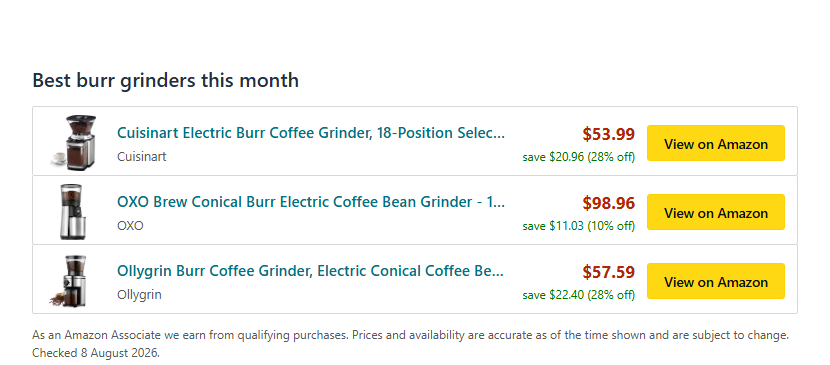 ``` Find me three burr coffee grinders and give me deal rows for the post ``` Each row is a fixed 70px so ten products read as a scannable list rather than ten screens of scrolling. Feature bullets are off by default for the same reason - set `featureCount` if you want them, and unset the row's `max-height` in your own CSS to make room. Two things it will not print: - **A Prime badge.** Nothing in the Creators API response says whether an item is Prime-eligible, so claiming it would be inventing a delivery promise on a page someone might buy from. - **Empty stars.** Review data is [restricted per Associates account](#a-note-on-star-ratings); where Amazon returns none, the rating line is dropped rather than rendered as zero. ### A note on star ratings `customerReviews.starRating` and `customerReviews.count` are requested on every call, but Amazon only returns them for accounts eligible for that data. If your rows have no stars, that's the account, not the tool - the fields are being asked for correctly and the formatter degrades rather than inventing a number. --- ## Output formats - **`markdown`** - image, linked title, price, disclosure. Drops straight into a blog editor. Full untruncated titles. - **`html-deals`** - structural deal rows that inherit your site's CSS. See above. The one to use for articles. - **`html-card`** - one self-contained `