# ai-context [Health: Active]
**Category:** 💻 Developer Tools
**Repository:** https://github.com/vibgrate/cli
**GitHub Stars:** 4
**Views:** 1
**Installs:** 0
**Upvotes:** 0
**Directory Page:** https://allmcps.com/mcp/ai-context
## Description
Local-first MCP server: version-correct library docs, code map, and offline drift for your repo.
## Tools
Capabilities this server exposes over MCP:
- **orient** — start here: project overview, entry points, where to look first.
- **search_symbols** — find a symbol by name or literal string.
- **query_graph** — find code by meaning: symptoms, relationships, what-breaks-if.
- **get_node** — inspect one symbol: signature, callers, callees, area.
- **find_path** — shortest connection between two symbols.
- **impact_of** — blast radius of a change: dependents, files, covering tests, risk.
- **tests_for** — which tests cover a symbol.
- **get_graph_summary** — code map overview: counts, languages, top areas and hubs.
- **list_areas** — code areas (communities) by size.
- **list_hubs** — most-depended-on symbols.
- **get_facts** — deterministic facts for a node (contract / invariant / characterization).
- **guide_node** — cited standards and practices for a node (OWASP/CWE).
- **check_drift** — offline dependency inventory with optional git who-added attribution.
- **vuln_attribution** — who introduced each open vulnerability, exposure windows, CRA remediation metrics.
- **list_vulnerabilities** — known vulnerabilities from the last `vg scan --vulns`: CVE, severity, CVSS, fixed version.
- **upgrade_impact** — what breaks if you upgrade a package: major distance, import blast radius, vulns fixed.
- **list_models** — local models on disk (Ollama / LM Studio / gguf).
- **resolve_library** — resolve a library to its canonical id and the version your project uses.
- **library_docs** — version-correct usage docs for a library, sliced to a token budget.
## Claude Desktop Quick Installation
Install path detected from listing signals. Uses `npx` (confidence: high):
```json
"mcpServers": {
"ai-context": {
"command": "npx",
"args": ["-y","@vibgrate/cli"]
}
}
```
## Documentation & README

@vibgrate/cli
Local codebase intelligence for AI coding agents — graph, drift, and version-correct docs on your machine








`vg` answers three questions for any repo:
1. **What is this codebase?** — A deterministic [code graph](https://vibgrate.com/graph): call trees, import paths, impact surfaces, dependency facts.
2. **How far behind is it?** — A ranked **[DriftScore](https://vibgrate.com/driftscore)** (0–100) with runtime/framework lag, dependency age and EOL proximity, and a prioritized fix list. Exposure is scored separately as a **[RiskScore](https://vibgrate.com/riskscore)**; the two together are the **[DriftRisk Index](https://vibgrate.com/driftrisk)**. The full methodology — formulas, sources, and limitations — is published as a [whitepaper](https://vibgrate.com/whitepapers/software-risk-and-drift-scoring-methodology) under CC BY 4.0 (DOI [10.5281/zenodo.21336304](https://doi.org/10.5281/zenodo.21336304)).
3. **Can we fix it here?** — [**VG Code**](#vg-code--write-the-change-not-just-the-report), a coding agent whose search tool is the code graph, not a grep — in your terminal as `vg code` and as the VG Code panel in [Vibgrate for VS Code](https://vibgrate.com/vscode) — plus `vg fix`, ranked upgrade plans it can apply.
Everything runs **on your machine**. No API key, no network call, no data leaving your repo unless you explicitly push. The `vibgrate` command is an alias for `vg` — they are interchangeable.
---
## See it run
A real vg scan replay — drift score, breakdown, and ranked priorities in one command. Animation plays right here on GitHub; nothing runs in your browser.
▶ Try the live, interactive CLI simulator →
Step through every command (scan, build, ask, why, …) against real sample repos.
---
## Try it in 10 seconds
No install, no signup:
```bash
npx @vibgrate/cli scan # drift score + upgrade priorities
npx @vibgrate/cli build # build the code graph
npx @vibgrate/cli ask "what does AuthService do?"
npx @vibgrate/cli code # a coding agent — it asks before every edit
```
Install for repeat runs:
```bash
npm install -D @vibgrate/cli
npx vg scan # vg is the primary command; vibgrate is an alias
```
> Local binaries live in `node_modules/.bin` — use `npx vg` (or an npm script) unless you install globally.
---
## Use it with your AI assistant
`vg serve` starts **[Vibgrate AI Context](https://vibgrate.com/library)** — a local-first [MCP](https://vibgrate.com/glossary/model-context-protocol) server that
gives any MCP-compatible assistant (Claude, Cursor, Windsurf, Copilot, Gemini
CLI, …) your code map, **offline drift**, local models, and **version-correct
library docs**, all from your machine (no account, nothing uploaded; thin
local docs fall through to the hosted catalog unless you pass `--local`). No
context-window stuffing, no hallucinated APIs. The map **keeps itself fresh**:
when files change — including edits the assistant itself just made — the next
tool call rebuilds it incrementally before answering, with no watcher or
daemon involved.
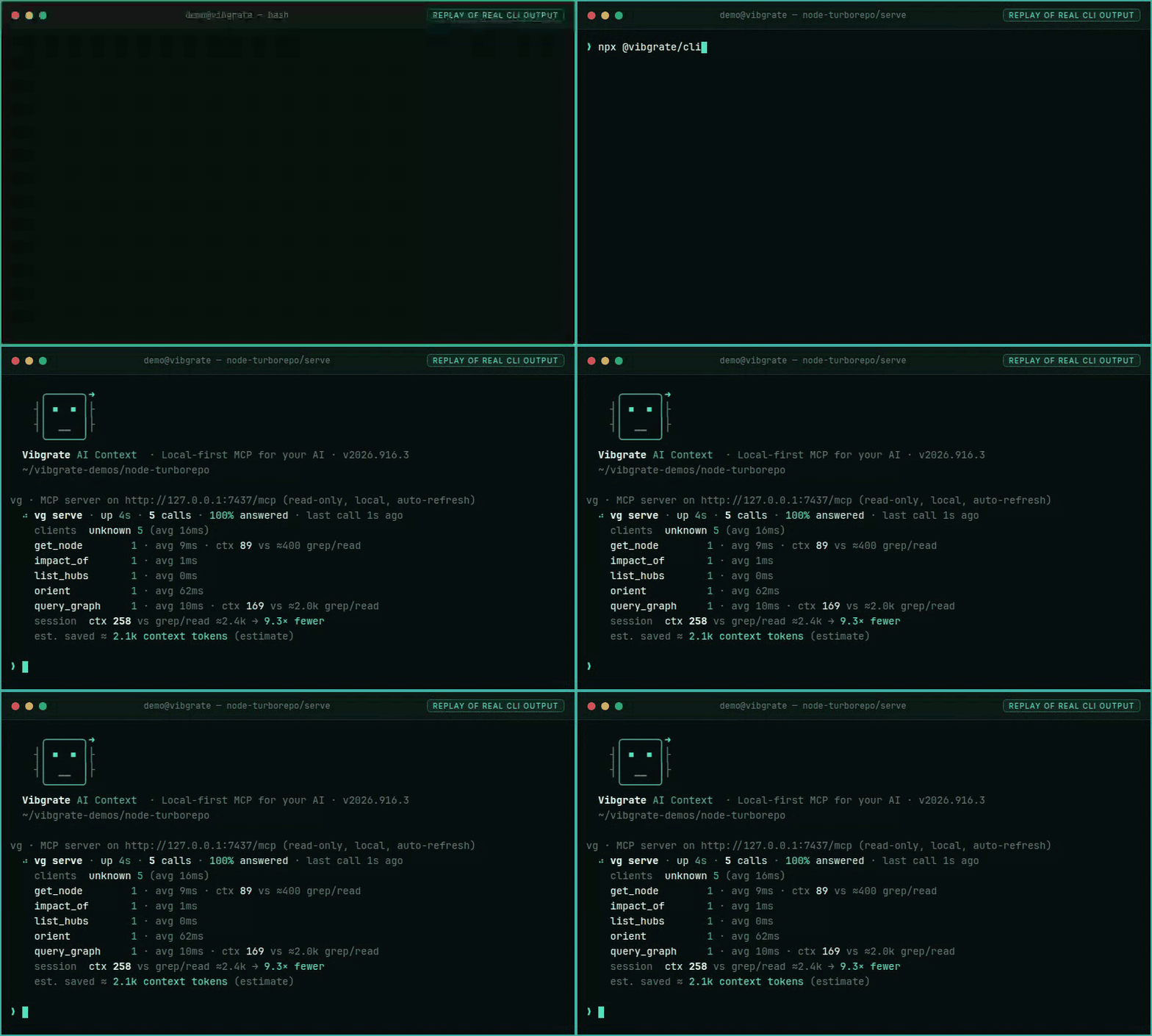
node-turborepo/serve — vg serve --http starts Vibgrate AI Context. Live simulator.
Wire it up in one command:
```bash
vg install # interactive: pick your assistant(s) and done
vg install --all # install for every detected assistant at once
```
This writes the MCP config for your chosen tool(s) and installs a skill that teaches the assistant how to query the graph. After reloading your assistant you get graph-aware answers: call trees, impact analysis, drift findings, version-correct library docs — all from local data. The token savings are measured and published, methodology included, at [vibgrate.com/cli/benchmarks/token-savings](https://vibgrate.com/cli/benchmarks/token-savings).
Browse all 21+ supported assistants and their skill descriptions at **[vibgrate.com/skills](https://vibgrate.com/skills)**.
## Cut what your assistant re-reads: context compression
Every turn, your AI assistant re-sends the whole conversation — including the
20,000-line test log, the 400-row JSON payload, and the grep output it has
already acted on. You pay for that context again on every step. Vibgrate CLI
compresses tool output and older turns **before** they reach the model, keeps
the originals retrievable on your machine, and reports what it saved.
```bash
vg install claude --compress # point Claude Code at the listener and start it (undo with `vg uninstall claude`)
vg savings # tokens and estimated dollars saved, today / 7 days / 30 days
```
There is no separate command to learn: compression is a mode of the server you
already run and a flag on the installer you already use. `vg install
--compress` writes the agent's own base-URL config, starts the listener in the
background (or reuses one already running) and, for Claude Code, adds a
SessionStart hook that brings it back after a reboot. `vg serve --compress`
serves the code map and compresses in one foreground process; `vg serve
--compress --background` starts only the listener and returns. For a single
session without writing any config, `vg serve --compress claude` runs one
agent through it and restores your environment when it exits. Inside `vg code`
it is already on — bulky tool results are compressed before they re-enter the
loop, and the model can pull any original back with `vg_retrieve`.
What it does, in the order it runs:
- **Routes each block by what it is** — JSON arrays, logs and build output, grep
results, diffs, HTML, tables, config files, source code, prose — and applies
the compressor built for that shape. Errors, ids, stack traces and the lines
that match what you asked are always kept.
- **Lossless first.** Repeated lines, grep headings and diff index lines fold
into byte-reversible markers. Lossy compression runs only when it saves
clearly more, and never on file reads or edits, so read-then-edit stays exact.
- **Nothing is lost.** Compressed blocks carry a marker; the model (or you, with
`vg serve retrieve `) can pull back the original or just the slice it needs.
Originals live in a short-lived local store — nothing is uploaded.
- **Prefix-cache aware.** The default `cache` mode compresses only the newest
turn so your provider's prompt cache keeps hitting; `token` mode compresses
everything eligible for the largest saving.
- **Works with any agent.** `vg install --compress` supports Claude Code,
Codex, Cursor, Aider, Copilot, OpenCode, Cline, Continue, Goose, OpenHands,
Gemini CLI, Kimi, Grok and more; `vg uninstall ` restores their config
byte-for-byte. Or use the SDK wrappers for the Anthropic, OpenAI and Vercel AI
SDK shapes.
Everything runs locally and offline. The listener binds to loopback, forwards
your provider credentials untouched, redacts secret shapes before anything is
written to disk, and never phones home. `vg serve config` lists every knob and
`vg serve config set KEY VALUE` changes one.
## Tools
`vg serve` exposes 24 MCP tools (plus two memory tools with `--memory`):
- **orient** — start here: project overview, entry points, where to look first.
- **search_symbols** — find a symbol by name or literal string.
- **query_graph** — find code by meaning: symptoms, relationships, what-breaks-if.
- **get_node** — inspect one symbol: signature, callers, callees, area.
- **find_path** — shortest connection between two symbols.
- **impact_of** — blast radius of a change: dependents, files, covering tests, risk.
- **tests_for** — which tests cover a symbol.
- **get_graph_summary** — code map overview: counts, languages, top areas and hubs.
- **list_areas** — code areas (communities) by size.
- **list_hubs** — most-depended-on symbols.
- **get_facts** — deterministic facts for a node (contract / invariant / characterization).
- **guide_node** — cited standards and practices for a node (OWASP/CWE).
- **check_drift** — offline dependency inventory with optional git who-added attribution.
- **vuln_attribution** — who introduced each open vulnerability, exposure windows, CRA remediation metrics.
- **list_vulnerabilities** — known vulnerabilities from the last `vg scan --vulns`: CVE, severity, CVSS, fixed version.
- **upgrade_impact** — what breaks if you upgrade a package: major distance, import blast radius, vulns fixed.
- **list_models** — local models on disk (Ollama / LM Studio / gguf).
- **resolve_library** — resolve a library to its canonical id and the version your project uses.
- **library_docs** — version-correct usage docs for a library, sliced to a token budget.
- **compress_content** / **retrieve_original** / **compression_stats** (with `--compress`) — shrink a tool output before it enters the context, expand a marker back to the original or just the slice you need, and report what compression saved.
- **memory_search** / **memory_save** (with `--memory`) — project-scoped memory shared across your AI agents.
The last two groups are listed only when you ask for them. Every advertised
tool schema is re-sent on every agent step, so a capability nobody enabled is a
standing cost; both groups stay callable either way.
Prefer the hosted server over your team's scan data? **[Vibgrate Cloud MCP](https://vibgrate.com/mcp)** connects your assistant to Vibgrate Cloud (OAuth 2.1, 51 tools).
---
## Understand any codebase
Build the graph once, query it continuously. These are recorded replays of the real CLI on sample repos — [run them live](https://vibgrate.com/cli).
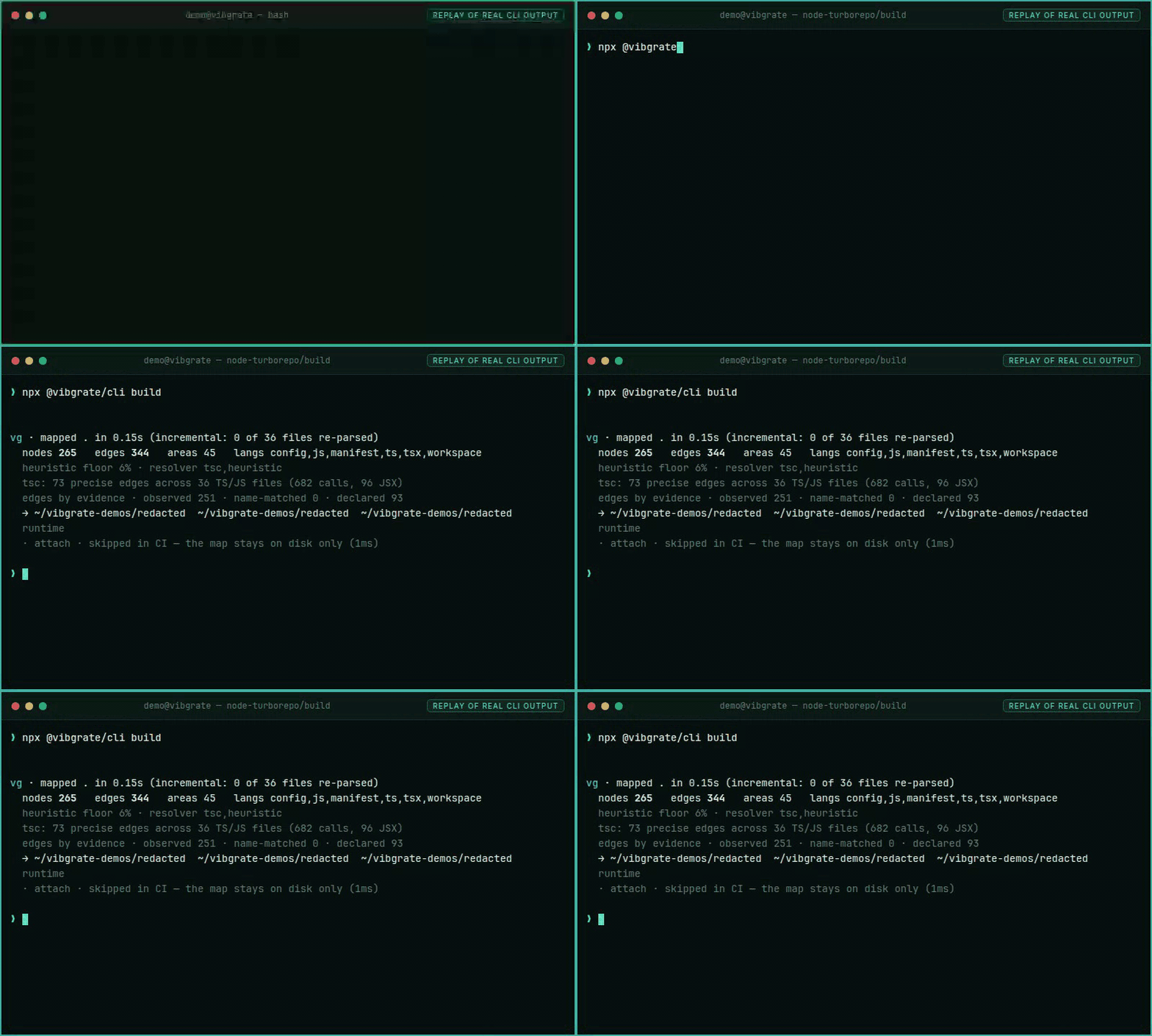
node-turborepo/build — vg build maps a pnpm monorepo.
```bash
vg build # index the repo (incremental; re-run after changes)
vg show src/auth/service.ts # what this file does, calls, and is called by
vg ask "where is rate limiting enforced?"
vg impact src/db/connection.ts # what breaks if this changes + tests to run
vg path src/api/handler.ts src/db/query.ts # shortest call path between two files
vg tree src/server.ts # call tree rooted at a node
vg insights # overview: hubs, hotspots, untested paths
```
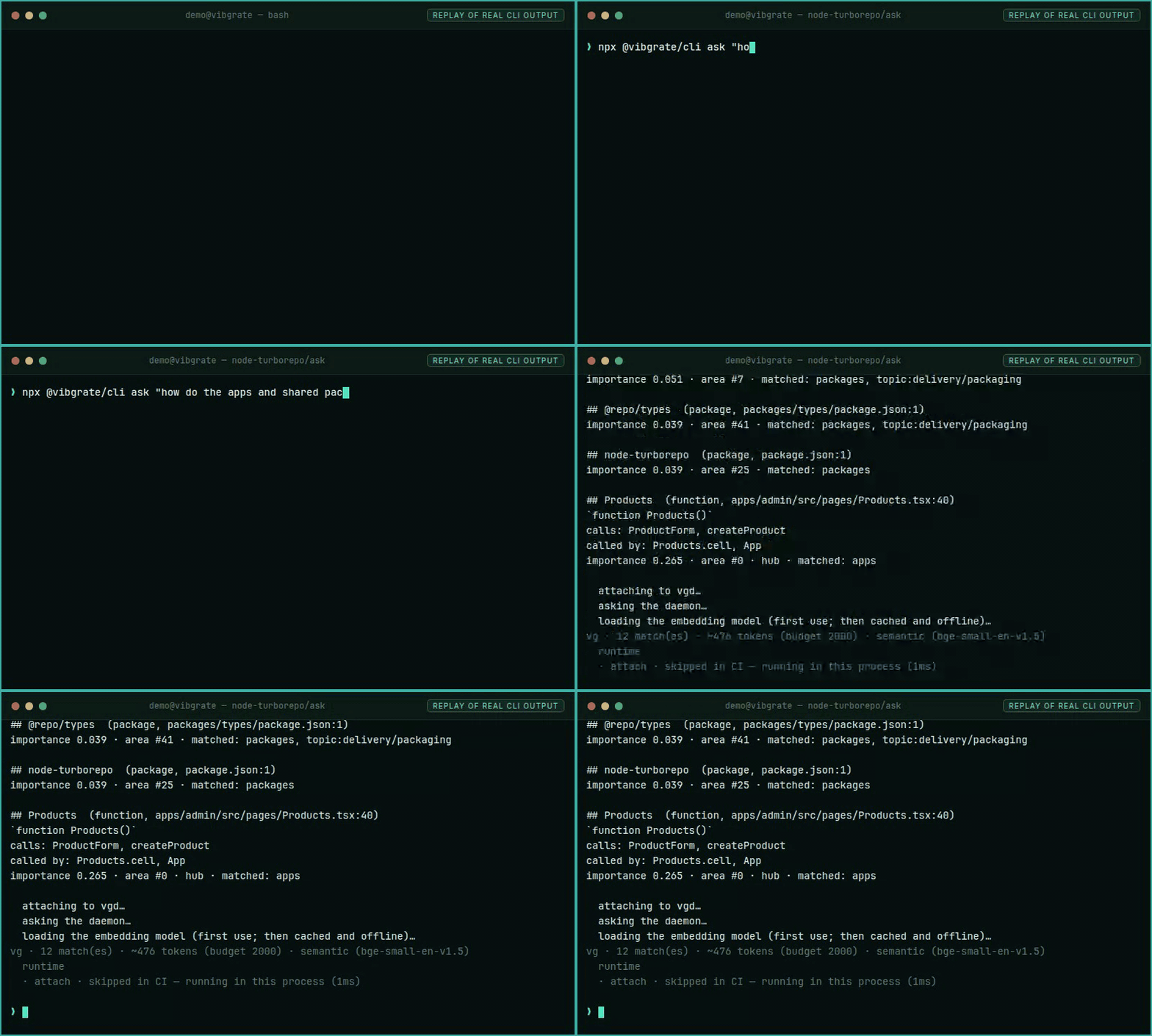
node-turborepo/ask — vg ask returns cited nodes, not a chat essay.
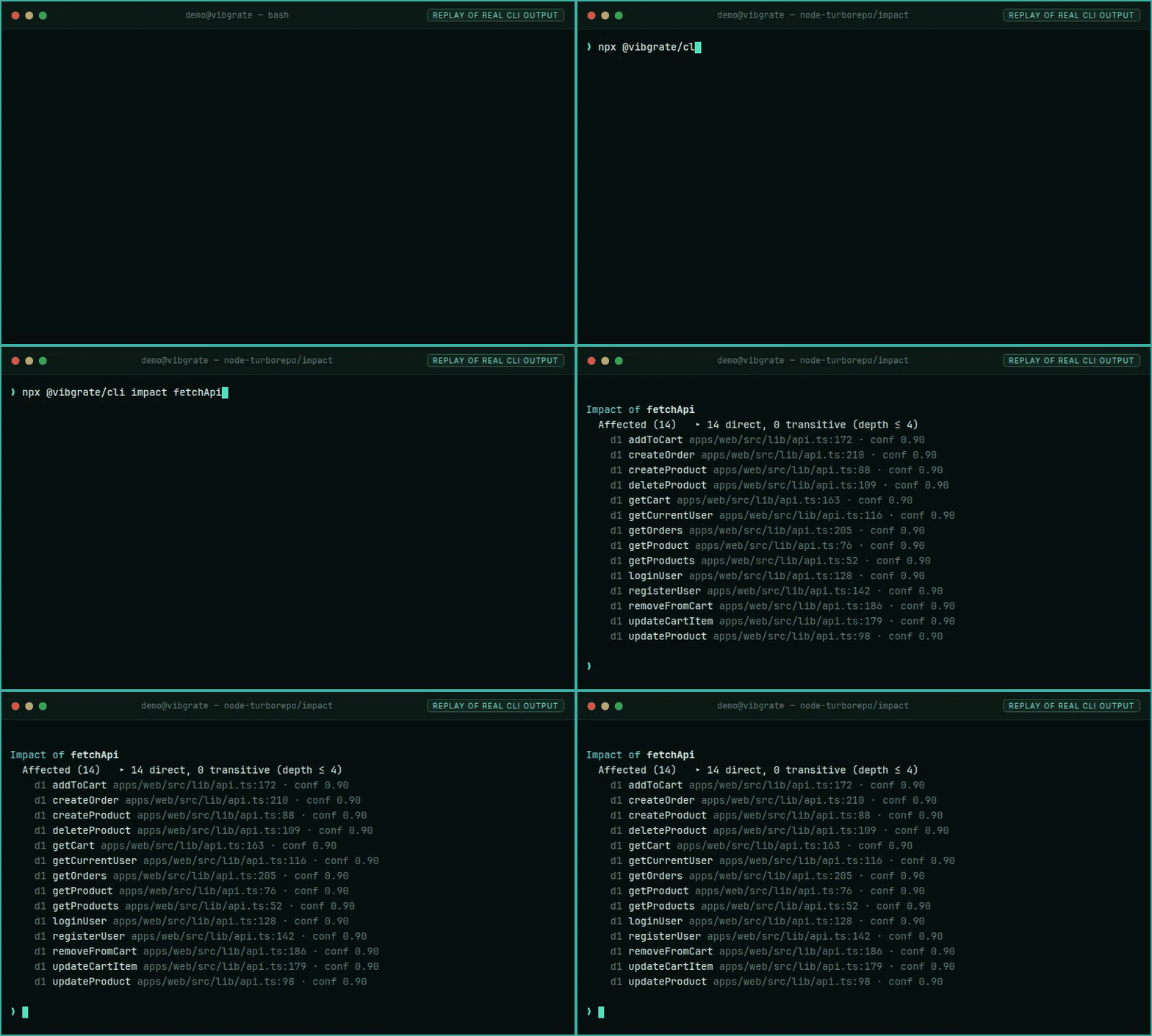
node-turborepo/impact — blast radius of changing a hub before you edit.
The graph is byte-deterministic and reproducible — the same repo always produces the same graph on every machine.
```bash
vg share # make the graph committable + auto-updating for the team
vg serve # start Vibgrate AI Context (local-first MCP: code map + drift + version-correct docs)
```
---
## VG Code — write the change, not just the report
**VG Code** is the coding agent inside Vibgrate CLI. Its search tool is the deterministic code graph — **not a grep, not embeddings over chunks** — and it runs on a local model or a hosted one, your choice.
```bash
vg code # guided: pick a model, then describe tasks
vg code "add a --timeout flag to the scan command"
```
**Does it write to your disk?** Yes — through steps you approve, and only those. Read-only steps (search, read, list, impact) run without prompting; every edit and every command asks first. `--auto` runs the same loop with no prompts for CI. Without a terminal and without `--auto`, `vg code` refuses to start rather than writing unattended.
**Two surfaces, one agent.** `vg code` is the terminal surface. The **VG Code panel** in [Vibgrate for VS Code](https://vibgrate.com/vscode) is the graphical one, and for most people it will be the one they live in: warm sessions between tasks, chat history, inline Approve / Reject cards with diffs, checkpoints, and @-mentions. The extension does not re-implement the agent — it runs the one shipped with this CLI over `--stream-json` and relays your decisions to it, so terminal, editor, and CI behave the same way.
### Why an agent here, and not another chat window?
- **Search is the graph.** `search_code` resolves symbols, callers, and callees from the map `vg build` produced — so the model gets the three functions that matter, not forty files that mention the word.
- **Blast radius before the edit.** `graph_impact` tells the model what depends on a symbol *before* it changes it, and `vg tests` knows which tests to run after.
- **Version-correct library docs.** `library_docs` pins to the version in your lockfile, so the model writes against the API you actually have.
- **Invented identifiers are blocked, not flagged.** Before an edit is written, its replacement body is scanned against the graph's identifier trie. A symbol the graph does not know — and that is not already local to the target file — stops the write.
- **Local models are first-class, hosted models are one flag away.** With a pulled model there is no account and no key, and Code Modes fit the model to the machine. When a task needs more, [Vibgrate Relay](https://vibgrate.com/relay) supplies hosted models on your Vibgrate account — no per-provider API keys — and falls back to your local model if it is unreachable.
- **It adopts the MCP servers you already have.** `.mcp.json` (Claude Code), `.cursor/mcp.json`, and `.vscode/mcp.json` are read and merged with `.vibgrate/code.json`, which wins on a name clash.
- **Cost is visible.** A token/$ meter after each task and on `/cost`; `vg savings` reports graph-backed calls per model.
**Trade-off:** no model ships with the CLI, and VG Code is only as good as the model you point it at. A 7B local model is not a frontier model — it buys you privacy, offline inference, and no per-token cost. Relay buys you capacity at a per-token price. Pick the tier that matches the task; the graph grounding is the same either way.
### A session, end to end
```text
VG Code · graph-grounded coding · v2026.x
✔ Code map built
✔ Model catalog loaded
◆ Ready — ollama/qwen2.5-coder:7b · graph 48213. Describe a task, or /help.
code › add a --timeout flag to the scan command and use it
→ search_code(query: --timeout flag scan command)
scanCommand (function) src/commands/scan.ts:12
→ graph_impact(symbol: runScan)
3 symbol(s) depend on runScan: …
→ edit_file(path: src/commands/scan.ts, …)
? Apply edit to src/commands/scan.ts? [Y/n] y
✔ edited src/commands/scan.ts
→ run_command(command: npm test -- scan)
? Run `npm test -- scan`? [y/N] y
✔ exit 0 … 12 passing
✔ added a --timeout flag to scan and covered it with tests
+6 -1 across 1 file(s) · via ollama/qwen2.5-coder:7b
```
What happened, step by step:
1. The code map is built or refreshed incrementally — only changed files re-parse.
2. The model catalog loads and you pick a local model or a hosted provider. Before pulling a local model, a memory pre-flight compares its estimated footprint against available RAM/VRAM and refuses a model this machine cannot run.
3. Vibgrate Graph (`vg serve`) starts as a child process for the life of the session and stops when you exit. Every graph call is attributed to VG Code and the model in use.
4. The agent loops: search → read → assess impact → edit → run.
5. You approve each mutating step, or it runs unattended under `--auto`.
6. Edits land through a deterministic merge, so the change goes exactly where it was meant to.
### Approval modes
| Mode | Behavior |
| --- | --- |
| **Interactive** (default) | Read-only steps run freely. Every edit and every command asks first. |
| **`--auto`** | No prompts. A denylist blocks catastrophic commands — filesystem wipes, `curl … \| sh`, force-push, `sudo`. For CI and scripted runs. |
| **`--single`** | One-shot: propose a diff and stop. No tool loop, no commands. Dry-run unless you pass `--apply --yes`. |
`--max-steps ` caps the loop (default 24). `--worktree` runs the whole session in an isolated git worktree so nothing touches your main tree until you apply it.
### Which model — local, or hosted through Relay
**Code Modes** pick a local model that actually fits this machine, checked against your real RAM, VRAM, and disk before anything downloads:
| Mode | Intent |
| --- | --- |
| **Spark** | Fast, small footprint — quick edits and tight memory |
| **Flow** | Balanced default for day-to-day coding |
| **Forge** | Heavier pack when you have headroom and want more capacity |
```bash
vg models # what's set, and what fits this machine
vg models install flow # install the pack (--dry-run to preview)
vg models pull qwen2.5-coder:7b
```
**[Vibgrate Relay](https://vibgrate.com/relay)** is the hosted tier that supplements those local models when a task needs more capacity than the machine has. One Vibgrate account and endpoint, a curated catalog of hosted models, per-token metering against prepaid credit — and no per-provider API keys to manage:
```bash
export VIBGRATE_RELAY_TOKEN=… # Relay is then preferred, with local fallback
vg code --provider vibgrate-relay --model
```
You are not locked to it. `--provider` also takes `ollama`, `lmstudio`, `foundry-local`, `llama-cpp`, `openrouter`, `litellm`, `openai`, and `together`; those API keys are read from the environment only (`OPENROUTER_API_KEY` and friends), never passed as flags. With no `--provider`, `vg code` uses what you have already configured — Relay first if its token is set, then another hosted key, then a local model — and never dials an endpoint you did not set up. `--local` keeps it on-device.
### Tools the agent has
| Tool | What it does | Approval |
| --- | --- | --- |
| `search_code` | Search the code graph — symbols and relations, plus a literal sweep for exact phrases | free |
| `read_file` / `list_files` | Read a file or line range; list files in the map | free |
| `graph_impact` | Blast radius of changing a symbol | free |
| `library_docs` | Version-correct docs for a dependency you actually have installed | free |
| `edit_file` / `create_file` / `delete_file` / `apply_patch` | Change the working tree | **approved** |
| `run_command` | Run tests, builds, anything else | **approved** |
| `web_fetch` / `web_search` | Fetch or search the public web — untrusted, secret-redacted, size-capped | **approved** |
| `browser_*` / `read_notebook` / `spawn_subagent` | Drive a browser, work in Jupyter notebooks, delegate a sub-task | **approved** |
| `mcp____` | Tools from your configured MCP servers | free if read-only, else **approved** |
### In-session commands
| Command | What it does |
| --- | --- |
| `/undo` | Revert the files changed by the last task |
| `/diff` | Show the last change |
| `/model` | Switch model without leaving the session |
| `/cost` | Running token and dollar cost (local models are free) |
| `/compact` | Condense the session so far into one checkpoint recap |
| `/help` / `/exit` | List commands / quit |
### Where state lives
| On disk | In the session |
| --- | --- |
| The code map (`.vibgrate/`), gitignored | Conversation and step history |
| Your config (`.vibgrate/code.json`) | The `/undo` stack |
| The edits themselves — local and git-reversible | The token/$ meter |
| Session store, so `--continue` can resume | The `vg serve` child process |
`--continue` resumes your most recent session: it recaps what was already done for the model and restores `/undo`.
### Configure once
`.vibgrate/code.json` — flags still override:
```json
{
"provider": "ollama",
"model": "qwen2.5-coder:7b",
"testCommand": "npm test",
"auto": false,
"denyCommands": ["deploy", "kubectl\\s+delete"],
"maxSteps": 24,
"mcpServers": {
"playwright": { "command": "npx", "args": ["-y", "@playwright/mcp"] }
}
}
```
Full key reference — including `securityTier`, `capsule`, and `modelProfile` — is in [DOCS.md](https://github.com/vibgrate/cli/blob/HEAD/DOCS.md#vg-code).
### Safety
- Secrets files (`.env`, `.npmrc`, `.netrc`, key material) are never read into a prompt, and credential shapes are redacted from any file the agent does read.
- Under `--auto`, a denylist blocks catastrophic commands. Interactively you see and approve every command yourself.
- Every change is local and git-reversible. `/undo` reverts the last task; `--worktree` keeps the whole session off your main tree.
- Web and browser results are treated as untrusted content, never as instructions.
---
## Measure and manage upgrade drift
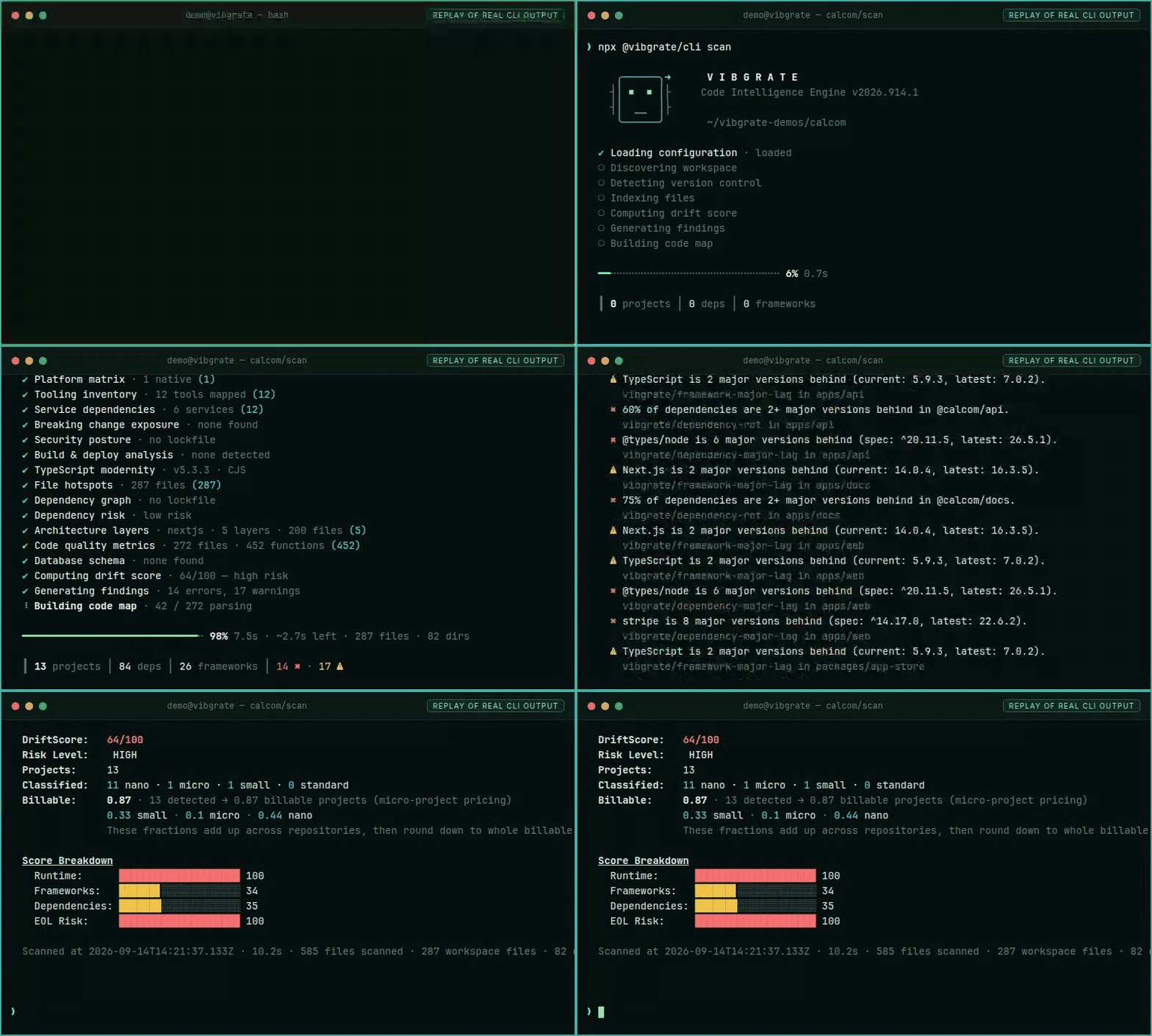
calcom/scan — a bare vg drift scan on sample Cal.com data. Live simulator.
```bash
vg scan # drift score + risk level + ranked priorities
vg scan --push # same, and upload to Vibgrate Cloud for trend tracking
vg baseline # snapshot current drift for regression gating
vg report # generate a report from a saved scan artifact
```
One scan gives you:
- **Overall score** (0–100) and risk level (**Low / Moderate / High**)
- **Score breakdown** — runtime, frameworks, dependencies, EOL
- **Per-project detail** across Node.js/TypeScript, .NET, Python, and Java
- **Actionable findings** ranked by likely impact
- **[SBOM](https://vibgrate.com/glossary/sbom) export** (CycloneDX / SPDX)
- **Known vulnerabilities** (opt in with `--vulns`) — severity, CVSS, the fixing version, and, in a git repo, who introduced them
---
## Find known vulnerabilities and who introduced them
`vg scan --vulns` checks your installed dependencies against the public [OSV](https://vibgrate.com/glossary/osv) database and reports each known vulnerability with its severity, CVSS score, and the version that fixes it — as text, JSON, or SARIF. Add `--package-manifest` to run it fully offline from a local advisory bundle.
```bash
vg scan --vulns # drift score + known vulnerabilities
vg scan --full # drift + vulnerabilities + a banned-dependency report
```
In a git repository, every finding is attributed from history: who introduced the vulnerable version, in which commit, and how long you have been exposed. Those exposure windows roll up into per-severity time-exposed and SLA-breach metrics, framed around the [EU Cyber Resilience Act (CRA)](https://vibgrate.com/cra) — so "are we fixing things fast enough?" has a number.
That answers the question about *this checkout*. For the question a regulator asks — which **shipped** products contain it — see [Vibgrate Evidence](#vibgrate-evidence--answer-which-shipped-products-contain-this) below.
```bash
vg why lodash # who added a dependency, every version since, and any open vulnerabilities
vg bisect lodash 4.17.21 # the commit where lodash crossed a version line (e.g. reached the fix)
```
Detection and attribution span the whole npm ecosystem (npm, pnpm, yarn) plus pip/poetry, cargo, composer, bundler, go, pub, hex, NuGet, and Maven/Gradle — read from each project's lockfile, so it works whatever you build in.
Your AI assistant sees this too: `vg serve` exposes `list_vulnerabilities`, `vuln_attribution`, and an `upgrade_impact` tool that tells an agent what an upgrade will cost — version distance, how many files import the package, the vulnerabilities it fixes, and (online, opt in) the breaking-change notes between your version and the latest.
---
## Vibgrate Evidence — answer "which shipped products contain this?"
A scanner tells you about the code in front of you. A regulator asks about the code you **shipped** — eighteen months ago, at version 3.2.1, into Germany and France, still in its support window. **[Vibgrate Evidence](https://vibgrate.com/evidence)** answers that question as a signed artifact a third party can verify offline, with no account and no network.
It produces **evidence, not a verdict.** It will not tell you that you are compliant, and it is not legal advice. It gives you a defensible, reproducible answer and the audit trail behind it; the determination and the filing stay yours.
```bash
vg evidence init --regime cra # who files, and to which coordinator
vg evidence product add "Acme Gateway" --markets DE,FR --in-scope
vg evidence release acme-gateway 3.2.1 --from sbom.cdx.json --ship-date 2025-02-14
vg evidence exposure CVE-2025-12345 --bundle ./ev # signed answer, exit code for CI
```
### Why freeze a manifest instead of scanning again?
- **Ships are immutable; your tree is not.** `exposure` matches against the manifest **frozen at ship time**, not `HEAD`. Re-scanning today tells you what you would ship now, which is not the question asked.
- **It refuses to guess.** A product bound to a release with no frozen manifest comes back `undetermined` **with a reason**, never a confident-looking `not affected`. That distinction is the whole value of the artifact.
- **Jurisdiction-neutral by design.** Reporting duties are modeled as **regimes**: the EU CRA (`--regime cra`, applies from **11 September 2026**) and DORA incident reporting (`--regime dora-incident`) ship today. A new jurisdiction is a regime profile, not a new command or a new tool.
- **No model touches a figure.** Nothing in the evidence path is generated by a language model. Every number is computed from frozen manifests and advisory data.
- **Offline end to end.** `--offline` with a local advisory file needs no network, and `vg evidence verify` works on a machine that has never heard of Vibgrate.
**Trade-off:** the answer is only as good as the manifests you froze. Evidence cannot reconstruct what you shipped before you started recording it — a release you never froze is `undetermined`, permanently. The value compounds from the day you start, which is the argument for starting now rather than in September.
### The lifecycle
| Step | Command | What it does |
| --- | --- | --- |
| 1. Set up | `vg evidence init` | Org, coordinator CSIRT, and the person with filing authority |
| 2. Register | `vg evidence product add` | A product with digital elements — markets, classification, scope rationale |
| 3. Freeze | `vg evidence release` | Pin a shipped version to an immutable component manifest, from an SBOM, a scan, or what BuildKit built |
| 4. Ask | `vg evidence exposure ` | Which shipped products contain it, at which versions, in which markets, still in support |
| 5. Prove | `vg evidence verify ` | Re-check the signed answer offline, on any machine |
Between those: `vg evidence readiness` is a deterministic gap report against the regime's obligations, `vg evidence regimes` lists the regimes and their clocks, `vg evidence drill` runs a timed rehearsal against a simulated advisory, `vg evidence watch` joins the CISA KEV catalog to your frozen manifests, `vg evidence pack` builds the submission pack a human pastes into the reporting platform, and `vg evidence export` writes an air-gapped bundle of everything.
### Freeze a container release from what the build wrote
If the shipped artefact is a container image, the build already produced the facts a manifest needs. `vg evidence release` can read them directly rather than have someone type them in:
```bash
docker buildx build --push --provenance=true --sbom=true --metadata-file build.json -t ghcr.io/acme/gateway:3.2.1 .
vg evidence release acme-gateway 3.2.1 --image ghcr.io/acme/gateway:3.2.1 --ship-date 2025-02-14
```
`--image [` asks Docker for the image digest, its `org.opencontainers.image.*` labels, and the provenance and SBOM attestations attached to it; the attached SBOM becomes the manifest. It runs `docker image inspect` and `docker buildx imagetools inspect`, and the second contacts the registry when the reference is not present locally. Without a daemon, pass the same facts as files: `--buildkit-metadata build.json` for the digest and build reference, `--provenance ` for a SLSA attestation (source repository, commit, base images), and `--from ` for a CycloneDX or SPDX SBOM, bare or as an attestation. The result is recorded under `build` in the frozen manifest. A `--digest` that contradicts the build is an error, and attestation signatures are recorded as unverified — `vg` has no registry trust root, so verify them with `cosign`.
### What is in a bundle, and what "verified" means
`--bundle ` writes `result.json`, a DSSE/Ed25519 in-toto attestation over it (`evidence.intoto.jsonl`), a `VERIFY.md` a third party can follow, and — with `--tsa ` — an RFC 3161 trusted-timestamp token (`timestamp.tsr`).
`vg evidence verify` reports one of three honest states, and the middle one matters:
| State | Meaning |
| --- | --- |
| `verified` | Signature checks, the signer is pinned to a trust root you supplied with `--pub`, **and** the result digest still matches |
| `unverified` | Cryptographically intact and unmodified, but the signer is not pinned — real, and not yet trusted by you |
| `failed` | Bad signature, or a `result.json` that no longer matches what was signed |
Exit codes make it a CI gate: **0** no exposure · **2** exposure found · **3** undetermined, needs manual review · **1** operational error.
Evidence state lives in `.vibgrate/evidence/`. The Ed25519 signing key is minted on first use at `.vibgrate/attest-key.pem` (mode `0600`, with a `.pub` beside it) unless you point at your own with `VG_ATTEST_KEY` — back it up, and never commit it.
---
## Track drift over time → create a free workspace
The CLI is fully useful offline. When you want **trends across runs and repos** — so drift becomes a metric you manage, not a surprise you discover — push scans to a [Vibgrate Cloud](https://vibgrate.com/cloud) workspace:
1. **Create a workspace** at **[dash.vibgrate.com](https://dash.vibgrate.com)** and copy your DSN.
2. **Connect and push:**
```bash
VIBGRATE_DSN="vibgrate+https://:@us.ingest.vibgrate.com/" \
vg scan --push
```
Upload is opt-in — nothing leaves your machine until you run `--push`. Store the DSN as a CI secret, never commit it.
**[→ Create your workspace](https://dash.vibgrate.com)**
---
## CI integration
]
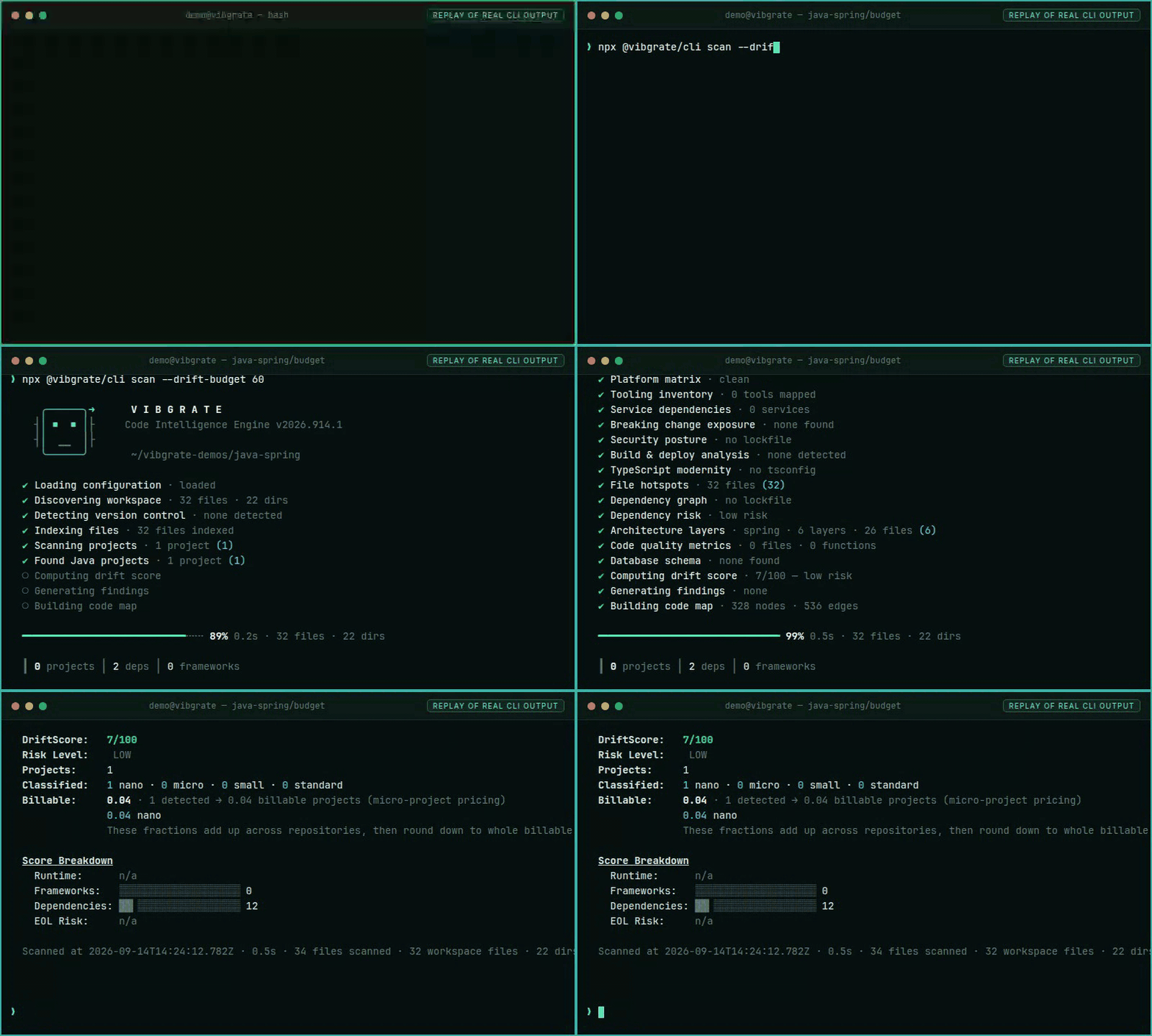
java-spring/budget — vg scan --drift-budget 60 as a CI gate (this recording exits 0). Live simulator.
Drop `vg` into any pipeline to turn drift scoring into a quality gate:
```yaml
# GitHub Actions — drift gate + SARIF upload
- name: Vibgrate scan
env:
VIBGRATE_DSN: ${{ secrets.VIBGRATE_DSN }}
run: npx @vibgrate/cli scan --push --format sarif --out vibgrate.sarif --fail-on error
- name: Upload SARIF
if: always()
uses: github/codeql-action/upload-sarif@v3
with:
sarif_file: vibgrate.sarif
```
Gate on drift budgets and regression relative to a baseline:
```bash
vg baseline
vg scan --baseline .vibgrate/baseline.json --drift-budget 40 --drift-worsening 5
```
- `--drift-budget ` fails the build if drift exceeds your budget.
- `--drift-worsening ` fails the build if drift worsens by more than X% vs baseline.
Copy-paste CI templates live in `examples/github-actions/`. Azure DevOps and GitLab CI snippets are in [DOCS.md](https://github.com/vibgrate/cli/blob/HEAD/DOCS.md#ci-integration).
---
## Version-correct library docs
`vg lib` fetches usage docs pinned to the **exact version in your lockfile** — never a newer API your code can't call yet:
```bash
vg lib react # React docs at your installed version
vg lib express --fn middleware # specific function reference
```
AI assistants connected via MCP use `vg lib` automatically when answering questions about library APIs in your project.
---
## SBOM and OpenVEX
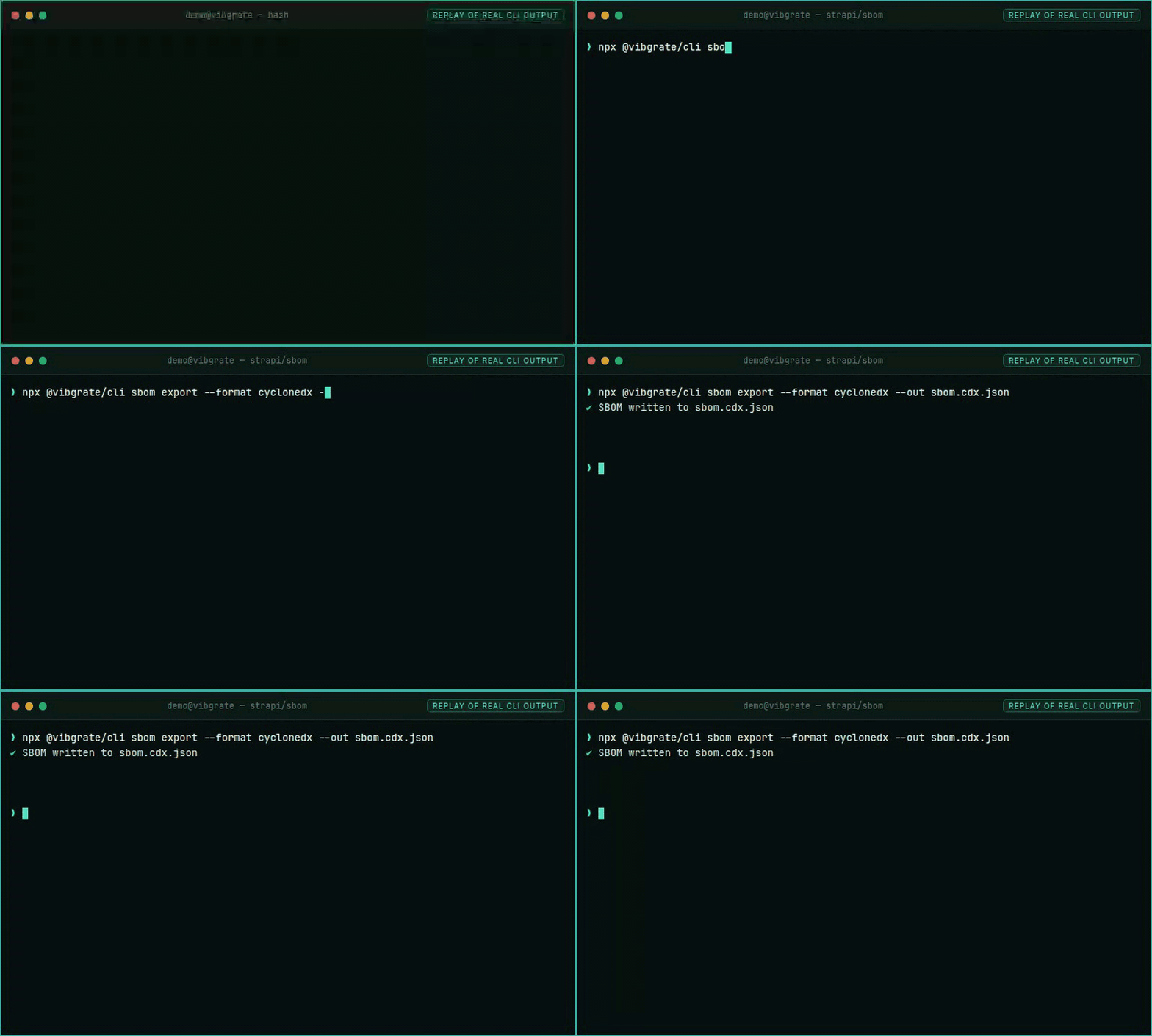
strapi/sbom — vg sbom export --format cyclonedx --out sbom.cdx.json. An inventory, not a compliance determination. Live simulator.
```bash
vg sbom export --format cyclonedx --out sbom.cdx.json
vg sbom export --format spdx --out sbom.spdx.json
vg sbom delta --from .vibgrate/baseline.json --to .vibgrate/scan_result.json --out delta.txt
vg vex # generate an OpenVEX document for attestation
```
## Review a change
**Vibgrate Review** reads the current change against the declared architecture and security-control policy. It reports change integrity, not a proof of security.
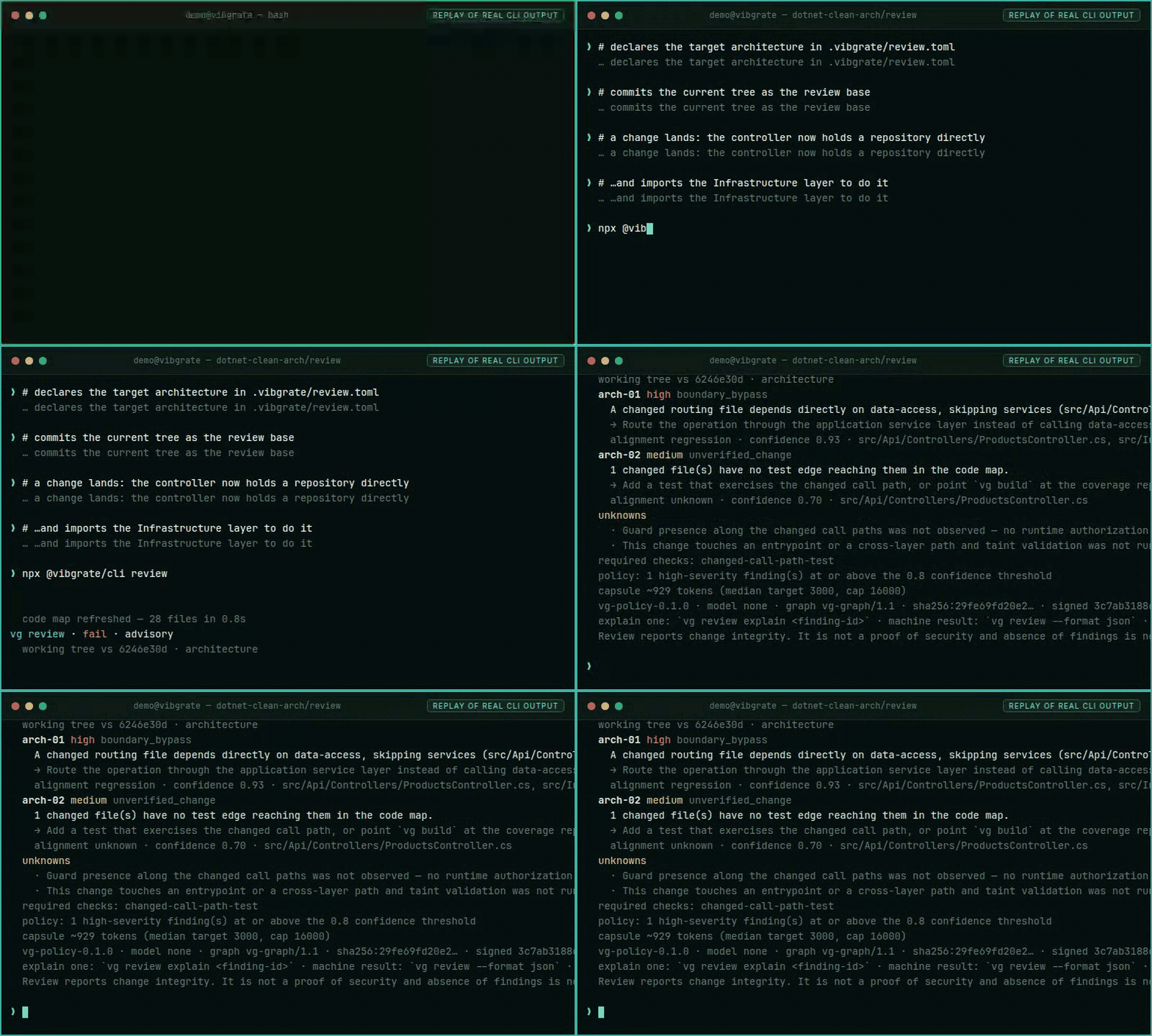
dotnet-clean-arch/review — vg review on a Clean Architecture fixture. Live simulator.
```bash
vg review
vg review findings-from-diff --base origin/main --format json
vg review propose blast: --model forge --json
vg review propose arch:: --model forge --json --findings findings.json
```
`vg review findings-from-diff` prints the deterministic `vg.review.findings.v1`
document (blast-radius and architecture-policy `correctness` rows plus security
scanners) and writes `.vibgrate/review-propose-handoff.json`.
`vg review propose ` attaches a PatchIR dry-run — `--model` is
`relay:` (hosted Review) or `spark` | `flow` | `forge` (local Code Mode).
Lookup is the current change set, then `--findings` JSON, then that last-run
handoff; pass the same `--base` / `--in-place` / `--diff` as findings-from-diff
when you want that change set explicitly. It writes nothing unless you pass
`--apply --yes` on a topic branch.
---
## Privacy & offline-first
- No data leaves your machine unless you run `--push` / `vg push` / `vg share`.
- Drift scoring reads manifests and configs only. The code graph (`vg build`/`vg map`) and a few extended scanners (code quality, database schema, UI text) read your source **locally** to compute structural facts and metrics — never a raw source line, and never uploaded as-is; see [DOCS.md](https://github.com/vibgrate/cli/blob/HEAD/DOCS.md#extended-scanners) for exactly what each one reads.
- Works without login and without any SaaS dependency.
- `--offline` disables registry/network lookups; `--package-manifest ` feeds drift scoring a local version bundle.
- `--max-privacy` suppresses local artifact writes and high-context scanners; `--no-local-artifacts` skips writing `.vibgrate/*.json` to disk.
- `vg code --local` keeps model inference on-device: a local model, the local graph, no hosted call and no model-catalog fetch. The agent's own web tools stay available and, like every network step, are approved by you before they run.
- `vg code` never reads a secrets file into a prompt, and redacts credential shapes from files it does read.
- `vg evidence` runs locally: `--offline` with a local advisory file needs no network, and `vg evidence verify` checks a bundle on a machine with no account and no connection. Nothing reaches Vibgrate Cloud until you run `vg evidence push`.
```bash
vg scan --offline --package-manifest ./package-versions.zip --max-privacy --format json --out scan.json
```
Add `.vibgrate/` to your `.gitignore` — those are regenerated local outputs.
More on how Vibgrate handles code and data: [vibgrate.com/security](https://vibgrate.com/security), and the [subprocessor register](https://vibgrate.com/subprocessors).
---
## Quick start with AI assistants
Paste this into your AI coding tool (Claude, Cursor, Copilot, Gemini CLI, …):
```
Set up Vibgrate for local codebase intelligence:
1. Install: npm install -g @vibgrate/cli@latest
2. Build the graph: vg build
3. Wire your assistant: vg install
4. Ask: vg ask "what are the main entry points?"
Then explain the architecture and my top 3 upgrade priorities.
```
See [docs/QUICKSTART-PROMPT.md](https://github.com/vibgrate/cli/blob/HEAD/docs/QUICKSTART-PROMPT.md) for the full prompt.
---
## Command reference
Under each set, commands are listed A–Z. A short **typical path** (usual order) is called out where it helps.
### Code graph
**Typical path:** `vg build` → `vg status` → `vg ask` → `vg impact` → `vg share`
| Command | Description |
| --- | --- |
| `vg ask ""` | Query the map in natural language |
| `vg build [path]` | Build / update the code map (incremental, deterministic); `--policy hexagonal-v1\|layered-v1\|vertical-v1` picks the boundary rules the architecture module evaluates (default from `.vibgrate/architecture.toml`, which may also carry your own `[[overlay]]` rules); `--init-policy` writes a first draft of that file from what the build classified (the packs and overlays are described in [docs/architecture-policies.md](https://github.com/vibgrate/cli/blob/HEAD/docs/architecture-policies.md)) |
| `vg bundle` | Build an air-gapped bundle (grammars + graph + library catalog) |
| `vg code [""]` | Graph-grounded coding agent — local or hosted model, every edit and command approved (`--auto` for CI, `--single` for a one-shot diff) |
| `vg embed` | Precompute the semantic index for instant `vg ask` |
| `vg export` | Export the map (json / ndjson / graphml / dot / cypher / md / html / SBOM) |
| `vg facts ` | Deterministic facts for a node (contracts, invariants) |
| `vg guide ` | Cited standards / practices for a node (free pack) |
| `vg impact ` | What breaks if you change it — and the tests to run |
| `vg install` / `vg uninstall` | Wire (or remove) **Vibgrate AI Context** + skill in your AI assistant (`--detect`, `--all`, `--list`) |
| `vg lib ` | Version-correct, drift-annotated library docs |
| `vg locale` | Manage your app's translations — locale projects, keys, and translations in Vibgrate Cloud (`push` / `pull` / `status`; `vg localize` is an alias) |
| `vg map` / `vg hubs` / `vg areas` / `vg oddities` | Map insights: overview, most-depended-on code, natural groupings, cross-area smells |
| `vg models` | Code Modes (Spark / Flow / Forge) + local fleet (Ollama / LM Studio / gguf); `install` / `pull` by default (`--dry-run` to preview) |
| `vg module` | Manage optional local modules (`relevance`, `hcs`): `status`, `install`, `remove` |
| `vg path ` | How A connects to B (shortest path) |
| `vg savings` | Local report of tokens/$ saved — the grep baseline for map queries, and context compression by window, model and client (estimates) |
| `vg watch` | Rebuild the map when files change |
| `vg serve` | Start **Vibgrate AI Context** (local-first MCP: code map + drift + version-correct docs) |
| `vg share` | Make the graph committable + auto-updating for your team |
| `vg show ` | Explain a node: what it is, what it calls, what calls it |
| `vg show arch` | Open a local architecture map: workspace packages first, then a column slice (UI → service → store). Loopback; `--focus `, `--no-open` |
| `vg status` | Cache/freshness, counts, staleness |
| `vg tests ` | Which tests cover a node |
| `vg tree ` | Call tree rooted at a node |
| `vg unknowns` | What the graph cannot resolve, ranked by blast radius |
### Context compression
Compression adds no new command. It is a mode of `vg serve`, a flag on
`vg install`, and a section of `vg savings`.
**Typical path:** `vg install claude --compress` → use Claude Code as usual → `vg savings`
| Command | Description |
| --- | --- |
| `vg serve --compress` | Serve the code map **and** compress context: an Anthropic- and OpenAI-compatible listener on loopback for any agent |
| `vg serve --compress --background` | Start the listener as a background process (or reuse the running one) and return; `vg serve stop` ends it |
| `vg serve --compress ` | Run one agent session through it, environment only — nothing written, nothing left behind |
| `vg install --compress` | Point an agent at it durably by writing its own base-URL config (marker-tracked and reversible), and start the listener |
| `vg uninstall ` | Put that config back byte-for-byte, along with everything else `vg install` wrote |
| `vg install --learn` | Turn your past agent sessions into guardrails in its instructions file: repeated failures, loops, missing context (`--apply` writes) |
| `vg savings` | Tokens and dollars saved, today / 7 days / 30 days, by model, client and project |
| `vg savings --benchmark` | Offline compression benchmark on built-in fixtures: latency and ratio per content type |
| `vg show savings` | Open the same numbers as a local page, live, next to `vg show arch` |
| `vg serve status` / `vg serve stop` | What is listening and which agents are routed; stop a background listener |
| `vg serve config` | Every `VG_*` knob and where its value came from; `set` / `unset` write `settings.json` |
| `vg serve memory` | Cross-agent project memory: `list`, `search`, `add`, `delete`, `stats`, `export`, `import` |
| `vg serve compress [file]` | Run the pipeline over a file by hand — the debug path, not part of normal use |
| `vg serve retrieve ` | Expand a compression marker back to the original, or a slice of it (`--grep`, `--lines`, `--head`, `--tail`, `--json-path`) |
### Holistic Code Specification (`vg hcs`)
Deterministic code facts for **Rust, Ruby, PHP, Dart, Swift, Scala, C++, COBOL, and VB6** — one NDJSON line per fact, reproducible on any machine, so a fact stream is something you can commit, diff, and gate CI on. Extraction is incremental by default: re-running over an existing stream costs only the delta.
All HCS computation runs in an optional, separately-licensed engine module that executes in a local WASM sandbox — no network calls, no process spawns. It is fetched on first use, or ahead of time with `vg module install hcs`. When it is unavailable, every `vg hcs` command exits `6` — never `2`, so a CI gate can't mistake "engine missing" for a verdict.
**Typical path:** `vg hcs extract` → `vg hcs digest` / `vg hcs map` / `vg hcs gate`
| Command | Description |
| --- | --- |
| `vg hcs extract [dir]` | Extract facts into an NDJSON stream (incremental by default; `--full` to re-extract) |
| `vg hcs digest` | Render a fact stream as a readable specification (`md` / `json` / `html`) |
| `vg hcs gate` | Governance gate: diff two streams, fail (exit `2`) on material structural regressions |
| `vg hcs map` | Build the System Map from a fact stream (`json` / `md` / `mermaid`) |
| `vg hcs validate ` | Validate a stream against the HCS spec (Appendix-I conformance code) |
### Diagnostics, IDE & runtime
**Typical path:** `vg doctor` → `vg lsp` → `vg daemon`
| Command | Description |
| --- | --- |
| `vg daemon` | Local workspace daemon for multi-root graph sessions (IDE / agents): `status`, `ensure`, `publish`, `query`, `impact`, … |
| `vg doctor` | Read-only diagnosis: config, credentials (redacted), map freshness, hosted reachability, MCP launch, compression proxy and store |
| `vg llm-host` | Isolated local inference host process (`serve`, `status`) for enterprise process isolation |
| `vg lsp` | Language server (stdio) — engine behind Vibgrate for VS Code and other thin IDE clients |
| `vg policy` | Show production context-policy pin; `vg policy verify ` for signed learning patches |
### Drift scoring & supply chain
**Typical path:** `vg init` → `vg scan` → `vg baseline` → `vg report` → `vg fix`
| Command | Description |
| --- | --- |
| `vg baseline [path]` | Create a drift baseline |
| `vg bisect ` | The commit where a dependency crossed a version line (`--assert` to gate CI) |
| `vg drift` | What is outdated across dependencies (offline; `--online` for currency) |
| `vg evidence` | Signed, reproducible regulatory evidence — jurisdiction-neutral regimes (EU CRA first, DORA incident reporting too): `init`, `product`, `release`, `exposure`, `readiness`, `drill`, `watch`, `pack`, `verify`, `push`, `export` |
| `vg fix` | Ranked, risk-tiered upgrade plans from the hosted planner — then apply the one you choose |
| `vg init [path]` | Initialise config and `.vibgrate/` |
| `vg report` | Generate a report from a scan artifact |
| `vg review` | **Vibgrate Review** — architecture + security-control review of the current change, locally (`--in-place`, `--local`, `--loop`). Deterministic blast-radius findings from the code graph via `vg review findings-from-diff`; `vg review propose ` attaches a PatchIR dry-run (same `--base` / `--in-place` / `--diff`, `--findings`, or `.vibgrate/review-propose-handoff.json`). One decision (`pass` / `needs_review` / `fail` / `undetermined`) in a signed receipt (Ed25519 over the receipt digest; `vg review verify ` checks it offline); protected findings cannot be blessed into a pass. Reports change integrity, not a proof of security. Builds or refreshes the code map itself when it is missing or stale (`--no-auto-build` opts out) |
| `vg sbom export` / `delta` / `vex` | Export CycloneDX/SPDX SBOM, diff two artifacts, or emit an OpenVEX document |
| `vg scan [path]` | Scan for upgrade drift |
| `vg scan --full` | Comprehensive scan: drift + vulnerabilities + a banned-dependency report |
| `vg scan --push` | Scan and push results to Vibgrate Cloud |
| `vg scan --vulns` | Also detect known vulnerabilities (OSV; offline via `--package-manifest`) |
| `vg update` | Check for and install updates |
| `vg why ` | Who introduced a dependency, its version history, and any open vulnerabilities |
### Workspace auth & cloud upload
Local scoring does not require this — nothing leaves your machine until you push.
**Typical path:** `vg login` → `vg dsn create` → `vg push` → `vg logout`
| Command | Description |
| --- | --- |
| `vg dsn create` | Generate a DSN token |
| `vg login` / `vg logout` | Authenticate the CLI with your Vibgrate workspace (or clear stored credentials) |
| `vg push` | Upload scan results to Vibgrate Cloud |
```bash
vg scan [path] [--vulns] [--full] [--format text|json|sarif|md] [--out ] [--fail-on warn|error|architecture-finding|architecture-warning] \
[--offline] [--package-manifest ] [--no-local-artifacts] [--max-privacy] \
[--drift-budget ] [--drift-worsening ] [--baseline ]
```
Full flag and configuration reference: **[DOCS.md](https://github.com/vibgrate/cli/blob/HEAD/DOCS.md)** · **[vibgrate.com/cli](https://vibgrate.com/cli)** · [help center](https://vibgrate.com/help) · [glossary](https://vibgrate.com/glossary).
---
## Why teams adopt Vibgrate
Most systems don't fail all at once — they accumulate upgrade debt and architectural [drift](https://vibgrate.com/glossary/code-drift) silently until migrations become expensive. `vg` makes that debt measurable and repeatable — the practice we call [Code Drift Intelligence](https://vibgrate.com/code-drift-intelligence) — and gives AI assistants the local context they need to be useful. See how it lands for [teams](https://vibgrate.com/solutions/teams) and [enterprises](https://vibgrate.com/solutions/enterprise), or compare it with what you already run: [vs Renovate](https://vibgrate.com/vs/renovate) · [vs Dependabot](https://vibgrate.com/vs/dependabot) · [vs Snyk](https://vibgrate.com/vs/snyk).
| Mode | What you get | Best for |
| --- | --- | --- |
| **One-off scan** | Fast snapshot of drift score, lag, and findings | Audits, due diligence, migration planning |
| **CI-integrated scan** | Continuous drift signal, SARIF annotations, regression guardrails | Keeping upgrade debt under control long-term |
| **MCP + graph** | AI assistant with real-time, offline codebase context | Day-to-day development, code review, refactoring |
| **VG Code** | A coding agent grounded in the graph — terminal or VS Code panel, local model or Relay, governed edit by edit | Making the change, not just planning it |
Recommended rollout: `vg build` + `vg install` now, add `vg scan` to CI this week, try `vg code` on one small task.
---
## Known limits
- **Drift and risk scores are estimates**, computed from manifests, lockfiles, and public advisory data. They are a prioritization signal, not a compliance determination or a certification.
- **VG Code quality tracks the model you choose.** No model ships with the CLI. A small local model handles mechanical edits well and struggles with cross-cutting design changes; `vg models` tells you what fits this machine, not what will do the job. Reach for Relay or another hosted model when the task is bigger than the machine.
- **Guided `vg code` needs a terminal.** In CI, pass an instruction plus `--auto` (or `--mock`) — the interactive picker never appears, and the agent refuses to run unattended without it.
- **The map is the ceiling.** Anything the resolver could not tie to a definition is invisible to `search_code` and `graph_impact`. Run `vg unknowns` to see what the graph is missing, ranked by blast radius.
- **`--auto` is a denylist, not a sandbox.** It blocks known-catastrophic commands; it does not confine the agent. Run untrusted instructions in a container, or under `--worktree` with `--security-tier L1`.
- **`--verify` re-runs your tests; it does not prove correctness.** Failures are fed back for a repair attempt. Passing tests mean passing tests.
- **Vulnerability data is only as current as its source.** `--vulns` reports what OSV knows at scan time; offline runs report what is in the bundle you supplied.
- **Vibgrate Evidence produces evidence, not a compliance determination.** It supports your obligations under a regime; it does not decide that you meet them, does not certify anything, and is not legal advice. The filing is yours.
- **Evidence cannot look backwards.** Exposure is answered from manifests frozen at ship time. A release you never froze stays `undetermined` — there is no way to reconstruct it after the fact.
- **`vg evidence watch` surfaces a KEV listing, not a determination.** Whether a vulnerability is "actively exploited" for the purposes of a filing is your call, not the tool's.
- **`vg evidence verify` does not re-verify the TSA certificate chain.** It confirms the RFC 3161 token's imprint binds to `result.json` and surfaces the trusted time. For the full chain, use `openssl ts -verify -in timestamp.tsr -data result.json -CAfile `.
---
## Requirements
- Node.js **22+**
- macOS, Linux, Windows
- VG Code additionally needs a model: a local runtime (a Code Mode pack, Ollama, LM Studio, or a GGUF on disk), a [Vibgrate Relay](https://vibgrate.com/relay) token, or an API key for another hosted provider. Run `vg models` to see what fits this machine.
## Command name conflicts
`vg` is short and occasionally conflicts with other tools (`virtualgo`, `vugu`, the oh-my-zsh `git verify-commit` alias, custom shell aliases, etc.).
**`vibgrate` is an identical alias** — same binary, same flags, same behavior. If `vg` is taken on your system, use `vibgrate` everywhere instead:
```bash
vibgrate scan # same as: vg scan
vibgrate build # same as: vg build
vibgrate serve # same as: vg serve
```
When `@vibgrate/cli` is installed, it registers **both** bin entries unconditionally. If it detects at install time that `vg` is already claimed by another tool, it prints a one-line notice pointing you to `vibgrate`.
---
## Everything else Vibgrate makes
| | |
|---|---|
| [**Vibgrate CLI**](https://vibgrate.com/cli) | This package — scan, score, and map any repository. [Live demo](https://vibgrate.com/cli) · [benchmarks](https://vibgrate.com/cli/benchmarks) · [token savings](https://vibgrate.com/cli/benchmarks/token-savings) |
| [**Vibgrate for VS Code**](https://vibgrate.com/vscode) | The same score in your editor, plus the **[VG Code](https://vibgrate.com/vgcode)** panel — the graphical surface for `vg code`, running this same agent. [Marketplace](https://marketplace.visualstudio.com/items?itemName=vibgrate.vibgrate-vscode) · [Open VSX](https://open-vsx.org/extension/vibgrate/vibgrate-vscode) |
| [**Vibgrate Relay**](https://vibgrate.com/relay) | Hosted models for VG Code on one Vibgrate account — no per-provider API keys, prepaid per-token credit, local models still the offline path |
| [**Vibgrate Graph**](https://vibgrate.com/graph) | The deterministic local code map behind `vg map`, `vg impact` and `vg show` |
| [**Vibgrate AI Context**](https://vibgrate.com/library) | `vg serve` — version-correct library docs, your code map, and offline drift, served to any assistant. [Supported assistants](https://vibgrate.com/skills) · [on mcp.so](https://mcp.so/servers/cli-a2b26f) |
| [**Vibgrate Cloud MCP**](https://vibgrate.com/mcp) | The hosted MCP server over your workspace data (OAuth 2.1) |
| [**Vibgrate Cloud**](https://vibgrate.com/cloud) | History, trends, and team rollups. [Create a workspace](https://dash.vibgrate.com) · [pricing](https://vibgrate.com/pricing) |
| [**Vibgrate Review**](https://vibgrate.com/cli/docs/review-command) | `vg review` — did this change move the system toward its declared architecture, or weaken a security control? Runs locally from the code map; the receipt, not the repository, is what gets pushed |
| [**Vibgrate Evidence**](https://vibgrate.com/evidence) | `vg evidence` — freeze shipped releases, then answer "which shipped products contain this vulnerability?" as signed, offline-verifiable evidence. Jurisdiction-neutral regimes, [EU CRA](https://vibgrate.com/cra) first |
**How the scores work:** [DriftScore](https://vibgrate.com/driftscore) · [RiskScore](https://vibgrate.com/riskscore) · [DriftRisk Index](https://vibgrate.com/driftrisk) · [published methodology](https://vibgrate.com/whitepapers/software-risk-and-drift-scoring-methodology) · [public index of real scans](https://vibgrate.com/driftrisk/index) · [README badges](https://vibgrate.com/badges)
**Reference:** [package registry](https://vibgrate.com/packages) · [integrations marketplace](https://vibgrate.com/marketplace) · [glossary](https://vibgrate.com/glossary) · [help center](https://vibgrate.com/help) · [security](https://vibgrate.com/security) · [mission](https://vibgrate.com/mission)
Create a free workspace →
·
Try the live demo
·
VG Code
·
Evidence
·
Full docs
Apache-2.0 licensed · Copyright © 2026 Vibgrate