# admob-mcp-server [Health: Active]
**Category:** 💰 Finance & Fintech
**Repository:** https://github.com/ParkSangGwon/admob-mcp-server
**GitHub Stars:** 4
**npm Downloads (last month):** 332
**Views:** 2
**Installs:** 0
**Upvotes:** 0
**Directory Page:** https://allmcps.com/mcp/admob-mcp-server
## Description
MCP server for the Google AdMob API — apps, ad units, mediation, and revenue reports
## Tools
Capabilities this server exposes over MCP:
- **list_accounts** — List accessible publisher accounts — use to find your `pub-...` ID
- **get_account** — Get account details: publisher ID, reporting currency, reporting time zone
- **list_apps** — List registered apps with app ID, platform, store link, and approval state
- **list_ad_units** — List ad units with their IDs, formats, and owning apps
- **generate_network_report** — AdMob Network performance: earnings, impressions, clicks, match rate, RPM, ...
- **generate_mediation_report** — Mediation performance across ad sources: earnings, observed eCPM per `AD_SOURCE` / `MEDIATION_GROUP
- **generate_campaign_report** — Cross-promotion campaign stats (last 30 days only): impressions, clicks, installs, cost
- **list_ad_sources** — List available mediation ad sources (ad networks) and their IDs
- **list_adapters** — List adapters of an ad source, incl. required configuration keys
## Claude Desktop Quick Installation
Install path detected from listing signals. Uses `npx` (confidence: high):
```json
"mcpServers": {
"admob-mcp-server": {
"command": "npx",
"args": ["-y","admob-mcp-server"]
}
}
```
## Documentation & README
# AdMob MCP Server
[](https://www.npmjs.com/package/admob-mcp-server)
[](https://github.com/ParkSangGwon/admob-mcp-server/actions/workflows/ci.yml)
[](LICENSE)
**English** | [한국어](https://github.com/ParkSangGwon/admob-mcp-server/blob/HEAD/README.ko.md)
Ask your AI assistant about your AdMob apps and earnings — in plain language:
> - "How much did my apps earn in the last 7 days, broken down by country?"
> - "Which mediation ad source had the best eCPM this month?"
> - "Compare the RPM of my banner vs. rewarded ad units."
> - "List my apps and their ad units."
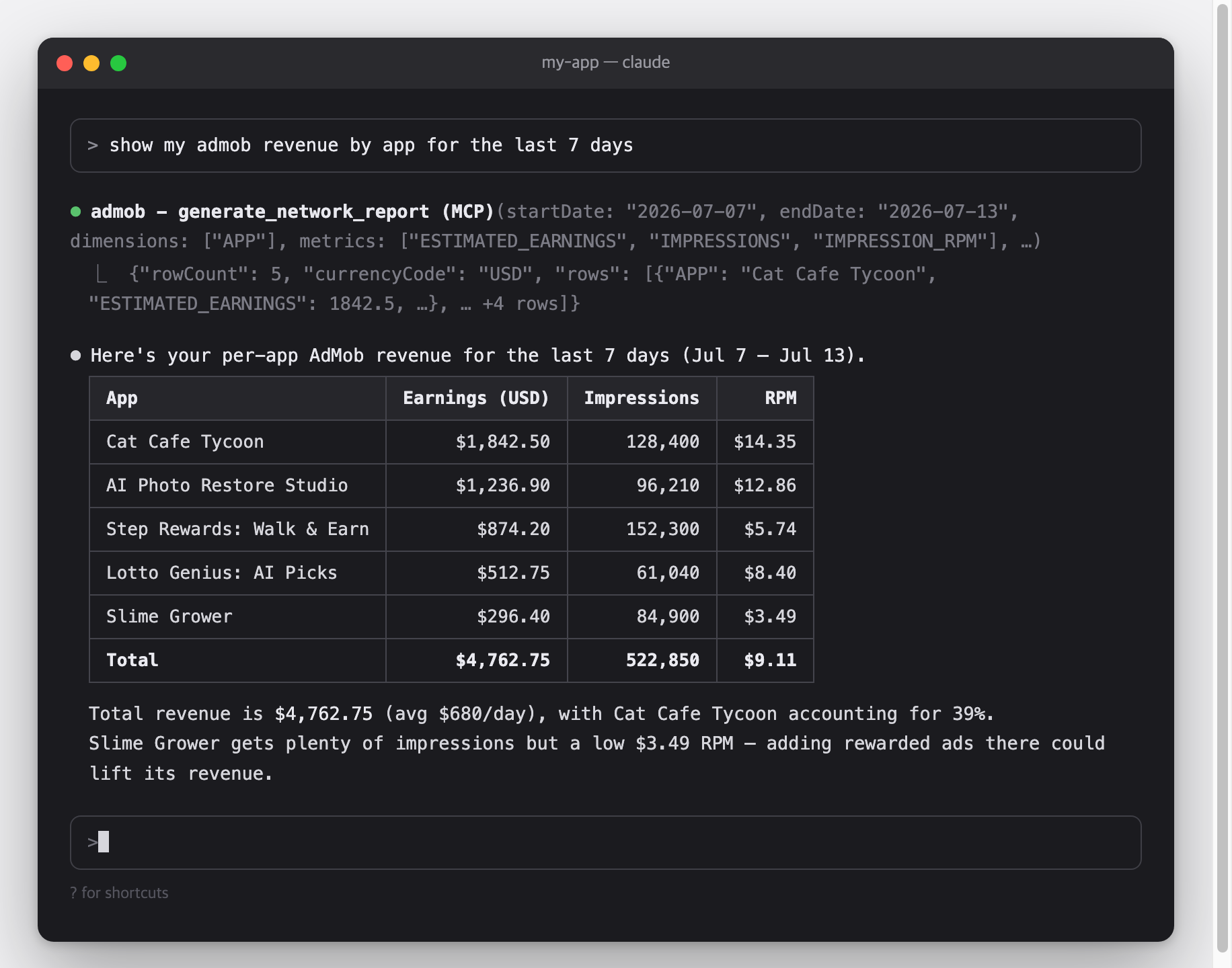
This is a [Model Context Protocol (MCP)](https://modelcontextprotocol.io) server for the [Google AdMob API](https://developers.google.com/admob/api).\
It works with Claude Code, Claude Desktop, Cursor, Gemini CLI, and any other MCP-capable AI client.
## Architecture
```mermaid
flowchart LR
C["MCP client
Claude Code · Claude Desktop · Cursor · Gemini CLI"]
subgraph S["admob-mcp-server — runs on your machine"]
direction TB
T["9 read-only tools in 5 toolsets
accounts · apps · adunits · reports · mediation
(filtered by --toolsets)"]
A["Credential resolver
env vars → token.json → gcloud ADC"]
R["Report flattener
chunk stream → rows · micros → currency"]
end
G["Google AdMob API
v1beta"]
C <-->|"MCP over stdio"| T
T --> A
A <-->|"OAuth 2.0 / HTTPS"| G
G -.->|"report chunks"| R
R -.-> T
```
Credentials and revenue data travel only between your machine and Google — there is no third-party server in between.
## Features
- **Everything the AdMob API opens to normal accounts** — 9 tools across accounts, apps, ad units, reports, and mediation ([why there are no write tools](#why-there-are-no-write-tools))
- **Reports made readable** — streaming report responses are flattened into simple row tables, and monetary values (micros) are converted to real currency units
- **Read-only by design** — the sign-in requests read scopes only, so the server cannot change anything in your AdMob account
- **Toolsets** — enable only the tool groups you need, e.g. `--toolsets reports,accounts`
- **Three authentication options** — one-command browser sign-in (`npx admob-mcp-server auth`), environment-variable refresh token, or gcloud Application Default Credentials
- **Built-in analysis prompts** and report-spec reference resources
## Setup at a glance
One-time setup, roughly 10 minutes:
| Step | What you do | Where |
| ------------------------------------------------------------ | ----------------------------------------------------------------- | -------- |
| [1. Google Cloud setup](#part-1--google-cloud-setup) | Register a personal "app" so Google lets you access your own data | browser |
| [2. Sign in](#part-2--sign-in) | Run one command and log in with Google | terminal |
| [3. Connect your AI client](#part-3--connect-your-ai-client) | Add one config entry and restart the client | terminal |
### Requirements
- **Node.js 18 or newer** — check with `node --version`; if missing, install from [nodejs.org](https://nodejs.org)
- An [AdMob](https://admob.google.com) account and the Google account that owns it
## Setup
### Part 1 — Google Cloud setup
Why is this needed?\
The AdMob API has no simple API keys — Google requires every program that accesses your data to be registered as an "OAuth app".\
Here you register a personal one that only you will use.\
It's free and needs no billing setup.
1. **Create (or select) a Google Cloud project**: [console.cloud.google.com/projectcreate](https://console.cloud.google.com/projectcreate) — any name works; reusing an existing project is fine too.
2. **Enable the AdMob API**: [console.cloud.google.com/apis/library/admob.googleapis.com](https://console.cloud.google.com/apis/library/admob.googleapis.com) → check that your project is selected in the top bar → **Enable**.
3. **Configure the OAuth consent screen**: [console.cloud.google.com/auth/overview](https://console.cloud.google.com/auth/overview) — the first visit opens a short wizard:
- App name: anything (e.g. `admob-mcp`), and your email as the support/contact email
- Audience: **External**
- Finish the wizard — you do **not** need to submit the app for Google's verification
- Then go to **Audience → Test users → Add users** and add **the Google account that owns your AdMob account**
4. **Create an OAuth client**: [console.cloud.google.com/apis/credentials](https://console.cloud.google.com/apis/credentials) → **Create credentials → OAuth client ID**
- Application type: **Desktop app**
- After creating it, click **Download JSON** — you'll use this file in Part 2
> [!WARNING]
> While the consent screen is in **Testing** mode, Google expires sign-ins after **7 days**, so you'll need to re-run the sign-in weekly.\
> To stop that, publish the app (**Audience → Publish app**).\
> Publishing for your own use doesn't require Google's verification — you'll just see an "unverified app" warning during sign-in, which is expected.
### Part 2 — Sign in
Move the JSON file you downloaded to where the server looks for it, then run the sign-in command:
```bash
mkdir -p ~/.admob-mcp
mv ~/Downloads/client_secret_*.json ~/.admob-mcp/oauth_client.json
npx admob-mcp-server auth
```
(On Windows, move the file to `C:\Users\\.admob-mcp\oauth_client.json` in Explorer, then run the `npx` command.)
Your browser opens.\
Pick **the Google account that owns your AdMob account** and allow access.\
If you see a **"Google hasn't verified this app"** warning, that's your own app from Part 1 — click "Continue".\
When the terminal prints `Setup complete`, your sign-in is saved to `~/.admob-mcp/token.json` and reused from then on.
The sign-in requests the `admob.readonly` and `admob.report` scopes — read access only.
What the `auth` command does:
```mermaid
sequenceDiagram
autonumber
participant T as Terminal
participant S as admob-mcp-server
participant B as Browser
participant G as Google
T->>S: npx admob-mcp-server auth
S->>S: read ~/.admob-mcp/oauth_client.json
S->>B: open consent URL (loopback redirect, random port)
B->>G: sign in & allow scopes
G-->>S: authorization code → refresh token
S->>S: save ~/.admob-mcp/token.json (reused for every later call)
```
Advanced: environment variables (headless / CI)
If you already have a refresh token, no files are needed:
```bash
export GOOGLE_CLIENT_ID="....apps.googleusercontent.com"
export GOOGLE_CLIENT_SECRET="..."
export GOOGLE_REFRESH_TOKEN="..."
```
Advanced: gcloud Application Default Credentials
The same pattern Google's official Analytics/Ads MCP servers use:
```bash
gcloud auth application-default login \
--scopes=https://www.googleapis.com/auth/admob.readonly,https://www.googleapis.com/auth/admob.report,https://www.googleapis.com/auth/cloud-platform \
--client-id-file=path/to/oauth_client.json
```
Credential resolution order: **environment variables → `token.json` (from `auth`) → ADC**.
### Part 3 — Connect your AI client
Pick your client below.\
MCP servers are loaded when the client starts, so **restart the client** after adding the config.
**Claude Code**
```bash
claude mcp add admob -- npx -y admob-mcp-server
```
Verify with `claude mcp list` — you should see `admob: ... - ✔ Connected`.
**Claude Desktop** — open **Settings → Developer → Edit Config**, which opens `claude_desktop_config.json` (macOS: `~/Library/Application Support/Claude/`, Windows: `%APPDATA%\Claude\`), and add:
```json
{
"mcpServers": {
"admob": {
"command": "npx",
"args": ["-y", "admob-mcp-server"]
}
}
}
```
Restart the app; the admob tools appear in the tools menu of the chat input.
**Cursor** — add the same `mcpServers` block to `~/.cursor/mcp.json`, then check **Settings → MCP** shows admob as enabled.
**Gemini CLI** — add the same `mcpServers` block to `~/.gemini/settings.json`, then check with `/mcp` inside the CLI.
> [!TIP]
> If you used the environment-variable sign-in, pass the variables through your client's `env` block (Claude Code: repeat `--env KEY=value` before `--`; JSON configs: add an `"env": { ... }` object next to `"args"`).
## Try it
You don't call tools yourself — just ask in plain language and the assistant picks the right tools.\
Some starters:
- _"What did my apps earn last week?"_
- _"Break down this month's revenue by country and app."_
- _"Which ad format had the highest RPM in the last 30 days?"_
- _"How is my mediation doing? Compare ad sources by observed eCPM."_
- _"List my apps and their ad units."_
Most clients ask for your permission before each tool call, so nothing runs without your approval.
## Configuration
All configuration is optional — the defaults work for a single AdMob account.
### Environment variables
| Variable | Description | Default |
| ------------------------- | ----------------------------------------------------------------------------------------------- | ------------------------------------- |
| `ADMOB_ACCOUNT` | Publisher ID (`pub-XXXXXXXXXXXXXXXX`). Only needed when your login can access multiple accounts | auto-discovered |
| `ADMOB_TOOLSETS` | Comma-separated toolsets to enable | all |
| `ADMOB_CREDENTIALS_DIR` | Directory for `oauth_client.json` / `token.json` | `~/.admob-mcp` |
| `ADMOB_OAUTH_CLIENT_FILE` | Path to the OAuth client JSON used by `auth` | `/oauth_client.json` |
| `GOOGLE_CLIENT_ID` | OAuth client ID (env sign-in; also used by `auth` instead of the JSON file) | — |
| `GOOGLE_CLIENT_SECRET` | OAuth client secret (env sign-in) | — |
| `GOOGLE_REFRESH_TOKEN` | OAuth refresh token (env sign-in) | — |
### CLI flags
| Flag | Description |
| ---------------------- | -------------------------------------------------------- |
| `--toolsets ` | Same as `ADMOB_TOOLSETS`, e.g. `--toolsets reports,apps` |
| `--account ` | Same as `ADMOB_ACCOUNT` |
| `--client-file ` | Same as `ADMOB_OAUTH_CLIENT_FILE` (for `auth`) |
CLI flags take precedence over environment variables.\
Flags go after the command in your client config, e.g. `npx -y admob-mcp-server --toolsets reports`.
## Tools
A "tool" is a function the AI assistant can call on your behalf.\
Tools are grouped into five toolsets; all are enabled by default:
| Toolset | Tools |
| ----------- | ---------------------------------------------------------------------------------- |
| `accounts` | `list_accounts`, `get_account` |
| `apps` | `list_apps` |
| `adunits` | `list_ad_units` |
| `reports` | `generate_network_report`, `generate_mediation_report`, `generate_campaign_report` |
| `mediation` | `list_ad_sources`, `list_adapters` |
All tools are read-only and require the `admob.readonly` / `admob.report` scopes.
### Why there are no write tools
The AdMob API does expose write methods (`adUnits.create`, `apps.create`, the whole `mediationGroups` resource), but Google marks each of them **limited access**:
> This method has limited access. If you see a 403 permission denied error, please reach out to your account manager for access.
A normal publisher account gets `PERMISSION_DENIED` from all of them even with a valid `admob.monetization` token — and the same wall blocks `mediationGroups.list` and `adUnitMappings.list`, which are reads. Since these tools cannot work without an allowlisted account, they are not shipped: an assistant that sees them will try them and fail. Create ad units and mediation groups in the [AdMob console](https://apps.admob.com) instead.
### accounts
| Tool | Description |
| --------------- | -------------------------------------------------------------------------- |
| `list_accounts` | List accessible publisher accounts — use to find your `pub-...` ID |
| `get_account` | Get account details: publisher ID, reporting currency, reporting time zone |
### apps
| Tool | Description |
| ----------- | -------------------------------------------------------------------------- |
| `list_apps` | List registered apps with app ID, platform, store link, and approval state |
### adunits
| Tool | Description |
| --------------- | ------------------------------------------------------ |
| `list_ad_units` | List ad units with their IDs, formats, and owning apps |
### reports
All report tools take `startDate` / `endDate` (`YYYY-MM-DD`), `metrics`, and optional `dimensions`, `dimensionFilters`, `sortConditions`, `maxReportRows` (default 1000), `currencyCode`.\
Responses are flat tables; monetary metrics are converted from micros to currency units.
| Tool | Description |
| --------------------------- | ---------------------------------------------------------------------------------------------------- |
| `generate_network_report` | AdMob Network performance: earnings, impressions, clicks, match rate, RPM, ... |
| `generate_mediation_report` | Mediation performance across ad sources: earnings, observed eCPM per `AD_SOURCE` / `MEDIATION_GROUP` |
| `generate_campaign_report` | Cross-promotion campaign stats (last 30 days only): impressions, clicks, installs, cost |
Valid dimensions/metrics per report are exposed as MCP resources (reference documents the assistant can read): `admob://reference/network-report-spec`, `mediation-report-spec`, `campaign-report-spec`.
### mediation
| Tool | Description |
| ----------------- | ---------------------------------------------------------------- |
| `list_ad_sources` | List available mediation ad sources (ad networks) and their IDs |
| `list_adapters` | List adapters of an ad source, incl. required configuration keys |
Mediation groups and ad unit mappings are not covered — see [Why there are no write tools](#why-there-are-no-write-tools).
## Prompts
Prompts are ready-made analysis requests.\
Your client surfaces them as slash commands or a prompt picker (e.g. `/top_performing_apps` in Claude Code).\
All take an optional `days` argument:
| Prompt | What it does |
| --------------------- | ---------------------------------------------------------- |
| `top_performing_apps` | Ranks your apps by revenue with RPM and match-rate context |
| `revenue_summary` | Daily revenue trend with anomaly call-outs |
| `compare_ad_formats` | Compares earnings and efficiency across ad formats |
## Security & privacy
- The server runs entirely on your computer.\
Your data flows only between your machine and Google's API — never through any third-party server.
- Two files are stored locally, both readable only by your user account: `~/.admob-mcp/oauth_client.json` (your OAuth app) and `~/.admob-mcp/token.json` (your sign-in).
- **To sign out**: delete `~/.admob-mcp/token.json`, and optionally revoke the app's access at [myaccount.google.com/permissions](https://myaccount.google.com/permissions).
- Nothing can be modified: the sign-in requests read scopes only, and every tool is a read.
## Troubleshooting
### Install & connection
#### `command not found: npx` / `spawn npx ENOENT`
- **Cause**: Node.js is not installed, or your client can't find it.
- **Fix**: install Node 18+ from [nodejs.org](https://nodejs.org), then restart the client.
#### The server doesn't appear in the client
- **Cause**: MCP servers load at client startup, or the server fails to start.
- **Fix**: restart the client first.\
Then check its MCP status (Claude Code: `claude mcp list`, Gemini CLI: `/mcp`), and make sure `npx -y admob-mcp-server` runs in a terminal without errors.
### Sign-in & auth
#### "No usable Google credentials found"
- **Cause**: sign-in hasn't been set up yet.
- **Fix**: follow [Part 2 — Sign in](#part-2--sign-in).
#### `invalid_grant` / "token has been expired or revoked"
- **Cause**: your sign-in expired.\
With a consent screen in **Testing** mode this happens every 7 days.
- **Fix**: re-run `npx admob-mcp-server auth`.\
To stop it recurring, publish the app (**Audience → Publish app**).
#### `access_denied` during browser sign-in
- **Cause**: the Google account you picked is not a test user of the consent screen.
- **Fix**: add it under **Audience → Test users**, or publish the app.
#### "The publisher could not be authenticated"
- **Cause**: the Google account you signed in with has no active AdMob account.
- **Fix**: re-run `npx admob-mcp-server auth` and pick the account that owns your AdMob account in the account chooser.
### API errors
#### 403 `PERMISSION_DENIED`
- **Cause**: the AdMob API isn't enabled, the wrong Google account is signed in, or the token predates a scope change.
- **Fix**: check the following:
1. The [AdMob API is enabled](https://console.cloud.google.com/apis/library/admob.googleapis.com) in the same project as your OAuth client
2. You signed in with the account that owns the AdMob account
3. Your token covers `admob.readonly` and `admob.report` — re-run `npx admob-mcp-server auth` to refresh it
#### 429 `RESOURCE_EXHAUSTED`
- **Cause**: AdMob API quota hit ([usage limits](https://developers.google.com/admob/api/limits)).
- **Fix**: retry later, or reduce the request — narrower date range, fewer dimensions.
#### "Multiple AdMob accounts found"
- **Cause**: your Google login can access several publisher accounts.
- **Fix**: set `ADMOB_ACCOUNT=pub-...` (find IDs with `list_accounts`).
## Development
```bash
git clone https://github.com/ParkSangGwon/admob-mcp-server.git
cd admob-mcp-server
npm install
npm test
npm run build
# debug with the MCP Inspector
npm run inspect
```
To run a local build in a client, point it at the built entry instead of npx: `node /path/to/admob-mcp-server/dist/index.js`.
Releases: pushing a `v*` tag runs CI and publishes to npm with provenance (see `.github/workflows/release.yml`).
## Contributing
Issues and pull requests are welcome.\
For larger changes, please open an issue first to discuss the direction.\
Make sure `npm run lint`, `npm run format:check`, and `npm test` pass.
## License
[MIT](https://github.com/ParkSangGwon/admob-mcp-server/blob/HEAD/LICENSE)